2002 JEEP LIBERTY removal
[x] Cancel search: removalPage 741 of 1803

and maintain proper contact with the glass, even as
the blade is moved over the varied curvature found
across the glass surface. The wiper element flexor
provides the claws of the blade superstructure with a
rigid, yet flexible component on the element which
can be gripped. The rubber element is designed to be
stiff enough to maintain an even cleaning edge as it
is drawn across the glass, but resilient enough to
conform to the glass surface and flip from one clean-
ing edge to the other each time the wiper blade
changes directions.
REMOVAL
NOTE: The notched end of the wiper element flexor
should always be oriented towards the end of the
wiper blade that is nearest to the wiper motor out-
put shaft.
(1) Disengage the rear wiper arm support from the
rear wiper arm park ramp on the right side of the
tailgate just below the rear flip-up glass.
(2) Lift the rear wiper arm to raise the wiper blade
and element off of the tailgate and the rear flip-up
glass.
(3) To remove the wiper blade from the wiper arm,
carefully lift up the pivot block latch release tab on
the top of the wiper arm to unlatch it from the arm
(Fig. 13).(4) Raise the pivot block latch release tab until it
is perpendicular to the rear wiper blade superstruc-
ture (Fig. 14).
(5) Slide the rear wiper blade away from the tip of
the arm towards the pivot end of the arm far enough
to disengage the pivot block from the hook formation
on the end of the arm.
(6) Extract the hook formation on the tip of the
wiper arm from the window in the wiper blade pivot
block/latch unit.
CAUTION: Do not allow the wiper arm to spring
back against the tailgate or the flip-up glass without
the wiper blade in place or they may be damaged.
(7) Gently lower the wiper arm and place the arm
support in the park ramp.
INSTALLATION
NOTE: The notched end of the wiper element flexor
should always be oriented towards the end of the
wiper blade that is nearest to the wiper motor out-
put shaft.
(1) Lift the rear wiper arm support out of the tail
gate park ramp.
(2) Position the rear wiper blade near the hook for-
mation on the tip of the arm with the notched end of
the wiper element flexor oriented towards the end of
the wiper arm that is nearest to the wiper motor out-
put shaft.
Fig. 13 Rear Wiper Blade Release
1 - PIVOT BLOCK WINDOW
2 - TIP OF REAR WIPER ARM
3 - SUPERSTRUCTURE
4 - PIVOT BLOCK HINGE PIN
5 - LATCH RELEASE TAB
Fig. 14 Rear Wiper Blade Remove/Install
1 - SUPERSTRUCTURE
2 - HOOK
3 - ELEMENT
4 - LATCH RELEASE
5 - REAR WIPER ARM
8R - 40 REAR WIPERS/WASHERSKJ
REAR WIPER BLADE (Continued)
Page 743 of 1803

REMOVAL
(1) Disconnect and isolate the battery negative
cable.
(2) Remove the rear wiper arm from the rear
wiper motor output shaft. (Refer to 8 - ELECTRI-
CAL/REAR WIPERS/WASHERS/REAR WIPER ARM
- REMOVAL).
(3) Using a small thin-bladed tool, gently pry at
the notch in the base of the rear wiper motor output
shaft bezel to unsnap the nut cover from the bezel
(Fig. 16).Be certain to take proper precautions
to protect the outer tailgate panel and its paint
finish from damage during this procedure.
(4) Remove the nut that secures the rear wiper
motor output shaft to the outer swing gate panel
(Fig. 16).
(5) Remove the bezel and gasket from the rear
wiper motor output shaft.
(6) Remove the trim panel from the tailgate inner
panel. (Refer to 23 - BODY/SWING GATE/TRIM
PANEL - REMOVAL).
(7) Disconnect the tailgate wire harness connector
for the flip-up glass ajar switch from the flip-up glass
latch connector receptacle.
(8) Disconnect the tailgate wire harness connector
for the rear wiper motor from the motor connector
receptacle (Fig. 17).
(9) Loosen the two screws that secure the rear
wiper motor mounting bracket to the top of the tail-
gate inner panel.
(10) Slide the rear wiper motor and mounting
bracket back far enough to disengage the two mount-ing screws from the keyed slots in the top of the tail-
gate inner panel.
(11) Remove the rear wiper motor and mounting
bracket from the tailgate as a unit.
INSTALLATION
(1) Position the rear wiper motor and bracket into
the tailgate as a unit (Fig. 17).
(2) Insert the rear wiper motor output shaft
through the hole in the tailgate outer panel and
engage the two mounting screws into the keyed slots
in the top of tailgate inner panel.
(3) From the outside of the tailgate, center the
rear wiper motor output shaft in the tailgate outer
panel clearance hole and install the gasket and bezel
over the centered shaft (Fig. 16).
(4) Install and tighten the nut that secures the
rear wiper motor output shaft to the outer tailgate
panel. Tighten the nut to 5 N´m (43 in. lbs.).
(5) From the inside of the tailgate, tighten the two
screws that secure the rear wiper motor mounting
bracket to the top of the tailgate inner panel. Tighten
the screws to 6 N´m (57 in. lbs.).
(6) Reconnect the tailgate wire harness connector
for the rear wiper motor to the motor connector
receptacle.
Fig. 16 Rear Wiper Motor Output Shaft Nut
Remove/Install
1 - BEZEL AND GASKET
2 - OUTPUT SHAFT
3 - TAILGATE OUTER PANEL
4 - NUT
5 - NUT COVER
Fig. 17 Rear Wiper Motor Remove/Install
1 - KEYED SLOT (2)
2 - SWING GATE INNER PANEL
3 - SCREW (2)
4 - REAR WIPER MOTOR ELECTRICAL CONNECTOR
5 - REAR WIPER MOTOR
8R - 42 REAR WIPERS/WASHERSKJ
REAR WIPER MOTOR (Continued)
Page 744 of 1803

(7) Reconnect the tailgate wire harness connector
for the flip-up glass ajar switch to the flip-up glass
latch connector receptacle.
(8) Reinstall the trim panel onto the tailgate inner
panel. (Refer to 23 - BODY/SWING GATE/TRIM
PANEL - INSTALLATION).
(9) From the outside of the tailgate, press the nut
cover firmly and evenly over the rear wiper motor
output shaft bezel using hand pressure until it snaps
into place.
(10) Reinstall the rear wiper arm onto the rear
wiper motor output shaft. (Refer to 8 - ELECTRI-
CAL/REAR WIPERS/WASHERS/REAR WIPER ARM
- INSTALLATION).
(11) Reconnect the battery negative cable.
REAR WIPER/WASHER
SWITCH
DESCRIPTION
The rear wiper and washer switches are integral to
the right (wiper) control stalk of the multi-function
switch. (Refer to 8 - ELECTRICAL/LAMPS/LIGHT-
ING - EXTERIOR/MULTI-FUNCTION SWITCH -
DESCRIPTION).
OPERATION
The rear wiper and washer switches are integral to
the right (wiper) control stalk of the multi-function
switch. (Refer to 8 - ELECTRICAL/LAMPS/LIGHT-
ING - EXTERIOR/MULTI-FUNCTION SWITCH -
OPERATION).
WIPER ARM PARK RAMP
REMOVAL
(1) Disengage the rear wiper arm support from the
wiper arm park ramp on the right side of the tailgate
just below the rear flip-up glass.(2) Lift the wiper arm and blade away from the
tailgate until the wiper arm hinge is in its over-cen-
ter position.
Remove the screw that secures the wiper arm park
ramp to the tailgate outer panel (Fig. 18).
(3) Remove the wiper arm park ramp from the
tailgate outer panel.
INSTALLATION
(1) Position the wiper arm park ramp onto the
tailgate outer panel (Fig. 18).
(2) Install and tighten the screw that secures the
wiper arm park ramp to the tailgate outer panel.
Tighten the screw to 5 N´m (45 in. lbs.).
(3) Lower the rear wiper arm and blade and place
the wiper arm support onto the wiper arm park
ramp.
Fig. 18 Wiper Arm Park Ramp Remove/Install
1 - SCREW (1)
2 - PARK RAMP
3 - RIVET NUT (1)
4 - TAILGATE OUTER PANEL
KJREAR WIPERS/WASHERS 8R - 43
REAR WIPER MOTOR (Continued)
Page 748 of 1803

8W-01 WIRING DIAGRAM INFORMATION
TABLE OF CONTENTS
page page
WIRING DIAGRAM INFORMATION
DESCRIPTION
DESCRIPTION - HOW TO USE WIRING
DIAGRAMS...........................1
DESCRIPTION - CIRCUIT INFORMATION....5
DESCRIPTION - CIRCUIT FUNCTIONS......5
DESCRIPTION - SECTION IDENTIFICATION
AND INFORMATION....................6
DESCRIPTION - CONNECTOR, GROUND
AND SPLICE INFORMATION..............6
WARNINGS - GENERAL...................6
DIAGNOSIS AND TESTING - WIRING
HARNESS............................7
STANDARD PROCEDURE
STANDARD PROCEDURE -
ELECTROSTATIC DISCHARGE (ESD)
SENSITIVE DEVICES...................8
STANDARD PROCEDURE - TESTING OF
VOLTAGE POTENTIAL...................8
STANDARD PROCEDURE - TESTING FOR
CONTINUITY..........................8STANDARD PROCEDURE - TESTING FOR A
SHORT TO GROUND...................9
STANDARD PROCEDURE - TESTING FOR A
SHORT TO GROUND ON FUSES
POWERING SEVERAL LOADS............9
STANDARD PROCEDURE - TESTING FOR A
VOLTAGE DROP.......................9
SPECIAL TOOLS
WIRING/TERMINAL....................10
CONNECTOR
REMOVAL.............................10
INSTALLATION.........................13
DIODE
REMOVAL.............................13
INSTALLATION.........................13
TERMINAL
REMOVAL.............................13
INSTALLATION.........................13
WIRE
STANDARD PROCEDURE - WIRE SPLICING . . 13
WIRING DIAGRAM
INFORMATION
DESCRIPTION
DESCRIPTION - HOW TO USE WIRING
DIAGRAMS
DaimlerChrysler Corporation wiring diagrams are
designed to provide information regarding the vehi-
cles wiring content. In order to effectively use the
wiring diagrams to diagnose and repair
DaimlerChrysler Corporation vehicles, it is important
to understand all of their features and characteris-
tics.
Diagrams are arranged such that the power (B+)
side of the circuit is placed near the top of the page,
and the ground (B-) side of the circuit is placed near
the bottom of the page (Fig. 1).
All switches, components, and modules are shown
in the at rest position with the doors closed and the
key removed from the ignition (Fig. 2).Components are shown two ways. A solid line
around a component indicates that the component is
complete. A dashed line around the component indi-
cates that the component is being shown is not com-
plete. Incomplete components have a reference
number to indicate the page where the component is
shown complete.
It is important to realize that no attempt is made
on the diagrams to represent components and wiring
as they appear on the vehicle. For example, a short
piece of wire is treated the same as a long one. In
addition, switches and other components are shown
as simply as possible, with regard to function only.
SYMBOLS
International symbols are used throughout the wir-
ing diagrams. These symbols are consistent with
those being used around the world (Fig. 3).
KJ8W-01 WIRING DIAGRAM INFORMATION8Wa-01-1
Page 757 of 1803

SPECIAL TOOLS
WIRING/TERMINAL
CONNECTOR
REMOVAL
(1) Disconnect battery.
(2) Release Connector Lock (Fig. 10).
(3) Disconnect the connector being repaired from
its mating half/component.
(4) Remove the dress cover (if applicable) (Fig. 10).
(5) Release the Secondary Terminal Lock, if
required (Fig. 11).
(6) Position the connector locking finger away from
the terminal using the proper special tool. Pull on
the wire to remove the terminal from the connector
(Fig. 12).
PROBING TOOL PACKAGE 6807
TERMINAL PICK TOOL SET 6680
TERMINAL REMOVING TOOLS 6932 AND 8638
TERMINAL REMOVING TOOL 6934
Fig. 10 REMOVAL OF DRESS COVER
1 - DRESS COVER
2 - CONNECTOR LOCK
3 - CONNECTOR
8Wa - 01 - 10 8W-01 WIRING DIAGRAM INFORMATIONKJ
WIRING DIAGRAM INFORMATION (Continued)
Page 759 of 1803

1 - TYPICAL CONNECTOR
2 - PICK FROM SPECIAL TOOL KIT 6680
3 - APEX CONNECTOR
4 - PICK FROM SPECIAL TOOL KIT 6680
5 - AUGAT CONNECTOR
6 - SPECIAL TOOL 6932
7 - MOLEX CONNECTOR8 - SPECIAL TOOL 6742
9 - THOMAS AND BETTS CONNECTOR
10 - SPECIAL TOOL 6934
11 - TYCO CONNECTOR
12 - SPECIAL TOOL 8638
Fig. 12 TERMINAL REMOVAL
8Wa - 01 - 12 8W-01 WIRING DIAGRAM INFORMATIONKJ
CONNECTOR (Continued)
Page 760 of 1803

INSTALLATION
(1) Insert the removed terminal in the same cavity
on the repair connector.
(2) Repeat steps for each terminal in the connec-
tor, being sure that all wires are inserted into the
proper cavities. For additional connector pin-out
identification, refer to the wiring diagrams.
(3) When the connector is re-assembled, the sec-
ondary terminal lock must be placed in the locked
position to prevent terminal push out.
(4) Replace dress cover (if applicable).
(5) Connect connector to its mating half/compo-
nent.
(6) Connect battery and test all affected systems.
DIODE
REMOVAL
(1) Disconnect the battery.
(2) Locate the diode in the harness, and remove
the protective covering.
(3) Remove the diode from the harness, pay atten-
tion to the current flow direction (Fig. 13).
INSTALLATION
(1) Remove the insulation from the wires in the
harness. Only remove enough insulation to solder in
the new diode.(2) Install the new diode in the harness, making
sure current flow is correct. If necessary, refer to the
appropriate wiring diagram for current flow (Fig. 13).
(3) Solder the connection together using rosin core
type solder only.Do not use acid core solder.
(4) Tape the diode to the harness using electrical
tape. Make sure the diode is completely sealed from
the elements.
(5) Re-connect the battery and test affected sys-
tems.
TERMINAL
REMOVAL
(1) Follow steps for removing terminals described
in the connector removal section.
(2) Cut the wire 6 inches from the back of the con-
nector.
INSTALLATION
(1) Select a wire from the terminal repair kit that
best matches the color and gage of the wire being
repaired.
(2) Cut the repair wire to the proper length and
remove one±half (1/2) inch of insulation.
(3) Splice the repair wire to the wire harness (see
wire splicing procedure).
(4) Insert the repaired wire into the connector.
(5) Install the connector locking wedge, if required,
and reconnect the connector to its mating half/compo-
nent.
(6) Re-tape the wire harness starting at 1±1/2
inches behind the connector and 2 inches past the
repair.
(7) Connect battery and test all affected systems.
WIRE
STANDARD PROCEDURE - WIRE SPLICING
When splicing a wire, it is important that the cor-
rect gage be used as shown in the wiring diagrams.
(1) Remove one-half (1/2) inch of insulation from
each wire that needs to be spliced.
(2) Place a piece of adhesive lined heat shrink tub-
ing on one side of the wire. Make sure the tubing will
be long enough to cover and seal the entire repair
area.
Fig. 13 DIODE IDENTIFICATION
1 - CURRENT FLOW
2 - BAND AROUND DIODE INDICATES CURRENT FLOW
3 - DIODE AS SHOWN IN THE DIAGRAMS
KJ8W-01 WIRING DIAGRAM INFORMATION8Wa-01-13
CONNECTOR (Continued)
Page 1216 of 1803
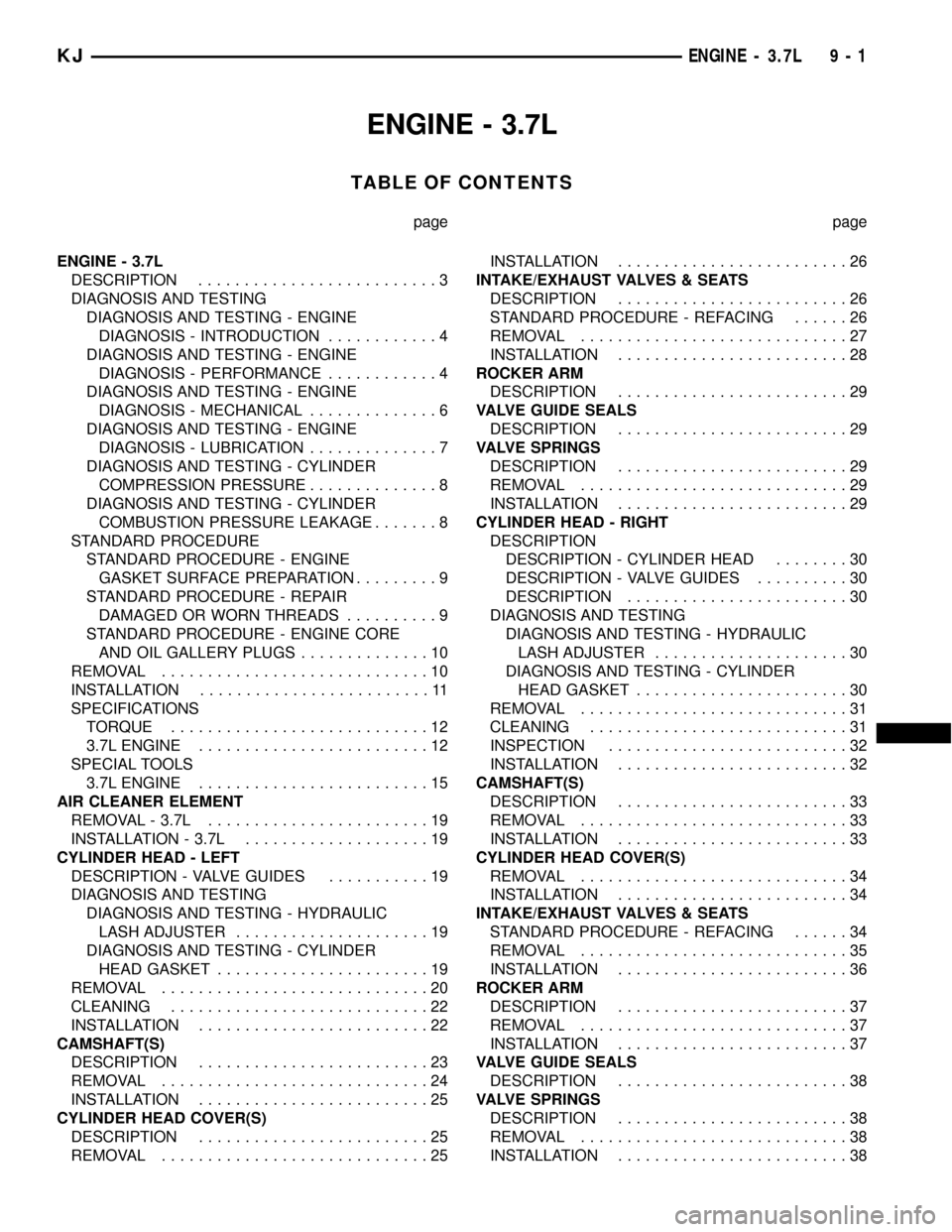
ENGINE - 3.7L
TABLE OF CONTENTS
page page
ENGINE - 3.7L
DESCRIPTION..........................3
DIAGNOSIS AND TESTING
DIAGNOSIS AND TESTING - ENGINE
DIAGNOSIS - INTRODUCTION............4
DIAGNOSIS AND TESTING - ENGINE
DIAGNOSIS - PERFORMANCE............4
DIAGNOSIS AND TESTING - ENGINE
DIAGNOSIS - MECHANICAL..............6
DIAGNOSIS AND TESTING - ENGINE
DIAGNOSIS - LUBRICATION..............7
DIAGNOSIS AND TESTING - CYLINDER
COMPRESSION PRESSURE..............8
DIAGNOSIS AND TESTING - CYLINDER
COMBUSTION PRESSURE LEAKAGE.......8
STANDARD PROCEDURE
STANDARD PROCEDURE - ENGINE
GASKET SURFACE PREPARATION.........9
STANDARD PROCEDURE - REPAIR
DAMAGED OR WORN THREADS..........9
STANDARD PROCEDURE - ENGINE CORE
AND OIL GALLERY PLUGS..............10
REMOVAL.............................10
INSTALLATION.........................11
SPECIFICATIONS
TORQUE............................12
3.7L ENGINE.........................12
SPECIAL TOOLS
3.7L ENGINE.........................15
AIR CLEANER ELEMENT
REMOVAL - 3.7L........................19
INSTALLATION - 3.7L....................19
CYLINDER HEAD - LEFT
DESCRIPTION - VALVE GUIDES...........19
DIAGNOSIS AND TESTING
DIAGNOSIS AND TESTING - HYDRAULIC
LASH ADJUSTER.....................19
DIAGNOSIS AND TESTING - CYLINDER
HEAD GASKET.......................19
REMOVAL.............................20
CLEANING............................22
INSTALLATION.........................22
CAMSHAFT(S)
DESCRIPTION.........................23
REMOVAL.............................24
INSTALLATION.........................25
CYLINDER HEAD COVER(S)
DESCRIPTION.........................25
REMOVAL.............................25INSTALLATION.........................26
INTAKE/EXHAUST VALVES & SEATS
DESCRIPTION.........................26
STANDARD PROCEDURE - REFACING......26
REMOVAL.............................27
INSTALLATION.........................28
ROCKER ARM
DESCRIPTION.........................29
VALVE GUIDE SEALS
DESCRIPTION.........................29
VALVE SPRINGS
DESCRIPTION.........................29
REMOVAL.............................29
INSTALLATION.........................29
CYLINDER HEAD - RIGHT
DESCRIPTION
DESCRIPTION - CYLINDER HEAD........30
DESCRIPTION - VALVE GUIDES..........30
DESCRIPTION........................30
DIAGNOSIS AND TESTING
DIAGNOSIS AND TESTING - HYDRAULIC
LASH ADJUSTER.....................30
DIAGNOSIS AND TESTING - CYLINDER
HEAD GASKET.......................30
REMOVAL.............................31
CLEANING............................31
INSPECTION..........................32
INSTALLATION.........................32
CAMSHAFT(S)
DESCRIPTION.........................33
REMOVAL.............................33
INSTALLATION.........................33
CYLINDER HEAD COVER(S)
REMOVAL.............................34
INSTALLATION.........................34
INTAKE/EXHAUST VALVES & SEATS
STANDARD PROCEDURE - REFACING......34
REMOVAL.............................35
INSTALLATION.........................36
ROCKER ARM
DESCRIPTION.........................37
REMOVAL.............................37
INSTALLATION.........................37
VALVE GUIDE SEALS
DESCRIPTION.........................38
VALVE SPRINGS
DESCRIPTION.........................38
REMOVAL.............................38
INSTALLATION.........................38
KJENGINE - 3.7L 9 - 1