2002 JEEP LIBERTY Heat
[x] Cancel search: HeatPage 1719 of 1803

(M)Malfunction Indicator Lamp (MIL) illuminated during engine operation if this DTC was recorded
(depending if required by CARB and/or EPA). MIL is displayed as an engine icon on instrument panel.
(G)Generator lamp illuminated
Generic Scan
Tool P-CodeDRB Scan Tool Display Brief Description of DTC
P1478 Battery Temp Sensor Volts Out of
LimitInternal temperature sensor input voltage out of an
acceptable range.
P1479 Transmission Fan Relay Circuit An open or shorted condition detected in the transmission
fan relay circuit.
P1480 PCV Solenoid Circuit An open or shorted condition detected in the PCV
solenoid circuit.
P1481 EATX RPM Pulse Perf EATX RPM pulse generator signal for misfire detection
does not correlate with expected value.
P1482 Catalyst Temperature Sensor Circuit
Shorted LowCatalyst temperature sensor circuit shorted low.
P1483 Catalyst Temperature Sensor Circuit
Shorted High.Catalyst temperature sensor circuit shorted high.
P1484 Catalytic Converter Overheat
DetectedA catalyst overheat condition has been detected by the
catalyst temperature sensor.
P1485 Air Injection Solenoid Circuit An open or shorted condition detected in the air assist
solenoid circuit.
P1486 Evap Leak Monitor Pinched Hose
FoundLDP has detected a pinched hose in the evaporative hose
system.
P1487 Hi Speed Rad Fan CTRL Relay
CircuitAn open or shorted condition detected in the control
circuit of the #2 high speed radiator fan control relay.
P1488 Auxiliary 5 Volt Supply Output Too
LowAuxiliary 5 volt sensor feed is sensed to be below an
acceptable limit.
P1488 5 Volt Supply Voltage Low Sensor supply voltage for ECM sensors is too low.
P1489 High Speed Fan CTRL Relay Circuit An open or shorted condition detected in the control
circuit of the high speed radiator fan control relay.
P1490 Low Speed Fan CTRL Relay Circuit An open or shorted condition detected in control circuit of
the low speed radiator fan control relay.
P1491 Rad Fan Control Relay Circuit An open or shorted condition detected in the radiator fan
control relay control circuit. This includes PWM solid state
relays.
P1492 Ambient/Batt Temp Sen Volts Too
HighExternal temperature sensor input above acceptable
voltage.
P1492 (M) Ambient/Batt Temp Sensor Volts Too
HighBattery temperature sensor input voltage above an
acceptable range.
P1493 (M) Ambient/Batt Temp Sen Volts Too
LowExternal temperature sensor input below acceptable
voltage.
P1493 (M) Ambient/Batt Temp Sen Volts Too
LowBattery temperature sensor input voltage below an
acceptable range.
P1494 (M) Leak Detection Pump Sw or
Mechanical FaultIncorrect input state detected for the Leak Detection
Pump (LDP) pressure switch.
P1495 Leak Detection Pump Solenoid
CircuitAn open or shorted condition detected in the Leak
Detection Pump (LDP) solenoid circuit.
P1496 5 Volt Supply, Output Too Low 5 volt sensor feed is sensed to be below an acceptable
limit. ( less than 4v for 4 sec )
KJEMISSIONS CONTROL 25 - 13
EMISSIONS CONTROL (Continued)
Page 1723 of 1803

DESCRIPTION - TASK MANAGER
The PCM is responsible for efficiently coordinating
the operation of all the emissions-related compo-
nents. The PCM is also responsible for determining if
the diagnostic systems are operating properly. The
software designed to carry out these responsibilities
is referred to as the 'Task Manager'.
DESCRIPTION - MONITORED SYSTEMS
There are new electronic circuit monitors that
check fuel, emission, engine and ignition perfor-
mance. These monitors use information from various
sensor circuits to indicate the overall operation of the
fuel, engine, ignition and emission systems and thus
the emissions performance of the vehicle.
The fuel, engine, ignition and emission systems
monitors do not indicate a specific component prob-
lem. They do indicate that there is an implied prob-
lem within one of the systems and that a specific
problem must be diagnosed.
If any of these monitors detect a problem affecting
vehicle emissions, the Malfunction Indicator Lamp
(MIL) will be illuminated. These monitors generate
Diagnostic Trouble Codes that can be displayed with
the MIL or a scan tool.
The following is a list of the system monitors:
²Misfire Monitor
²Fuel System Monitor
²Oxygen Sensor Monitor
²Oxygen Sensor Heater Monitor
²Catalyst Monitor
²Leak Detection Pump Monitor (if equipped)
All these system monitors require two consecutive
trips with the malfunction present to set a fault.
Refer to the appropriate Powertrain Diagnos-
tics Procedures manual for diagnostic proce-
dures.
The following is an operation and description of
each system monitor:
OXYGEN SENSOR (O2S) MONITOR
Effective control of exhaust emissions is achieved
by an oxygen feedback system. The most important
element of the feedback system is the O2S. The O2S
is located in the exhaust path. Once it reaches oper-
ating temperature 300É to 350ÉC (572É to 662ÉF), the
sensor generates a voltage that is inversely propor-
tional to the amount of oxygen in the exhaust. The
information obtained by the sensor is used to calcu-
late the fuel injector pulse width. This maintains a
14.7 to 1 Air Fuel (A/F) ratio. At this mixture ratio,
the catalyst works best to remove hydrocarbons (HC),
carbon monoxide (CO) and nitrogen oxide (NOx) from
the exhaust.The O2S is also the main sensing element for the
Catalyst and Fuel Monitors.
The O2S can fail in any or all of the following
manners:
²slow response rate
²reduced output voltage
²dynamic shift
²shorted or open circuits
Response rate is the time required for the sensor to
switch from lean to rich once it is exposed to a richer
than optimum A/F mixture or vice versa. As the sen-
sor starts malfunctioning, it could take longer to
detect the changes in the oxygen content of the
exhaust gas.
The output voltage of the O2S ranges from 0 to 1
volt. A good sensor can easily generate any output
voltage in this range as it is exposed to different con-
centrations of oxygen. To detect a shift in the A/F
mixture (lean or rich), the output voltage has to
change beyond a threshold value. A malfunctioning
sensor could have difficulty changing beyond the
threshold value.
OXYGEN SENSOR HEATER MONITOR
If there is an oxygen sensor (O2S) shorted to volt-
age DTC, as well as a O2S heater DTC, the O2S
fault MUST be repaired first. Before checking the
O2S fault, verify that the heater circuit is operating
correctly.
Effective control of exhaust emissions is achieved
by an oxygen feedback system. The most important
element of the feedback system is the O2S. The O2S
is located in the exhaust path. Once it reaches oper-
ating temperature 300É to 350ÉC (572 É to 662ÉF), the
sensor generates a voltage that is inversely propor-
tional to the amount of oxygen in the exhaust. The
information obtained by the sensor is used to calcu-
late the fuel injector pulse width. This maintains a
14.7 to 1 Air Fuel (A/F) ratio. At this mixture ratio,
the catalyst works best to remove hydrocarbons (HC),
carbon monoxide (CO) and nitrogen oxide (NOx) from
the exhaust.
The voltage readings taken from the O2S sensor
are very temperature sensitive. The readings are not
accurate below 300ÉC. Heating of the O2S sensor is
done to allow the engine controller to shift to closed
loop control as soon as possible. The heating element
used to heat the O2S sensor must be tested to ensure
that it is heating the sensor properly.
The O2S sensor circuit is monitored for a drop in
voltage. The sensor output is used to test the heater
by isolating the effect of the heater element on the
O2S sensor output voltage from the other effects.
KJEMISSIONS CONTROL 25 - 17
EMISSIONS CONTROL (Continued)
Page 1725 of 1803

Normal vehicle miles or engine misfire can cause a
catalyst to decay. This can increase vehicle emissions
and deteriorate engine performance, driveability and
fuel economy.
The catalyst monitor uses dual oxygen sensors
(O2S's) to monitor the efficiency of the converter. The
dual O2S's sensor strategy is based on the fact that
as a catalyst deteriorates, its oxygen storage capacity
and its efficiency are both reduced. By monitoring
the oxygen storage capacity of a catalyst, its effi-
ciency can be indirectly calculated. The upstream
O2S is used to detect the amount of oxygen in the
exhaust gas before the gas enters the catalytic con-
verter. The PCM calculates the A/F mixture from the
output of the O2S. A low voltage indicates high oxy-
gen content (lean mixture). A high voltage indicates a
low content of oxygen (rich mixture).
When the upstream O2S detects a lean condition,
there is an abundance of oxygen in the exhaust gas.
A functioning converter would store this oxygen so it
can use it for the oxidation of HC and CO. As the
converter absorbs the oxygen, there will be a lack of
oxygen downstream of the converter. The output of
the downstream O2S will indicate limited activity in
this condition.
As the converter loses the ability to store oxygen,
the condition can be detected from the behavior of
the downstream O2S. When the efficiency drops, no
chemical reaction takes place. This means the con-
centration of oxygen will be the same downstream as
upstream. The output voltage of the downstream
O2S copies the voltage of the upstream sensor. The
only difference is a time lag (seen by the PCM)
between the switching of the O2S's.
To monitor the system, the number of lean-to-rich
switches of upstream and downstream O2S's is
counted. The ratio of downstream switches to
upstream switches is used to determine whether the
catalyst is operating properly. An effective catalyst
will have fewer downstream switches than it has
upstream switches i.e., a ratio closer to zero. For a
totally ineffective catalyst, this ratio will be one-to-
one, indicating that no oxidation occurs in the device.
The system must be monitored so that when cata-
lyst efficiency deteriorates and exhaust emissions
increase to over the legal limit, the MIL will be illu-
minated.
DESCRIPTION - TRIP DEFINITION
The term ªTripº has different meanings depending
on what the circumstances are. If the MIL (Malfunc-
tion Indicator Lamp) is OFF, a Trip is defined as
when the Oxygen Sensor Monitor and the Catalyst
Monitor have been completed in the same drive cycle.
When any Emission DTC is set, the MIL on the
dash is turned ON. When the MIL is ON, it takes 3good trips to turn the MIL OFF. In this case, it
depends on what type of DTC is set to know what a
ªTripº is.
For the Fuel Monitor or Mis-Fire Monitor (contin-
uous monitor), the vehicle must be operated in the
ªSimilar Condition Windowº for a specified amount of
time to be considered a Good Trip.
If a Non-Contiuous OBDII Monitor fails twice in a
row and turns ON the MIL, re-running that monitor
which previously failed, on the next start-up and
passing the monitor, is considered to be a Good Trip.
These will include the following:
²Oxygen Sensor
²Catalyst Monitor
²Purge Flow Monitor
²Leak Detection Pump Monitor (if equipped)
²EGR Monitor (if equipped)
²Oxygen Sensor Heater Monitor
If any other Emission DTC is set (not an OBDII
Monitor), a Good Trip is considered to be when the
Oxygen Sensor Monitor and Catalyst Monitor have
been completed; or 2 Minutes of engine run time if
the Oxygen Sensor Monitor or Catalyst Monitor have
been stopped from running.
It can take up to 2 Failures in a row to turn on the
MIL. After the MIL is ON, it takes 3 Good Trips to
turn the MIL OFF. After the MIL is OFF, the PCM
will self-erase the DTC after 40 Warm-up cycles. A
Warm-up cycle is counted when the ECT (Engine
Coolant Temperature Sensor) has crossed 160ÉF and
has risen by at least 40ÉF since the engine has been
started.
DESCRIPTION - COMPONENT MONITORS
There are several components that will affect vehi-
cle emissions if they malfunction. If one of these com-
ponents malfunctions the Malfunction Indicator
Lamp (MIL) will illuminate.
Some of the component monitors are checking for
proper operation of the part. Electrically operated
components now have input (rationality) and output
(functionality) checks. Previously, a component like
the Throttle Position sensor (TPS) was checked by
the PCM for an open or shorted circuit. If one of
these conditions occurred, a DTC was set. Now there
is a check to ensure that the component is working.
This is done by watching for a TPS indication of a
greater or lesser throttle opening than MAP and
engine rpm indicate. In the case of the TPS, if engine
vacuum is high and engine rpm is 1600 or greater
and the TPS indicates a large throttle opening, a
DTC will be set. The same applies to low vacuum if
the TPS indicates a small throttle opening.
All open/short circuit checks or any component that
has an associated limp in will set a fault after 1 trip
with the malfunction present. Components without
KJEMISSIONS CONTROL 25 - 19
EMISSIONS CONTROL (Continued)
Page 1728 of 1803

²Priority4ÐTwotrip failure or matured fault
for fuel system (rich/lean) and misfire or one trip cat-
alyst damaging misfire.
Non-emissions related failures have no priority.
One trip failures of two trip faults have low priority.
Two trip failures or matured faults have higher pri-
ority. One and two trip failures of fuel system and
misfire monitor take precedence over non-fuel system
and non-misfire failures.
DTC Self Erasure
With one trip components or systems, the MIL is
illuminated upon test failure and DTCs are stored.
Two trip monitors are components requiring failure
in two consecutive trips for MIL illumination. Upon
failure of the first test, the Task Manager enters a
maturing code. If the component fails the test for a
second time the code matures and a DTC is set.
After three good trips the MIL is extinguished and
the Task Manager automatically switches the trip
counter to a warm-up cycle counter. DTCs are auto-
matically erased following 40 warm-up cycles if the
component does not fail again.
For misfire and fuel system monitors, the compo-
nent must pass the test under a Similar Conditions
Window in order to record a good trip. A Similar Con-
ditions Window is when engine RPM is within 375
RPM and load is within 10% of when the fault
occurred.
NOTE: It is important to understand that a compo-
nent does not have to fail under a similar window of
operation to mature. It must pass the test under a
Similar Conditions Window when it failed to record
a Good Trip for DTC erasure for misfire and fuel
system monitors.
DTCs can be erased anytime with a DRB III. Eras-
ing the DTC with the DRB III erases all OBD II
information. The DRB III automatically displays a
warning that erasing the DTC will also erase all
OBD II monitor data. This includes all counter infor-
mation for warm-up cycles, trips and Freeze Frame.
Trip Indicator
TheTripis essential for running monitors and
extinguishing the MIL. In OBD II terms, a trip is a
set of vehicle operating conditions that must be met
for a specific monitor to run. All trips begin with a
key cycle.
Good Trip
The Good Trip counters are as follows:
²Specific Good Trip
²Fuel System Good Trip
²Misfire Good Trip
²Alternate Good Trip (appears as a Global Good
Trip on DRB III)²Comprehensive Components
²Major Monitor
²Warm-Up Cycles
Specific Good Trip
The term Good Trip has different meanings
depending on the circumstances:
²If the MIL is OFF, a trip is defined as when the
Oxygen Sensor Monitor and the Catalyst Monitor
have been completed in the same drive cycle.
²If the MIL is ON and a DTC was set by the Fuel
Monitor or Misfire Monitor (both continuous moni-
tors), the vehicle must be operated in the Similar
Condition Window for a specified amount of time.
²If the MIL is ON and a DTC was set by a Task
Manager commanded once-per-trip monitor (such as
the Oxygen Sensor Monitor, Catalyst Monitor, Purge
Flow Monitor, Leak Detection Pump Monitor, EGR
Monitor or Oxygen Sensor Heater Monitor), a good
trip is when the monitor is passed on the next start-
up.
²If the MIL is ON and any other emissions DTC
was set (not an OBD II monitor), a good trip occurs
when the Oxygen Sensor Monitor and Catalyst Mon-
itor have been completed, or two minutes of engine
run time if the Oxygen Sensor Monitor and Catalyst
Monitor have been stopped from running.
Fuel System Good Trip
To count a good trip (three required) and turn off
the MIL, the following conditions must occur:
²Engine in closed loop
²Operating in Similar Conditions Window
²Short Term multiplied by Long Term less than
threshold
²Less than threshold for a predetermined time
If all of the previous criteria are met, the PCM will
count a good trip (three required) and turn off the
MIL.
Misfire Good Trip
If the following conditions are met the PCM will
count one good trip (three required) in order to turn
off the MIL:
²Operating in Similar Condition Window
²1000 engine revolutions with no misfire
Warm-Up Cycles
Once the MIL has been extinguished by the Good
Trip Counter, the PCM automatically switches to a
Warm-Up Cycle Counter that can be viewed on the
DRB III. Warm-Up Cycles are used to erase DTCs
and Freeze Frames. Forty Warm-Up cycles must
occur in order for the PCM to self-erase a DTC and
Freeze Frame. A Warm-Up Cycle is defined as fol-
lows:
²Engine coolant temperature must start below
and rise above 160É F
²Engine coolant temperature must rise by 40É F
²No further faults occur
25 - 22 EMISSIONS CONTROLKJ
EMISSIONS CONTROL (Continued)
Page 1731 of 1803

Fig. 1 FUEL DELIVERY COMPONENTS
1 - FUEL TANK 10 - EVAP CANISTER
2 - FUEL TANK STRAPS 11 - FLOW MANAGEMENT VALVE
3 - FUEL PUMP MODULE LOCK RING 12 - FRESH AIR TUBE
4 - CHECK (CONTROL) VALVE 13 - HOSE SLEEVE
5 - FUEL PUMP MODULE FLANGE 14 - FUEL FILTER
6 - FUEL FILL HOSE 15 - LEAK DETECTION PUMP
7 - FRESH AIR FILTER 16 - HEAT SHIELD
8 - FUEL FILL CAP/BEZEL 17 - SKID PLATE
9 - FUEL FILL TUBE
KJEVAPORATIVE EMISSIONS 25 - 25
EVAPORATIVE EMISSIONS (Continued)
Page 1732 of 1803
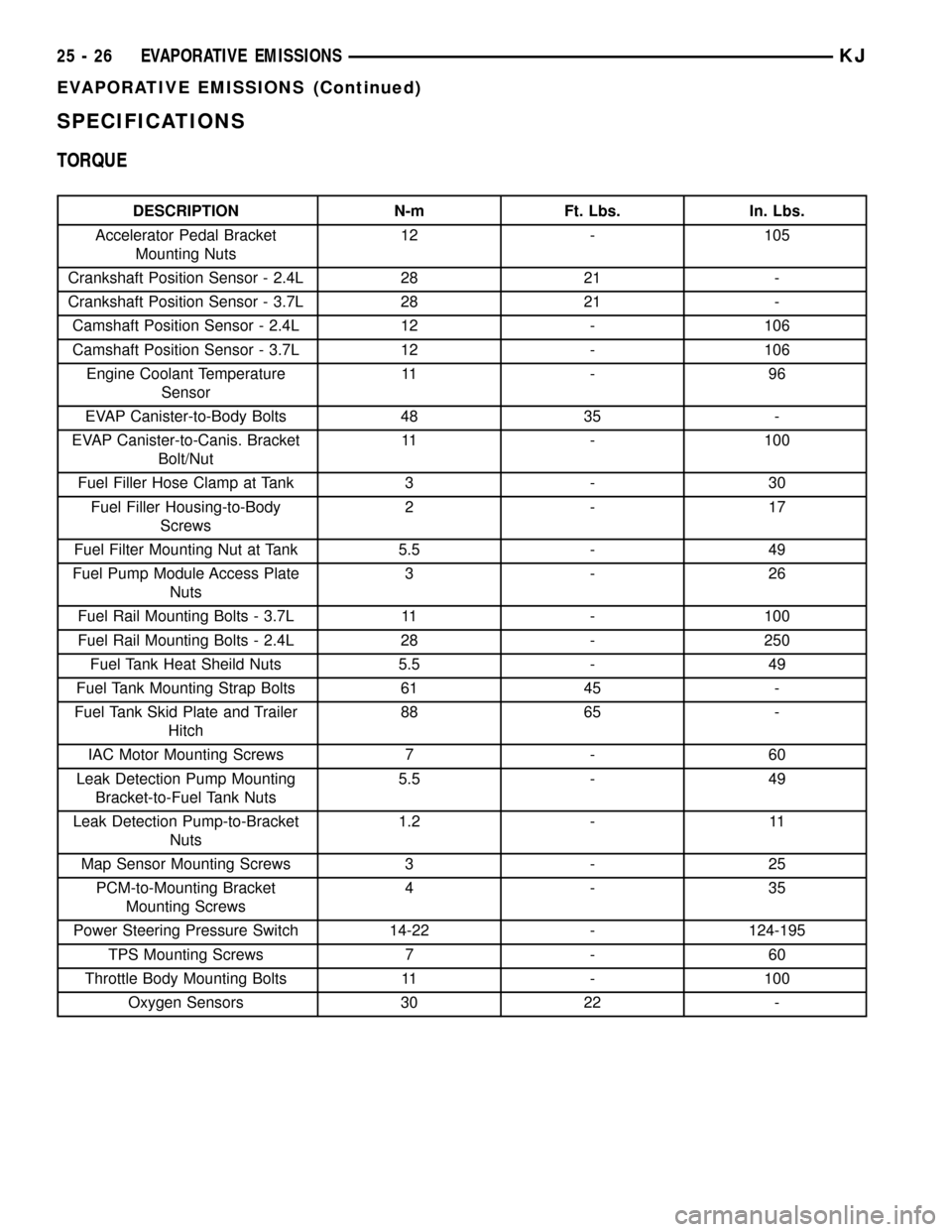
SPECIFICATIONS
TORQUE
DESCRIPTION N-m Ft. Lbs. In. Lbs.
Accelerator Pedal Bracket
Mounting Nuts12 - 105
Crankshaft Position Sensor - 2.4L 28 21 -
Crankshaft Position Sensor - 3.7L 28 21 -
Camshaft Position Sensor - 2.4L 12 - 106
Camshaft Position Sensor - 3.7L 12 - 106
Engine Coolant Temperature
Sensor11 - 9 6
EVAP Canister-to-Body Bolts 48 35 -
EVAP Canister-to-Canis. Bracket
Bolt/Nut11 - 100
Fuel Filler Hose Clamp at Tank 3 - 30
Fuel Filler Housing-to-Body
Screws2-17
Fuel Filter Mounting Nut at Tank 5.5 - 49
Fuel Pump Module Access Plate
Nuts3-26
Fuel Rail Mounting Bolts - 3.7L 11 - 100
Fuel Rail Mounting Bolts - 2.4L 28 - 250
Fuel Tank Heat Sheild Nuts 5.5 - 49
Fuel Tank Mounting Strap Bolts 61 45 -
Fuel Tank Skid Plate and Trailer
Hitch88 65 -
IAC Motor Mounting Screws 7 - 60
Leak Detection Pump Mounting
Bracket-to-Fuel Tank Nuts5.5 - 49
Leak Detection Pump-to-Bracket
Nuts1.2 - 11
Map Sensor Mounting Screws 3 - 25
PCM-to-Mounting Bracket
Mounting Screws4-35
Power Steering Pressure Switch 14-22 - 124-195
TPS Mounting Screws 7 - 60
Throttle Body Mounting Bolts 11 - 100
Oxygen Sensors 30 22 -
25 - 26 EVAPORATIVE EMISSIONSKJ
EVAPORATIVE EMISSIONS (Continued)
Page 1740 of 1803

ABS - DESCRIPTION, BRAKES...........5-32
ABS - OPERATION, BRAKES.............5-32
ABS - SPECIFICATIONS, BRAKES.........5-33
ABS BRAKE BLEEDING - STANDARD
PROCEDURE.........................5-33
ABS INDICATOR - DESCRIPTION.........8J-11
ABS INDICATOR - OPERATION..........8J-11
A/C APPLICATION TABLE,
SPECIFICATIONS......................24-9
A/C COMPRESSOR CLUTCH -
INSPECTION........................24-14
A/C COMPRESSOR CLUTCH -
INSTALLATION.......................24-14
A/C COMPRESSOR CLUTCH - REMOVAL . . 24-13
A/C COMPRESSOR CLUTCH BREAK-IN -
STANDARD PROCEDURE...............24-12
A/C COMPRESSOR CLUTCH COIL -
DIAGNOSIS AND TESTING.............24-12
A/C COMPRESSOR CLUTCH RELAY -
DESCRIPTION.......................24-15
A/C COMPRESSOR CLUTCH RELAY -
INSTALLATION.......................24-16
A/C COMPRESSOR CLUTCH RELAY -
OPERATION.........................24-15
A/C COMPRESSOR CLUTCH RELAY -
REMOVAL..........................24-16
A/C COMPRESSOR NOISE - DIAGNOSIS
AND TESTING.......................24-42
A/C CONDENSER - DESCRIPTION........24-45
A/C CONDENSER - INSTALLATION.......24-46
A/C CONDENSER - OPERATION...........24-45
A/C CONDENSER - REMOVAL...........24-45
A/C DISCHARGE LINE - INSTALLATION . . . 24-47
A/C DISCHARGE LINE - REMOVAL.......24-46
A/C EVAPORATOR - DESCRIPTION.......24-49
A/C EVAPORATOR - INSTALLATION......24-49
A/C EVAPORATOR - OPERATION.........24-49
A/C EVAPORATOR - REMOVAL..........24-49
A/C HEATER CONTROL - DESCRIPTION . . . 24-16
A/C HEATER CONTROL - INSTALLATION . . . 24-17
A/C HEATER CONTROL - REMOVAL......24-17
A/C HIGH PRESSURE SWITCH -
DESCRIPTION.......................24-17
A/C HIGH PRESSURE SWITCH -
DIAGNOSIS AND TESTING.............24-18
A/C HIGH PRESSURE SWITCH -
INSTALLATION.......................24-18
A/C HIGH PRESSURE SWITCH -
OPERATION.........................24-18
A/C HIGH PRESSURE SWITCH -
REMOVAL..........................24-18
A/C LIQUID LINE - INSTALLATION.......24-47
A/C LIQUID LINE - REMOVAL...........24-47
A/C LOW PRESSURE SWITCH -
DESCRIPTION.......................24-18
A/C LOW PRESSURE SWITCH -
DIAGNOSIS AND TESTING.............24-19
A/C LOW PRESSURE SWITCH -
INSTALLATION.......................24-19
A/C LOW PRESSURE SWITCH -
OPERATION.........................24-18
A/C LOW PRESSURE SWITCH -
REMOVAL..........................24-19
A/C ORIFICE TUBE - DESCRIPTION.......24-50
A/C ORIFICE TUBE - INSTALLATION......24-50
A/C ORIFICE TUBE - OPERATION........24-50
A/C ORIFICE TUBE - REMOVAL..........24-50
A/C PERFORMANCE - DIAGNOSIS AND
TESTING............................24-2
A/C SUCTION LINE - INSTALLATION......24-49
A/C SUCTION LINE - REMOVAL.........24-48
ACCELERATOR PEDAL - INSTALLATION . . . 14-30
ACCELERATOR PEDAL - REMOVAL.......14-29
ACCESS PANEL - DESCRIPTION, LATCH . . 23-139
ACCESS PANEL - INSTALLATION, LATCH . 23-139
ACCESS PANEL - REMOVAL, LATCH.....23-139
ACCUMULATOR - DESCRIPTION.........24-51
ACCUMULATOR - INSTALLATION........24-51
ACCUMULATOR - OPERATION..........24-51
ACCUMULATOR - REMOVAL
............24-51
ACTUATION TEST MODE - DESCRIPTION,
CIRCUIT
.............................25-2
ACTUATOR - INSTALLATION, BLEND
DOOR
.............................24-20
ACTUATOR - INSTALLATION, FLOOR -
DEFROST DOOR
.....................24-25
ACTUATOR - INSTALLATION, PANEL
DOOR
.............................24-25ACTUATOR - INSTALLATION,
RECIRCULATION DOOR................24-26
ACTUATOR - REMOVAL, BLEND DOOR....24-20
ACTUATOR - REMOVAL, FLOOR -
DEFROST DOOR.....................24-24
ACTUATOR - REMOVAL, PANEL DOOR....24-24
ACTUATOR - REMOVAL, RECIRCULATION
DOOR.............................24-26
ADAPTER - INSTALLATION, DISC BRAKE
CALIPER............................5-18
ADAPTER - REMOVAL, DISC BRAKE
CALIPER............................5-18
ADAPTER HOUSING SEAL -
INSTALLATION......................21-124
ADAPTER HOUSING SEAL - REMOVAL . . . 21-124
ADAPTOR - REMOVAL, DEFROST
DUCT/DEMISTER.....................24-32
ADHESIVE LOCATIONS -
SPECIFICATIONS, WELD AND
STRUCTURAL........................23-9
ADJUSTER - DIAGNOSIS AND TESTING,
HYDRAULIC LASH.................9-19,9-30
ADJUSTER - INSTALLATION, SEAT BELT
TURNING LOOP.....................8O-38
ADJUSTER - REMOVAL, SEAT BELT
TURNING LOOP.....................8O-37
ADJUSTMENT - STANDARD
PROCEDURE, CAMBER AND CASTER.......2-5
ADJUSTMENT - STANDARD
PROCEDURE, CAMBER, CASTER AND
TOE .................................2-5
ADJUSTMENT - STANDARD
PROCEDURE, COMPASS VARIATION......8M-3
ADJUSTMENT - STANDARD
PROCEDURE, TOE......................2-5
ADJUSTMENT, ADJUSTMENTS . . . 23-119,23-124,
23-131
ADJUSTMENT, ADJUSTMENTS...........3-55
ADJUSTMENT, ADJUSTMENTS -
SUNROOF GLASS PANEL.............23-178
ADJUSTMENT, FRONT FOG LAMP UNIT . . . 8L-25
ADJUSTMENT, HEADLAMP UNIT.........8L-42
ADJUSTMENT, LOCK OUT...............5-30
ADJUSTMENT, REAR DRUM BRAKE.......5-12
ADJUSTMENTS - ADJUSTMENT . . 23-119,23-124,
23-131
ADJUSTMENTS - ADJUSTMENT..........3-55
ADJUSTMENTS - SUNROOF GLASS
PANEL ADJUSTMENT................23-178
ADJUSTMENTS, FRONT AXLE - 186FIA....3-25
ADJUSTMENTS, GEARSHIFT CABLE.....21-130
ADJUSTMENTS, PARK-INTERLOCK
CABLE............................21-154
ADJUSTMENTS, REAR AXLE - 8 1/4 .......3-92
AFTER A SUPPLEMENTAL RESTRAINT
DEPLOYMENT - STANDARD
PROCEDURE, SERVICE.................8O-6
AIR CHECKING TRANSMISSION CLUTCH
OPERATION - DIAGNOSIS AND
TESTING...........................21-80
AIR CONDITIONER - DESCRIPTION,
HEATER .............................24-1
AIR CONDITIONER - OPERATION,
HEATER .............................24-2
AIR CONTROL MOTOR - DESCRIPTION,
IDLE...............................14-35
AIR CONTROL MOTOR - INSTALLATION,
IDLE...............................14-36
AIR CONTROL MOTOR - OPERATION,
IDLE...............................14-35
AIR CONTROL MOTOR - REMOVAL, IDLE . . 14-36
AIR TEMPERATURE SENSOR -
DESCRIPTION, INTAKE................14-36
AIR TEMPERATURE SENSOR -
INSTALLATION, INTAKE................14-38
AIR TEMPERATURE SENSOR -
OPERATION, INTAKE..................14-36
AIR TEMPERATURE SENSOR -
REMOVAL, INTAKE...................14-37
AIRBAG - DESCRIPTION, DRIVER........8O-17
AIRBAG - DESCRIPTION, PASSENGER....8O-27
AIRBAG - DESCRIPTION, SIDE CURTAIN . . 8O-38
AIRBAG - INSTALLATION, DRIVER.......8O-20
AIRBAG - INSTALLATION, PASSENGER
. . . 8O-29
AIRBAG - INSTALLATION, SIDE CURTAIN
. . 8O-41
AIRBAG - OPERATION, DRIVER
.........8O-18
AIRBAG - OPERATION, PASSENGER
......8O-27
AIRBAG - OPERATION, SIDE CURTAIN
....8O-39AIRBAG - REMOVAL, DRIVER...........8O-19
AIRBAG - REMOVAL, PASSENGER.......8O-28
AIRBAG - REMOVAL, SIDE CURTAIN.....8O-40
AIRBAG CONTROL MODULE -
DESCRIPTION........................8O-9
AIRBAG CONTROL MODULE -
DESCRIPTION, SIDE IMPACT...........8O-43
AIRBAG CONTROL MODULE -
INSTALLATION......................8O-12
AIRBAG CONTROL MODULE -
INSTALLATION, SIDE IMPACT...........8O-45
AIRBAG CONTROL MODULE -
OPERATION.........................8O-10
AIRBAG CONTROL MODULE -
OPERATION, SIDE IMPACT.............8O-43
AIRBAG CONTROL MODULE - REMOVAL . . 8O-11
AIRBAG CONTROL MODULE - REMOVAL,
SIDE IMPACT.......................8O-44
AIRBAG DOOR - INSTALLATION,
PASSENGER........................8O-30
AIRBAG DOOR - REMOVAL, PASSENGER . . 8O-29
AIRBAG INDICATOR - DESCRIPTION......8J-12
AIRBAG INDICATOR - OPERATION.......8J-12
AIRBAG MOUNTING BRACKET -
INSTALLATION, PASSENGER...........8O-31
AIRBAG MOUNTING BRACKET -
REMOVAL, PASSENGER...............8O-31
AJAR INDICATOR - DESCRIPTION, DOOR . . 8J-17
AJAR INDICATOR - DESCRIPTION, GATE . . 8J-20
AJAR INDICATOR - DESCRIPTION,
GLASS..............................8J-21
AJAR INDICATOR - OPERATION, DOOR . . . 8J-17
AJAR INDICATOR - OPERATION, GATE....8J-20
AJAR INDICATOR - OPERATION, GLASS . . . 8J-21
AJAR SWITCH - DESCRIPTION, DOOR....8L-77
AJAR SWITCH - DESCRIPTION, FLIP-UP
GLASS.............................8L-77
AJAR SWITCH - DESCRIPTION, HOOD....8Q-11
AJAR SWITCH - DESCRIPTION,
TAILGATE...........................8L-82
AJAR SWITCH - DIAGNOSIS AND
TESTING, HOOD.....................8Q-12
AJAR SWITCH - INSTALLATION, HOOD . . . 8Q-12
AJAR SWITCH - OPERATION, DOOR......8L-77
AJAR SWITCH - OPERATION, FLIP-UP
GLASS.............................8L-77
AJAR SWITCH - OPERATION, HOOD.....8Q-12
AJAR SWITCH - OPERATION, TAILGATE . . . 8L-82
AJAR SWITCH - REMOVAL, HOOD.......8Q-12
AJAR SWITCH BRACKET -
INSTALLATION, HOOD.................8Q-13
AJAR SWITCH BRACKET - REMOVAL,
HOOD.............................8Q-13
AJAR SWITCH STRIKER -
INSTALLATION, HOOD.................8Q-14
AJAR SWITCH STRIKER - REMOVAL,
HOOD.............................8Q-13
ALIGNMENT - DESCRIPTION, WHEEL.......2-3
ALIGNMENT - OPERATION, WHEEL........2-3
ALIGNMENT, SPECIFICATIONS............2-6
ALUMINUM THREAD REPAIR -
STANDARD PROCEDURE...............21-81
AMBIENT TEMP SENSOR - DESCRIPTION . . 8M-9
AMBIENT TEMP SENSOR - OPERATION . . . 8M-9
AMBIENT TEMPERATURE SENSOR -
DIAGNOSIS AND TESTING..............8M-9
AMBIENT TEMPERATURE SENSOR
CIRCUIT - DIAGNOSIS AND TESTING.....8M-9
AMPERAGE TEST - DIAGNOSIS AND
TESTING, FUEL PUMP.................14-16
AMPLIFIER CHOKE AND RELAY -
DESCRIPTION........................8A-3
AMPLIFIER CHOKE AND RELAY -
DIAGNOSIS AND TESTING..............8A-4
AMPLIFIER CHOKE AND RELAY -
INSTALLATION.......................8A-4
AMPLIFIER CHOKE AND RELAY -
OPERATION..........................8A-3
AMPLIFIER CHOKE AND RELAY -
REMOVAL...........................8A-4
ANCHOR - DESCRIPTION, CHILD TETHER
. 8O-13
ANCHOR - OPERATION, CHILD TETHER
. . . 8O-13
ANGLE - STANDARD PROCEDURES,
PROPELLER SHAFT
.....................3-3
ANTENNA BODY & CABLE -
DESCRIPTION
........................8A-4
ANTENNA BODY & CABLE -
INSTALLATION
.......................8A-6
KJINDEX 1
Description Group-Page Description Group-Page Description Group-Page
Page 1743 of 1803

BRAKE CALIPERS - OPERATION, DISC.....5-14
BRAKE CALIPERS - REMOVAL, DISC......5-14
BRAKE COMPONENTS, SPECIFICATIONS....5-6
BRAKE DRUM - DIAGNOSIS AND
TESTING............................5-27
BRAKE DRUM MACHINING - STANDARD
PROCEDURES........................5-27
BRAKE FLUID CONTAMINATION -
DIAGNOSIS AND TESTING..............5-26
BRAKE FLUID, SPECIFICATIONS..........5-27
BRAKE HOSE - INSTALLATION, FRONT.....5-10
BRAKE HOSE - INSTALLATION, REAR......5-10
BRAKE HOSE - REMOVAL, REAR..........5-9
BRAKE INDICATOR - DESCRIPTION,
BRAKE/PARK........................8J-13
BRAKE INDICATOR - DIAGNOSIS AND
TESTING...........................8J-14
BRAKE INDICATOR - OPERATION,
BRAKE/PARK........................8J-13
BRAKE LAMP SWITCH - DESCRIPTION . . . 8L-16
BRAKE LAMP SWITCH - DIAGNOSIS
AND TESTING.......................8L-17
BRAKE LAMP SWITCH - INSTALLATION . . . 8L-18
BRAKE LAMP SWITCH - OPERATION.....8L-16
BRAKE LAMP SWITCH - REMOVAL......8L-17
BRAKE LINE AND HOSES - DIAGNOSIS
AND TESTING.........................5-8
BRAKE LINES - DESCRIPTION............5-8
BRAKE PADS - INSTALLATION, FRONT.....5-11
BRAKE PADS - REMOVAL, FRONT........5-11
BRAKE ROTOR - DIAGNOSIS AND
TESTING, DISC.......................5-18
BRAKE ROTOR - STANDARD
PROCEDURE, DISC....................5-19
BRAKE SHOES - INSTALLATION, DRUM....5-11
BRAKE SHOES - REMOVAL, DRUM.......5-11
BRAKE SYSTEM - DIAGNOSIS AND
TESTING, BASE........................5-3
BRAKE TRANSMISSION SHIFT
INTERLOCK SYSTEM - DESCRIPTION....21-124
BRAKE TRANSMISSION SHIFT
INTERLOCK SYSTEM - DIAGNOSIS
AND TESTING......................21-125
BRAKE TRANSMISSION SHIFT
INTERLOCK SYSTEM - OPERATION.....21-125
BRAKE/PARK BRAKE INDICATOR -
DESCRIPTION.......................8J-13
BRAKE/PARK BRAKE INDICATOR -
OPERATION.........................8J-13
BRAKES - ABS - DESCRIPTION...........5-32
BRAKES - ABS - OPERATION............5-32
BRAKES - ABS - SPECIFICATIONS........5-33
BRAKES - BASE - DESCRIPTION...........5-2
BRAKES - BASE - WARNING..............5-2
BRAKES, SPECIAL TOOLS - BASE.........5-7
BRAKING SYSTEM - DIAGNOSIS AND
TESTING, ANTILOCK...................5-33
BREAK-IN - STANDARD PROCEDURE,
A/C COMPRESSOR CLUTCH............24-12
BUCKLE - INSTALLATION, FRONT SEAT
BELT ..............................8O-26
BUCKLE - INSTALLATION, REAR SEAT
BELT ..............................8O-35
BUCKLE - REMOVAL, FRONT SEAT BELT . . 8O-25
BUCKLE - REMOVAL, REAR SEAT BELT . . . 8O-34
BUILT-IN INDICATOR TEST - STANDARD
PROCEDURE........................8F-10
BULB - INSTALLATION, ASH RECEIVER
LAMP..............................8L-71
BULB - INSTALLATION, CARGO LAMP....8L-73
BULB - INSTALLATION, CENTER HIGH
MOUNTED STOP LAMP................8L-19
BULB - INSTALLATION, COMPASS
MINI-TRIP ILLUMINATION..............8L-75
BULB - INSTALLATION, COURTESY
LAMP..............................8L-76
BULB - INSTALLATION, FRONT FOG
LAMP..............................8L-22
BULB - INSTALLATION, FRONT LAMP....8L-27
BULB - INSTALLATION, FRONT POSITION
LAMP..............................8L-28
BULB - INSTALLATION, HEADLAMP
......8L-32
BULB - INSTALLATION, HEATER-A/C
CONTROL ILLUMINATION
..............8L-78
BULB - INSTALLATION, LICENSE PLATE
LAMP
..............................8L-45
BULB - INSTALLATION, READING LAMP
. . . 8L-79
BULB - INSTALLATION, REAR LAMP
.....8L-59BULB - INSTALLATION, REPEATER LAMP . . 8L-60
BULB - INSTALLATION, TRANSMISSION
RANGE INDICATOR ILLUMINATION.......8L-83
BULB - INSTALLATION, VANITY LAMP....8L-84
BULB - REMOVAL, ASH RECEIVER LAMP . . 8L-71
BULB - REMOVAL, CARGO LAMP........8L-72
BULB - REMOVAL, CENTER HIGH
MOUNTED STOP LAMP................8L-18
BULB - REMOVAL, COMPASS MINI-TRIP
ILLUMINATION......................8L-74
BULB - REMOVAL, COURTESY LAMP.....8L-75
BULB - REMOVAL, FRONT FOG LAMP....8L-21
BULB - REMOVAL, FRONT LAMP........8L-26
BULB - REMOVAL, FRONT POSITION
LAMP..............................8L-28
BULB - REMOVAL, HEADLAMP..........8L-31
BULB - REMOVAL, HEATER-A/C
CONTROL ILLUMINATION..............8L-78
BULB - REMOVAL, LICENSE PLATE
LAMP..............................8L-44
BULB - REMOVAL, READING LAMP......8L-79
BULB - REMOVAL, REAR LAMP.........8L-58
BULB - REMOVAL, REPEATER LAMP.....8L-60
BULB - REMOVAL, TRANSMISSION
RANGE INDICATOR ILLUMINATION.......8L-82
BULB - REMOVAL, VANITY LAMP........8L-83
BUMPER - INSTALLATION, JOUNCE.......2-19
BUMPER - REMOVAL, JOUNCE...........2-19
BURNT FLUID - DIAGNOSIS AND
TESTING, CAUSES OF................21-125
BUSHING - NV3550 - INSTALLATION,
EXTENSION HOUSING.................21-74
BUSHING - NV3550 - REMOVAL,
EXTENSION HOUSING.................21-73
BUSHINGS - INSTALLATION, STABILIZER
BAR.................................2-9
BUSHINGS - REMOVAL, STABILIZER BAR . . . 2-9
BUSHINGS, AND BALL JOINT -
DESCRIPTION, UPPER SUSPENSION
ARM ...............................2-20
BUSHINGS, AND BALL JOINT -
OPERATION, UPPER SUSPENSION
ARM ...............................2-20
CABLE - ADJUSTMENTS, GEARSHIFT....21-130
CABLE - ADJUSTMENTS, PARK-
INTERLOCK........................21-154
CABLE - DESCRIPTION.................8P-3
CABLE - DESCRIPTION, ANTENNA BODY . . . 8A-4
CABLE - DIAGNOSIS AND TESTING,
ANTENNA BODY......................8A-5
CABLE - DIAGNOSIS AND TESTING,
GEARSHIFT........................21-128
CABLE - INSTALLATION, ANTENNA BODY . . 8A-6
CABLE - INSTALLATION, GEARSHIFT....21-129
CABLE - INSTALLATION, INSTRUMENT
PANEL ANTENNA......................8A-8
CABLE - INSTALLATION, LATCH RELEASE . 23-120
CABLE - INSTALLATION, PARK -
INTERLOCK........................21-153
CABLE - INSTALLATION, THROTTLE
CONTROL..........................14-46
CABLE - OPERATION...................8P-3
CABLE - OPERATION, ANTENNA BODY.....8A-5
CABLE - REMOVAL, ANTENNA BODY......8A-6
CABLE - REMOVAL, GEARSHIFT........21-128
CABLE - REMOVAL, INSTRUMENT PANEL
ANTENNA...........................8A-7
CABLE - REMOVAL, LATCH RELEASE....23-120
CABLE - REMOVAL, PARK - INTERLOCK . 21-153
CABLE - REMOVAL, THROTTLE
CONTROL..........................14-45
CABLE RESISTANCE, 2.4L - SPARK PLUG . . . 8I-3
CABLES - DESCRIPTION, BATTERY.......8F-18
CABLES - DIAGNOSIS AND TESTING,
BATTERY...........................8F-19
CABLES - INSTALLATION...............5-30
CABLES - OPERATION, BATTERY........8F-18
CABLES - REMOVAL...................5-30
CALIBRATION - STANDARD PROCEDURE,
COMPASS...........................8M-2
CALIPER ADAPTER - INSTALLATION,
DISC BRAKE.........................5-18
CALIPER ADAPTER - REMOVAL, DISC
BRAKE
..............................5-18
CALIPERS - ASSEMBLY, DISC BRAKE
......5-16
CALIPERS - CLEANING, DISC BRAKE
......5-16
CALIPERS - DESCRIPTION, DISC BRAKE
. . . 5-13
CALIPERS - DISASSEMBLY, DISC BRAKE
. . . 5-14CALIPERS - INSPECTION, DISC BRAKE....5-16
CALIPERS - INSTALLATION, DISC BRAKE . . . 5-17
CALIPERS - OPERATION, DISC BRAKE.....5-14
CALIPERS - REMOVAL, DISC BRAKE......5-14
CAMBER AND CASTER ADJUSTMENT -
STANDARD PROCEDURE.................2-5
CAMBER, CASTER AND TOE
ADJUSTMENT - STANDARD
PROCEDURE..........................2-5
CAMSHAFT(S) - DESCRIPTION.......9-23,9-33
CAMSHAFT(S) - INSTALLATION......9-25,9-33
CAMSHAFT(S) - REMOVAL..........9-24,9-33
CANISTER - DESCRIPTION, VAPOR......25-33
CANISTER - INSTALLATION, VAPOR......25-33
CANISTER - OPERATION, VAPOR........25-33
CANISTER - REMOVAL, VAPOR..........25-33
CAP - CLEANING, RADIATOR PRESSURE . . . 7-25
CAP - DESCRIPTION, FUEL FILLER.......25-27
CAP - DESCRIPTION, RADIATOR
PRESSURE..........................7-25
CAP - DIAGNOSIS AND TESTING,
RADIATOR PRESSURE.................7-25
CAP - INSPECTION, RADIATOR
PRESSURE..........................7-25
CAP - INSTALLATION, INSTRUMENT
PANEL END........................23-153
CAP - OPERATION, FUEL FILLER........25-27
CAP - OPERATION, RADIATOR
PRESSURE..........................7-25
CAP - REMOVAL, INSTRUMENT PANEL
END ..............................23-153
CAPACITIES - SPECIFICATIONS, FLUID......0-4
CAPACITOR - DESCRIPTION, IGNITION
COIL...............................8I-16
CAPACITOR - INSTALLATION, IGNITION
COIL...............................8I-16
CAPACITOR - OPERATION, IGNITION
COIL...............................8I-16
CAPACITOR - REMOVAL, IGNITION COIL . . . 8I-16
CAPACITY - SPECIFICATIONS, CHARGE . . . 24-42
CAPACITY TEST - DIAGNOSIS AND
TESTING, FUEL PUMP.................14-15
CARDAN UNIVERSAL JOINTS -
ASSEMBLY, SINGLE.....................3-9
CARDAN UNIVERSAL JOINTS -
DISASSEMBLY, SINGLE..................3-8
CARGO LAMP BULB - INSTALLATION.....8L-73
CARGO LAMP BULB - REMOVAL........8L-72
CARGO LAMP SWITCH - INSTALLATION . . 8L-74
CARGO LAMP SWITCH - REMOVAL......8L-73
CARGO LAMP UNIT - INSTALLATION.....8L-74
CARGO LAMP UNIT - REMOVAL.........8L-74
CARPETS AND FLOOR MATS -
INSTALLATION......................23-158
CARPETS AND FLOOR MATS - REMOVAL . 23-158
CASE - NV231 - ASSEMBLY, TRANSFER . . 21-194
CASE - NV231 - CLEANING, TRANSFER . . 21-190
CASE - NV231 - DESCRIPTION,
TRANSFER............................0-3
CASE - NV231 - DESCRIPTION,
TRANSFER.........................21-178
CASE - NV231 - DIAGNOSIS AND
TESTING, TRANSFER.................21-180
CASE - NV231 - DISASSEMBLY,
TRANSFER.........................21-182
CASE - NV231 - INSPECTION, TRANSFER . 21-190
CASE - NV231 - INSTALLATION,
TRANSFER.........................21-205
CASE - NV231 - OPERATION, TRANSFER
. 21-179
CASE - NV231 - REMOVAL, TRANSFER
. . 21-181
CASE - NV242 - ASSEMBLY, TRANSFER
. . 21-230
CASE - NV242 - CLEANING, TRANSFER
. . 21-227
CASE - NV242 - DESCRIPTION,
TRANSFER
............................0-3
CASE - NV242 - DESCRIPTION,
TRANSFER
.........................21-215
CASE - NV242 - DIAGNOSIS AND
TESTING, TRANSFER
.................21-216
CASE - NV242 - DISASSEMBLY,
TRANSFER
.........................21-218
CASE - NV242 - INSPECTION, TRANSFER
. 21-228
CASE - NV242 - INSTALLATION,
TRANSFER
.........................21-243
CASE - NV242 - OPERATION, TRANSFER
. 21-215
CASE - NV242 - REMOVAL, TRANSFER
. . 21-217
CASE BEARINGS - INSTALLATION,
DIFFERENTIAL
...............3-110,3-44,3-79
4 INDEXKJ
Description Group-Page Description Group-Page Description Group-Page