2002 JEEP LIBERTY water
[x] Cancel search: waterPage 1601 of 1803

EXTERIOR HANDLE
REMOVAL
(1) Remove the trim panel and waterdam. (Refer
to 23 - BODY/SWING GATE/TRIM PANEL -
REMOVAL)
(2) Disconnect the lock switch and flip-up glass
release electrical connectors.
(3) Unclip the threaded clips and disconnect the
actuator rods. (Fig. 2)
(4) Remove the screws.
(5) Remove the nuts and remove the handle.
INSTALLATION
(1) Install the handle and hold tightly against the
gate and support bracket.
(2) Install the nuts and tighten to 6 N´m (55 in.
lbs.).
(3) Install the screws.
(4) Connect the actuator rods and electrical con-
nectors.
(5) Install the trim panel and waterdam. (Refer to
23 - BODY/SWING GATE/TRIM PANEL - INSTAL-
LATION)
FLIP-UP GLASS
REMOVAL
(1) Open the flip-up glass and disconnect the elec-
trical connectors.(2) Remove the support cylinders. (Refer to 23 -
BODY/SWING GATE/FLIP-UP GLASS SUPPORT
CYLINDER - REMOVAL)
(3) Open the glass to the full travel with the sup-
port cylinders off.
(4) Remove the bolts and remove the glass. (Fig. 3)
INSTALLATION
(1) Install the flip-up glass and install the hinge
bolts.
(2) Install the support cylinders. (Refer to 23 -
BODY/SWING GATE/FLIP-UP GLASS SUPPORT
CYLINDER - INSTALLATION)
(3) Connect the electrical connectors.
(4) Adjust flip-up glass fit if necessary and tighten
the hinge bolts to 7 N´m (60 in. lbs.). (Refer to 23 -
BODY/BODY STRUCTURE/GAP AND FLUSH -
SPECIFICATIONS)
FLIP-UP GLASS LATCH
REMOVAL
(1) Remove the trim panel. (Refer to 23 - BODY/
SWING GATE/TRIM PANEL - REMOVAL)
(2) Disconnect the electrical connectors. (Fig. 4)
(3) Using a trim stick C-4755 or equivalent, mark
the location of the latch assembly for installation.
(4) Remove the nuts and remove the latch assem-
bly.
INSTALLATION
(1) Install the latch assembly.
Fig. 2 EXTERIOR HANDLE
1 - LOCK CYLINDER SCREW
2 - LATCH ACTUATOR ROD CONNECTOR
3 - EXTERIOR HANDLE
4 - NUTS (2)
5 - SCREWS (2)
Fig. 3 FLIP-UP GLASS
1 - BOLTS (4)
2 - HINGE MOUNTING HOLES
3 - DEFROSTER WIRE HARNESS
4 - DEFROSTER ELECTRICAL CONNECTOR
5 - FLIPPER GLASS
23 - 136 SWING GATEKJ
Page 1602 of 1803

(2) Install the nuts and tighten to 12 N´m (9 ft.
lbs.).
(3) Connect the electrical connectors.
(4) Install the trim panel. (Refer to 23 - BODY/
SWING GATE/TRIM PANEL - INSTALLATION)
(5) Adjust the latch to achieve the best glass fit.
(Refer to 23 - BODY/BODY STRUCTURE/GAP AND
FLUSH - SPECIFICATIONS)
HINGE
REMOVAL
(1) Remove the swing gate. (Refer to 23 - BODY/
SWING GATE/SWING GATE - REMOVAL)
(2) Remove the bolts and remove the hinges.
INSTALLATION
(1) Install the hinges.
(2) Install the bolts and tighten to 31 N´m (23 ft.
lbs.).
(3) Install the swing gate. (Refer to 23 - BODY/
SWING GATE/ SWING GATE - INSTALLATION)
LATCH
REMOVAL
(1) Remove the trim panel and waterdam. (Refer
to 23 - BODY/SWING GATE/TRIM PANEL -
REMOVAL)
(2) Disconnect the electrical connector and actua-
tor rod at the threaded clip. (Fig. 5)(3) Remove the screws and remove the latch.
INSTALLATION
(1) Connect the electrical connector and install the
latch.
(2) Install the screws and tighten to 11 N´m (8 ft.
lbs.).
(3) Connect the actuator rod.
(4) Install the trim panel and waterdam. (Refer to
23 - BODY/SWING GATE/TRIM PANEL - INSTAL-
LATION)
LATCH STRIKER
REMOVAL
(1) Open the gate and remove the screws attaching
the striker to the d-pillar.
INSTALLATION
(1) Install the striker and install the nuts.
(2) Tighten the nuts to 28 N´m (21 ft. lbs.).
(3) Adjust the swing gate as necessary. (Refer to
23 - BODY/BODY STRUCTURE/GAP AND FLUSH -
SPECIFICATIONS)
LOCK CYLINDER
REMOVAL
(1) Remove the exterior handle. (Refer to 23 -
BODY/SWING GATE/EXTERIOR HANDLE -
REMOVAL)
Fig. 4 FLIP-UP GLASS LATCH
1 - NUTS (2)
2 - ELECTRICAL CONNECTOR
3 - SWING GATE
4 - ELECTRICAL CONNECTOR
5 - FLIP-UP GLASS LATCHFig. 5 LATCH
1 - SWING GATE
2 - LATCH ASSEMBLY
3 - ELECTRICAL CONNECTOR
4 - SCREWS
KJSWING GATE 23 - 137
FLIP-UP GLASS LATCH (Continued)
Page 1605 of 1803

EXTERIOR
TABLE OF CONTENTS
page page
BODY SIDE MOLDINGS
REMOVAL............................140
INSTALLATION........................140
COWL GRILLE
REMOVAL............................140
INSTALLATION........................140
EXTERIOR NAME PLATES
REMOVAL............................140
INSTALLATION........................141
FRONT FENDER
REMOVAL............................141
INSTALLATION........................141
FUEL FILL DOOR/HOUSING
REMOVAL............................141
INSTALLATION........................141
GRILLE
REMOVAL............................142
INSTALLATION........................142
GRILLE OPENING REINFORCEMENT
REMOVAL............................142
INSTALLATION........................142FRONT WHEELHOUSE SPLASH SHIELD
REMOVAL............................143
INSTALLATION........................143
LUGGAGE RACK
REMOVAL............................144
INSTALLATION........................144
REAR WHEELHOUSE SPLASH SHIELD
REMOVAL............................144
INSTALLATION........................144
SIDE VIEW MIRROR
REMOVAL............................145
INSTALLATION........................145
FRONT WHEEL OPENING FLARE MOLDINGS
REMOVAL............................145
INSTALLATION........................145
REAR WHEEL OPENING FLARE MOLDINGS
REMOVAL............................145
INSTALLATION........................145
RADIATOR CROSSMEMBER
REMOVAL............................146
INSTALLATION........................146
BODY SIDE MOLDINGS
REMOVAL
(1) Using a trim stick C-4755 or equivalent,
remove and discard the molding from the outside of
the door.
INSTALLATION
(1) Thoroughly clean all residue from the body side
molding attachment area of the door.
(2) Wipe area clean with a 50% solution of water
and alcohol and wipe dry.
(3) Apply new body side molding using the locators
in the door and apply pressure of approximately 40
p.s.i. over the entire surface of the molding.
COWL GRILLE
REMOVAL
(1) Remove the hood seal.
(2) Remove the wiper arms. (Refer to 8 - ELEC-
TRICAL/WIPERS/WASHERS/WIPER ARMS -
REMOVAL)
(3) Remove the four plastic retainers and remove
the cowl grill.
INSTALLATION
(1) Position the cowl grill and engage the nine
clips to the bottom of the windshield.
(2) Install the five plastic retainers.
(3) Install the wiper arms. (Refer to 8 - ELECTRI-
CAL/WIPERS/WASHERS/WIPER ARMS - INSTAL-
LATION)
(4) Install the hood seal.
EXTERIOR NAME PLATES
REMOVAL
NOTE: Exterior nameplates are attached to body
panels with adhesive tape.
(1) Apply a length of masking tape on the body,
parallel to the top edge of the nameplate to use as a
guide, if necessary.
(2) If temperature is below 21ÉC (70ÉF) warm
emblem with a heat lamp or gun. Do not exceed 52ÉC
(120ÉF) when heating emblem.
(3) Using a trim stick C-4755 or equivalent, behind
the emblem to separate the adhesive backing from
the body.
23 - 140 EXTERIORKJ
Page 1637 of 1803

STATIONARY GLASS
TABLE OF CONTENTS
page page
DOOR GLASS
REMOVAL............................172
INSTALLATION........................172
QUARTER WINDOW
REMOVAL............................172
INSTALLATION........................172WINDSHIELD
WARNING
WINDSHIELD SAFETY PRECAUTIONS....173
REMOVAL............................173
INSTALLATION........................173
DOOR GLASS
REMOVAL
(1) Remove the rear door glass run channel. (Refer
to 23 - BODY/DOORS - REAR/GLASS RUN CHAN-
NEL - REMOVAL)
INSTALLATION
(1) Install the rear door glass run channel. (Refer
to 23 - BODY/DOORS - REAR/GLASS RUN CHAN-
NEL - INSTALLATION)
QUARTER WINDOW
REMOVAL
(1) Remove the headliner as necessary to gain
access to the glass seal from the inside. (Refer to 23 -
BODY/INTERIOR/HEADLINER - REMOVAL)
(2) Cut urethane bonding from around quarter
window glass using a suitable sharp cold knife. A
pneumatic cutting device can be used if available.
(3) Separate glass from vehicle.
INSTALLATION
CAUTION: Open a window before installing glass.
This will avoid pressurizing the passenger compart-
ment. If a door or swing gate flip-up glass is
slammed before urethane is cured, water leaks can
result.
The window opening fence should be cleaned of old
urethane bonding material.
(1) Install the headliner as necessary. (Refer to 23
- BODY/INTERIOR/HEADLINER - INSTALLATION)
(2) Clean inside of glass with Mopar Glass Cleaner
and lint-free cloth.
(3) Apply PVC (vinyl) primer 25 mm (1 in.) wide
around edge of glass. Wipe with clean/dry lint-free
cloth.
(4) Apply fence primer around edge of fence. Allow
at least eighteen minutes drying time.
(5) Apply a 10 mm (0.4 in.) bead of urethane
around window vinyl border location.
(6)
Position glass into window opening and lock clips
into place.
23 - 172 STATIONARY GLASSKJ
Page 1638 of 1803

WINDSHIELD
WARNING
WINDSHIELD SAFETY PRECAUTIONS
WARNING: DO NOT OPERATE THE VEHICLE
WITHIN 24 HOURS OF WINDSHIELD INSTALLATION.
IT TAKES AT LEAST 24 HOURS FOR URETHANE
ADHESIVE TO CURE. IF IT IS NOT CURED, THE
WINDSHIELD MAY NOT PERFORM PROPERLY IN
AN ACCIDENT.
²URETHANE ADHESIVES ARE APPLIED AS A
SYSTEM. USE GLASS CLEANER, GLASS PREP
SOLVENT, GLASS PRIMER, PVC (VINYL) PRIMER
AND PINCH WELD (FENCE) PRIMER PROVIDED BY
THE ADHESIVE MANUFACTURER. IF NOT, STRUC-
TURAL INTEGRITY COULD BE COMPROMISED.
²DAIMLERCHRYSLER DOES NOT RECOMMEND
GLASS ADHESIVE BY BRAND. TECHNICIANS
SHOULD REVIEW PRODUCT LABELS AND TECHNI-
CAL DATA SHEETS, AND USE ONLY ADHESIVES
THAT THEIR MANUFACTURES WARRANT WILL
RESTORE A VEHICLE TO THE REQUIREMENTS OF
FMVSS 212. TECHNICIANS SHOULD ALSO INSURE
THAT PRIMERS AND CLEANERS ARE COMPATIBLE
WITH THE PARTICULAR ADHESIVE USED.
²BE SURE TO REFER TO THE URETHANE MAN-
UFACTURER'S DIRECTIONS FOR CURING TIME
SPECIFICATIONS, AND DO NOT USE ADHESIVE
AFTER ITS EXPIRATION DATE.
²VAPORS THAT ARE EMITTED FROM THE URE-
THANE ADHESIVE OR PRIMER COULD CAUSE
PERSONAL INJURY. USE THEM IN A WELL-VENTI-
LATED AREA.
²SKIN CONTACT WITH URETHANE ADHESIVE
SHOULD BE AVOIDED. PERSONAL INJURY MAY
RESULT.
²ALWAYS WEAR EYE AND HAND PROTECTION
WHEN WORKING WITH GLASS.
CAUTION: Protect all painted and trimmed surfaces
from coming in contact with urethane or primers.
Be careful not to damage painted surfaces when
removing moldings or cutting urethane around
windshield.
REMOVAL
(1) Remove inside rear view mirror. (Refer to 23 -
BODY/INTERIOR/REAR VIEW MIRROR -
REMOVAL)
(2) Remove cowl cover. (Refer to 23 - BODY/EXTE-
RIOR/COWL GRILLE - REMOVAL)(3) Remove screws attaching windshield side mold-
ing to A-pillar.
(4) Remove upper windshield molding.
(5) Cut urethane bonding from around windshield
using a suitable sharp cold knife. A pneumatic cut-
ting device can be used if available.
(6) Separate windshield from vehicle.
INSTALLATION
WARNING: REVIEW ALL WARNINGS AND CAU-
TIONS IN THIS GROUP BEFORE PRECEDING WITH
INSTALLATION.
CAUTION: Open a window before installing wind-
shield. This will avoid pressurizing the passenger
compartment. If a door or swing gate flip-up glass
is slammed before urethane is cured, water leaks
can result.
The windshield fence should be cleaned of old ure-
thane bonding material. Support spacers should be
cleaned and properly installed on weld studs or
repair screws at bottom of windshield opening.
(1) Place replacement windshield into windshield
opening. Position glass in the center of the opening
against the support spacers. Mark the glass at the
support spacers with a grease pencil or masking tape
and ink pen to use as a reference for installation.
Remove replacement windshield from windshield
opening.
(2) Position the windshield inside up on a suitable
work surface with two padded, wood 10 cm by 10 cm
by 50 cm (4 in. by 4 in. by 20 in.) blocks, placed par-
allel 75 cm (2.5 ft.) apart.
(3) Clean inside of windshield with Mopar Glass
Cleaner and lint-free cloth.
(4) Apply clear glass primer 25 mm (1 in.) wide
around edge of windshield. Wipe with clean/dry lint-
free cloth.
(5) Apply black-out primer 15 mm (.75 in.) wide on
top and sides of windshield and 25 mm (1 in.) on bot-
tom of windshield. Allow at least three minutes dry-
ing time.
(6) Position windshield spacers on lower fence
above support spacers at the edge of the windshield
opening.
(7) Align the dot on the upper molding to the tick
mark in the center of the glass and install upper
molding onto windshield.
(8) Apply a 10 mm (0.4 in.) bead of urethane
around perimeter of windshield along the inside of
the moldings. Apply two beads along the bottom
edge.
KJSTATIONARY GLASS 23 - 173
Page 1639 of 1803

(9) Apply fence primer around the perimeter of the
windshield opening fence. Allow at least 18 minutes
drying time.
(10) With aid of a helper, position windshield over
windshield opening. Align reference marks at bottom
of windshield to support spacers.
(11) Slowly lower windshield glass to windshield
opening fence. Guide top molding into proper position
if necessary. Push windshield inward to fence spacers
at bottom and until top molding is flush to roof line.
(12) Clean excess urethane from exterior with
Mopar Super Clean or equivalent.(13) Install windshield side moldings. (Refer to 23
- BODY/WEATHERSTRIP/SEALS/WINDSHIELD
A-PILLAR WEATHERSTRIP - INSTALLATION)
(14) Install cowl grille. (Refer to 23 - BODY/EXTE-
RIOR/COWL GRILLE - INSTALLATION)
(15) Install inside rear view mirror. (Refer to 23 -
BODY/INTERIOR/REAR VIEW MIRROR - INSTAL-
LATION)
(16) After urethane has cured, water test wind-
shield to verify repair.
23 - 174 STATIONARY GLASSKJ
WINDSHIELD (Continued)
Page 1640 of 1803

SUNROOF
TABLE OF CONTENTS
page page
SUNROOF
DESCRIPTION........................175
DIAGNOSIS AND TESTING
WATER DRAINAGE AND WIND NOISE
DIAGNOSIS.........................176
DIAGNOSTIC PROCEDURES...........176
GLASS PANEL
REMOVAL............................178
INSTALLATION........................178
ADJUSTMENTS
SUNROOF GLASS PANEL ADJUSTMENT . . 178
GLASS PANEL SEAL
REMOVAL............................178
INSTALLATION........................178
SUNSHADE
REMOVAL............................179
INSTALLATION........................179
GUIDE ASSEMBLY
REMOVAL............................179
INSTALLATION........................179
WIND DEFLECTOR
REMOVAL............................180INSTALLATION........................180
OPENING TRIM LACE
REMOVAL............................180
INSTALLATION........................180
DRAIN TUBE
REMOVAL............................180
INSTALLATION........................181
MODULE ASSEMBLY
REMOVAL............................181
INSTALLATION........................181
DRIVE MOTOR
REMOVAL............................182
INSTALLATION........................182
CONTROL MODULE
REMOVAL............................183
INSTALLATION........................183
CONTROL SWITCH
DESCRIPTION........................184
OPERATION..........................184
DIAGNOSIS AND TESTING...............184
REMOVAL............................184
INSTALLATION........................184
SUNROOF
DESCRIPTION
WARNING: Keep fingers and other body parts out
of sunroof opening at all times.
The sunroof features a power sliding glass panel
and a sunshade which can be manually positioned
anywhere along its travel, rearward of glass panel
front edge.
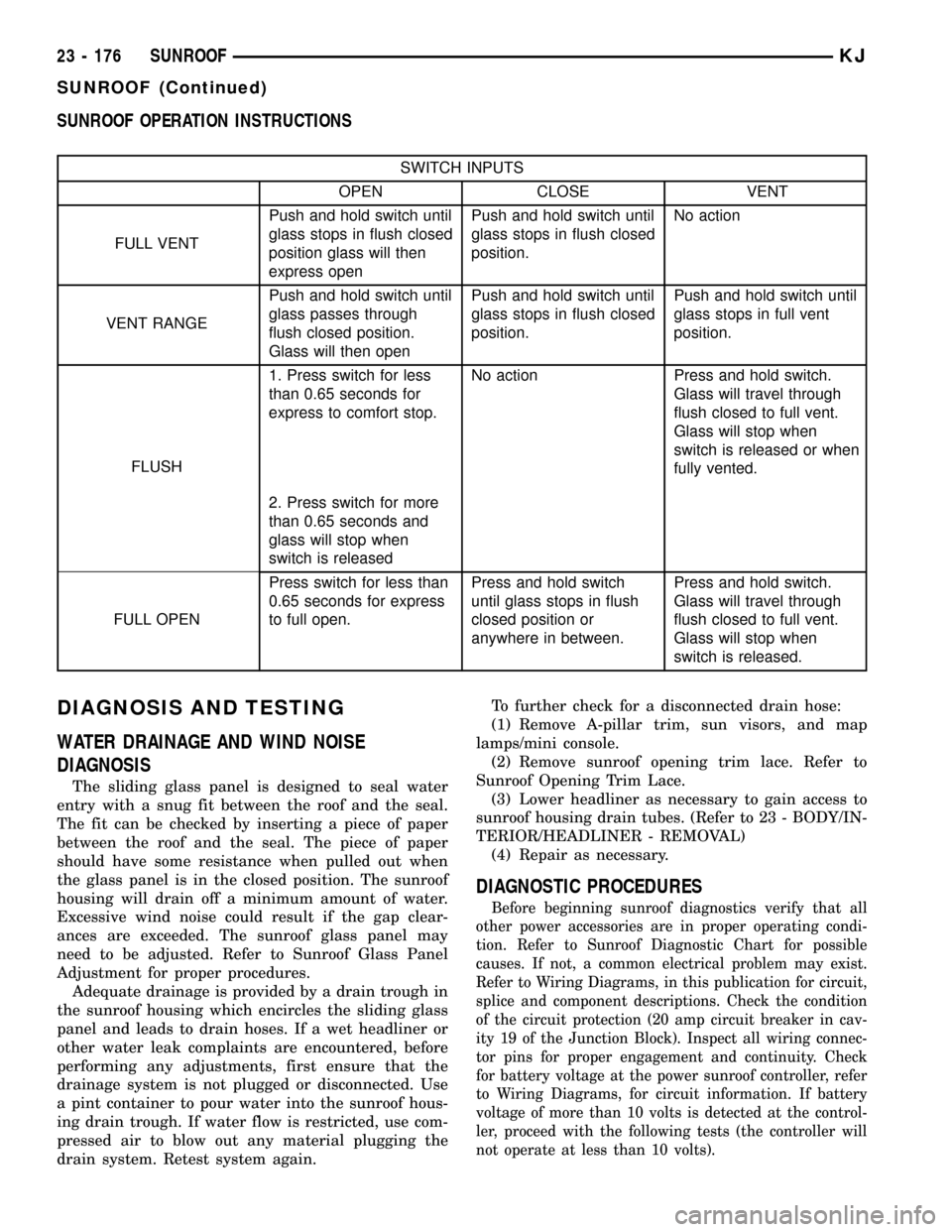
The sunroof is electrically operated from two
switches located on the windshield header, rearwardof the map lamp. To operate the sunroof the ignition
switch must be in either the Accessory or On/Run
position. One switch (vent) is a push button type and
opens the sunroof to the vent position only. The other
switch (open/close) is a rocker type for opening and
closing the sunroof. Pressing and releasing the open
button once the sunroof will express open and the
wind deflector will raise. If the button is pressed a
second time the sunroof will stop in that position.
Pressing and holding the close button will close the
sunroof. If the close button is released the sunroof
will stop in that position.
KJSUNROOF 23 - 175
Page 1641 of 1803
SUNROOF OPERATION INSTRUCTIONS
SWITCH INPUTS
OPEN CLOSE VENT
FULL VENTPush and hold switch until
glass stops in flush closed
position glass will then
express openPush and hold switch until
glass stops in flush closed
position.No action
VENT RANGEPush and hold switch until
glass passes through
flush closed position.
Glass will then openPush and hold switch until
glass stops in flush closed
position.Push and hold switch until
glass stops in full vent
position.
FLUSH1. Press switch for less
than 0.65 seconds for
express to comfort stop.No action Press and hold switch.
Glass will travel through
flush closed to full vent.
Glass will stop when
switch is released or when
fully vented.
2. Press switch for more
than 0.65 seconds and
glass will stop when
switch is released
FULL OPENPress switch for less than
0.65 seconds for express
to full open.Press and hold switch
until glass stops in flush
closed position or
anywhere in between.Press and hold switch.
Glass will travel through
flush closed to full vent.
Glass will stop when
switch is released.
DIAGNOSIS AND TESTING
WATER DRAINAGE AND WIND NOISE
DIAGNOSIS
The sliding glass panel is designed to seal water
entry with a snug fit between the roof and the seal.
The fit can be checked by inserting a piece of paper
between the roof and the seal. The piece of paper
should have some resistance when pulled out when
the glass panel is in the closed position. The sunroof
housing will drain off a minimum amount of water.
Excessive wind noise could result if the gap clear-
ances are exceeded. The sunroof glass panel may
need to be adjusted. Refer to Sunroof Glass Panel
Adjustment for proper procedures.
Adequate drainage is provided by a drain trough in
the sunroof housing which encircles the sliding glass
panel and leads to drain hoses. If a wet headliner or
other water leak complaints are encountered, before
performing any adjustments, first ensure that the
drainage system is not plugged or disconnected. Use
a pint container to pour water into the sunroof hous-
ing drain trough. If water flow is restricted, use com-
pressed air to blow out any material plugging the
drain system. Retest system again.To further check for a disconnected drain hose:
(1) Remove A-pillar trim, sun visors, and map
lamps/mini console.
(2) Remove sunroof opening trim lace. Refer to
Sunroof Opening Trim Lace.
(3) Lower headliner as necessary to gain access to
sunroof housing drain tubes. (Refer to 23 - BODY/IN-
TERIOR/HEADLINER - REMOVAL)
(4) Repair as necessary.
DIAGNOSTIC PROCEDURES
Before beginning sunroof diagnostics verify that all
other power accessories are in proper operating condi-
tion. Refer to Sunroof Diagnostic Chart for possible
causes. If not, a common electrical problem may exist.
Refer to Wiring Diagrams, in this publication for circuit,
splice and component descriptions. Check the condition
of the circuit protection (20 amp circuit breaker in cav-
ity 19 of the Junction Block). Inspect all wiring connec-
tor pins for proper engagement and continuity. Check
for battery voltage at the power sunroof controller, refer
to Wiring Diagrams, for circuit information. If battery
voltage of more than 10 volts is detected at the control-
ler, proceed with the following tests (the controller will
not operate at less than 10 volts).
23 - 176 SUNROOFKJ
SUNROOF (Continued)