2002 JEEP LIBERTY exhaust
[x] Cancel search: exhaustPage 1475 of 1803
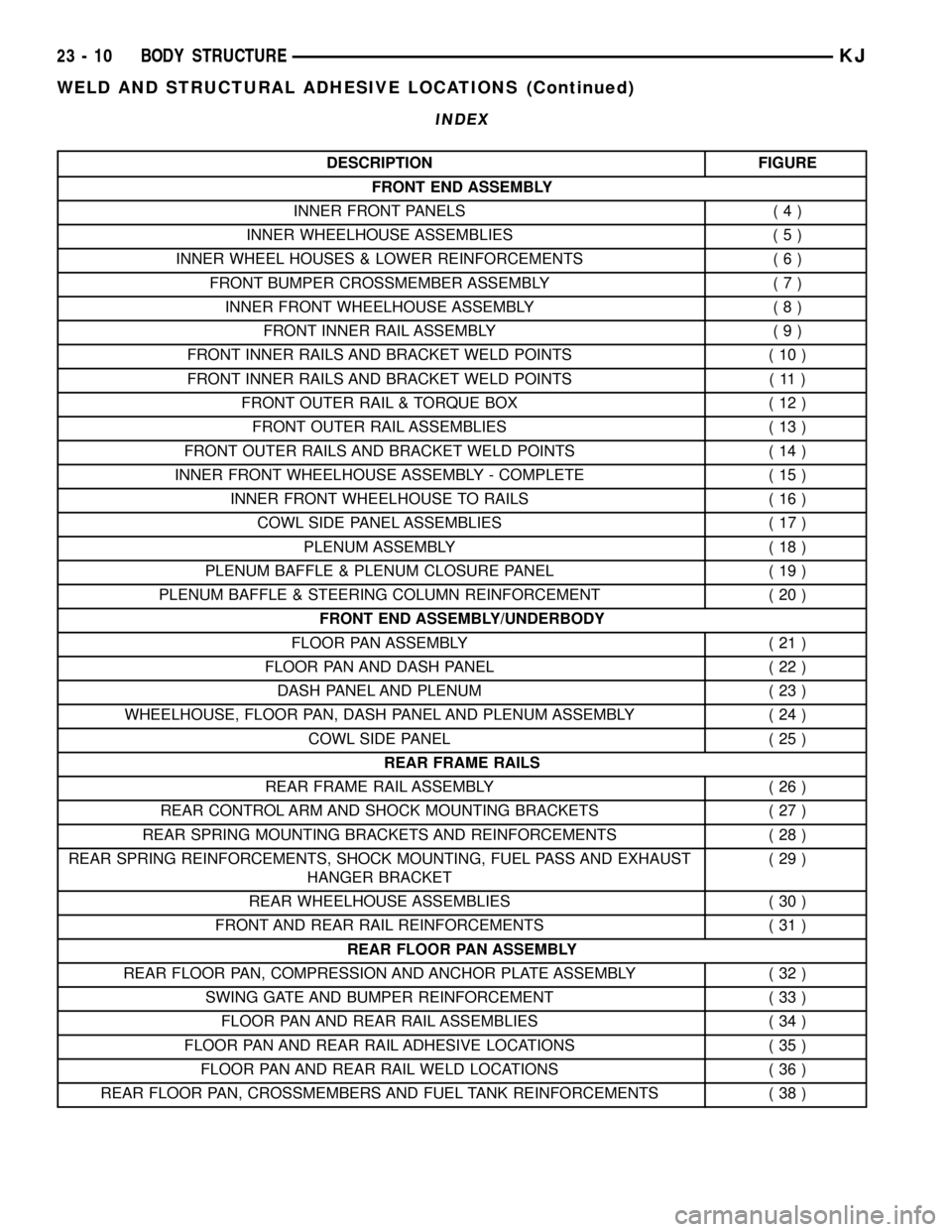
INDEX
DESCRIPTION FIGURE
FRONT END ASSEMBLY
INNER FRONT PANELS ( 4 )
INNER WHEELHOUSE ASSEMBLIES ( 5 )
INNER WHEEL HOUSES & LOWER REINFORCEMENTS ( 6 )
FRONT BUMPER CROSSMEMBER ASSEMBLY ( 7 )
INNER FRONT WHEELHOUSE ASSEMBLY ( 8 )
FRONT INNER RAIL ASSEMBLY ( 9 )
FRONT INNER RAILS AND BRACKET WELD POINTS ( 10 )
FRONT INNER RAILS AND BRACKET WELD POINTS ( 11 )
FRONT OUTER RAIL & TORQUE BOX ( 12 )
FRONT OUTER RAIL ASSEMBLIES ( 13 )
FRONT OUTER RAILS AND BRACKET WELD POINTS ( 14 )
INNER FRONT WHEELHOUSE ASSEMBLY - COMPLETE ( 15 )
INNER FRONT WHEELHOUSE TO RAILS ( 16 )
COWL SIDE PANEL ASSEMBLIES ( 17 )
PLENUM ASSEMBLY ( 18 )
PLENUM BAFFLE & PLENUM CLOSURE PANEL ( 19 )
PLENUM BAFFLE & STEERING COLUMN REINFORCEMENT ( 20 )
FRONT END ASSEMBLY/UNDERBODY
FLOOR PAN ASSEMBLY ( 21 )
FLOOR PAN AND DASH PANEL ( 22 )
DASH PANEL AND PLENUM ( 23 )
WHEELHOUSE, FLOOR PAN, DASH PANEL AND PLENUM ASSEMBLY ( 24 )
COWL SIDE PANEL ( 25 )
REAR FRAME RAILS
REAR FRAME RAIL ASSEMBLY ( 26 )
REAR CONTROL ARM AND SHOCK MOUNTING BRACKETS ( 27 )
REAR SPRING MOUNTING BRACKETS AND REINFORCEMENTS ( 28 )
REAR SPRING REINFORCEMENTS, SHOCK MOUNTING, FUEL PASS AND EXHAUST
HANGER BRACKET(29)
REAR WHEELHOUSE ASSEMBLIES ( 30 )
FRONT AND REAR RAIL REINFORCEMENTS ( 31 )
REAR FLOOR PAN ASSEMBLY
REAR FLOOR PAN, COMPRESSION AND ANCHOR PLATE ASSEMBLY ( 32 )
SWING GATE AND BUMPER REINFORCEMENT ( 33 )
FLOOR PAN AND REAR RAIL ASSEMBLIES ( 34 )
FLOOR PAN AND REAR RAIL ADHESIVE LOCATIONS ( 35 )
FLOOR PAN AND REAR RAIL WELD LOCATIONS ( 36 )
REAR FLOOR PAN, CROSSMEMBERS AND FUEL TANK REINFORCEMENTS ( 38 )
23 - 10 BODY STRUCTUREKJ
WELD AND STRUCTURAL ADHESIVE LOCATIONS (Continued)
Page 1503 of 1803

Fig. 29 REAR SPRING, SHOCK, FUEL PASS AND EXHAUST BRACKETS
23 - 38 BODY STRUCTUREKJ
WELD AND STRUCTURAL ADHESIVE LOCATIONS (Continued)
Page 1691 of 1803

In addition, the flexible hose refrigerant lines should
be routed so they are at least 80 millimeters (3
inches) from an exhaust manifold.
WARNING
SERVICE WARNINGS
WARNING: THE AIR CONDITIONING SYSTEM CON-
TAINS REFRIGERANT UNDER HIGH PRESSURE.
SEVERE PERSONAL INJURY MAY RESULT FROM
IMPROPER SERVICE PROCEDURES. REPAIRS
SHOULD ONLY BE PERFORMED BY QUALIFIED SER-
VICE PERSONNEL.
AVOID BREATHING THE REFRIGERANT AND REFRIG-
ERANT OIL VAPOR OR MIST. EXPOSURE MAY IRRI-
TATE THE EYES, NOSE, AND/OR THROAT. WEAR EYE
PROTECTION WHEN SERVICING THE AIR CONDITION-
ING REFRIGERANT SYSTEM. SERIOUS EYE INJURY
CAN RESULT FROM DIRECT CONTACT WITH THE
REFRIGERANT. IF EYE CONTACT OCCURS, SEEK
MEDICAL ATTENTION IMMEDIATELY.
DO NOT EXPOSE THE REFRIGERANT TO OPEN
FLAME. POISONOUS GAS IS CREATED WHEN
REFRIGERANT IS BURNED. AN ELECTRONIC LEAK
DETECTOR IS RECOMMENDED.
IF ACCIDENTAL SYSTEM DISCHARGE OCCURS, VEN-
TILATE THE WORK AREA BEFORE RESUMING SER-
VICE. LARGE AMOUNTS OF REFRIGERANT
RELEASED IN A CLOSED WORK AREA WILL DIS-
PLACE THE OXYGEN AND CAUSE SUFFOCATION.
THE EVAPORATION RATE OF R-134a REFRIGERANT
AT AVERAGE TEMPERATURE AND ALTITUDE IS
EXTREMELY HIGH. AS A RESULT, ANYTHING THAT
COMES IN CONTACT WITH THE REFRIGERANT WILL
FREEZE. ALWAYS PROTECT THE SKIN OR DELICATE
OBJECTS FROM DIRECT CONTACT WITH THE
REFRIGERANT.
THE R-134a SERVICE EQUIPMENT OR THE VEHICLE
REFRIGERANT SYSTEM SHOULD NOT BE PRESSURE
TESTED OR LEAK TESTED WITH COMPRESSED AIR.
SOME MIXTURES OF AIR AND R-134a HAVE BEEN
SHOWN TO BE COMBUSTIBLE AT ELEVATED PRES-
SURES. THESE MIXTURES ARE POTENTIALLY DAN-
GEROUS, AND MAY RESULT IN FIRE OR EXPLOSION
CAUSING INJURY OR PROPERTY DAMAGE.
CAUTION
SERVICE CAUTIONS
CAUTION: Liquid refrigerant is corrosive to metal sur-
faces. Follow the operating instructions supplied with
the service equipment being used.Never add R-12 to a refrigerant system designed to
use R-134a. Damage to the system will result.
R-12 refrigerant oil must not be mixed with R-134a
refrigerant oil. They are not compatible.
Do not use R-12 equipment or parts on the R-134a
system. Damage to the system will result.
Do not overcharge the refrigerant system. This will
cause excessive compressor head pressure and can
cause noise and system failure.
Recover the refrigerant before opening any fitting or
connection. Open the fittings with caution, even after
the system has been discharged. Never open or
loosen a connection before recovering the refrigerant.
Do not remove the secondary retention clip from any
spring-lock coupler connection while the refrigerant
system is under pressure. Recover the refrigerant
before removing the secondary retention clip. Open
the fittings with caution, even after the system has
been discharged. Never open or loosen a connection
before recovering the refrigerant.
The refrigerant system must always be evacuated
before charging.
Do not open the refrigerant system or uncap a
replacement component until you are ready to service
the system. This will prevent contamination in the sys-
tem.
Before disconnecting a component, clean the outside
of the fittings thoroughly to prevent contamination
from entering the refrigerant system.
Immediately after disconnecting a component from the
refrigerant system, seal the open fittings with a cap or
plug.
Before connecting an open refrigerant fitting, always
install a new seal or gasket. Coat the fitting and seal
with clean refrigerant oil before connecting.
Do not remove the sealing caps from a replacement
component until it is to be installed.
When installing a refrigerant line, avoid sharp bends
that may restrict refrigerant flow. Position the refriger-
ant lines away from exhaust system components or
any sharp edges, which may damage the line.
Tighten refrigerant fittings only to the specified torque.
The aluminum fittings used in the refrigerant system
will not tolerate overtightening.
When disconnecting a refrigerant fitting, use a wrench
on both halves of the fitting. This will prevent twisting
of the refrigerant lines or tubes.
Refrigerant oil will absorb moisture from the atmo-
sphere if left uncapped. Do not open a container of
refrigerant oil until you are ready to use it. Replace the
cap on the oil container immediately after using. Store
refrigerant oil only in a clean, airtight, and moisture-
free container.
Keep service tools and the work area clean. Contami-
nation of the refrigerant system through careless work
habits must be avoided.
KJPLUMBING 24 - 39
PLUMBING (Continued)
Page 1692 of 1803

CAUTION - REFRIGERANT HOSES/LINES/
TUBES PRECAUTIONS
Kinks or sharp bends in the refrigerant plumbing will
reduce the capacity of the entire system. High pressures
are produced in the system when it is operating.
Extreme care must be exercised to make sure that all
refrigerant system connections are pressure tight.
A good rule for the flexible hose refrigerant lines is
to keep the radius of all bends at least ten times the
diameter of the hose. Sharp bends will reduce the
flow of refrigerant. The flexible hose lines should be
routed so they are at least 80 millimeters (3 inches)
from the exhaust manifold. It is a good practice to
inspect all flexible refrigerant system hose lines at
least once a year to make sure they are in good con-
dition and properly routed.
There are two types of refrigerant fittings:
²
All fittings with O-rings need to be coated with
refrigerant oil before installation. Use only O-rings that
are the correct size and approved for use with R-134a
refrigerant. Failure to do so may result in a leak.
²Unified plumbing connections with gaskets can-
not be serviced with O-rings. The gaskets are not
reusable and new gaskets do not require lubrication
before installing.
Using the proper tools when making a refrigerant
plumbing connection is very important. Improper
tools or improper use of the tools can damage the
refrigerant fittings. Always use two wrenches when
loosening or tightening tube fittings. Use one wrench
to hold one side of the connection stationary, while
loosening or tightening the other side of the connec-
tion with a second wrench.
The refrigerant must be recovered completely from
the system before opening any fitting or connection.
Open the fittings with caution, even after the refrig-
erant has been recovered. If any pressure is noticed
as a fitting is loosened, tighten the fitting and
recover the refrigerant from the system again.
Do not discharge refrigerant into the atmosphere.
Use an R-134a refrigerant recovery/recycling device
that meets SAE Standard J2210.
The refrigerant system will remain chemically sta-
ble as long as pure, moisture-free R-134a refrigerant
and refrigerant oil is used. Dirt, moisture, or air can
upset this chemical stability. Operational troubles or
serious damage can occur if foreign material is
present in the refrigerant system.
When it is necessary to open the refrigerant sys-
tem, have everything needed to service the system
ready. The refrigerant system should not be left open
to the atmosphere any longer than necessary. Cap or
plug all lines and fittings as soon as they are opened
to prevent the entrance of dirt and moisture. All lines
and components in parts stock should be capped or
sealed until they are to be installed.All tools, including the refrigerant recycling equip-
ment, the manifold gauge set, and test hoses should
be kept clean and dry. All tools and equipment must
be designed for R-134a refrigerant.
STANDARD PROCEDURE
STANDARD PROCEDURE - REFRIGERANT
SYSTEM SERVICE EQUIPMENT
WARNING: REVIEW THE WARNINGS AND CAU-
TIONS IN THE FRONT OF THIS SECTION BEFORE
PERFORMING THE FOLLOWING OPERATION.
(Refer to 24 - HEATING & AIR CONDITIONING/
PLUMBING - WARNING) (Refer to 24 - HEATING &
AIR CONDITIONING/PLUMBING - CAUTION)
When servicing the air conditioning system, a
R-134a refrigerant recovery/recycling/charging sta-
tion that meets SAE Standard J2210 must be used.
Contact an automotive service equipment supplier for
refrigerant recovery/recycling/charging equipment.
Refer to the operating instructions supplied by the
equipment manufacturer for proper care and use of
this equipment.
A manifold gauge set may be needed with some
recovery/recycling/charging equipment (Fig. 1). The
service hoses on the gauge set being used should
have manual (turn wheel), or automatic back-flow
valves at the service port connector ends. This will
prevent refrigerant from being released into the
atmosphere.
MANIFOLD GAUGE SET CONNECTIONS
CAUTION: Do not use an R-12 manifold gauge set
on an R-134a system. The refrigerants are not com-
patible and system damage will result.
LOW PRESSURE GAUGE HOSE The low pressure
hose (Blue with Black stripe) attaches to the suction
service port. This port is located on the suction line
between the accumulator outlet and the compressor.
HIGH PRESSURE GAUGE HOSE The high pres-
sure hose (Red with Black stripe) attaches to the dis-
charge service port. This port is located on the
discharge line between the compressor and the con-
denser inlet.
RECOVERY/RECYCLING/EVACUATION/CHARG-
ING HOSE The center manifold hose (Yellow, or
White, with Black stripe) is used to recover, evacu-
ate, and charge the refrigerant system. When the low
or high pressure valves on the manifold gauge set
are opened, the refrigerant in the system will escape
through this hose.
24 - 40 PLUMBINGKJ
PLUMBING (Continued)
Page 1723 of 1803

DESCRIPTION - TASK MANAGER
The PCM is responsible for efficiently coordinating
the operation of all the emissions-related compo-
nents. The PCM is also responsible for determining if
the diagnostic systems are operating properly. The
software designed to carry out these responsibilities
is referred to as the 'Task Manager'.
DESCRIPTION - MONITORED SYSTEMS
There are new electronic circuit monitors that
check fuel, emission, engine and ignition perfor-
mance. These monitors use information from various
sensor circuits to indicate the overall operation of the
fuel, engine, ignition and emission systems and thus
the emissions performance of the vehicle.
The fuel, engine, ignition and emission systems
monitors do not indicate a specific component prob-
lem. They do indicate that there is an implied prob-
lem within one of the systems and that a specific
problem must be diagnosed.
If any of these monitors detect a problem affecting
vehicle emissions, the Malfunction Indicator Lamp
(MIL) will be illuminated. These monitors generate
Diagnostic Trouble Codes that can be displayed with
the MIL or a scan tool.
The following is a list of the system monitors:
²Misfire Monitor
²Fuel System Monitor
²Oxygen Sensor Monitor
²Oxygen Sensor Heater Monitor
²Catalyst Monitor
²Leak Detection Pump Monitor (if equipped)
All these system monitors require two consecutive
trips with the malfunction present to set a fault.
Refer to the appropriate Powertrain Diagnos-
tics Procedures manual for diagnostic proce-
dures.
The following is an operation and description of
each system monitor:
OXYGEN SENSOR (O2S) MONITOR
Effective control of exhaust emissions is achieved
by an oxygen feedback system. The most important
element of the feedback system is the O2S. The O2S
is located in the exhaust path. Once it reaches oper-
ating temperature 300É to 350ÉC (572É to 662ÉF), the
sensor generates a voltage that is inversely propor-
tional to the amount of oxygen in the exhaust. The
information obtained by the sensor is used to calcu-
late the fuel injector pulse width. This maintains a
14.7 to 1 Air Fuel (A/F) ratio. At this mixture ratio,
the catalyst works best to remove hydrocarbons (HC),
carbon monoxide (CO) and nitrogen oxide (NOx) from
the exhaust.The O2S is also the main sensing element for the
Catalyst and Fuel Monitors.
The O2S can fail in any or all of the following
manners:
²slow response rate
²reduced output voltage
²dynamic shift
²shorted or open circuits
Response rate is the time required for the sensor to
switch from lean to rich once it is exposed to a richer
than optimum A/F mixture or vice versa. As the sen-
sor starts malfunctioning, it could take longer to
detect the changes in the oxygen content of the
exhaust gas.
The output voltage of the O2S ranges from 0 to 1
volt. A good sensor can easily generate any output
voltage in this range as it is exposed to different con-
centrations of oxygen. To detect a shift in the A/F
mixture (lean or rich), the output voltage has to
change beyond a threshold value. A malfunctioning
sensor could have difficulty changing beyond the
threshold value.
OXYGEN SENSOR HEATER MONITOR
If there is an oxygen sensor (O2S) shorted to volt-
age DTC, as well as a O2S heater DTC, the O2S
fault MUST be repaired first. Before checking the
O2S fault, verify that the heater circuit is operating
correctly.
Effective control of exhaust emissions is achieved
by an oxygen feedback system. The most important
element of the feedback system is the O2S. The O2S
is located in the exhaust path. Once it reaches oper-
ating temperature 300É to 350ÉC (572 É to 662ÉF), the
sensor generates a voltage that is inversely propor-
tional to the amount of oxygen in the exhaust. The
information obtained by the sensor is used to calcu-
late the fuel injector pulse width. This maintains a
14.7 to 1 Air Fuel (A/F) ratio. At this mixture ratio,
the catalyst works best to remove hydrocarbons (HC),
carbon monoxide (CO) and nitrogen oxide (NOx) from
the exhaust.
The voltage readings taken from the O2S sensor
are very temperature sensitive. The readings are not
accurate below 300ÉC. Heating of the O2S sensor is
done to allow the engine controller to shift to closed
loop control as soon as possible. The heating element
used to heat the O2S sensor must be tested to ensure
that it is heating the sensor properly.
The O2S sensor circuit is monitored for a drop in
voltage. The sensor output is used to test the heater
by isolating the effect of the heater element on the
O2S sensor output voltage from the other effects.
KJEMISSIONS CONTROL 25 - 17
EMISSIONS CONTROL (Continued)
Page 1725 of 1803

Normal vehicle miles or engine misfire can cause a
catalyst to decay. This can increase vehicle emissions
and deteriorate engine performance, driveability and
fuel economy.
The catalyst monitor uses dual oxygen sensors
(O2S's) to monitor the efficiency of the converter. The
dual O2S's sensor strategy is based on the fact that
as a catalyst deteriorates, its oxygen storage capacity
and its efficiency are both reduced. By monitoring
the oxygen storage capacity of a catalyst, its effi-
ciency can be indirectly calculated. The upstream
O2S is used to detect the amount of oxygen in the
exhaust gas before the gas enters the catalytic con-
verter. The PCM calculates the A/F mixture from the
output of the O2S. A low voltage indicates high oxy-
gen content (lean mixture). A high voltage indicates a
low content of oxygen (rich mixture).
When the upstream O2S detects a lean condition,
there is an abundance of oxygen in the exhaust gas.
A functioning converter would store this oxygen so it
can use it for the oxidation of HC and CO. As the
converter absorbs the oxygen, there will be a lack of
oxygen downstream of the converter. The output of
the downstream O2S will indicate limited activity in
this condition.
As the converter loses the ability to store oxygen,
the condition can be detected from the behavior of
the downstream O2S. When the efficiency drops, no
chemical reaction takes place. This means the con-
centration of oxygen will be the same downstream as
upstream. The output voltage of the downstream
O2S copies the voltage of the upstream sensor. The
only difference is a time lag (seen by the PCM)
between the switching of the O2S's.
To monitor the system, the number of lean-to-rich
switches of upstream and downstream O2S's is
counted. The ratio of downstream switches to
upstream switches is used to determine whether the
catalyst is operating properly. An effective catalyst
will have fewer downstream switches than it has
upstream switches i.e., a ratio closer to zero. For a
totally ineffective catalyst, this ratio will be one-to-
one, indicating that no oxidation occurs in the device.
The system must be monitored so that when cata-
lyst efficiency deteriorates and exhaust emissions
increase to over the legal limit, the MIL will be illu-
minated.
DESCRIPTION - TRIP DEFINITION
The term ªTripº has different meanings depending
on what the circumstances are. If the MIL (Malfunc-
tion Indicator Lamp) is OFF, a Trip is defined as
when the Oxygen Sensor Monitor and the Catalyst
Monitor have been completed in the same drive cycle.
When any Emission DTC is set, the MIL on the
dash is turned ON. When the MIL is ON, it takes 3good trips to turn the MIL OFF. In this case, it
depends on what type of DTC is set to know what a
ªTripº is.
For the Fuel Monitor or Mis-Fire Monitor (contin-
uous monitor), the vehicle must be operated in the
ªSimilar Condition Windowº for a specified amount of
time to be considered a Good Trip.
If a Non-Contiuous OBDII Monitor fails twice in a
row and turns ON the MIL, re-running that monitor
which previously failed, on the next start-up and
passing the monitor, is considered to be a Good Trip.
These will include the following:
²Oxygen Sensor
²Catalyst Monitor
²Purge Flow Monitor
²Leak Detection Pump Monitor (if equipped)
²EGR Monitor (if equipped)
²Oxygen Sensor Heater Monitor
If any other Emission DTC is set (not an OBDII
Monitor), a Good Trip is considered to be when the
Oxygen Sensor Monitor and Catalyst Monitor have
been completed; or 2 Minutes of engine run time if
the Oxygen Sensor Monitor or Catalyst Monitor have
been stopped from running.
It can take up to 2 Failures in a row to turn on the
MIL. After the MIL is ON, it takes 3 Good Trips to
turn the MIL OFF. After the MIL is OFF, the PCM
will self-erase the DTC after 40 Warm-up cycles. A
Warm-up cycle is counted when the ECT (Engine
Coolant Temperature Sensor) has crossed 160ÉF and
has risen by at least 40ÉF since the engine has been
started.
DESCRIPTION - COMPONENT MONITORS
There are several components that will affect vehi-
cle emissions if they malfunction. If one of these com-
ponents malfunctions the Malfunction Indicator
Lamp (MIL) will illuminate.
Some of the component monitors are checking for
proper operation of the part. Electrically operated
components now have input (rationality) and output
(functionality) checks. Previously, a component like
the Throttle Position sensor (TPS) was checked by
the PCM for an open or shorted circuit. If one of
these conditions occurred, a DTC was set. Now there
is a check to ensure that the component is working.
This is done by watching for a TPS indication of a
greater or lesser throttle opening than MAP and
engine rpm indicate. In the case of the TPS, if engine
vacuum is high and engine rpm is 1600 or greater
and the TPS indicates a large throttle opening, a
DTC will be set. The same applies to low vacuum if
the TPS indicates a small throttle opening.
All open/short circuit checks or any component that
has an associated limp in will set a fault after 1 trip
with the malfunction present. Components without
KJEMISSIONS CONTROL 25 - 19
EMISSIONS CONTROL (Continued)
Page 1726 of 1803

an associated limp in will take two trips to illumi-
nate the MIL.
Refer to the Diagnostic Trouble Codes Description
Charts in this section and the appropriate Power-
train Diagnostic Procedure Manual for diagnostic
procedures.
DESCRIPTION - NON-MONITORED CIRCUITS
The PCM does not monitor the following circuits,
systems and conditions that could have malfunctions
causing driveability problems. The PCM might not
store diagnostic trouble codes for these conditions.
However, problems with these systems may cause the
PCM to store diagnostic trouble codes for other sys-
tems or components. For example, a fuel pressure
problem will not register a fault directly, but could
cause a rich/lean condition or misfire. This could
cause the PCM to store an oxygen sensor or misfire
diagnostic trouble code
FUEL PRESSURE
The fuel pressure regulator controls fuel system
pressure. The PCM cannot detect a clogged fuel
pump inlet filter, clogged in-line fuel filter, or a
pinched fuel supply or return line. However, these
could result in a rich or lean condition causing the
PCM to store an oxygen sensor or fuel system diag-
nostic trouble code.
SECONDARY IGNITION CIRCUIT
The PCM cannot detect an inoperative ignition coil,
fouled or worn spark plugs, ignition cross firing, or
open spark plug cables.
CYLINDER COMPRESSION
The PCM cannot detect uneven, low, or high engine
cylinder compression.
EXHAUST SYSTEM
The PCM cannot detect a plugged, restricted or
leaking exhaust system, although it may set a fuel
system fault.
FUEL INJECTOR MECHANICAL MALFUNCTIONS
The PCM cannot determine if a fuel injector is
clogged, the needle is sticking or if the wrong injectoris installed. However, these could result in a rich or
lean condition causing the PCM to store a diagnostic
trouble code for either misfire, an oxygen sensor, or
the fuel system.
EXCESSIVE OIL CONSUMPTION
Although the PCM monitors engine exhaust oxygen
content when the system is in closed loop, it cannot
determine excessive oil consumption.
THROTTLE BODY AIRFLOW
The PCM cannot detect a clogged or restricted air
cleaner inlet or filter element.
VACUUM ASSIST
The PCM cannot detect leaks or restrictions in the
vacuum circuits of vacuum assisted engine control
system devices. However, these could cause the PCM
to store a MAP sensor diagnostic trouble code and
cause a high idle condition.
PCM SYSTEM GROUND
The PCM cannot determine a poor system ground.
However, one or more diagnostic trouble codes may
be generated as a result of this condition. The mod-
ule should be mounted to the body at all times, also
during diagnostic.
PCM CONNECTOR ENGAGEMENT
The PCM may not be able to determine spread or
damaged connector pins. However, it might store
diagnostic trouble codes as a result of spread connec-
tor pins.
DESCRIPTION - HIGH AND LOW LIMITS
The PCM compares input signal voltages from each
input device with established high and low limits for
the device. If the input voltage is not within limits
and other criteria are met, the PCM stores a diagnos-
tic trouble code in memory. Other diagnostic trouble
code criteria might include engine RPM limits or
input voltages from other sensors or switches that
must be present before verifying a diagnostic trouble
code condition.
DESCRIPTION - LOAD VALUE
ENGINE IDLE/NEUTRAL 2500 RPM/NEUTRAL
All Engines 2% to 8% of Maximum Load 9% to 17% of Maximum Load
25 - 20 EMISSIONS CONTROLKJ
EMISSIONS CONTROL (Continued)
Page 1748 of 1803

ENGINE - DESCRIPTION, COOLING
SYSTEM 3.7L.........................7-1
ENGINE - DESCRIPTION, COOLING
SYSTEM ROUTING 3.7L.................7-2
ENGINE - INSTALLATION, 3.7L . . . 7-17,7-18,7-22
ENGINE - REMOVAL, 3.7L...........7-17,7-21
ENGINE - STANDARD PROCEDURE,
DRAINING COOLING SYSTEM 3.7L........7-12
ENGINE - STANDARD PROCEDURE,
REFILLING COOLING SYSTEM 3.7L.......7-12
ENGINE BLOCK - CLEANING.............9-39
ENGINE BLOCK - DESCRIPTION..........9-39
ENGINE BLOCK - INSPECTION...........9-40
ENGINE COOLANT - DESCRIPTION.........0-3
ENGINE COOLANT TEMPERATURE
SENSOR - DESCRIPTION...............7-19
ENGINE COOLANT TEMPERATURE
SENSOR - INSTALLATION...............7-21
ENGINE COOLANT TEMPERATURE
SENSOR - OPERATION.................7-20
ENGINE COOLANT TEMPERATURE
SENSOR - REMOVAL...................7-20
ENGINE COOLANT THERMOSTAT -
OPERATION..........................7-21
ENGINE CORE AND OIL GALLERY PLUGS
- STANDARD PROCEDURE..............9-10
ENGINE CRADLE CROSSMEMBER -
INSTALLATION........................13-6
ENGINE CRADLE CROSSMEMBER -
REMOVAL...........................13-6
ENGINE DIAGNOSIS - INTRODUCTION -
DIAGNOSIS AND TESTING.................9-4
ENGINE DIAGNOSIS - LUBRICATION -
DIAGNOSIS AND TESTING...............9-7
ENGINE DIAGNOSIS - MECHANICAL -
DIAGNOSIS AND TESTING...............9-6
ENGINE DIAGNOSIS - PERFORMANCE -
DIAGNOSIS AND TESTING...............9-4
ENGINE FIRING ORDER, 2.4L 4-
CYLINDER...........................8I-2
ENGINE FIRING ORDER, 3.7L V-6.........8I-2
ENGINE GASKET SURFACE
PREPARATION - STANDARD
PROCEDURE..........................9-9
ENGINE OIL - STANDARD PROCEDURE....9-61
ENGINE OIL LEAK - DIAGNOSIS AND
TESTING............................9-60
ENGINE OIL PRESSURE - DIAGNOSIS
AND TESTING........................9-60
ENGINE, SPECIAL TOOLS - 3.7L..........9-15
ENGINE, SPECIFICATIONS - 3.7L.........9-12
ENGINE TEMPERATURE GAUGE -
DESCRIPTION.......................8J-18
ENGINE TEMPERATURE GAUGE -
OPERATION.........................8J-18
ENGINES - GENERATOR RATINGS, GAS . . . 8F-23
ENTRY MODULE - DESCRIPTION,
REMOTE KEYLESS....................8N-7
ENTRY MODULE - DIAGNOSIS AND
TESTING, REMOTE KEYLESS............8N-7
ENTRY MODULE - INSTALLATION,
REMOTE KEYLESS....................8N-7
ENTRY MODULE - OPERATION, REMOTE
KEYLESS............................8N-7
ENTRY MODULE - REMOVAL, REMOTE
KEYLESS............................8N-7
ENTRY TRANSMITTER - DIAGNOSIS AND
TESTING, REMOTE KEYLESS............8N-8
ENTRY TRANSMITTER -
SPECIFICATIONS, REMOTE KEYLESS......8N-9
EQUIPMENT - STANDARD PROCEDURE,
REFRIGERANT SYSTEM SERVICE........24-40
ERASING TRANSMITTER CODES -
STANDARD PROCEDURE...............8M-8
EVACUATE - STANDARD PROCEDURE,
REFRIGERANT SYSTEM...............24-41
EVAPORATION CONTROL SYSTEM -
DESCRIPTION.......................25-24
EVAPORATOR - DESCRIPTION, A/C.......24-49
EVAPORATOR - INSTALLATION, A/C......24-49
EVAPORATOR - OPERATION, A/C........24-49
EVAPORATOR - REMOVAL, A/C..........24-49
EVAP/PURGE SOLENOID - DESCRIPTION . . 25-27
EVAP/PURGE SOLENOID - INSTALLATION
. 25-27
EVAP/PURGE SOLENOID - OPERATION
....25-27
EVAP/PURGE SOLENOID - REMOVAL
.....25-27
EXCEPT DIESEL - TORQUE
.............8F-23
EXHAUST MANIFOLD - DESCRIPTION
.....9-69EXHAUST MANIFOLD - INSTALLATION.....9-70
EXHAUST MANIFOLD - REMOVAL.........9-69
EXHAUST SYSTEM - DESCRIPTION.......11-1
EXHAUST SYSTEM - DIAGNOSIS AND
TESTING............................11-2
EXTENSION HOUSING BUSHING -
NV3550 - INSTALLATION...............21-74
EXTENSION HOUSING BUSHING -
NV3550 - REMOVAL..................21-73
EXTENSION HOUSING SEAL - NV1500 -
INSTALLATION.......................21-32
EXTENSION HOUSING SEAL - NV1500 -
REMOVAL..........................21-32
EXTENSION HOUSING SEAL - NV3550 -
INSTALLATION.......................21-74
EXTENSION HOUSING SEAL - NV3550 -
REMOVAL..........................21-74
EXTERIOR - DESCRIPTION, LAMPS/
LIGHTING...........................8L-2
EXTERIOR - DIAGNOSIS AND TESTING,
LAMPS/LIGHTING.....................8L-7
EXTERIOR - OPERATION, LAMPS/
LIGHTING...........................8L-5
EXTERIOR - SPECIFICATIONS,
LAMPS/LIGHTING....................8L-15
EXTERIOR HANDLE - INSTALLATION....23-123,
23-130,23-136
EXTERIOR HANDLE - REMOVAL . 23-123,23-130,
23-136
EXTERIOR NAME PLATES -
INSTALLATION......................23-141
EXTERIOR NAME PLATES - REMOVAL . . . 23-140
FAN - ELECTRIC - DESCRIPTION,
RADIATOR...........................7-26
FAN - ELECTRIC - INSTALLATION,
RADIATOR...........................7-27
FAN - ELECTRIC - OPERATION,
RADIATOR...........................7-26
FAN - ELECTRIC - REMOVAL, RADIATOR . . . 7-26
FAN - VISCOUS - CLEANING, RADIATOR . . . 7-29
FAN - VISCOUS - DESCRIPTION,
RADIATOR...........................7-27
FAN - VISCOUS - INSPECTION,
RADIATOR...........................7-29
FAN - VISCOUS - INSTALLATION,
RADIATOR...........................7-29
FAN - VISCOUS - OPERATION,
RADIATOR...........................7-27
FAN - VISCOUS - REMOVAL, RADIATOR....7-28
FAN DRIVE - DIAGNOSIS AND TESTING,
VISCOUS............................7-28
FASCIA - INSTALLATION, FRONT.........13-2
FASCIA - INSTALLATION, REAR..........13-2
FASCIA - REMOVAL, FRONT.............13-1
FASCIA - REMOVAL, REAR..............13-2
FASCIA SUPPORT - INSTALLATION,
REAR...............................13-3
FASCIA SUPPORT - REMOVAL, REAR......13-3
FASTENER IDENTIFICATION -
DESCRIPTION......................Intro.-1
FENDER - INSTALLATION, FRONT.......23-141
FENDER - REMOVAL, FRONT..........23-141
FILL - STANDARD PROCEDURE, FLUID
DRAIN......................21-208,21-246
FILL - STANDARD PROCEDURE,
TRANSMISSION.....................21-128
FILL DOOR/HOUSING - INSTALLATION,
FUEL.............................23-141
FILL DOOR/HOUSING - REMOVAL, FUEL . 23-141
FILL/CHECK LOCATIONS - DESCRIPTION,
FLUID...............................0-4
FILLER CAP - DESCRIPTION, FUEL.......25-27
FILLER CAP - OPERATION, FUEL........25-27
FILTER - DESCRIPTION, FUEL............14-7
FILTER - INSTALLATION, FUEL...........14-8
FILTER - INSTALLATION, INLET..........14-28
FILTER - INSTALLATION, OIL............9-63
FILTER - REMOVAL, FUEL...............14-7
FILTER - REMOVAL, INLET.............14-28
FILTER - REMOVAL, OIL
................9-63
FILTER REPLACEMENT - STANDARD
PROCEDURE, FLUID
.................21-126
FINESSE SANDING/BUFFING &
POLISHING - DESCRIPTION
...........23-163
FINISH - DESCRIPTION, BASE
COAT/CLEAR COAT
..................23-162
FIRING ORDER, 2.4L 4-CYLINDER -
ENGINE
..............................8I-2FIRING ORDER, 3.7L V-6 - ENGINE........8I-2
FITTING - CONNECTING ROD BEARING....9-49
FITTING - DESCRIPTION, QUICK
CONNECT...........................14-10
FITTING - MAIN BEARING...............9-45
FITTING - STANDARD PROCEDURE,
CONNECTING ROD BEARING............9-40
FITTING - STANDARD PROCEDURE,
PISTON.............................9-50
FITTING - STANDARD PROCEDURE,
PISTON RING........................9-52
FITTINGS - STANDARD PROCEDURE,
QUICK-CONNECT.....................14-10
FLARE MOLDINGS - INSTALLATION,
FRONT WHEEL OPENING.............23-145
FLARE MOLDINGS - INSTALLATION,
REAR WHEEL OPENING..............23-145
FLARE MOLDINGS - REMOVAL, FRONT
WHEEL OPENING...................23-145
FLARE MOLDINGS - REMOVAL, REAR
WHEEL OPENING...................23-145
FLARING - STANDARD PROCEDURE,
DOUBLE INVERTED.....................5-8
FLARING - STANDARD PROCEDURE, ISO....5-8
FLASHER - DESCRIPTION, COMBINATION . 8L-19
FLASHER - OPERATION, COMBINATION . . . 8L-19
FLEX PLATE - INSTALLATION............9-49
FLEX PLATE - REMOVAL................9-49
FLIP-UP GLASS - INSTALLATION.......23-136
FLIP-UP GLASS - REMOVAL...........23-136
FLIP-UP GLASS AJAR SWITCH -
DESCRIPTION.......................8L-77
FLIP-UP GLASS AJAR SWITCH -
OPERATION.........................8L-77
FLIP-UP GLASS LATCH - INSTALLATION . 23-136
FLIP-UP GLASS LATCH - REMOVAL.....23-136
FLIP-UP GLASS RELEASE SWITCH -
DIAGNOSIS AND TESTING..............8N-5
FLIP-UP GLASS SUPPORT CYLINDER -
INSTALLATION......................23-139
FLIP-UP GLASS SUPPORT CYLINDER -
REMOVAL.........................23-139
FLOOR - DEFROST DOO - INSTALLATION . . 24-37
FLOOR - DEFROST DOOR - REMOVAL....24-36
FLOOR - DEFROST DOOR ACTUATOR -
INSTALLATION.......................24-25
FLOOR - DEFROST DOOR ACTUATOR -
REMOVAL..........................24-24
FLOOR CONSOLE - INSTALLATION......23-158
FLOOR CONSOLE - REMOVAL..........23-158
FLOOR CONSOLE DUCT - INSTALLATION . . 24-31
FLOOR CONSOLE DUCT - REMOVAL.....24-31
FLOOR CONSOLE LID LATCH -
INSTALLATION......................23-158
FLOOR CONSOLE LID LATCH - REMOVAL . 23-158
FLOOR DUCT - INSTALLATION..........24-32
FLOOR DUCT - REMOVAL..............24-32
FLOOR MATS - INSTALLATION, CARPETS . 23-158
FLOOR MATS - REMOVAL, CARPETS....23-158
FLOOR SHIFT BOOT - INSTALLATION,
4WD .............................23-156
FLOOR SHIFT BOOT - REMOVAL, 4WD . . . 23-156
FLOW AND PRESSURE - DIAGNOSIS
AND TESTING, POWER STEERING........19-3
FLOW MANAGEMENT VALVE -
DESCRIPTION........................14-6
FLOW MANAGEMENT VALVE -
INSTALLATION........................14-7
FLOW MANAGEMENT VALVE -
OPERATION..........................14-6
FLOW MANAGEMENT VALVE - REMOVAL . . . 14-6
FLUID - DESCRIPTION, AUTOMATIC
TRANSMISSION.......................0-2
FLUID - DIAGNOSIS AND TESTING,
CAUSES OF BURNT..................21-125
FLUID - OPERATION, AUTOMATIC
TRANSMISSION.......................0-4
FLUID AND FILTER REPLACEMENT -
STANDARD PROCEDURE..............21-126
FLUID CAPACITIES - SPECIFICATIONS......0-4
FLUID CONTAMINATION - DIAGNOSIS
AND TESTING......................21-125
FLUID CONTAMINATION - DIAGNOSIS
AND TESTING, BRAKE
..................5-26
FLUID COOLER - DESCRIPTION
.........19-20
FLUID COOLER - INSTALLATION
.........19-20
FLUID COOLER - OPERATION
...........19-20
FLUID COOLER - REMOVAL
............19-20
KJINDEX 9
Description Group-Page Description Group-Page Description Group-Page