2002 Hyundai Atos ECO mode
[x] Cancel search: ECO modePage 76 of 249
DRIVING YOUR HYUNDAI
DRIVING YOUR HYUNDAI DRIVING YOUR HYUNDAI
DRIVING YOUR HYUNDAI
DRIVING YOUR HYUNDAI
2- 13
4. To maintain engine braking efficiency andelectrical charging performance, do not use fifth gear (manual transaxle) or overdrive(automatic transaxle).
5. Always secure items in the trailer to prevent load shift while driving.
6. Check the condition and air pressure of all tires on the trailer and your car. Low tirepressure can seriously affect the handling.Also check the spare tire.
7. The vehicle/trailer combination is more af- fected by crosswind and buffeting. When being passed by a large vehicle, keep a constant speed and steer straight ahead.If there is too much wind buffeting slowdown to get out of the other vehicle's airturbulence.
8. When parking your car and trailer, especial- ly on a hill, be sure to follow all the normalprecautions. Turn your front wheel into thecurb, set the parking brake firmly, and putthe transaxle in 1st or Reverse (manual) orPark (automatic). In addition, place wheelchocks at each of the trailer's tires.
9. If the trailer has electric brakes, start your vehicle and trailer moving, and then applythe trailer brake controller by hand to besure the brakes are working. This lets youcheck your electrical connection at the sametime.
10. During your trip, check occasionally to be sure that the load is secure, and that thelights and any trailer brakes are still working.
WARNING:
WARNING: WARNING:
WARNING:
WARNING:
oo
oo
o The tongue load should never exceed;
The tongue load should never exceed; The tongue load should never exceed;
The tongue load should never exceed;
The tongue load should never exceed;
Auto: 25kg
Auto: 25kg Auto: 25kg
Auto: 25kg
Auto: 25kg
Manual : 28kg
Manual : 28kg Manual : 28kg
Manual : 28kg
Manual : 28kg
oo
oo
o Maximun permissible mass of the cou-
Maximun permissible mass of the cou- Maximun permissible mass of the cou-
Maximun permissible mass of the cou-
Maximun permissible mass of the cou-
pling device (ATOS VAN only) : 20kg
pling device (ATOS VAN only) : 20kg pling device (ATOS VAN only) : 20kg
pling device (ATOS VAN only) : 20kg
pling device (ATOS VAN only) : 20kg
oo
oo
o Improperly loading your car and trailer
Improperly loading your car and trailer Improperly loading your car and trailer
Improperly loading your car and trailer
Improperly loading your car and trailer
can seriously affect its steering and brak-
can seriously affect its steering and brak- can seriously affect its steering and brak-
can seriously affect its steering and brak-
can seriously affect its steering and brak-
ing performance causing a crash which
ing performance causing a crash which ing performance causing a crash which
ing performance causing a crash which
ing performance causing a crash which
could cause serious injury or death.
could cause serious injury or death. could cause serious injury or death.
could cause serious injury or death.
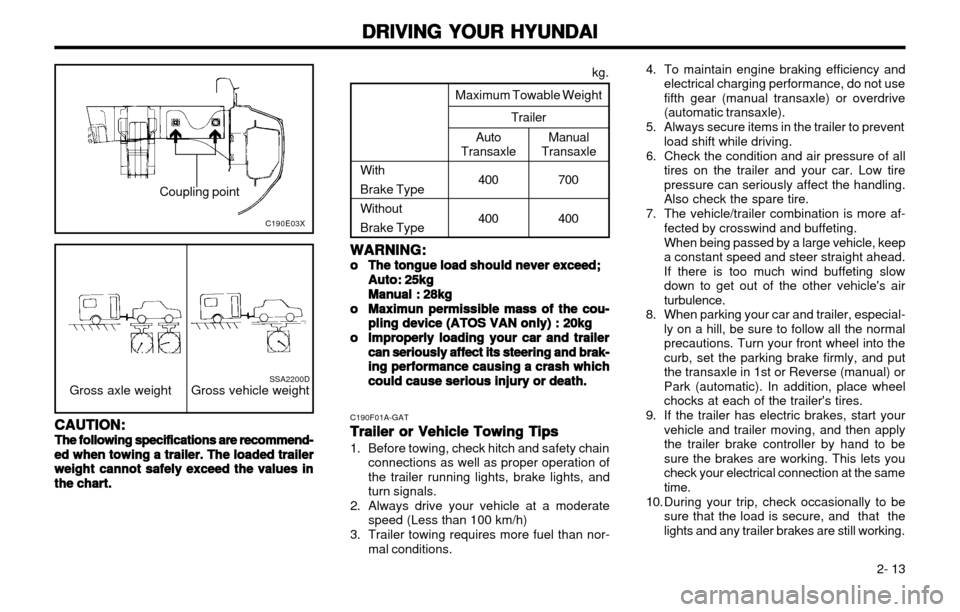
could cause serious injury or death. kg.
Maximum Towable Weight Trailer
Manual
TransaxleAuto
Transaxle
With Brake TypeWithoutBrake Type 400 400
C190F01A-GAT
Trailer or Vehicle Towing Tips
Trailer or Vehicle Towing Tips Trailer or Vehicle Towing Tips
Trailer or Vehicle Towing Tips
Trailer or Vehicle Towing Tips
1. Before towing, check hitch and safety chain
connections as well as proper operation of the trailer running lights, brake lights, andturn signals.
2. Always drive your vehicle at a moderate speed (Less than 100 km/h)
3. Trailer towing requires more fuel than nor- mal conditions.
Gross axle weight Gross vehicle weightSSA2200D
CAUTION:
CAUTION: CAUTION:
CAUTION:
CAUTION:
The following specifications are recommend-
The following specifications are recommend- The following specifications are recommend-
The following specifications are recommend-
The following specifications are recommend- ed when towing a
ed when towing a ed when towing a
ed when towing a
ed when towing a trailer. The loaded trailer
trailer. The loaded trailer trailer. The loaded trailer
trailer. The loaded trailer
trailer. The loaded trailer
weight cannot safely exceed the values in
weight cannot safely exceed the values in weight cannot safely exceed the values in
weight cannot safely exceed the values in
weight cannot safely exceed the values in
the the
the the
the chart.
chart. chart.
chart.
chart. Coupling point
C190E03X
700 400
Page 138 of 249
FEATURES OF YOUR HYUNDAI 1-1
ZB000A1-A
1. FEATURES OF
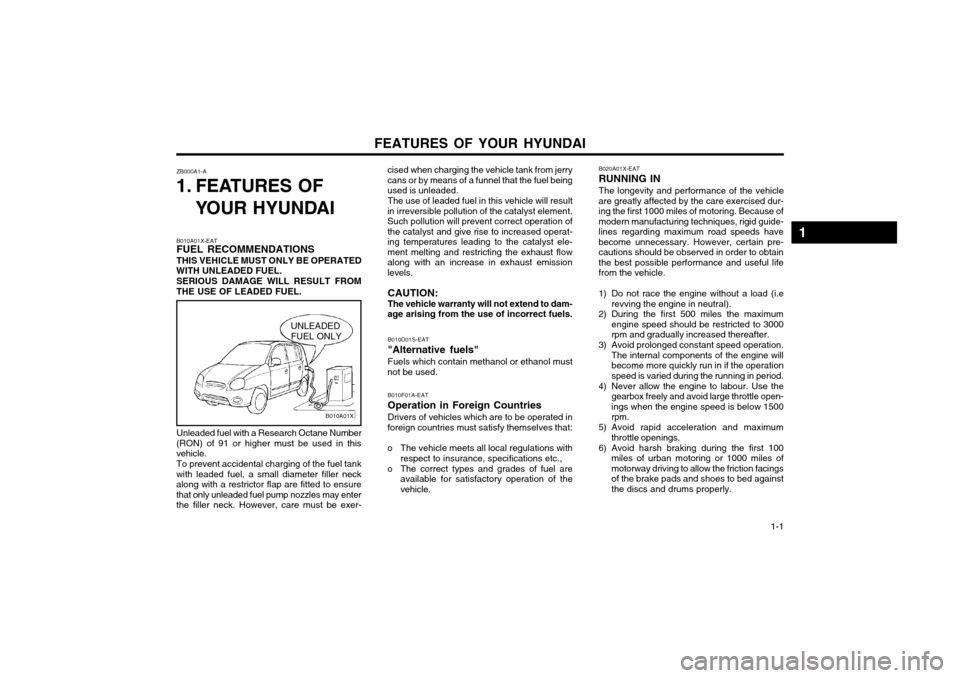
YOUR HYUNDAI cised when charging the vehicle tank from jerry cans or by means of a funnel that the fuel beingused is unleaded.
The use of leaded fuel in this vehicle will result
in irreversible pollution of the catalyst element.Such pollution will prevent correct operation ofthe catalyst and give rise to increased operat-ing temperatures leading to the catalyst ele-ment melting and restricting the exhaust flowalong with an increase in exhaust emissionlevels.
CAUTION: The vehicle warranty will not extend to dam-
age arising from the use of incorrect fuels.
Unleaded fuel with a Research Octane Number
(RON) of 91 or higher must be used in this vehicle.
To prevent accidental charging of the fuel tank
with leaded fuel, a small diameter filler neckalong with a restrictor flap are fitted to ensurethat only unleaded fuel pump nozzles may enterthe filler neck. However, care must be exer-
B010A01X
UNLEADED FUEL ONLY
B010A01X-EAT FUEL RECOMMENDATIONS THIS VEHICLE MUST ONLY BE OPERATED
WITH UNLEADED FUEL.
SERIOUS DAMAGE WILL RESULT FROM
THE USE OF LEADED FUEL. B020A01X-EAT RUNNING INThe longevity and performance of the vehicle
are greatly affected by the care exercised dur- ing the first 1000 miles of motoring. Because ofmodern manufacturing techniques, rigid guide-lines regarding maximum road speeds havebecome unnecessary. However, certain pre-cautions should be observed in order to obtainthe best possible performance and useful lifefrom the vehicle.
1) Do not race the engine without a load (i.e revving the engine in neutral).
2) During the first 500 miles the maximum engine speed should be restricted to 3000 rpm and gradually increased thereafter.
3) Avoid prolonged constant speed operation. The internal components of the engine willbecome more quickly run in if the operationspeed is varied during the running in period.
4) Never allow the engine to labour. Use the gearbox freely and avoid large throttle open-ings when the engine speed is below 1500rpm.
5) Avoid rapid acceleration and maximum throttle openings.
6) Avoid harsh braking during the first 100 miles of urban motoring or 1000 miles ofmotorway driving to allow the friction facingsof the brake pads and shoes to bed againstthe discs and drums properly.
B010D01S-EAT "Alternative fuels"Fuels which contain methanol or ethanol must
not be used.
B010F01A-EATOperation in Foreign CountriesDrivers of vehicles which are to be operated in
foreign countries must satisfy themselves that:
o The vehicle meets all local regulations with respect to insurance, specifications etc.,
o The correct types and grades of fuel are available for satisfactory operation of the vehicle.
1
Page 142 of 249
FEATURES OF YOUR HYUNDAI 1-5
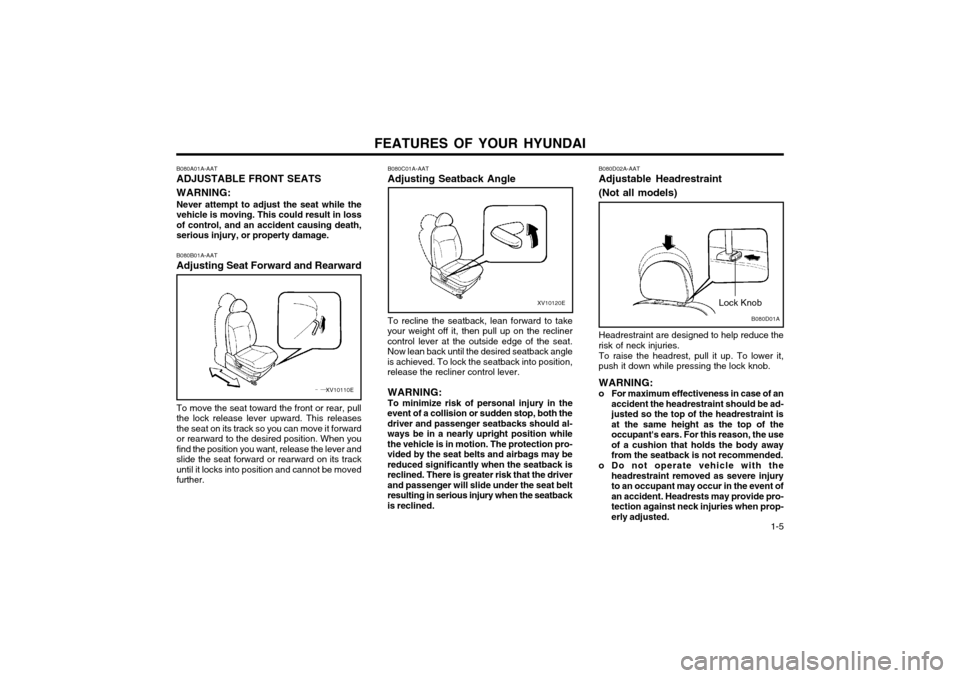
B080A01A-AAT ADJUSTABLE FRONT SEATS WARNING: Never attempt to adjust the seat while the vehicle is moving. This could result in lossof control, and an accident causing death,serious injury, or property damage. B080B01A-AAT Adjusting Seat Forward and Rearward
B080C01A-AATAdjusting Seatback Angle
XV10110E
To move the seat toward the front or rear, pull the lock release lever upward. This releasesthe seat on its track so you can move it forwardor rearward to the desired position. When youfind the position you want, release the lever andslide the seat forward or rearward on its trackuntil it locks into position and cannot be movedfurther.
XV10120E
To recline the seatback, lean forward to take
your weight off it, then pull up on the recliner control lever at the outside edge of the seat.Now lean back until the desired seatback angleis achieved. To lock the seatback into position,release the recliner control lever.
WARNING: To minimize risk of personal injury in the
event of a collision or sudden stop, both the driver and passenger seatbacks should al-ways be in a nearly upright position whilethe vehicle is in motion. The protection pro-vided by the seat belts and airbags may bereduced significantly when the seatback isreclined. There is greater risk that the driverand passenger will slide under the seat beltresulting in serious injury when the seatbackis reclined.B080D01A
Lock Knob
B080D02A-AAT Adjustable Headrestraint (Not all models) Headrestraint are designed to help reduce the
risk of neck injuries.
To raise the headrest, pull it up. To lower it,
push it down while pressing the lock knob.
WARNING:
o For maximum effectiveness in case of an accident the headrestraint should be ad- justed so the top of the headrestraint isat the same height as the top of theoccupant's ears. For this reason, the useof a cushion that holds the body awayfrom the seatback is not recommended.
o Do not operate vehicle with the headrestraint removed as severe injuryto an occupant may occur in the event ofan accident. Headrests may provide pro-tection against neck injuries when prop-erly adjusted.
Page 144 of 249
FEATURES OF YOUR HYUNDAI 1-7
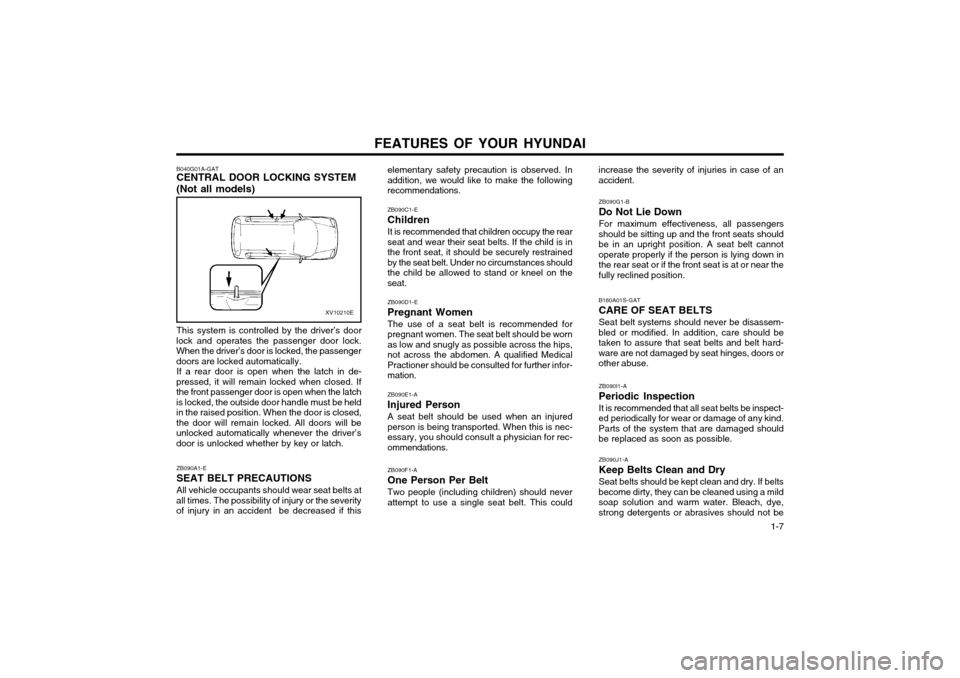
B040G01A-GAT CENTRAL DOOR LOCKING SYSTEM (Not all models)
XV10210E
This system is controlled by the driver’s door
lock and operates the passenger door lock. When the driver’s door is locked, the passengerdoors are locked automatically. If a rear door is open when the latch in de-
pressed, it will remain locked when closed. Ifthe front passenger door is open when the latchis locked, the outside door handle must be heldin the raised position. When the door is closed,the door will remain locked. All doors will beunlocked automatically whenever the driver’sdoor is unlocked whether by key or latch.
ZB090A1-E SEAT BELT PRECAUTIONSAll vehicle occupants should wear seat belts at
all times. The possibility of injury or the severity of injury in an accident be decreased if this elementary safety precaution is observed. Inaddition, we would like to make the followingrecommendations. ZB090C1-E ChildrenIt is recommended that children occupy the rear seat and wear their seat belts. If the child is inthe front seat, it should be securely restrainedby the seat belt. Under no circumstances shouldthe child be allowed to stand or kneel on theseat. ZB090D1-E Pregnant WomenThe use of a seat belt is recommended for pregnant women. The seat belt should be wornas low and snugly as possible across the hips,not across the abdomen. A qualified MedicalPractioner should be consulted for further infor-mation. ZB090E1-A Injured PersonA seat belt should be used when an injured person is being transported. When this is nec-essary, you should consult a physician for rec-ommendations. ZB090F1-A One Person Per BeltTwo people (including children) should never attempt to use a single seat belt. This could
increase the severity of injuries in case of anaccident.
ZB090G1-B Do Not Lie DownFor maximum effectiveness, all passengers
should be sitting up and the front seats should be in an upright position. A seat belt cannotoperate properly if the person is lying down inthe rear seat or if the front seat is at or near thefully reclined position.
B160A01S-GAT CARE OF SEAT BELTSSeat belt systems should never be disassem-
bled or modified. In addition, care should be taken to assure that seat belts and belt hard-
ware are not damaged by seat hinges, doors orother abuse.
ZB090I1-A Periodic InspectionIt is recommended that all seat belts be inspect-
ed periodically for wear or damage of any kind. Parts of the system that are damaged shouldbe replaced as soon as possible.
ZB090J1-A Keep Belts Clean and Dry Seat belts should be kept clean and dry. If belts
become dirty, they can be cleaned using a mild soap solution and warm water. Bleach, dye,strong detergents or abrasives should not be
Page 147 of 249
FEATURES OF YOUR HYUNDAI
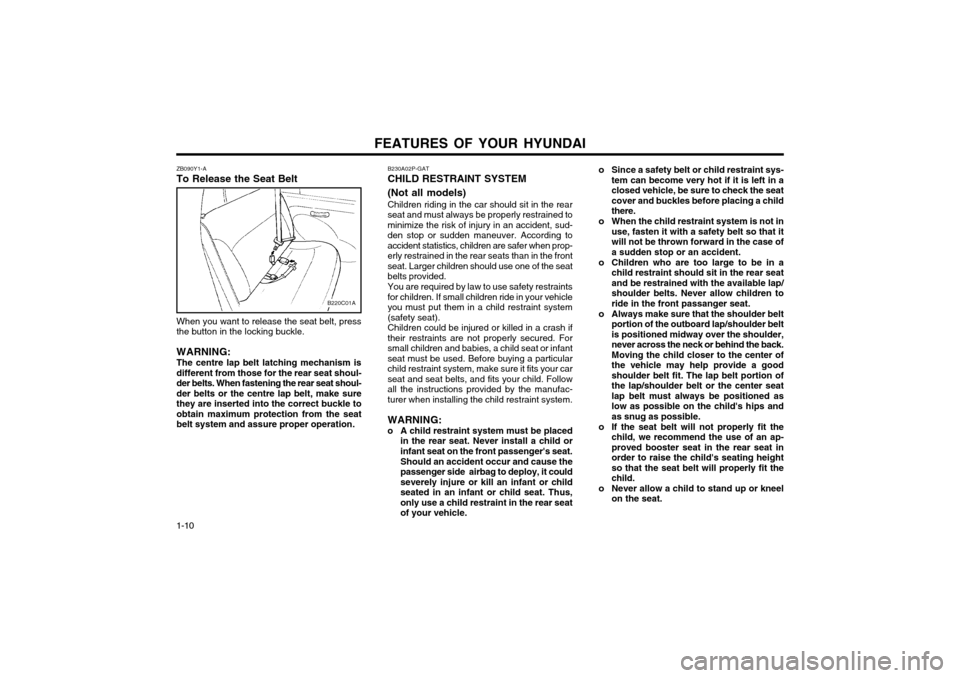
1-10 ZB090Y1-A To Release the Seat Belt
B220C01A
When you want to release the seat belt, press the button in the locking buckle. WARNING: The centre lap belt latching mechanism is different from those for the rear seat shoul-der belts. When fastening the rear seat shoul-der belts or the centre lap belt, make surethey are inserted into the correct buckle toobtain maximum protection from the seatbelt system and assure proper operation. B230A02P-GAT CHILD RESTRAINT SYSTEM (Not all models) Children riding in the car should sit in the rear seat and must always be properly restrained tominimize the risk of injury in an accident, sud-den stop or sudden maneuver. According toaccident statistics, children are safer when prop-erly restrained in the rear seats than in the frontseat. Larger children should use one of the seatbelts provided. You are required by law to use safety restraints for children. If small children ride in your vehicleyou must put them in a child restraint system(safety seat).Children could be injured or killed in a crash iftheir restraints are not properly secured. Forsmall children and babies, a child seat or infantseat must be used. Before buying a particularchild restraint system, make sure it fits your carseat and seat belts, and fits your child. Followall the instructions provided by the manufac-turer when installing the child restraint system. WARNING:
o A child restraint system must be placed in the rear seat. Never install a child or infant seat on the front passenger's seat. Should an accident occur and cause the passenger side airbag to deploy, it couldseverely injure or kill an infant or childseated in an infant or child seat. Thus,only use a child restraint in the rear seatof your vehicle. o Since a safety belt or child restraint sys-
tem can become very hot if it is left in aclosed vehicle, be sure to check the seatcover and buckles before placing a childthere.
o When the child restraint system is not in use, fasten it with a safety belt so that itwill not be thrown forward in the case ofa sudden stop or an accident.
o Children who are too large to be in a child restraint should sit in the rear seatand be restrained with the available lap/shoulder belts. Never allow children toride in the front passanger seat.
o Always make sure that the shoulder belt portion of the outboard lap/shoulder beltis positioned midway over the shoulder,never across the neck or behind the back.Moving the child closer to the center ofthe vehicle may help provide a goodshoulder belt fit. The lap belt portion ofthe lap/shoulder belt or the center seatlap belt must always be positioned aslow as possible on the child's hips andas snug as possible.
o If the seat belt will not properly fit the child, we recommend the use of an ap-proved booster seat in the rear seat inorder to raise the child's seating heightso that the seat belt will properly fit thechild.
o Never allow a child to stand up or kneel on the seat.
Page 155 of 249
FEATURES OF YOUR HYUNDAI
1-18 ZB110G2-E
TURN SIGNAL INDICATOR LIGHT
The blinking green arrow on the instrument panel shows the direction indicated by the turnsignals. If the arrow comes on but does notblink, blinks more rapidly than normal or doesnot blink at all, a malfunction in the turn signalsystem is indicated.
B260P02Y-AAT ABS SERVICE REMINDER INDICATOR (SRI) (Not all models)
When the key is turned to the “ON” position, the ABS light will come on and then go off in a fewseconds. If the ABS light remains on, comes on while
driving, or does not come on when the key isturned to the “ON” position, this indicates thatthere may be a problem with the ABS.
If this occurs, have your vehicle checked by
your Hyundai dealer as soon as possible. Thenormal braking system will still be operational,but without the assistance of the anti-lock brakesystem.
CAUTION: If the both ABS SRI and Parking Brake/
Brake fluid level warning lights remain "ON" or come on while driving, there may be aproblem with E.B.D (Electronic brake forcedistribution).
If this occurs, avoid sudden stops and have
your vehicle checked by your Hyundai dealeras soon as possible. SB210E1-E
OVERDRIVE OFF INDICATOR LIGHT (Not all models)
When the overdrive (4th gear) switch is turned off and the operation of overdrive (4th gear) iscancelled, the overdrive warning light (O/D OFF)will be illuminated. When the switch is at the onposition, the gearbox will operate in the normalfully automatic mode and the warning light willbe extinguished.
ZB110J2-E HIGH BEAM INDICATOR LIGHT
This light is coloured blue and should illuminate only when the headlight upper beam is on.
B260E02A-GAT SEAT BELT REMINDER LIGHT
The seat belt reminder light comes on until your seat belt is fastened when the ignition key isturned from the "OFF" position to "ON" or"START".
ZB110K2-E OIL PRESSURE WARNING LIGHT
The oil pressure warning light will illuminate when insufficient oil pressure exists for safeengine operation. The light should illuminate when the ignition is turned on and should be extinguished as soonas the engine is started.
ZB110L3-E PARKING BRAKE, BRAKE CIRCUIT FAILURE WARNING LIGHT
This light will be illuminated when the hand brake is applied and the ignition on, and shouldgo out when the hand brake is released. Thevehicle should not be driven until the handbrake has been released and the light go out. Italso will be illuminated if the brake fluid level inthe reservoir falls to the MIN. mark. If the lightilluminates while driving pull off the road ifpossible and stop immediately. Contact yournearest authorized dealer and have the systemchecked.
CAUTION: Operation of the engine with low oil pres- sure may result in serious damage to theengine. Should the oil pressure light fail to extinguish after starting or illuminate when the engine isrunning, the engine must be stopped immedi-ately. If the engine oil level is low, add a suffi-cient quantity of oil to raise the level to the fullmarking on the dip stick. Restart the engine andcheck that the warning light is extinguished.Should the light still be illuminated, stop theengine immediately and seek assistance fromthe nearest Hyundai dealer.
Page 156 of 249

FEATURES OF YOUR HYUNDAI 1-19
YB110C1-A
SRS (Airbag) SERVICE REMINDER INDICATOR(Not all models)
The SRS service reminder indicator (SRI) comes
on and flashes for about 6 seconds after the ignition key is turned to the “ON” position orafter the engine is started, after which it will goout.
This light also comes on when the SRS is not
working properly.
If the SRI does not come on, or continuously
remains on after flashing for about 6 secondswhen you turned the ignition key to the “ON”position or started the engine, or if it comes onwhile driving, have the SRS inspected by anauthorized Hyundai Dealer.
ZB110P2-E LOW FUEL LEVEL WARNING LIGHT
The low fuel level warning light comes on when the fuel tank is approaching empty. When itcomes on, you should add fuel as soon aspossible. Driving with the fuel level warning lighton or with the fuel level below "E" can cause theengine to misfire.
ZB110R1-E BRAKE PAD WEAR WARNING SOUNDWhen the brake pads of the front brakes be-
come worn to almost the limit of use, a metalfriction squealing sound will be heard as awarning to the driver that the brakes should bechecked. When this sound is heard, replace thebrake pads with new ones.
ZB110Q2-A MALFUNCTION INDICATOR LIGHT
This light illuminates when there is a malfunc- tion of an exhaust gas related component, andthe system is not functioning properly so that
B260L01A-GAT DOOR AJAR WARNING LIGHT
The door ajar warning light warns you that a
door is not completely closed.
ZB110M2-E CHARGING WARNING LIGHT
This red warning light indicates malfunctioning of the alternator and electrical charging system.If this warning light glows when the ignitionswitch is in the "ON" position (engine off), thebulb and electrical wiring are satisfactory. Thelight should go out when the engine is started.If the light glows when the engine is running, thealternator and electrical system should bechecked as soon as possible.
Warning Light Operation The parking brake/brake fluid level warning
light should come on when the parking brake is applied and the ignition switch is turned to "ON"or "START". After the engine is started, the lightshould go out when the parking brake is re-leased.
If the parking brake is not applied, the warning
light should come on when the ignition switch isturned to "ON" or "START", then go out whenthe engine starts. If the light comes on at anyother time, you should slow the vehicle andbring it to a complete stop in a safe location offthe roadway.
The brake warning light indicates that the brake
fluid level in the brake master cylinder is lowand hydraulic brake fluid conforming to DOT 3or DOT 4 specifications should be added. Afteradding fluid, if no other trouble is found, the carshould be immediately and carefully drivento a Hyundai dealer for inspection. If furthertrouble is experienced, the vehicle should notbe driven at all but taken to a dealer by aprofessional towing service or some other safemethod.
Your Hyundai is equipped with dual-diagonal
braking systems. This means you still havebraking on two wheels even if one of the dualsystems should fail. With only one of the dualsystems working, more than normal pedal trav-el and greater pedal pressure are required tostop the car. Also, the car will not stop in asshort a distance with only half of the brakesystem working. If the brakes fail while you are driving, shift to a lower gear for additional en-gine braking and stop the car as soon as it issafe to do so.
Page 157 of 249
FEATURES OF YOUR HYUNDAI
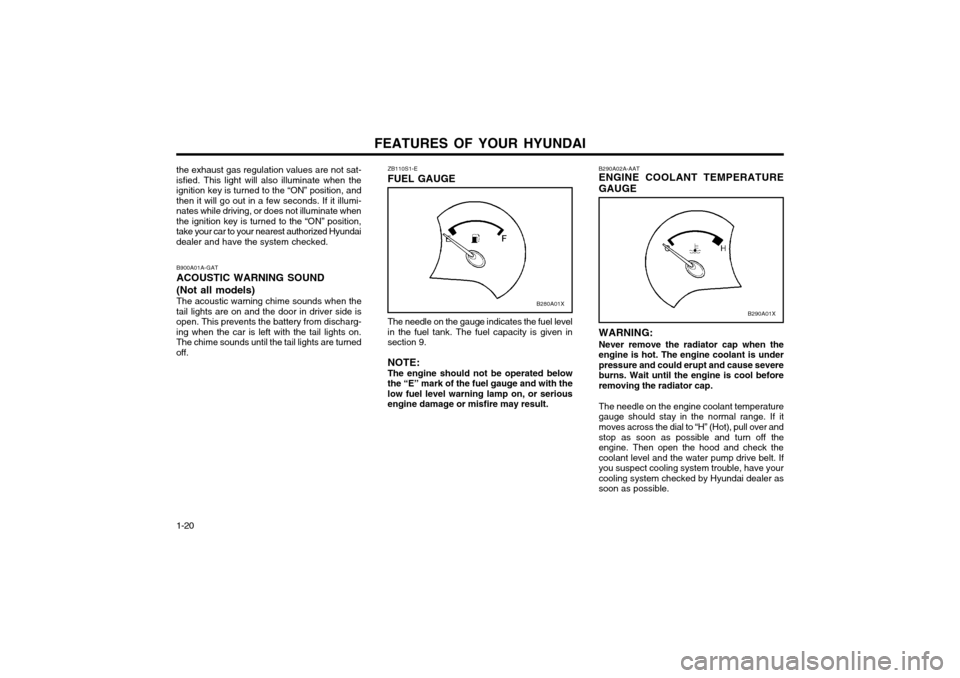
1-20 WARNING: Never remove the radiator cap when the engine is hot. The engine coolant is underpressure and could erupt and cause severeburns. Wait until the engine is cool beforeremoving the radiator cap. The needle on the engine coolant temperature
gauge should stay in the normal range. If itmoves across the dial to “H” (Hot), pull over and stop as soon as possible and turn off the engine. Then open the hood and check thecoolant level and the water pump drive belt. If
you suspect cooling system trouble, have yourcooling system checked by Hyundai dealer assoon as possible.
The needle on the gauge indicates the fuel levelin the fuel tank. The fuel capacity is given insection 9. NOTE: The engine should not be operated below the “E” mark of the fuel gauge and with thelow fuel level warning lamp on, or seriousengine damage or misfire may result. B290A02A-AAT ENGINE COOLANT TEMPERATURE GAUGE
ZB110S1-E FUEL GAUGE
B900A01A-GATACOUSTIC WARNING SOUND (Not all models) The acoustic warning chime sounds when the
tail lights are on and the door in driver side is open. This prevents the battery from discharg-ing when the car is left with the tail lights on.The chime sounds until the tail lights are turnedoff.
the exhaust gas regulation values are not sat-isfied. This light will also illuminate when theignition key is turned to the “ON” position, andthen it will go out in a few seconds. If it illumi-nates while driving, or does not illuminate whenthe ignition key is turned to the “ON” position,take your car to your nearest authorized Hyundaidealer and have the system checked.
B280A01XB290A01X