Page 601 of 1139

Conventional Brake Components
Brake Pedaland Brake PedalPosition Switch Adjustment
Pedal Height
1.Disconnect the brake pedal position switch
connector, turn the brake pedal position switch (A)
counterclockwise, and pull it back until it is no
longer touching the brake pedal.
Lift up the carpet and the insulator cutout (B).
l\4easure the pedal height (C) from the middle of
the left side of the pedal pad (D).
Standard Pedal Height (with carpet removed):
184 mm (7 4/16 in.)
Loosen the pushrod locknut (A), and screw the
pushrod in or out with pliers until the standard
pedal height from the floor is reached. After
adjustment, tighten the locknut firmly. Do not
adjust the pedal height with the pushrod pressed.
15 N.m(1.5 kgl m. 11 lbl ft)
19-6
7. Check the brake pedal free play as described below.
Pedal Free Play
4. With the engine off, inspect the play (A) on the
pedal pad (B) by pushing the pedal by hand.
Free Play: 0.4- 3.0 mm {0.016 0.'l18in.)
lf the pedal free play is out of specification, adjust
the brake pedal position switch (C). lf the pedal free
play is insufficient, it may result in brake drag.
Push in the brake oedal oosition switch until its
plunger is fully pressed (threaded end (A)touching
the pad (B) on the pedal arm). Then, turn the switch
45" clockwise to lock it. The gap between the brake
pedal position switch and the pad is automatically
adjusted to 0.4 to 3.0 mm (0.016 0.118 in.) by
locking the switch. Make sure the brake lights go
otf when the pedal is released.
t
6.
Page 602 of 1139

Parking Brake Check and Adiustment
Check
1. Pull the parking brake lever {A) with 196 N (20 kgf,
44 lbf) of force to fully apply the parking brake. The
parking brake lever should be locked within the
specified number of clicks (B).
Lever locked clicks: 7-8
- l2okqf, a4lbl)
2. Adjust the parking brake if the lever clicks are not
within the specification.
Adjustment
1. Release the parking brake lever fully.
Loosen the parking brake adjusting nut, start the
engine, and press the brake pedal several times to
set the self-adjusting brake before adjusting the
parking brake.
Block the front wheels, then raise the rear of the
vehicle, and support it with safety stands in the
proper location (see page 1-8).
Make sure the parking brake arm (A) on the rear
brake caliper contacts the brake caliper pin (B),
NOTE: The parking brake arm will only contact the
brake caliper pin when the parking brake adjusting
nut is loosened.
Remove the rear console {see page 20-57).
Pull the parking brake lever up one click,
7, Tighten the adjusting nut {A} until the parking
brakes drag slightly when the rear wheels are
tu rned.
A/
Release the parking brake lever fully, and check
that the parking brakes do not drag when the rear
wheels are turned. Readjust if necessary.
Make sure the parking brakes are fully applied
when the parking brake lever is pulled up fully.
Reinstall the rear console.
8.
9.
10.
19-7
Page 612 of 1139

5. With a feeler gauge (A), measure the clearance
between the gauge body and the adjusting nut (B)
as snown,
lf the clearance between the gauge body and the
adjusting nut is 0.4 mm (0.02 in.), the pushrod-to-
piston clearance is 0 mm. However. if the clearance
between the gauge body and the adjusting nut is
0 mm, the pushrod-to-piston clearance is 0 4 mm
{0.02 in.) or more. Therefore it must be adjusted
and rechecked.
Clearance: 0-0./t mm (0-0.02 in.)
lf the clearance is incorrect, loosen the star locknut
(A). and turn the adjuster (B) in or out to adjust.
. Adjust the clearance while the specified vacuum
is appiied to the booster.. Hold the clevis (C) while adjusting.
A0 0.4 mm l0 -0.02 in.) 22N.n
07JAG-SO40100
7. Tighten the star locknut securely.
8. Remove the special tool (D).
9. Check the pushrod length (A) asshownifthe
booster is removed, lf the length is incorrect,
loosen the pushrod locknut (B), and turn the clevis
(C) in or out to adjust.
A116 mm {4.6 in.)
10. Installthe master cylinder (see page l9-15)
10 x 1.0 mm1.5 N'm11.5 kgf.m,11 lbf.ftl
19-17
Page 616 of 1139
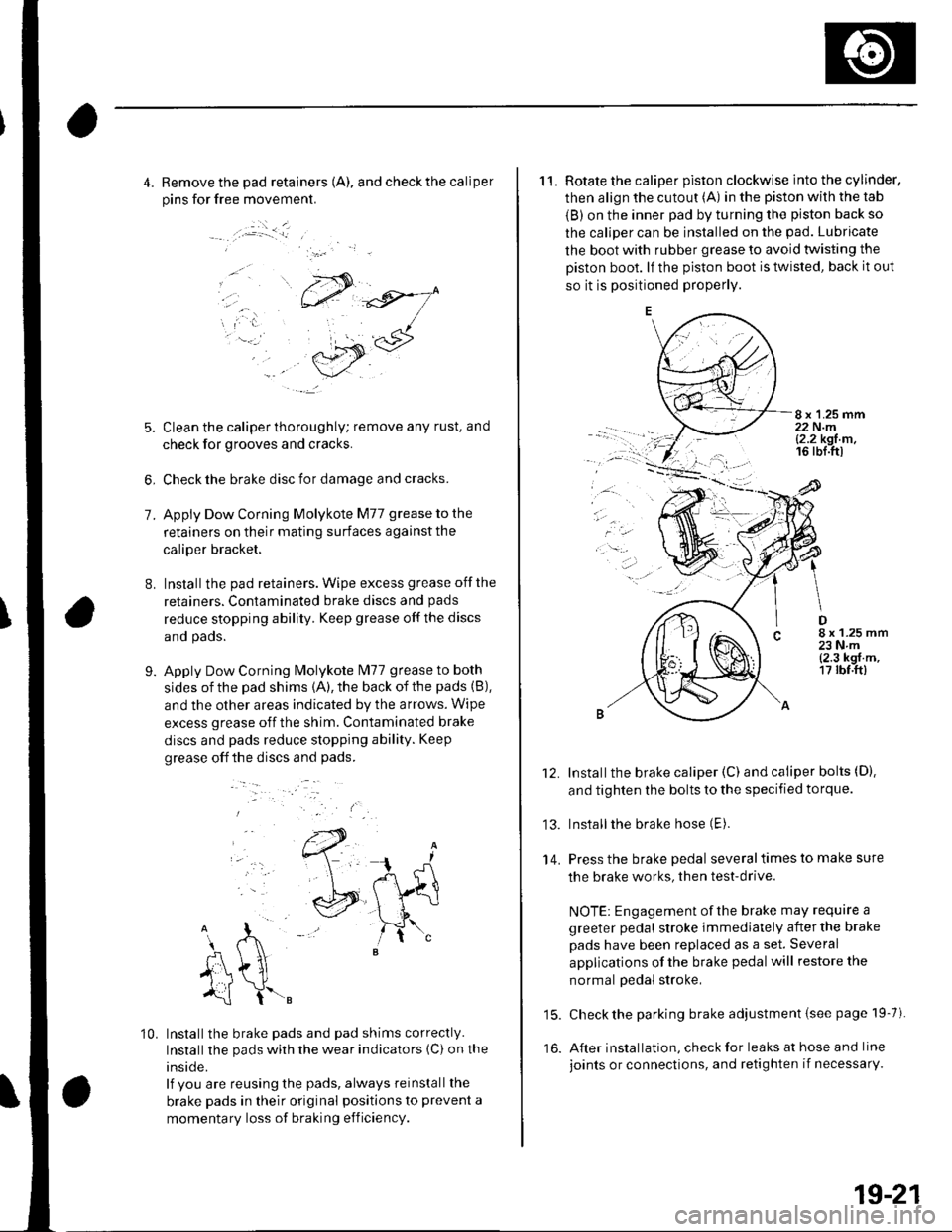
4. Remove the pad retainers (A). and check the caliper
pins for free movement.
:.i _ _l
7.
8.
5. Clean the caliper thoroughly; remove any rust. and
check for grooves and cracks.
6, Check the brake disc for damage and cracks.
Apply Dow Corning Molykote M77 grease to the
retainers on their mating surfaces against the
caliper bracket,
Installthe pad retainers. Wipe excess grease offthe
retainers. Contaminated brake discs and pads
reduce stopping ability. Keep grease off the discs
and pads.
Apply Dow Corning Molykote lvl77 grease to both
sides of the pad shims {A), the back of the pads (B),
and the other areas indicated by the arrows. Wipe
excess grease off the shim. Contaminated brake
discs and pads reduce stopping ability. Keep
grease off the discs and pads.
9.
..-.
10. Installthe brake pads and pad shims correctly.
Installthe pads wirh the wear indicators {C) on the
inside.
lf you are reusing the pads, always reinstall the
brake pads in their original positions to prevent a
momentary loss of braking efficiency.
11. Rotate the caliper piston clockwise into the cylinder,
then align the cutout (A) in the piston with the tab
{B) on the inner pad by turning the piston back so
the caliper can be installed on the pad. Lubricate
the boot with rubber grease to avoid twisting the
Diston boot. lf the piston boot is twisted, back it out
so it is positioned properly.
8 x 1.25 mm22 N.ml2.2 kgt m,16 rbl.ttl
.ar
D8 x 1.25 mm23Nm{2.3 kgf.m,17 rbf.ft)
13.
14.
Installthe brake caliper (C) and caliper bolts (D).
and tighten the bolts to the specified torque.
Installthe brake hose (E).
Press the brake pedal several times to make sure
the brake works, then test-drive.
NOTE: Engagement of the brake may require a
greeter pedal stroke immediately after the brake
pads have been replaced as a set. Several
applications of the brake pedal will restore the
normal pedal stroke,
15. Check the parking brake adjustment {see page 19-7).
16. After installation, check for leaks at hose and line
joints or connections, and retighten if necessarY.
19-21
Page 623 of 1139
Brakes
Conventional Brake Components ................ 1 9-1
ABS (Anti-lock Brake System) Components
Comoonent Location lndex .............,........................... 19-30
General Troubleshooting Information ....................... 19-31
DTC Troubleshooting Index .............. 19-34
Symptom Troubleshooting Index ...,........................... 19-35
System Description ................. ........... 19-36
Circuit Diagram ......... 19-42
DTC Troubleshooting ............... .......... 19-45
ABS Indicator CircuitTroubleshooting ...................... 19-52
Brake System Indicator Circuit
Troubleshooting ...................... ....... 19-55
ABS Modulator-Control Unit Removal and
lnstallation ............. 19-57
Wheel Sensor Insoection ................... 19-59
Wheel Sensor Reolacement .............. 19-59
Page 632 of 1139
ABS Gomponents
System Description (cont'd)
Features
When the brake pedal is pressed during driving, the wheels can lock before the vehicle comes to a stop. In such an
event. the maneuverability of the vehicle is reduced if the front wheels are locked, and the stability of the vehicle is
reduced if the rear wheels are locked, creating an extremely unstable condition. The ABS precisely controls the slip
rate of the wheels to ensure maximum grip force from the tires, thereby ensuring the maneuverability and stability of
the vehicle.
The ABS calculates the slip rate of the wheels based on the vehicle speed and the wheel speed, then it controls the
brake fluid pressure to reach the target slip rate.
Grip Force of Tire and Road Surface
TARGET SLIP RATE
COEFFICIENT OFFRICTION
SLIP RATE
19-38
Page 642 of 1139
ABS Components
DTC Troubleshooting (cont'd)
DTC 31, 32. 33, 34, 35, 36, 37, 38: Solenoid
1. Clear the DTC, then disconnect the Honda PGN4
Tester.
2. Test-drive the vehicle.
Does the ABS ind icator come on and are DT Cs 31,
32, 33, 34, 35, 36, 37, 38 indicated?
YES Replace the ABS modulator-control unit.t
NO The system is OK at this time. t
19-48
DTC 51: Motor Locked
'1. Check the No. 10 (40A)fuse in the under-hoodfuse/
retay Dox.
ls the tuse OK?
YES-Reinstall the fuse, and go to step 2.
NO- Replace the fuse, and recheck.l
2. Disconnect the ABS control unit 31P connector.
3. Measure the voltage between the ABS control unit
31P connector terminal No. 17 and body ground.
ABS CONTROL UNIT 31P CONNECTOR
I
Wire side of female terminals
ls thete battery voltage?
YES Go to step 4.
NO Repair open in the wire between the(40A) fuse and the ABS control unit.l
No. 10
Page 651 of 1139
ABS Modulator-Control Unit Removal and lnstallation
NOTE:. Donotspill brake fluid on the vehicle; it may damage the painU if brakefluidgetsonthepaint,washitoff
immediately with water.. Becareful not to damage or deform the brake lines during removal and installation.. To prevent the brake fluid from flowing, plug and cover the hose ends and joints with a shop towel orequivalent
malenal.
Removal
'1. Turn the ignition switch OFF.
2. Pull upthelock(A) oftheABScontrol unit3lPconnector(B),thendisconnecttheconnector.
FLARE NUTl5 N.m (1.5 kgt.m,11 lbt.ftl
6)o
CII mm NUT8.8 N.m {0.9 kgl m.6.5lbf ft)
6 mm BOLT9.8 N.m11.0 ksf.m,7.2lbf.ft)
\.
--/Q \,
\---'
(cont'd)
19-57


