Page 52 of 264
Starting autostore
1. Press and momentarily hold the AM/FM control.
2. AUTOSET will flash
in the display as the
frequency band is
scrolled through.
3. When the six strongest stations are filled, the
station stored in memory preset control 1 will start
playing.
If there are less than six strong stations available on
the frequency band, the remaining memory preset
controls will all store the last strong station
available.
To deactivate autoset and return to your audio
system's manually set memory stations, press the
AM/FM control again.
Setting the clock
Press the MENU
control until SELECT
HOUR or SELECT
MINUTE is displayed. (The menu mode must be
engaged to enable clock mode).
Use the SEL control to
manually set the time.
²Press
to
increase
hours/minutes.
²Press
to decrease hours/minutes.
Press the MENU control again to disengage the
clock mode.
Tune adjust
The tune control works in radio or CD mode.
SEL
Entertainment Systems
52
Page 54 of 264

CD select
CD mode may be
entered by pressing
the CD control and the
LOAD control. Load
the CD into the audio system. The first track of the
disc will begin playing. After that, CD play will begin
where it stopped last.
If an alternative CD is desired, press the
corresponding preset control (1±6) of a loaded CD,
or press the TUNE control to access the other
loaded CDs.
NO CD will display if the CD control is activated
when there is not a CD present in the audio system.
NO CD will illuminate in the display if the CD
control and a present number (that is currently
empty) are pressed. The system will play the next
available disc.
If your vehicle is equipped with a CD changer,
pressing the CD control again will allow you to
toggle between accessing the multi disc system and
the CD changer. The display will read CD or CDDJ.
Do not insert any promotional (odd shaped or
sized) discs, or discs with removable labels into
the CD player as jamming may occur.
Display description
Six circles are always lit in the digital display. These
signify the six CD slots in the audio system. When a
disc is loaded into a particular slot (1±6), the
number inside that specific circle lights. If the circle
is empty, there is no CD in that particular slot.
Entertainment Systems
54
Page 56 of 264
choose the next available one.) Wait until the CD
door opens. Load the CD into the player. LOADING
CD# is displayed. When the CD has been loaded, the
door will close and the CD will begin to play. For
example, to load a CD into slot 2, press the LOAD
control and then press preset 2.
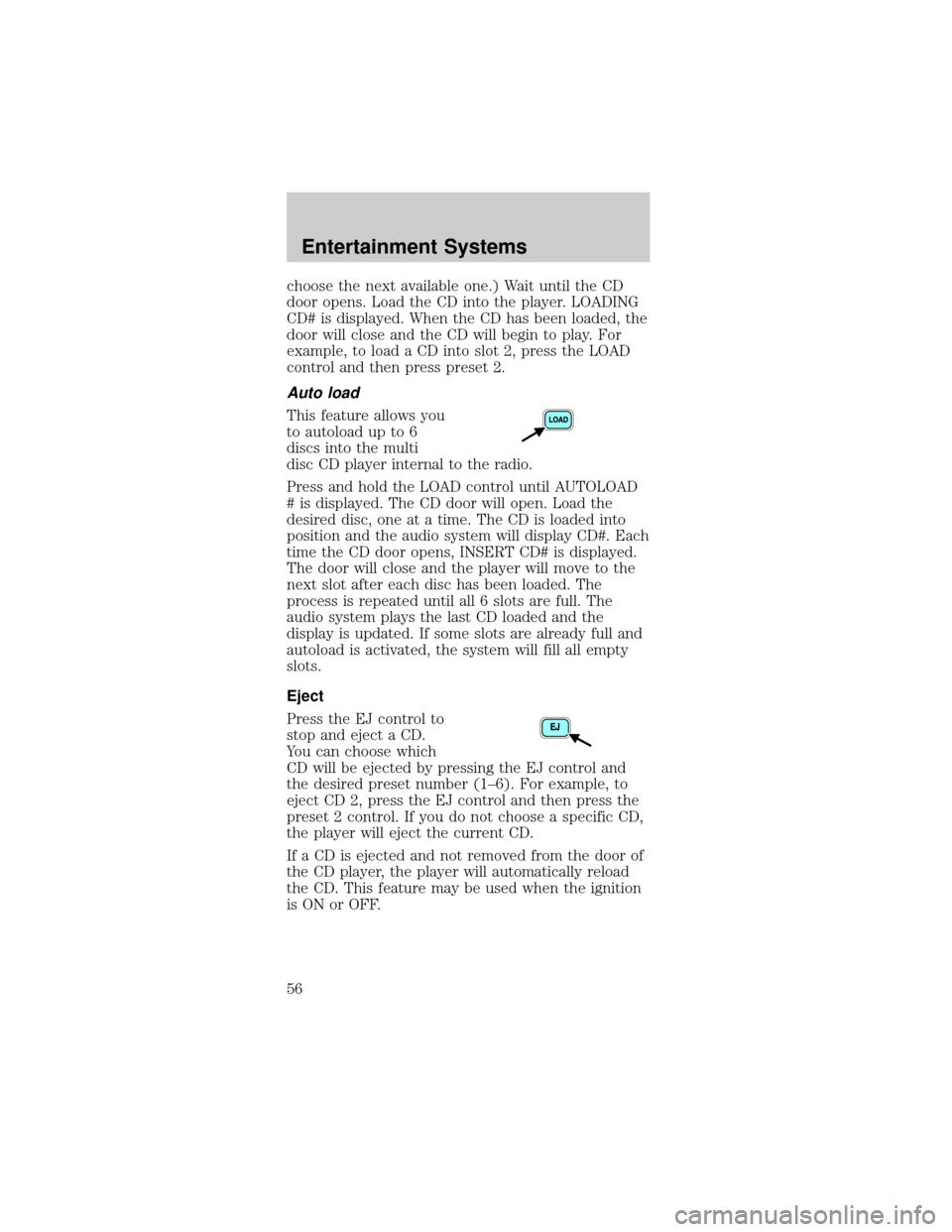
Auto load
This feature allows you
to autoload up to 6
discs into the multi
disc CD player internal to the radio.
Press and hold the LOAD control until AUTOLOAD
# is displayed. The CD door will open. Load the
desired disc, one at a time. The CD is loaded into
position and the audio system will display CD#. Each
time the CD door opens, INSERT CD# is displayed.
The door will close and the player will move to the
next slot after each disc has been loaded. The
process is repeated until all 6 slots are full. The
audio system plays the last CD loaded and the
display is updated. If some slots are already full and
autoload is activated, the system will fill all empty
slots.
Eject
Press the EJ control to
stop and eject a CD.
You can choose which
CD will be ejected by pressing the EJ control and
the desired preset number (1±6). For example, to
eject CD 2, press the EJ control and then press the
preset 2 control. If you do not choose a specific CD,
the player will eject the current CD.
If a CD is ejected and not removed from the door of
the CD player, the player will automatically reload
the CD. This feature may be used when the ignition
is ON or OFF.
Entertainment Systems
56
Page 57 of 264
Auto eject
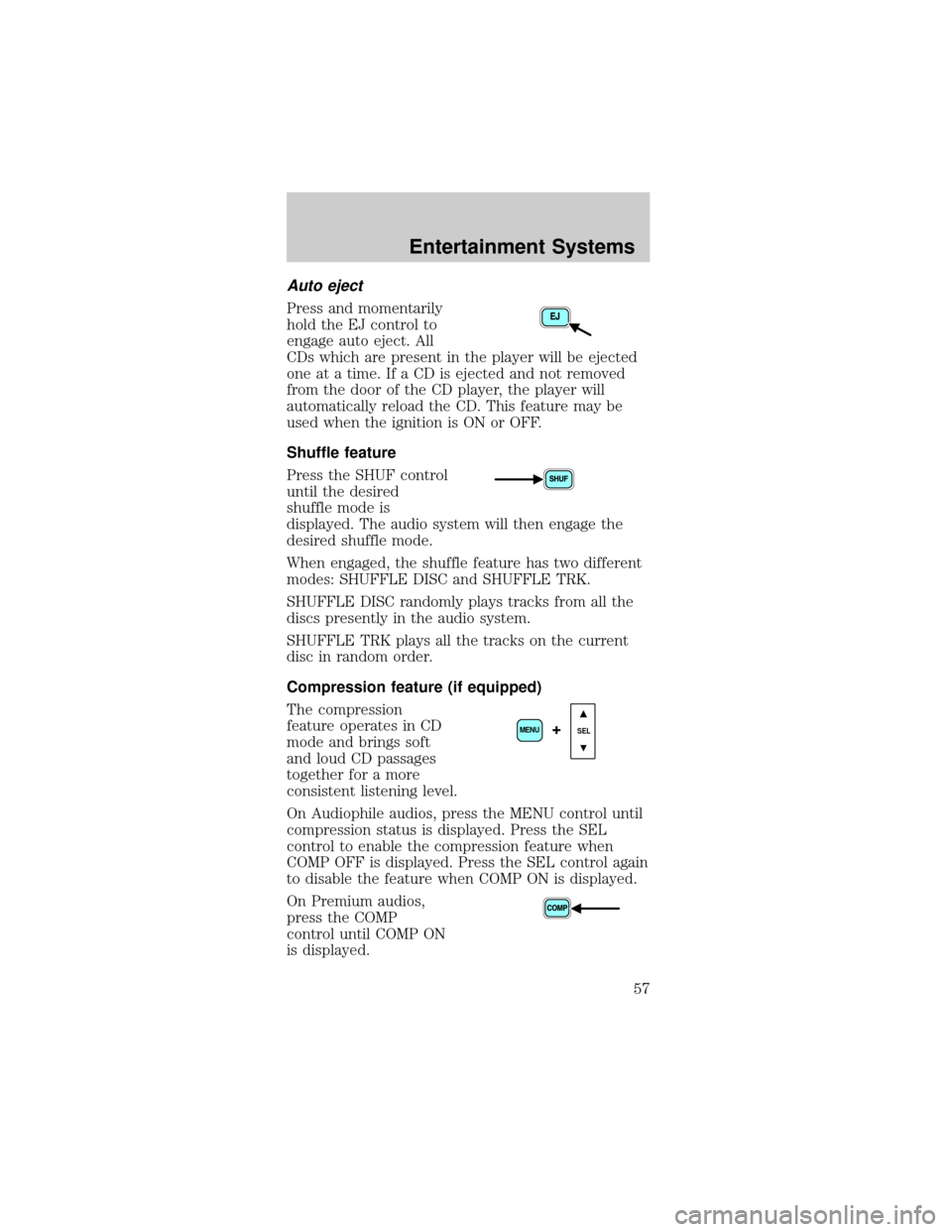
Press and momentarily
hold the EJ control to
engage auto eject. All
CDs which are present in the player will be ejected
one at a time. If a CD is ejected and not removed
from the door of the CD player, the player will
automatically reload the CD. This feature may be
used when the ignition is ON or OFF.
Shuffle feature
Press the SHUF control
until the desired
shuffle mode is
displayed. The audio system will then engage the
desired shuffle mode.
When engaged, the shuffle feature has two different
modes: SHUFFLE DISC and SHUFFLE TRK.
SHUFFLE DISC randomly plays tracks from all the
discs presently in the audio system.
SHUFFLE TRK plays all the tracks on the current
disc in random order.
Compression feature (if equipped)
The compression
feature operates in CD
mode and brings soft
and loud CD passages
together for a more
consistent listening level.
On Audiophile audios, press the MENU control until
compression status is displayed. Press the SEL
control to enable the compression feature when
COMP OFF is displayed. Press the SEL control again
to disable the feature when COMP ON is displayed.
On Premium audios,
press the COMP
control until COMP ON
is displayed.
SEL+MENU
Entertainment Systems
57
Page 59 of 264
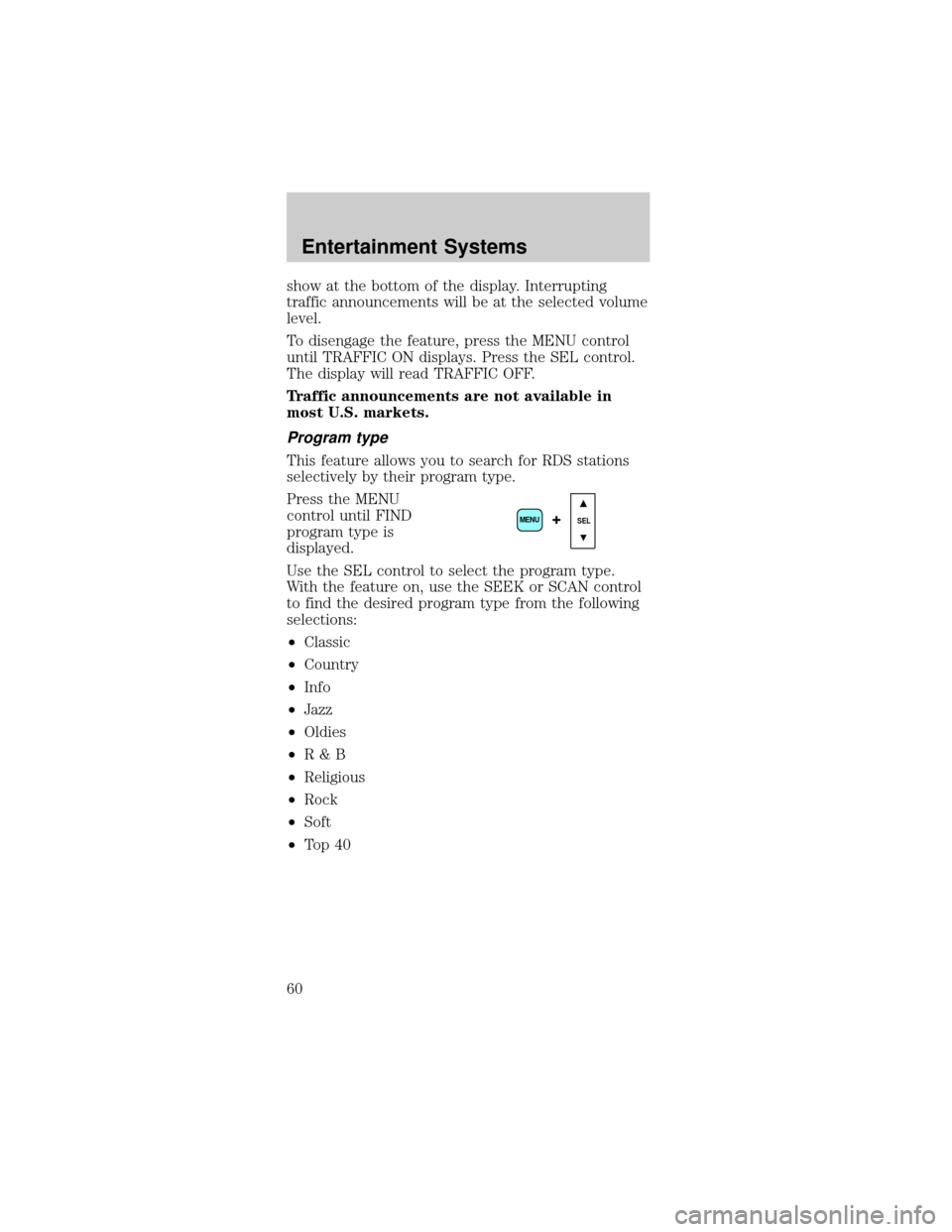
FIND type Ð Allows you to select your desired FM
program type and search for that selection.
SHOW Ð Allows you to select from NAME (displays
the name of the radio station), TYPE (displays the
RDS program type: rock, jazz, etc.), or NONE
(deactivates the RDS display).
Radio data system (RDS) feature
This feature allows
your audio system to
receive text
information from
RDS-equipped FM
radio stations.
To activate RDS:
²When in FM mode, press the MENU control until
RDS OFF displays.
²Press the SEL control to engage this feature (RDS
ON).
RDS features:
Once the RDS feature is on, press the MENU control
to scroll through the following selections:
Traffic announcements
This feature allows you to hear traffic
announcements while in CD mode. These
announcements are broadcast by traffic capable RDS
stations.
When in this mode, traffic announcements will
interrupt radio and CD play.
²Press the MENU control until TRAFFIC is
displayed.
²Press the SEL control to engage the feature. The
display will read TRAFFIC ON.
This feature also allows you to control the volume of
traffic announcements. With the display reading
TRAFFIC ON, adjust the volume using the volume
control to the desired level. The volume level will
SEL+MENU
Entertainment Systems
59
Page 60 of 264
show at the bottom of the display. Interrupting
traffic announcements will be at the selected volume
level.
To disengage the feature, press the MENU control
until TRAFFIC ON displays. Press the SEL control.
The display will read TRAFFIC OFF.
Traffic announcements are not available in
most U.S. markets.
Program type
This feature allows you to search for RDS stations
selectively by their program type.
Press the MENU
control until FIND
program type is
displayed.
Use the SEL control to select the program type.
With the feature on, use the SEEK or SCAN control
to find the desired program type from the following
selections:
²Classic
²Country
²Info
²Jazz
²Oldies
²R&B
²Religious
²Rock
²Soft
²To p 4 0
SEL+MENU
Entertainment Systems
60
Page 61 of 264
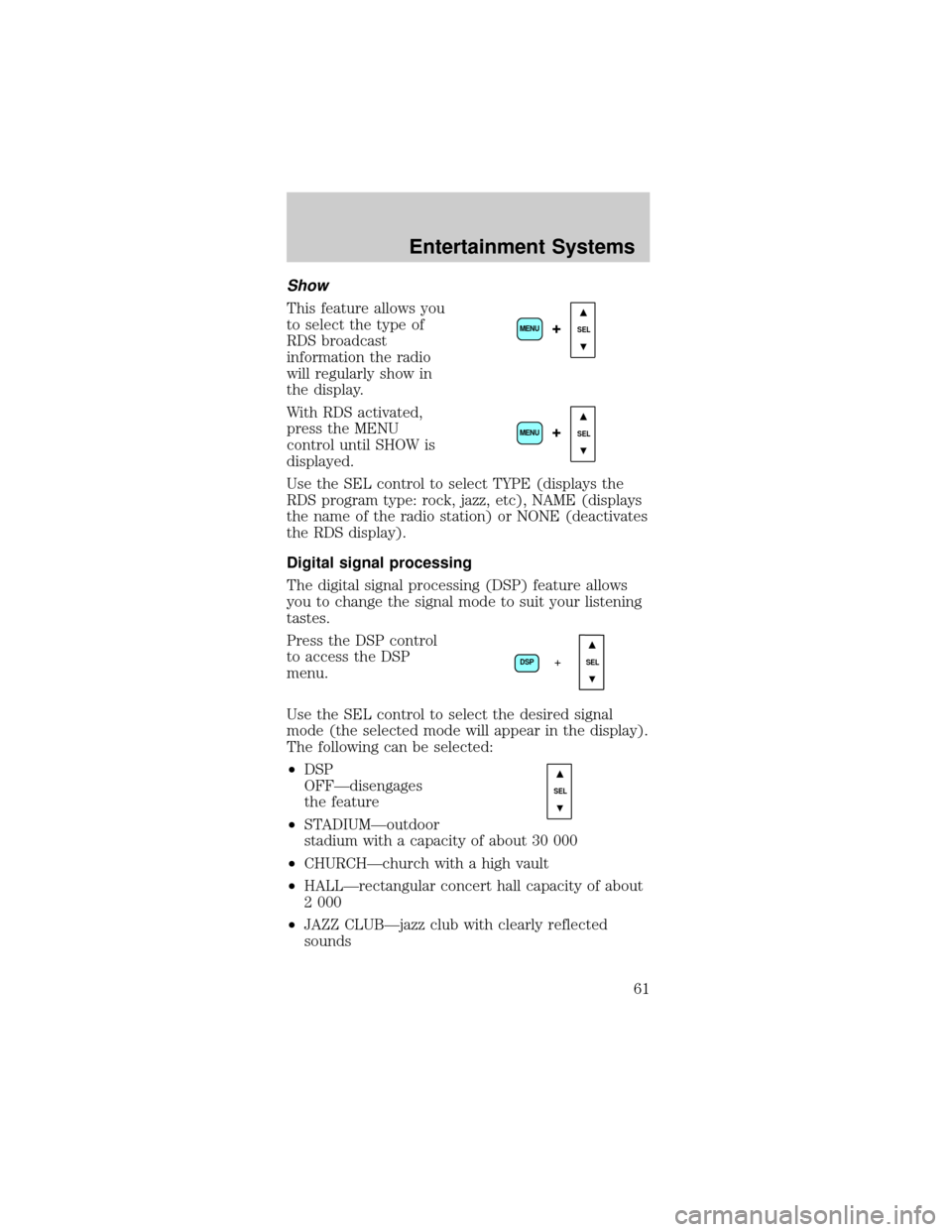
Show
This feature allows you
to select the type of
RDS broadcast
information the radio
will regularly show in
the display.
With RDS activated,
press the MENU
control until SHOW is
displayed.
Use the SEL control to select TYPE (displays the
RDS program type: rock, jazz, etc), NAME (displays
the name of the radio station) or NONE (deactivates
the RDS display).
Digital signal processing
The digital signal processing (DSP) feature allows
you to change the signal mode to suit your listening
tastes.
Press the DSP control
to access the DSP
menu.
Use the SEL control to select the desired signal
mode (the selected mode will appear in the display).
The following can be selected:
²DSP
OFFÐdisengages
the feature
²STADIUMÐoutdoor
stadium with a capacity of about 30 000
²CHURCHÐchurch with a high vault
²HALLÐrectangular concert hall capacity of about
2 000
²JAZZ CLUBÐjazz club with clearly reflected
sounds
SEL+MENU
SEL
+MENU
DSP
SEL+
SEL
Entertainment Systems
61
Page 66 of 264
RADIO RECEPTION FACTORS
Three factors can affect radio reception:
²Distance/strength.The further an FM signal
travels, the weaker it is. The listenable range of
the average FM station is approximately 40 km
(24 miles). This range can be affected by ªsignal
modulation.º Signal modulation is a process radio
stations use to increase their strength/volume
relative to other stations.
²Terrain.Hills, mountains and tall buildings
between your vehicle's antenna and the radio
station signal can cause FM reception problems.
Static can be caused on AM stations by power
lines, electric fences, traffic lights and
thunderstorms. Moving away from an interfering
structure (out of its ªshadowº) returns your
reception to normal.
²Station overload.Weak signals are sometimes
captured by stronger signals when you pass a
broadcast tower. A stronger signal may
temporarily overtake a weaker signal and play
while the weak station frequency is displayed.
The audio system automatically switches to single
channel reception if it will improve the reception of
a station normally received in stereo.
AUDIO SYSTEM WARRANTIES AND SERVICE
Refer to theWarranty Guidefor audio system
warranty information.
If service is necessary, see your dealer or a qualified
technician.
Entertainment Systems
66