Page 135 of 200

Fuse/Relay
LocationFuse Amp
RatingPower Distribution Box Description
50A–Not used
50B–Fuel pump relay
51–Not used
52–Not used
53–PCM diode
54–PCM relay
55–Blower relay
56A–A/C clutch solenoid
56B–Horn relay
CHANGING A FLAT TIRE
If you get a flat tire while driving:
•do not brake heavily.
•gradually decrease the vehicle’s speed.
•hold the steering wheel firmly.
•slowly move to a safe place on the side of the road.
The use of tire sealants is not recommended and may compromise the
integrity of your tires. The use of tire sealants may also affect your tire
pressure monitoring system (if equipped).
Spare tire information
The spare tire can be used as a spare or a regular tire.
Location of the spare tire and tools
The spare tire and tools for your vehicle are stowed in the following
locations:
Tool Location
Spare tire Under the vehicle, just in front of
the rear bumper
Jack, Jack handle, jack handle
extension, wheel lug nut wrenchIn the passenger side rear cab
compartment behind the access
door in trim panel
Roadside Emergencies
135
Page 136 of 200
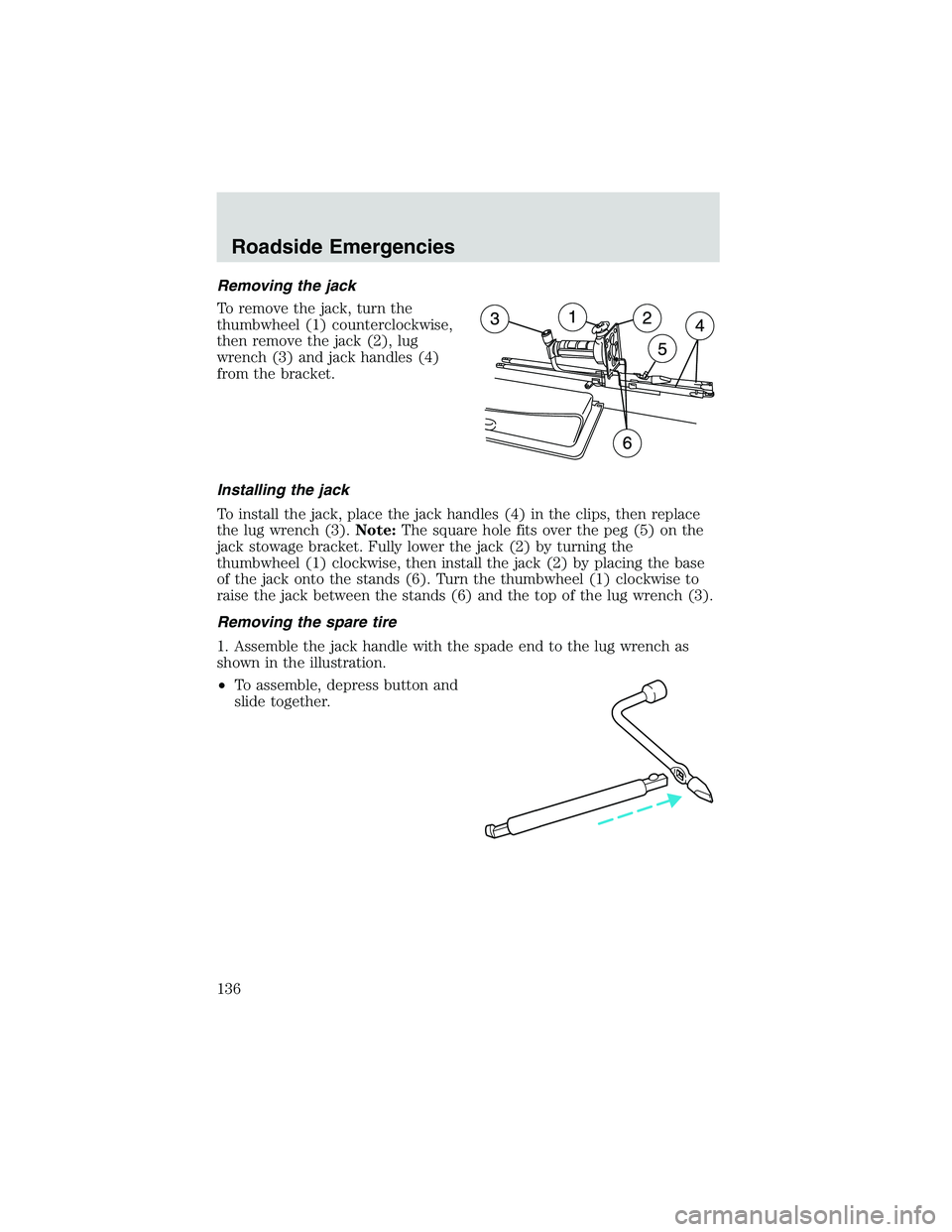
Removing the jack
To remove the jack, turn the
thumbwheel (1) counterclockwise,
then remove the jack (2), lug
wrench (3) and jack handles (4)
from the bracket.
Installing the jack
To install the jack, place the jack handles (4) in the clips, then replace
the lug wrench (3).Note:The square hole fits over the peg (5) on the
jack stowage bracket. Fully lower the jack (2) by turning the
thumbwheel (1) clockwise, then install the jack (2) by placing the base
of the jack onto the stands (6). Turn the thumbwheel (1) clockwise to
raise the jack between the stands (6) and the top of the lug wrench (3).
Removing the spare tire
1. Assemble the jack handle with the spade end to the lug wrench as
shown in the illustration.
•To assemble, depress button and
slide together.
Roadside Emergencies
136
Page 137 of 200
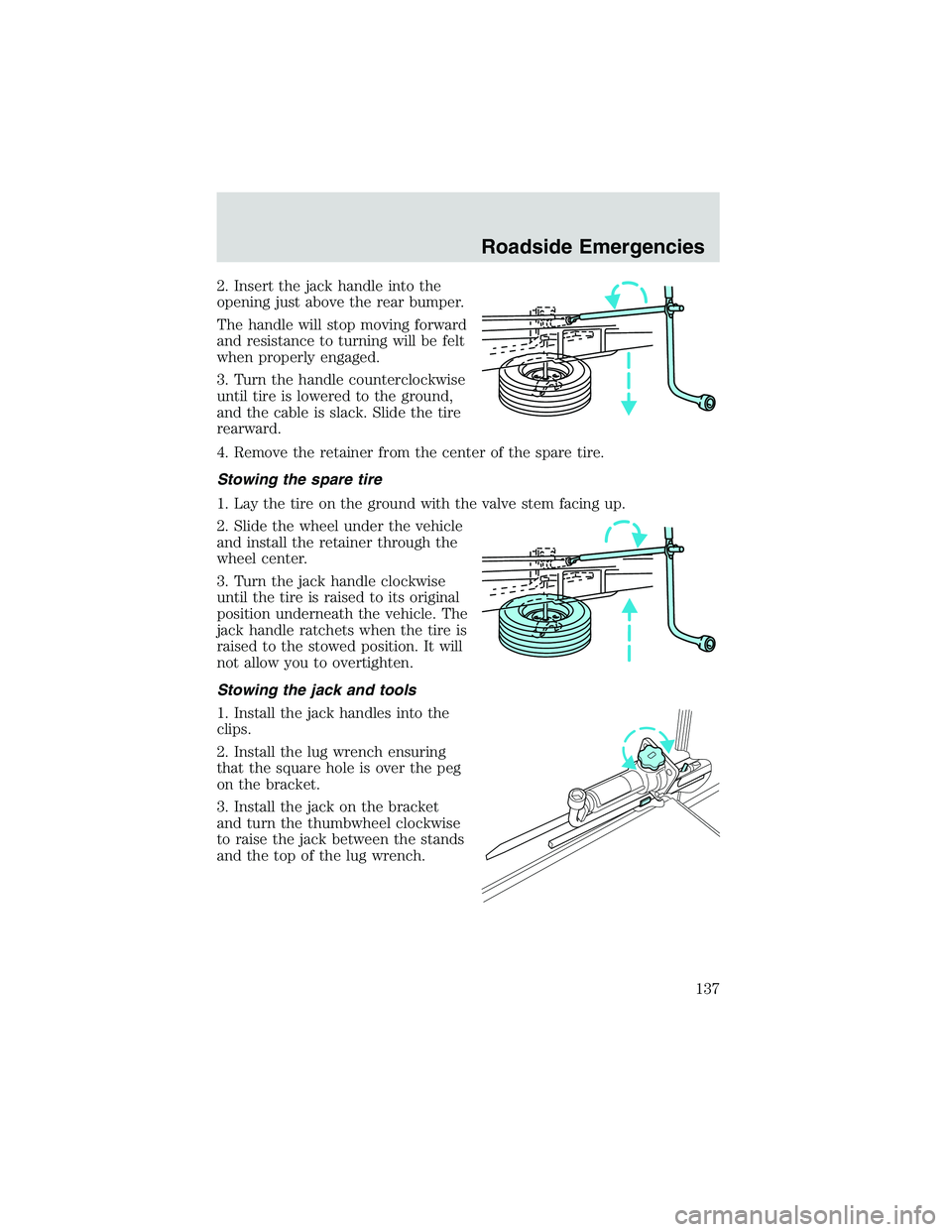
2. Insert the jack handle into the
opening just above the rear bumper.
The handle will stop moving forward
and resistance to turning will be felt
when properly engaged.
3. Turn the handle counterclockwise
until tire is lowered to the ground,
and the cable is slack. Slide the tire
rearward.
4. Remove the retainer from the center of the spare tire.
Stowing the spare tire
1. Lay the tire on the ground with the valve stem facing up.
2. Slide the wheel under the vehicle
and install the retainer through the
wheel center.
3. Turn the jack handle clockwise
until the tire is raised to its original
position underneath the vehicle. The
jack handle ratchets when the tire is
raised to the stowed position. It will
not allow you to overtighten.
Stowing the jack and tools
1. Install the jack handles into the
clips.
2. Install the lug wrench ensuring
that the square hole is over the peg
on the bracket.
3. Install the jack on the bracket
and turn the thumbwheel clockwise
to raise the jack between the stands
and the top of the lug wrench.
Roadside Emergencies
137
Page 140 of 200
•Rear
To lessen the risk of
personal injury, do not put
any part of your body under the
vehicle while changing a tire. Do
not start the engine when your
vehicle is on the jack. The jack is
only meant for changing the tire.
•Never use the differential as a
jacking point.
5. Remove the wheel lug nuts with the lug nut wrench.
6. Replace the flat tire with the spare tire, making sure the valve stem is
facing outward. Reinstall the lug nuts (cone side in) until the wheel is
snug against the hub. Do not fully tighten the lug nuts until the wheel
has been lowered.
7. Lower the wheel by turning the jack handle counterclockwise.
Roadside Emergencies
140
Page 141 of 200
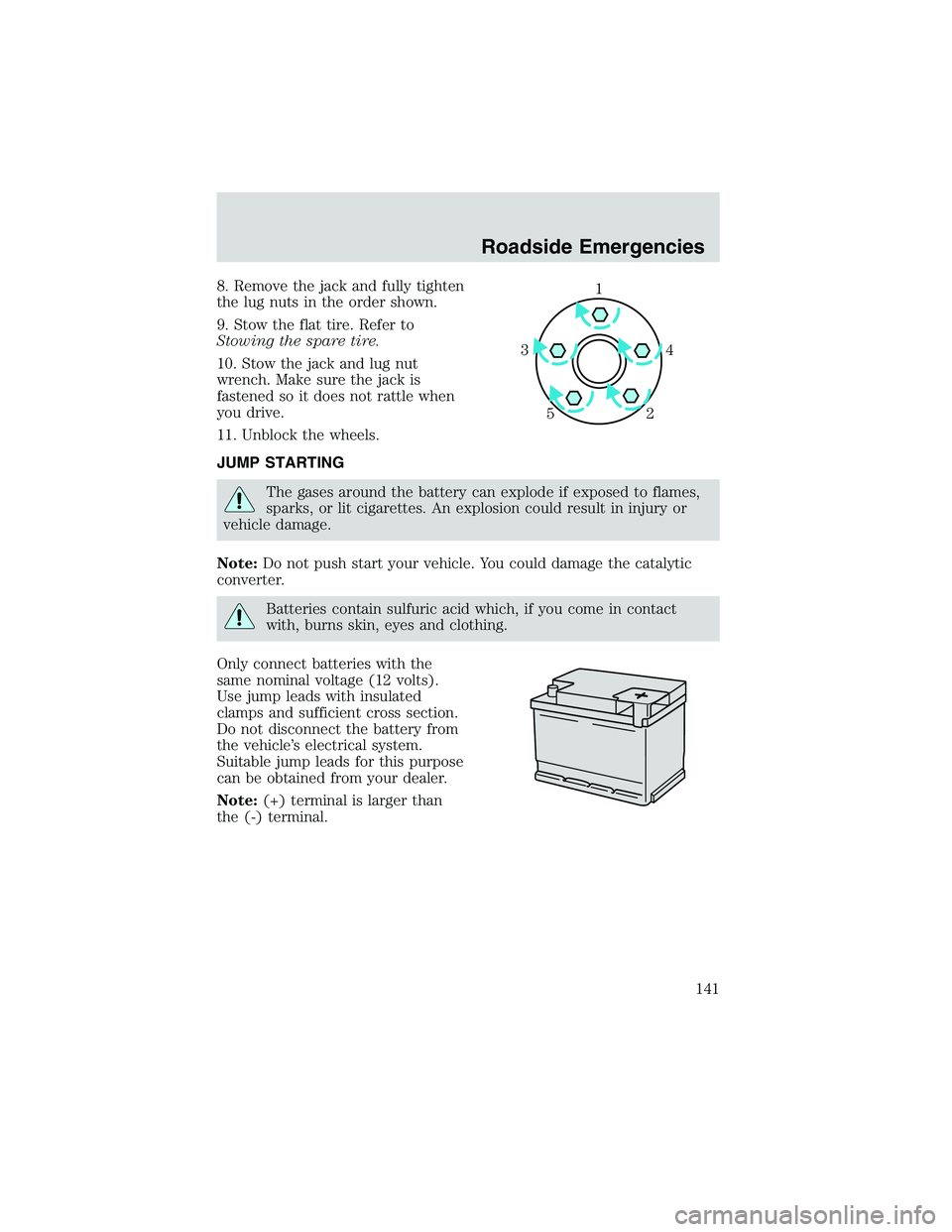
8. Remove the jack and fully tighten
the lug nuts in the order shown.
9. Stow the flat tire. Refer to
Stowing the spare tire.
10. Stow the jack and lug nut
wrench. Make sure the jack is
fastened so it does not rattle when
you drive.
11. Unblock the wheels.
JUMP STARTING
The gases around the battery can explode if exposed to flames,
sparks, or lit cigarettes. An explosion could result in injury or
vehicle damage.
Note:Do not push start your vehicle. You could damage the catalytic
converter.
Batteries contain sulfuric acid which, if you come in contact
with, burns skin, eyes and clothing.
Only connect batteries with the
same nominal voltage (12 volts).
Use jump leads with insulated
clamps and sufficient cross section.
Do not disconnect the battery from
the vehicle’s electrical system.
Suitable jump leads for this purpose
can be obtained from your dealer.
Note:(+) terminal is larger than
the (-) terminal.
1
4 3
2 5
Roadside Emergencies
141
Page 197 of 200

S
Safety belts (see Safety
restraints) ..............................73–77
Safety defects, reporting ..........152
Safety restraints ....................73–77
belt minder ...............................79
cleaning the safety belts ..........82
extension assembly ..................82
for adults .............................74–76
for children .........................87–88
lap belt ......................................78
warning light and chime ..........78
Safety seats for children ............91
Seat belts (see Safety
restraints) ....................................73
Seats ............................................68
child safety seats ......................91
Spare tire (see Changing the
Tire) ...........................................135
Spark plugs,
specifications .....................183, 188
Specification chart,
lubricants ...........................186, 188
Speed control ..............................49
Starting your vehicle ..99–100, 102
Steering wheel
tilting .........................................42
T
Tailgate ..................................54–55
Tires ...................................178–179
changing ..................................135tire grades ...............................179
treadwear ................................179
Tonneau cover .............................57
Towing .......................................118
recreational towing .................123
trailer towing ..........................118
Traction-lok rear axle ...............105
Transmission .............................106
fluid, checking and adding
(manual) .................................177
fluid, refill capacities ..............183
lubricant specifications ..186, 188
manual operation ....................109
Trunk ...........................................59
Turn signal ..................................36
V
Vehicle dimensions ...................188
Vehicle Identification Number
(VIN) ..........................................190
Vehicle loading ..........................116
camper bodies ........................123
Ventilating your vehicle ...........103
W
Warning lights (see Lights) .........8
Water, Driving through .............116
Windows
power .........................................45
power down back window .......46
Windshield washer fluid and
wipers ..........................................41
replacing wiper blades .............41
Index
197