2002 FORD ESCORT ABS
[x] Cancel search: ABSPage 103 of 216

The ABS operates by detecting the
onset of wheel lockup during brake
applications and compensates for
this tendency. The wheels are
prevented from locking even when
the brakes are firmly applied. The
accompanying illustration depicts
the advantage of an ABS equipped
vehicle (on bottom) to a non-ABS
equipped vehicle (on top) during hard braking with loss of front braking
traction.
Using ABS
²In an emergency or when maximum efficiency from the four-wheel
ABS is required, apply continuous force on the brake. The four wheel
ABS will be activated immediately, thus allowing you to retain full
steering control of your vehicle and, providing there is sufficient
space, will enable you to avoid obstacles and bring the vehicle to a
controlled stop.
²The anti-lock system does not decrease the time necessary to apply
the brakes or always reduce stopping distance. Always leave enough
room between your vehicle and the vehicle in front of you to stop.
²We recommend that you familiarize yourself with this braking
technique. However, avoid taking any unnecessary risks.
ABS warning lampABS
TheABSwarning lamp in the instrument cluster momentarily illuminates
when the ignition is turned to the ON position. If the light does not
illuminate momentarily at start up, remains on or continues to flash, the
ABS needs to be serviced.
With the ABS light on, the anti-lock
brake system is disabled and normal
braking is still effective unless the
brake warning light also remains
illuminated with parking brake
released. (If your brake warning lamp illuminates, have your vehicle
serviced immediately.)
P!
BRAKE
Driving
103
Page 122 of 216

Passenger compartment fuse panel
Coupe
The fuses are coded as follows:
Fuse/Relay
LocationFuse Amp
RatingPassenger Compartment Fuse
Panel Description
DRL 10A Daytime Running Lamps
HAZARD 15A Hazard Flasher
ROOM 10A Engine Controls, RAP System,
Radio, Shift Lock, Courtesy
Lamps, Starting System, Warning
Chime, Instrument Cluster
ENGINE 15A Electronic Automatic Transaxle,
Ignition System, Constant Control
Relay Module (PCM Relay)
RADIO 5A Power Mirrors, Radio, RAP
System
DOOR LOCK 30A Power Door Locks
HORN 15A Horn, Shift Lock
AIR COND 15A A/C-Heater, ABS
(DRL) (DOOR LK)
STOP
HAZARD HORN
TAIL
ROOM(AIR COND) (SUN ROOF)
ENGINE METER(ASC)
RADIO
WIPER
–P. Window (C.B.)
(FOG) CIGAR
(AUDIO)
AIR BAGFUEL INJ
HEATER
–
Roadside Emergencies
122
Page 124 of 216

Sedan
The fuses are coded as follows:
Fuse/Relay
LocationFuse Amp
RatingPassenger Compartment Fuse
Panel Description
R.WIPER 10A Daytime Running Lamps, Liftgate
Wiper/Washer
HAZARD 15A Hazard Flasher, Engine Controls
ROOM 10A Remote Anti-Theft Personality
(RAP) Module, Radio, Shift Lock,
Courtesy Lamps, Starting System,
Warning Chime
ENGINE 15A Air Bag, Engine Controls, TR
Sensor
MIRROR 5A Power Mirrors, Radio, Remote
Keyless Entry (RKE)
DOOR LOCK 30A Power Door Locks
HORN 15A Horn
AIR COND 15A A/C-Heater, ABS
R. WIPER (DOOR LK)
STOP
HAZARD HORN
TAIL
ROOM(AIR COND)SUNROOF
ENGINE METER(ASC)
MIRROR
WIPER
–P. Window (C.B.)
(FOG) CIGAR
(AUDIO)
AIR BAGFUEL INJ
HEATER
–
Roadside Emergencies
124
Page 126 of 216
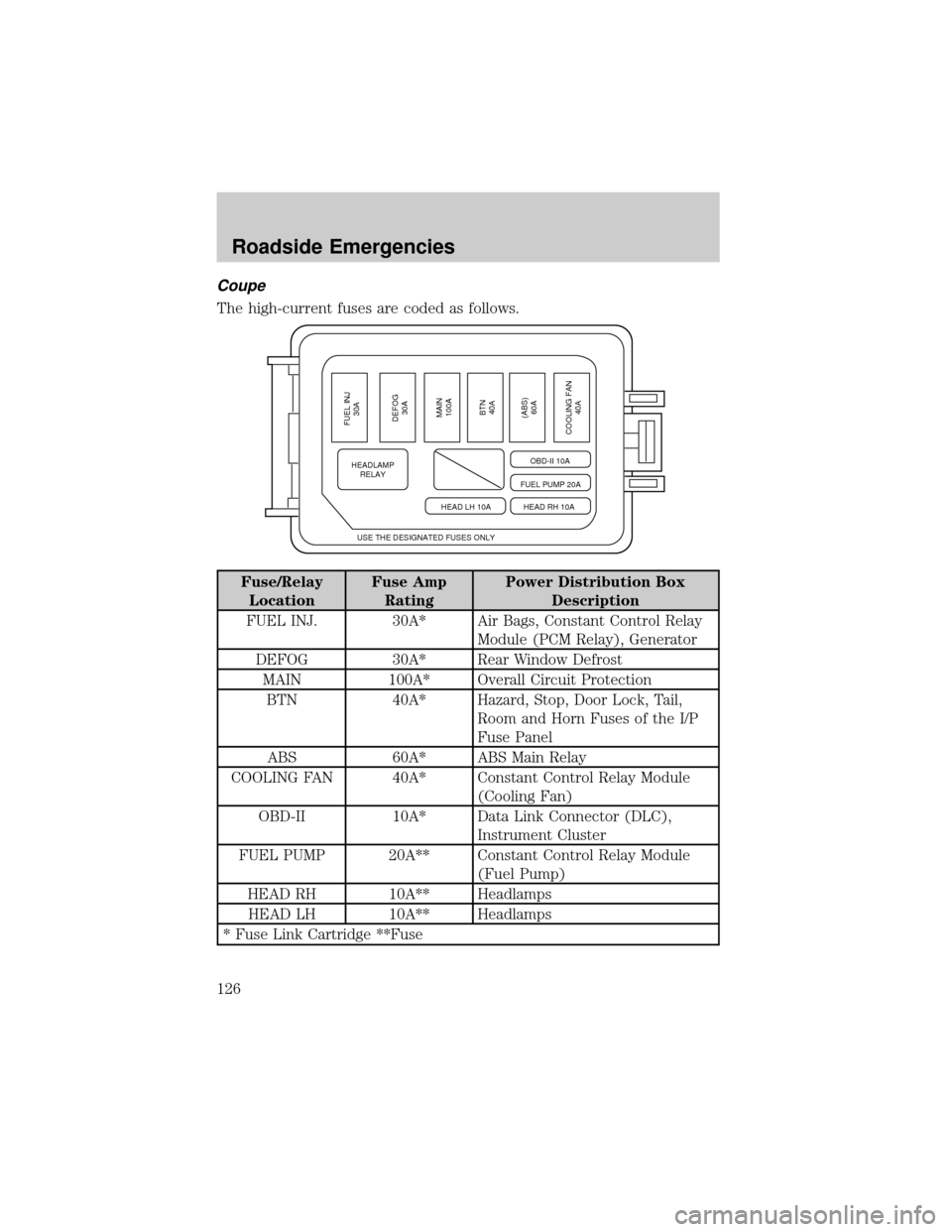
Coupe
The high-current fuses are coded as follows.
Fuse/Relay
LocationFuse Amp
RatingPower Distribution Box
Description
FUEL INJ. 30A* Air Bags, Constant Control Relay
Module (PCM Relay), Generator
DEFOG 30A* Rear Window Defrost
MAIN 100A* Overall Circuit Protection
BTN 40A* Hazard, Stop, Door Lock, Tail,
Room and Horn Fuses of the I/P
Fuse Panel
ABS 60A* ABS Main Relay
COOLING FAN 40A* Constant Control Relay Module
(Cooling Fan)
OBD-II 10A* Data Link Connector (DLC),
Instrument Cluster
FUEL PUMP 20A** Constant Control Relay Module
(Fuel Pump)
HEAD RH 10A** Headlamps
HEAD LH 10A** Headlamps
* Fuse Link Cartridge **Fuse
USE THE DESIGNATED FUSES ONLY
FUEL INJ
30A
DEFOG
30A
MAIN
100A
COOLING FAN
40A (ABS)
60A BTN
40A
HEADLAMP
RELAY
FUEL PUMP 20AOBD-II 10A
HEAD RH 10A HEAD LH 10A
Roadside Emergencies
126
Page 127 of 216
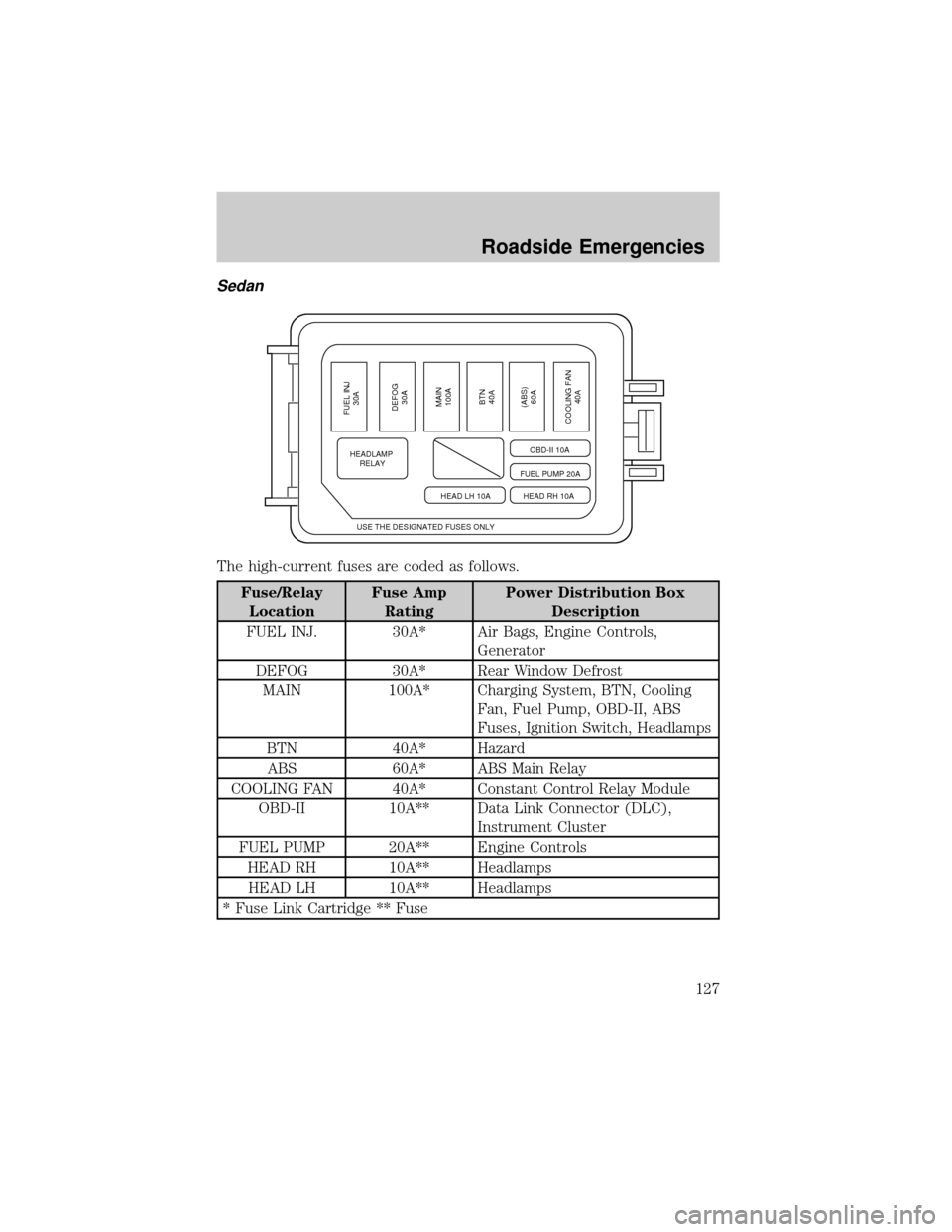
Sedan
The high-current fuses are coded as follows.
Fuse/Relay
LocationFuse Amp
RatingPower Distribution Box
Description
FUEL INJ. 30A* Air Bags, Engine Controls,
Generator
DEFOG 30A* Rear Window Defrost
MAIN 100A* Charging System, BTN, Cooling
Fan, Fuel Pump, OBD-II, ABS
Fuses, Ignition Switch, Headlamps
BTN 40A* Hazard
ABS 60A* ABS Main Relay
COOLING FAN 40A* Constant Control Relay Module
OBD-II 10A** Data Link Connector (DLC),
Instrument Cluster
FUEL PUMP 20A** Engine Controls
HEAD RH 10A** Headlamps
HEAD LH 10A** Headlamps
* Fuse Link Cartridge ** Fuse
USE THE DESIGNATED FUSES ONLY
FUEL INJ
30A
DEFOG
30A
MAIN
100A
COOLING FAN
40A (ABS)
60A BTN
40A
HEADLAMP
RELAY
FUEL PUMP 20AOBD-II 10A
HEAD RH 10A HEAD LH 10A
Roadside Emergencies
127
Page 176 of 216
Observe the following guidelines when handling automotive fuel:
²Extinguish all smoking materials
and any open flames before
fueling your vehicle.
²Always turn off the vehicle before
fueling.
²Automotive fuels can be harmful
or fatal if swallowed. Fuel such as
gasoline is highly toxic and if
swallowed can cause death or
permanent injury. If fuel is
swallowed, call a physician immediately, even if no symptoms are
immediately apparent. The toxic effects of fuel may not be visible for
hours.
²Avoid inhaling fuel vapors. Inhaling too much fuel vapor of any kind
can lead to eye and respiratory tract irritation. In severe cases,
excessive or prolonged breathing of fuel vapor can cause serious
illness and permanent injury.
²Avoid getting fuel liquid in your eyes. If fuel is splashed in the eyes,
remove contact lenses (if worn), flush with water for 15 minutes and
seek medical attention. Failure to seek proper medical attention could
lead to permanent injury.
²Fuels can also be harmful if absorbed through the skin. If fuel is
splashed on the skin and/or clothing, promptly remove contaminated
clothing and wash skin thoroughly with soap and water. Repeated or
prolonged skin contact with fuel liquid or vapor causes skin irritation.
²Be particularly careful if you are taking ªAntabuseº or other forms of
disulfiram for the treatment of alcoholism. Breathing gasoline vapors,
or skin contact could cause an adverse reaction. In sensitive
individuals, serious personal injury or sickness may result. If fuel is
splashed on the skin, promptly wash skin thoroughly with soap and
water. Consult a physician immediately if you experience an adverse
reaction.
When refueling always shut the engine off and never allow
sparks or open flames near the filler neck. Never smoke while
refueling. Fuel vapor is extremely hazardous under certain conditions.
Care should be taken to avoid inhaling excess fumes.
Maintenance and Specifications
176
Page 177 of 216
The flow of fuel through a fuel pump nozzle can produce static
electricity, which can cause a fire if fuel is pumped into an
ungrounded fuel container.
Use the following guidelines to avoid static build-up when filling an
ungrounded fuel container:
²Place approved fuel container on the ground.
²DO NOT fill a fuel container while it is in the vehicle (including the
cargo area).
²Keep the fuel pump nozzle in contact with the fuel container while
filling.
²DO NOT use a device that would hold the fuel pump handle in the fill
position.
Fuel Filler Cap
Your fuel tank filler cap has an indexed design with a 1/8 turn on/off
feature.
When fueling your vehicle:
1. Turn the engine off.
2. Carefully turn the filler cap counterclockwise 1/8 of a turn until it
stops.
3. Pull to remove the cap from the fuel filler pipe.
4. To install the cap, align the tabs on the cap with the notches on the
filler pipe.
5. Turn the filler cap clockwise 1/8 of a turn until it stops.
The ªCheck Fuel Capº light illuminates when the ignition is turned to the
ON position. It will also illuminate when the fuel filler cap is not properly
installed. Proper fuel filler cap installation is checked automatically as
the vehicle is driven, but not until after some fuel is used (fuel guage
drops below full). Once the fuel filler cap is properly secured, the ªCheck
Fuel Capº light will turn off after a short period of driving.
If you must replace the fuel filler cap, replace it with a fuel filler
cap that is designed for your vehicle. The customer warranty may
be void for any damage to the fuel tank or fuel system if the
correct genuine Ford or Motorcraft fuel filler cap is not used.
Maintenance and Specifications
177
Page 205 of 216

A
Air bag supplemental
restraint system ..........................85
and child safety seats ..............87
description ................................85
disposal ......................................89
driver air bag ............................87
indicator light .....................12, 89
operation ...................................87
passenger air bag .....................87
Air cleaner filter ...............190, 195
Air conditioning
manual heating and air
conditioning system .................38
Antifreeze
(see Engine coolant) ................169
Anti-lock brake system
(see Brakes) ......................102±103
Anti-theft system ..................69±70
arming the system ....................70
disarming a triggered
system .................................70±71
disarming an untriggered
system .......................................70
warning light .............................14
Automatic transaxle .................105
driving with .............................106
fluid, adding ............................187
fluid, checking ........................187
fluid, refill capacities ..............195
fluid, specification ..................198
Axle
lubricant specifications ..........196
B
Battery .......................................167
acid, treating emergencies .....167charging system
warning light .............................12
jumping a disabled battery ....132
maintenance-free ....................167
replacement, specifications ...195
servicing ..................................167
Belt minder .................................81
Brakes ........................................102
anti-lock ...........................102±103
anti-lock brake system
(ABS) warning light .........12, 103
brake warning light ..................12
fluid, checking and adding ....186
fluid, refill capacities ..............195
fluid, specifications .........196, 198
lubricant specifications ..196, 198
parking ....................................104
shift interlock ..........................105
Break-in period .............................6
C
Capacities for refilling fluids ....195
Certification Label ....................200
Child safety restraints ................90
child safety belts ......................90
Child safety seats ........................91
attaching with tether straps ....95
in front seat ..............................92
in rear seat ................................92
Cleaning your vehicle
engine compartment ..............150
exterior ....................................154
instrument cluster lens ..........153
instrument panel ....................152
interior .....................................153
plastic parts ....................151±152
safety belts ..............................154
washing ....................................148
Index
205