2002 DODGE RAM light
[x] Cancel search: lightPage 1933 of 2255
ASSEMBLY
BEARINGS AND SEALS
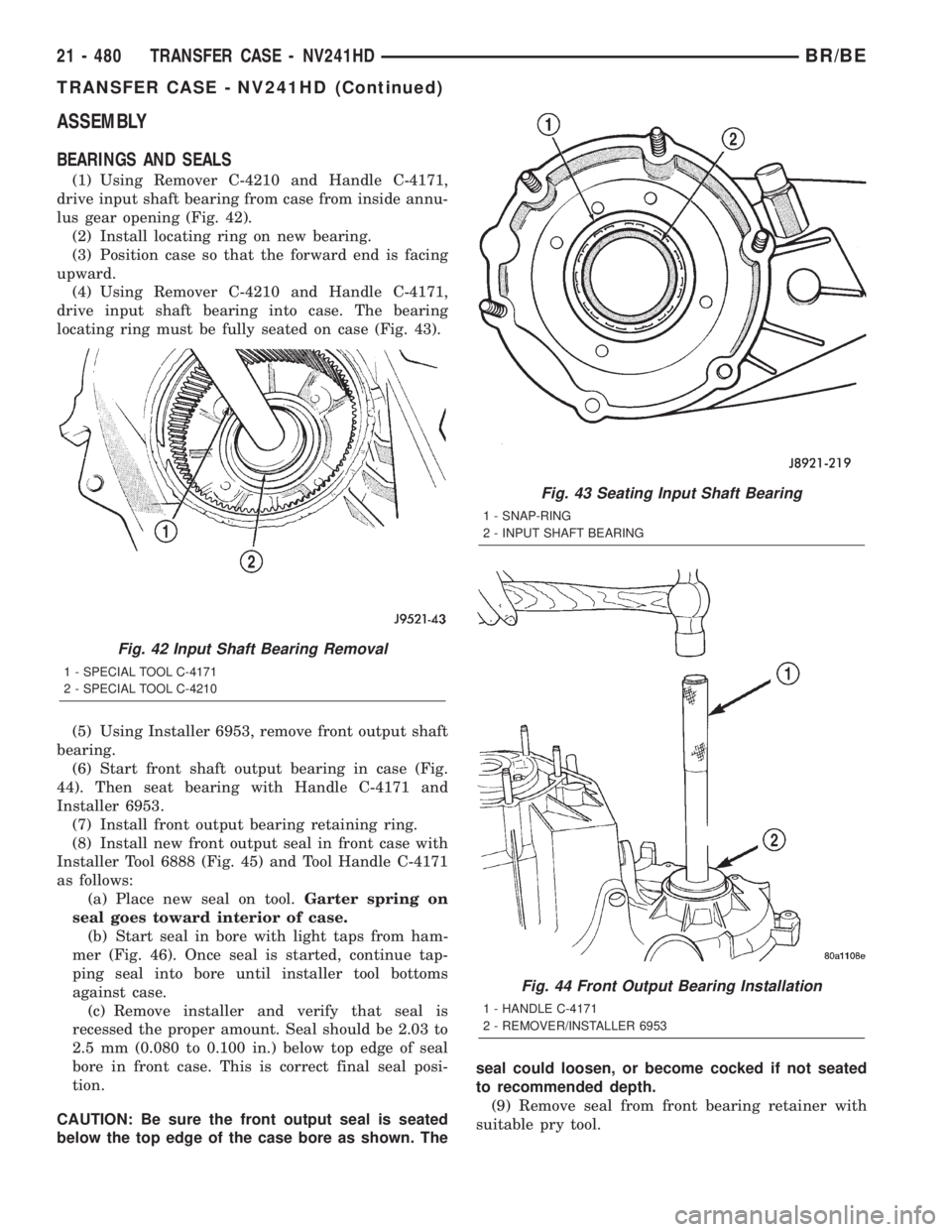
(1) Using Remover C-4210 and Handle C-4171,
drive input shaft bearing from case from inside annu-
lus gear opening (Fig. 42).
(2) Install locating ring on new bearing.
(3) Position case so that the forward end is facing
upward.
(4) Using Remover C-4210 and Handle C-4171,
drive input shaft bearing into case. The bearing
locating ring must be fully seated on case (Fig. 43).
(5) Using Installer 6953, remove front output shaft
bearing.
(6) Start front shaft output bearing in case (Fig.
44). Then seat bearing with Handle C-4171 and
Installer 6953.
(7) Install front output bearing retaining ring.
(8) Install new front output seal in front case with
Installer Tool 6888 (Fig. 45) and Tool Handle C-4171
as follows:
(a) Place new seal on tool.Garter spring on
seal goes toward interior of case.
(b) Start seal in bore with light taps from ham-
mer (Fig. 46). Once seal is started, continue tap-
ping seal into bore until installer tool bottoms
against case.
(c) Remove installer and verify that seal is
recessed the proper amount. Seal should be 2.03 to
2.5 mm (0.080 to 0.100 in.) below top edge of seal
bore in front case. This is correct final seal posi-
tion.
CAUTION: Be sure the front output seal is seated
below the top edge of the case bore as shown. Theseal could loosen, or become cocked if not seated
to recommended depth.
(9) Remove seal from front bearing retainer with
suitable pry tool.
Fig. 42 Input Shaft Bearing Removal
1 - SPECIAL TOOL C-4171
2 - SPECIAL TOOL C-4210
Fig. 43 Seating Input Shaft Bearing
1 - SNAP-RING
2 - INPUT SHAFT BEARING
Fig. 44 Front Output Bearing Installation
1 - HANDLE C-4171
2 - REMOVER/INSTALLER 6953
21 - 480 TRANSFER CASE - NV241HDBR/BE
TRANSFER CASE - NV241HD (Continued)
Page 1969 of 2255
DIAGNOSIS AND TESTING
DIAGNOSIS AND TESTING - WATER LEAKS
Water leaks can be caused by poor sealing,
improper body component alignment, body seam
porosity, missing plugs, or blocked drain holes. Cen-
trifugal and gravitational force can cause water to
drip from a location away from the actual leak point,
making leak detection difficult. All body sealing
points should be water tight in normal wet-driving
conditions. Water flowing downward from the front of
the vehicle should not enter the passenger or luggage
compartment. Moving sealing surfaces will not
always seal water tight under all conditions. At
times, side glass or door seals will allow water to
enter the passenger compartment during high pres-
sure washing or hard driving rain (severe) condi-
tions. Overcompensating on door or glass
adjustments to stop a water leak that occurs under
severe conditions can cause premature seal wear and
excessive closing or latching effort. After completing
a repair, water test vehicle to verify leak has stopped
before returning vehicle to use.
VISUAL INSPECTION BEFORE WATER LEAK TESTS
Verify that floor and body plugs are in place, body
drains are clear, and body components are properly
aligned and sealed. If component alignment or seal-
ing is necessary, refer to the appropriate section of
this group for proper procedures.
WATER LEAK TESTS
WARNING: DO NOT USE ELECTRIC SHOP LIGHTS
OR TOOLS IN WATER TEST AREA. PERSONAL
INJURY CAN RESULT.
When the conditions causing a water leak have
been determined, simulate the conditions as closely
as possible.
²If a leak occurs with the vehicle parked in a
steady light rain, flood the leak area with an open-
ended garden hose.²If a leak occurs while driving at highway speeds
in a steady rain, test the leak area with a reasonable
velocity stream or fan spray of water. Direct the
spray in a direction comparable to actual conditions.
²If a leak occurs when the vehicle is parked on an
incline, hoist the end or side of the vehicle to simu-
late this condition. This method can be used when
the leak occurs when the vehicle accelerates, stops or
turns. If the leak occurs on acceleration, hoist the
front of the vehicle. If the leak occurs when braking,
hoist the back of the vehicle. If the leak occurs on left
turns, hoist the left side of the vehicle. If the leak
occurs on right turns, hoist the right side of the vehi-
cle. For hoisting recommendations refer to Group 0,
Lubrication and Maintenance, General Information
section.
WATER LEAK DETECTION
To detect a water leak point-of-entry, do a water
test and watch for water tracks or droplets forming
on the inside of the vehicle. If necessary, remove inte-
rior trim covers or panels to gain visual access to the
leak area. If the hose cannot be positioned without
being held, have someone help do the water test.
Some water leaks must be tested for a considerable
length of time to become apparent. When a leak
appears, find the highest point of the water track or
drop. The highest point usually will show the point of
entry. After leak point has been found, repair the
leak and water test to verify that the leak has
stopped.
Locating the entry point of water that is leaking
into a cavity between panels can be difficult. The
trapped water may splash or run from the cavity,
often at a distance from the entry point. Most water
leaks of this type become apparent after accelerating,
stopping, turning, or when on an incline.
MIRROR INSPECTION METHOD
When a leak point area is visually obstructed, use
a suitable mirror to gain visual access. A mirror can
also be used to deflect light to a limited-access area
to assist in locating a leak point.
23 - 2 BODYBR/BE
BODY (Continued)
Page 1970 of 2255
BRIGHT LIGHT LEAK TEST METHOD
Some water leaks in the luggage compartment can
be detected without water testing. Position the vehi-
cle in a brightly lit area. From inside the darkened
luggage compartment inspect around seals and body
seams. If necessary, have a helper direct a drop light
over the suspected leak areas around the luggage
compartment. If light is visible through a normally
sealed location, water could enter through the open-
ing.
PRESSURIZED LEAK TEST METHOD
When a water leak into the passenger compart-
ment cannot be detected by water testing, pressurize
the passenger compartment and soap test exterior of
the vehicle. To pressurize the passenger compart-
ment, close all doors and windows, start engine, and
set heater control to high blower in HEAT position. If
engine can not be started, connect a charger to the
battery to ensure adequate voltage to the blower.
With interior pressurized, apply dish detergent solu-
tion to suspected leak area on the exterior of the
vehicle. Apply detergent solution with spray device or
soft bristle brush. If soap bubbles occur at a body
seam, joint, seal or gasket, the leak entry point could
be at that location.
DIAGNOSIS AND TESTING - WIND NOISE
Wind noise is the result of most air leaks. Air leaks
can be caused by poor sealing, improper body compo-
nent alignment, body seam porosity, or missing plugs
in the engine compartment or door hinge pillar areas.
All body sealing points should be airtight in normal
driving conditions. Moving sealing surfaces will not
always seal airtight under all conditions. At times,
side glass or door seals will allow wind noise to be
noticed in the passenger compartment during highcross winds. Over compensating on door or glass
adjustments to stop wind noise that occurs under
severe conditions can cause premature seal wear and
excessive closing or latching effort. After a repair pro-
cedure has been performed, test vehicle to verify
noise has stopped before returning vehicle to use.
Wind noise can also be caused by improperly fitted
exterior moldings or body ornamentation. Loose
moldings can flutter, creating a buzzing or chattering
noise. An open cavity or protruding edge can create a
whistling or howling noise. Inspect the exterior of the
vehicle to verify that these conditions do not exist.
VISUAL INSPECTION BEFORE TESTS
Verify that floor and body plugs are in place and
body components are aligned and sealed. If compo-
nent alignment or sealing is necessary, refer to the
appropriate section of this group for proper proce-
dures.
ROAD TESTING WIND NOISE
(1) Drive the vehicle to verify the general location
of the wind noise.
(2) Apply 50 mm (2 in.) masking tape in 150 mm
(6 in.) lengths along weatherstrips, weld seams or
moldings. After each length is applied, drive the vehi-
cle. If noise goes away after a piece of tape is applied,
remove tape, locate, and repair defect.
POSSIBLE CAUSE OF WIND NOISE
²Moldings standing away from body surface can
catch wind and whistle.
²Gaps in sealed areas behind overhanging body
flanges can cause wind-rushing sounds.
²Misaligned movable components.
²Missing or improperly installed plugs in pillars.
²Weld burn through holes.
BR/BEBODY 23 - 3
BODY (Continued)
Page 2034 of 2255
SLAM BUMPER
REMOVAL
(1) Open tailgate.
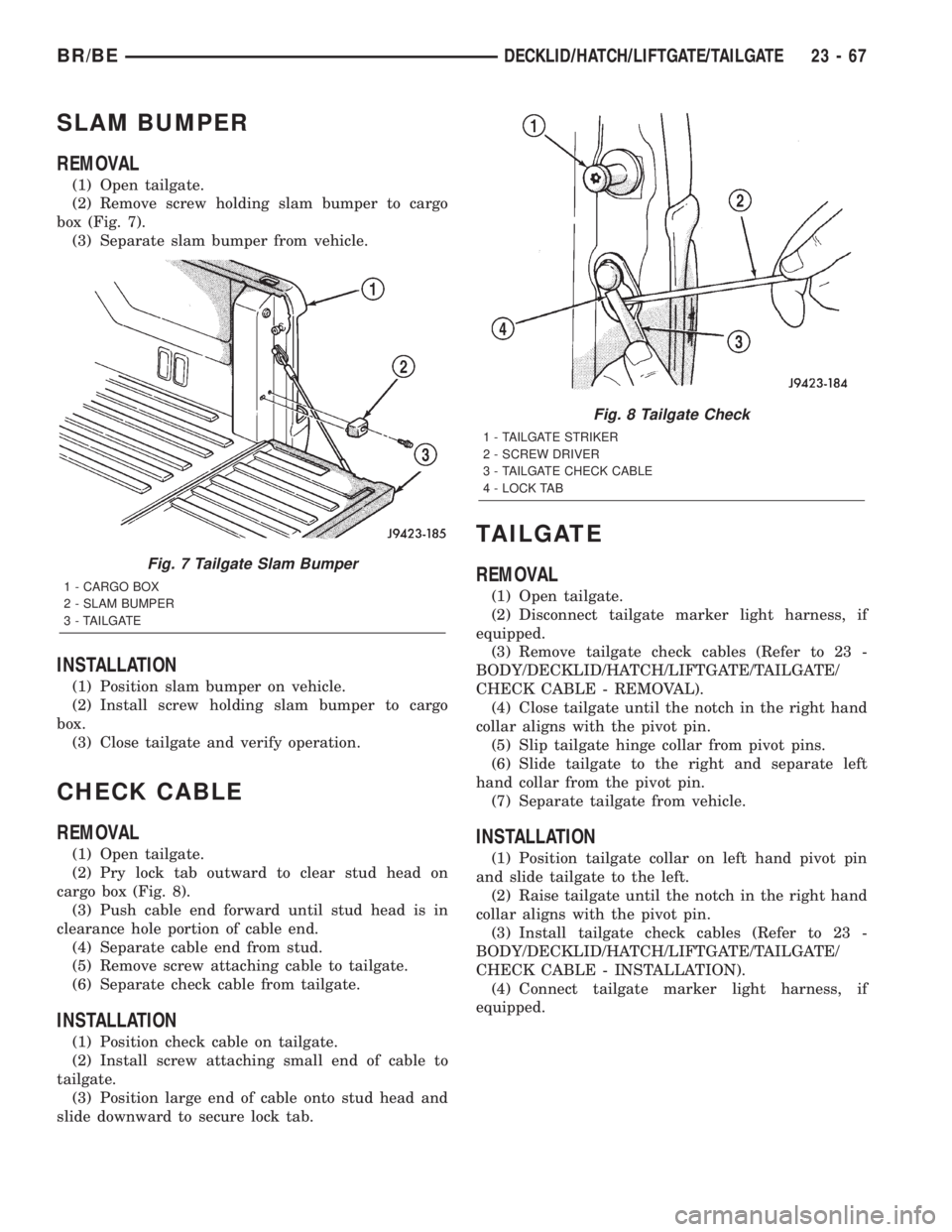
(2) Remove screw holding slam bumper to cargo
box (Fig. 7).
(3) Separate slam bumper from vehicle.
INSTALLATION
(1) Position slam bumper on vehicle.
(2) Install screw holding slam bumper to cargo
box.
(3) Close tailgate and verify operation.
CHECK CABLE
REMOVAL
(1) Open tailgate.
(2) Pry lock tab outward to clear stud head on
cargo box (Fig. 8).
(3) Push cable end forward until stud head is in
clearance hole portion of cable end.
(4) Separate cable end from stud.
(5) Remove screw attaching cable to tailgate.
(6) Separate check cable from tailgate.
INSTALLATION
(1) Position check cable on tailgate.
(2) Install screw attaching small end of cable to
tailgate.
(3) Position large end of cable onto stud head and
slide downward to secure lock tab.
TAILGATE
REMOVAL
(1) Open tailgate.
(2) Disconnect tailgate marker light harness, if
equipped.
(3) Remove tailgate check cables (Refer to 23 -
BODY/DECKLID/HATCH/LIFTGATE/TAILGATE/
CHECK CABLE - REMOVAL).
(4) Close tailgate until the notch in the right hand
collar aligns with the pivot pin.
(5) Slip tailgate hinge collar from pivot pins.
(6) Slide tailgate to the right and separate left
hand collar from the pivot pin.
(7) Separate tailgate from vehicle.
INSTALLATION
(1) Position tailgate collar on left hand pivot pin
and slide tailgate to the left.
(2) Raise tailgate until the notch in the right hand
collar aligns with the pivot pin.
(3) Install tailgate check cables (Refer to 23 -
BODY/DECKLID/HATCH/LIFTGATE/TAILGATE/
CHECK CABLE - INSTALLATION).
(4) Connect tailgate marker light harness, if
equipped.
Fig. 7 Tailgate Slam Bumper
1 - CARGO BOX
2 - SLAM BUMPER
3 - TAILGATE
Fig. 8 Tailgate Check
1 - TAILGATE STRIKER
2 - SCREW DRIVER
3 - TAILGATE CHECK CABLE
4 - LOCK TAB
BR/BEDECKLID/HATCH/LIFTGATE/TAILGATE 23 - 67
Page 2054 of 2255
INSTALLATION
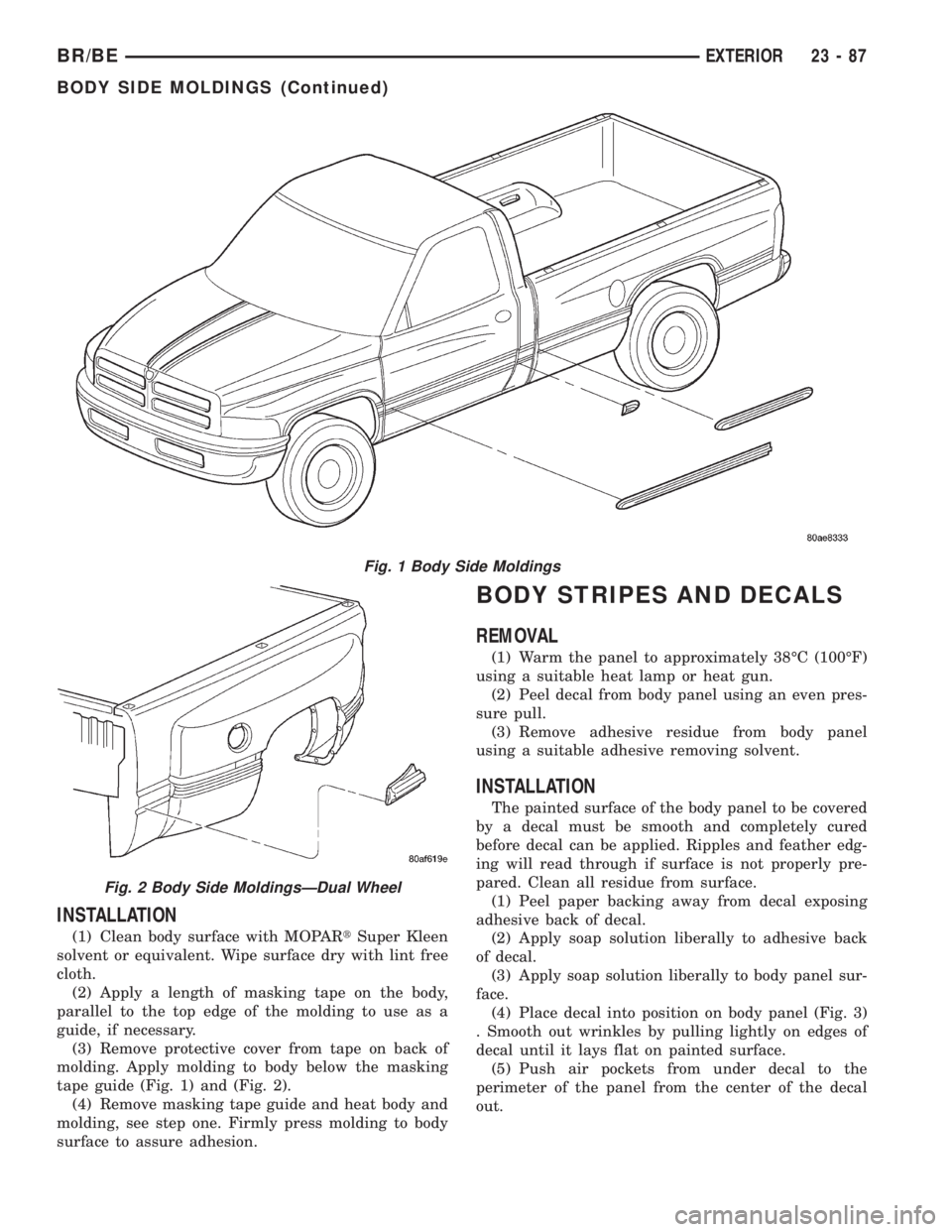
(1) Clean body surface with MOPARtSuper Kleen
solvent or equivalent. Wipe surface dry with lint free
cloth.
(2) Apply a length of masking tape on the body,
parallel to the top edge of the molding to use as a
guide, if necessary.
(3) Remove protective cover from tape on back of
molding. Apply molding to body below the masking
tape guide (Fig. 1) and (Fig. 2).
(4) Remove masking tape guide and heat body and
molding, see step one. Firmly press molding to body
surface to assure adhesion.
BODY STRIPES AND DECALS
REMOVAL
(1) Warm the panel to approximately 38ÉC (100ÉF)
using a suitable heat lamp or heat gun.
(2) Peel decal from body panel using an even pres-
sure pull.
(3) Remove adhesive residue from body panel
using a suitable adhesive removing solvent.
INSTALLATION
The painted surface of the body panel to be covered
by a decal must be smooth and completely cured
before decal can be applied. Ripples and feather edg-
ing will read through if surface is not properly pre-
pared. Clean all residue from surface.
(1) Peel paper backing away from decal exposing
adhesive back of decal.
(2) Apply soap solution liberally to adhesive back
of decal.
(3) Apply soap solution liberally to body panel sur-
face.
(4) Place decal into position on body panel (Fig. 3)
. Smooth out wrinkles by pulling lightly on edges of
decal until it lays flat on painted surface.
(5) Push air pockets from under decal to the
perimeter of the panel from the center of the decal
out.
Fig. 1 Body Side Moldings
Fig. 2 Body Side MoldingsÐDual Wheel
BR/BEEXTERIOR 23 - 87
BODY SIDE MOLDINGS (Continued)
Page 2056 of 2255
INSTALLATION
The painted surface of the body panel to be covered
by a tape stripe overlay must be smooth and com-
pletely cured before overlay can be applied. If painted
surface is not smooth, wet sand with 600 grit wet/dry
sand paper until surface is smooth. Ripples and
feather edging will read through overlay if surface is
not properly prepared. Clean all residue from sur-
face.
Installation equipment:
²Pail filled with mild dish soap solution.
²Lint free applicator cloth or sponge.
²Body putty applicator squeegee.
²Heat gun or sun lamp.
²Razor knife.
(1) Spread replacement tape stripe overlay across
a smooth flat work surface, finish side down.
(2) Peel paper backing away from overlay exposing
adhesive back of overlay.
(3) Apply soap solution liberally to adhesive back
of overlay.
(4) Apply soap solution liberally to body panel sur-
face.
(5) Place overlay into position on body panel.
Smooth out wrinkles by pulling lightly on edges of
overlay until it lays flat on painted surface.
(6) Push air pockets from under overlay to the
perimeter of the panel from the center of the overlay
out.
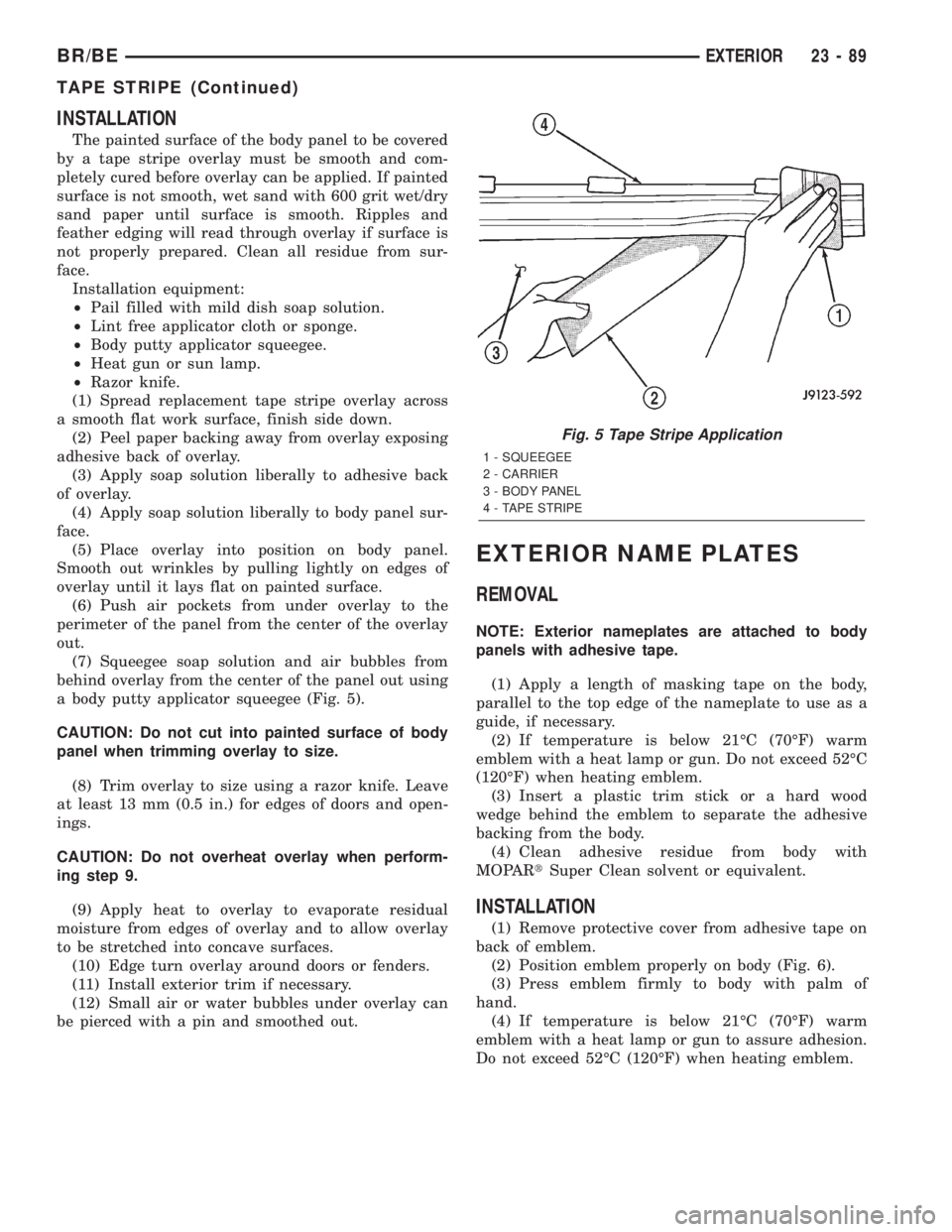
(7) Squeegee soap solution and air bubbles from
behind overlay from the center of the panel out using
a body putty applicator squeegee (Fig. 5).
CAUTION: Do not cut into painted surface of body
panel when trimming overlay to size.
(8) Trim overlay to size using a razor knife. Leave
at least 13 mm (0.5 in.) for edges of doors and open-
ings.
CAUTION: Do not overheat overlay when perform-
ing step 9.
(9) Apply heat to overlay to evaporate residual
moisture from edges of overlay and to allow overlay
to be stretched into concave surfaces.
(10) Edge turn overlay around doors or fenders.
(11) Install exterior trim if necessary.
(12) Small air or water bubbles under overlay can
be pierced with a pin and smoothed out.
EXTERIOR NAME PLATES
REMOVAL
NOTE: Exterior nameplates are attached to body
panels with adhesive tape.
(1) Apply a length of masking tape on the body,
parallel to the top edge of the nameplate to use as a
guide, if necessary.
(2) If temperature is below 21ÉC (70ÉF) warm
emblem with a heat lamp or gun. Do not exceed 52ÉC
(120ÉF) when heating emblem.
(3) Insert a plastic trim stick or a hard wood
wedge behind the emblem to separate the adhesive
backing from the body.
(4) Clean adhesive residue from body with
MOPARtSuper Clean solvent or equivalent.
INSTALLATION
(1) Remove protective cover from adhesive tape on
back of emblem.
(2) Position emblem properly on body (Fig. 6).
(3) Press emblem firmly to body with palm of
hand.
(4) If temperature is below 21ÉC (70ÉF) warm
emblem with a heat lamp or gun to assure adhesion.
Do not exceed 52ÉC (120ÉF) when heating emblem.
Fig. 5 Tape Stripe Application
1 - SQUEEGEE
2 - CARRIER
3 - BODY PANEL
4 - TAPE STRIPE
BR/BEEXTERIOR 23 - 89
TAPE STRIPE (Continued)
Page 2062 of 2255
FUEL FILL DOOR
REMOVAL
(1) Open fuel fill door.
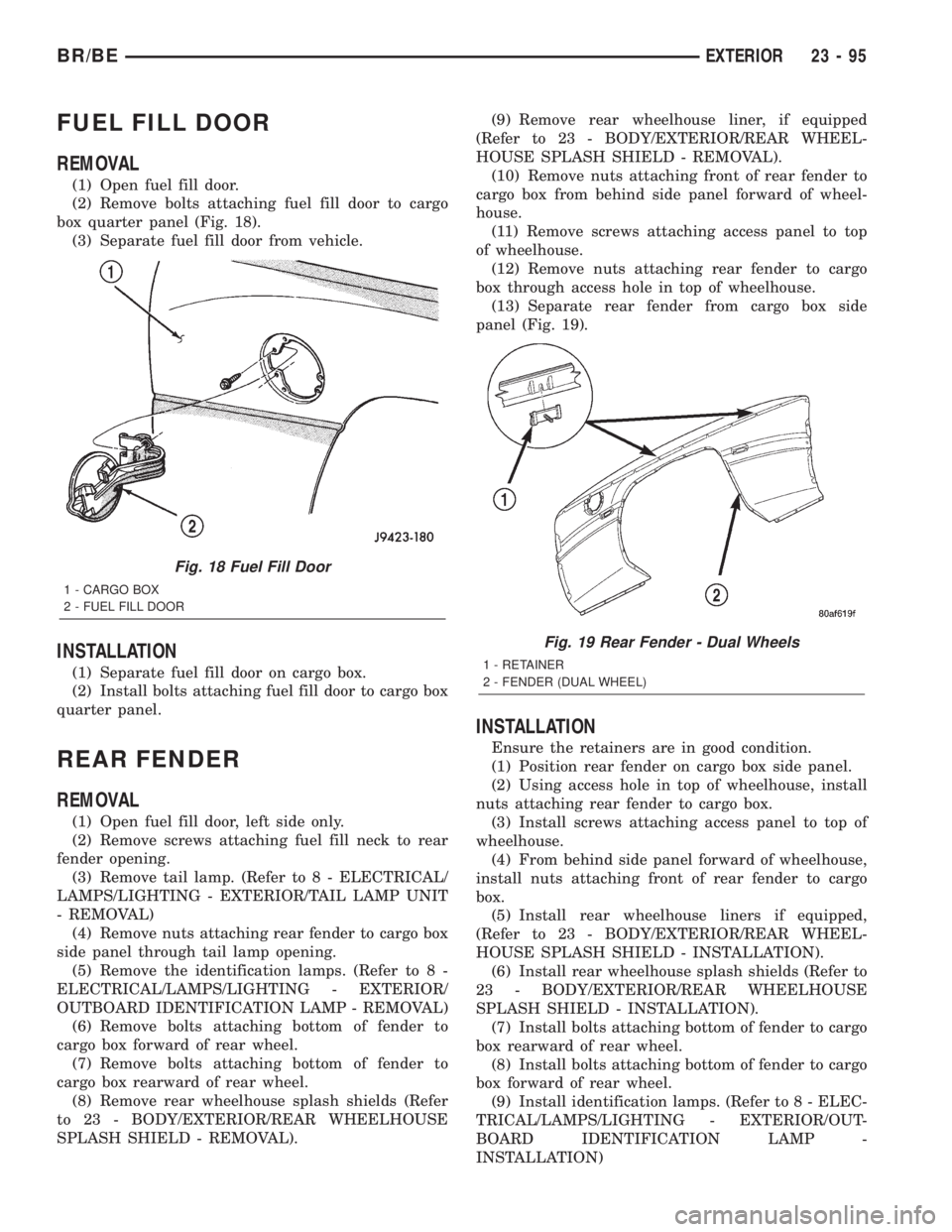
(2) Remove bolts attaching fuel fill door to cargo
box quarter panel (Fig. 18).
(3) Separate fuel fill door from vehicle.
INSTALLATION
(1) Separate fuel fill door on cargo box.
(2) Install bolts attaching fuel fill door to cargo box
quarter panel.
REAR FENDER
REMOVAL
(1) Open fuel fill door, left side only.
(2) Remove screws attaching fuel fill neck to rear
fender opening.
(3) Remove tail lamp. (Refer to 8 - ELECTRICAL/
LAMPS/LIGHTING - EXTERIOR/TAIL LAMP UNIT
- REMOVAL)
(4) Remove nuts attaching rear fender to cargo box
side panel through tail lamp opening.
(5) Remove the identification lamps. (Refer to 8 -
ELECTRICAL/LAMPS/LIGHTING - EXTERIOR/
OUTBOARD IDENTIFICATION LAMP - REMOVAL)
(6) Remove bolts attaching bottom of fender to
cargo box forward of rear wheel.
(7) Remove bolts attaching bottom of fender to
cargo box rearward of rear wheel.
(8) Remove rear wheelhouse splash shields (Refer
to 23 - BODY/EXTERIOR/REAR WHEELHOUSE
SPLASH SHIELD - REMOVAL).(9) Remove rear wheelhouse liner, if equipped
(Refer to 23 - BODY/EXTERIOR/REAR WHEEL-
HOUSE SPLASH SHIELD - REMOVAL).
(10) Remove nuts attaching front of rear fender to
cargo box from behind side panel forward of wheel-
house.
(11) Remove screws attaching access panel to top
of wheelhouse.
(12) Remove nuts attaching rear fender to cargo
box through access hole in top of wheelhouse.
(13) Separate rear fender from cargo box side
panel (Fig. 19).
INSTALLATION
Ensure the retainers are in good condition.
(1) Position rear fender on cargo box side panel.
(2) Using access hole in top of wheelhouse, install
nuts attaching rear fender to cargo box.
(3) Install screws attaching access panel to top of
wheelhouse.
(4) From behind side panel forward of wheelhouse,
install nuts attaching front of rear fender to cargo
box.
(5) Install rear wheelhouse liners if equipped,
(Refer to 23 - BODY/EXTERIOR/REAR WHEEL-
HOUSE SPLASH SHIELD - INSTALLATION).
(6) Install rear wheelhouse splash shields (Refer to
23 - BODY/EXTERIOR/REAR WHEELHOUSE
SPLASH SHIELD - INSTALLATION).
(7) Install bolts attaching bottom of fender to cargo
box rearward of rear wheel.
(8) Install bolts attaching bottom of fender to cargo
box forward of rear wheel.
(9) Install identification lamps. (Refer to 8 - ELEC-
TRICAL/LAMPS/LIGHTING - EXTERIOR/OUT-
BOARD IDENTIFICATION LAMP -
INSTALLATION)
Fig. 18 Fuel Fill Door
1 - CARGO BOX
2 - FUEL FILL DOOR
Fig. 19 Rear Fender - Dual Wheels
1 - RETAINER
2 - FENDER (DUAL WHEEL)
BR/BEEXTERIOR 23 - 95
Page 2063 of 2255
(10) Using tail lamp opening, install nuts attach-
ing rear fender to cargo box side panel.
(11) Install tail lamp. (Refer to 8 - ELECTRICAL/
LAMPS/LIGHTING - EXTERIOR/TAIL LAMP UNIT
- INSTALLATION)
(12) Install screws attaching fuel fill neck to rear
fender opening.
REAR SPLASH SHIELD
REMOVAL
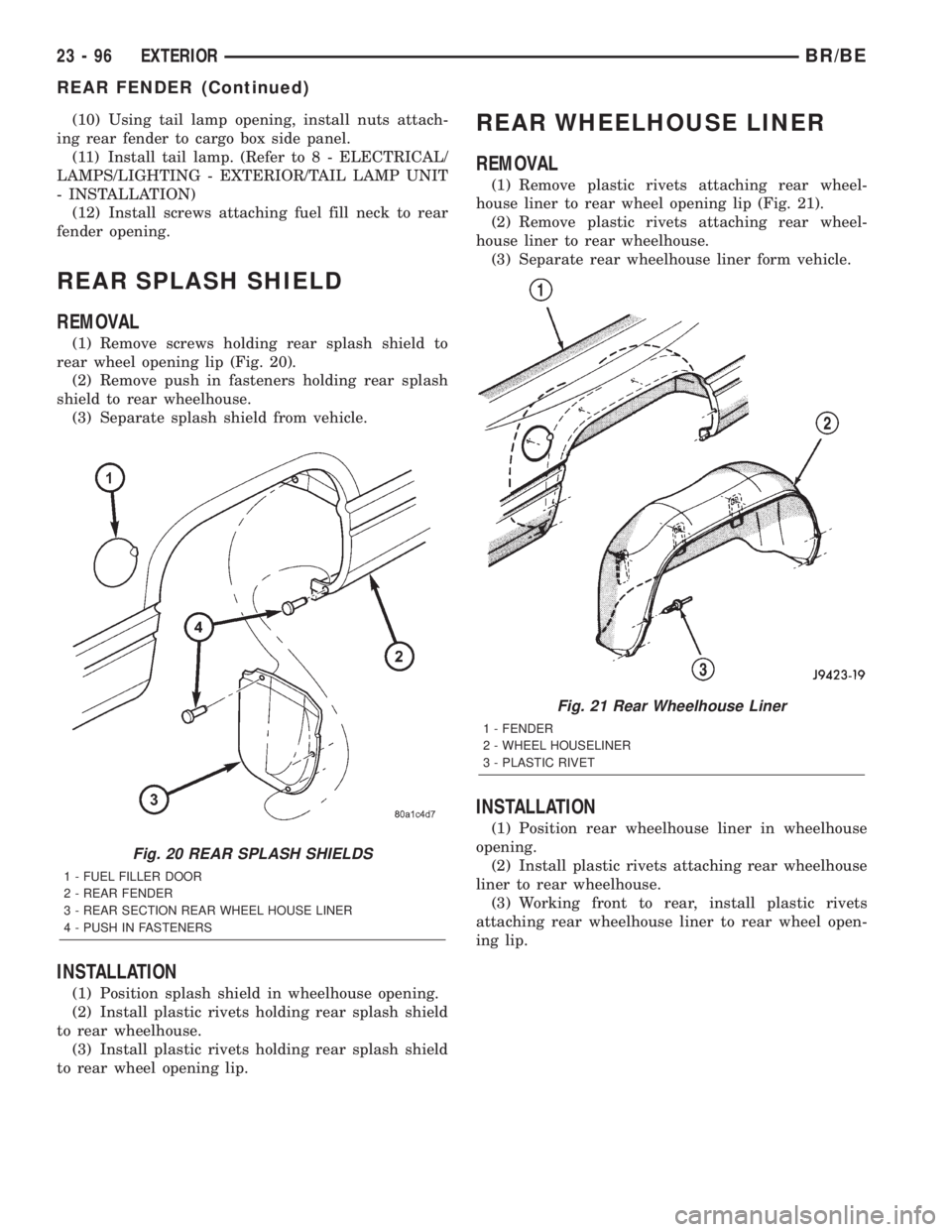
(1) Remove screws holding rear splash shield to
rear wheel opening lip (Fig. 20).
(2) Remove push in fasteners holding rear splash
shield to rear wheelhouse.
(3) Separate splash shield from vehicle.
INSTALLATION
(1) Position splash shield in wheelhouse opening.
(2) Install plastic rivets holding rear splash shield
to rear wheelhouse.
(3) Install plastic rivets holding rear splash shield
to rear wheel opening lip.
REAR WHEELHOUSE LINER
REMOVAL
(1) Remove plastic rivets attaching rear wheel-
house liner to rear wheel opening lip (Fig. 21).
(2) Remove plastic rivets attaching rear wheel-
house liner to rear wheelhouse.
(3) Separate rear wheelhouse liner form vehicle.
INSTALLATION
(1) Position rear wheelhouse liner in wheelhouse
opening.
(2) Install plastic rivets attaching rear wheelhouse
liner to rear wheelhouse.
(3) Working front to rear, install plastic rivets
attaching rear wheelhouse liner to rear wheel open-
ing lip.
Fig. 20 REAR SPLASH SHIELDS
1 - FUEL FILLER DOOR
2 - REAR FENDER
3 - REAR SECTION REAR WHEEL HOUSE LINER
4 - PUSH IN FASTENERS
Fig. 21 Rear Wheelhouse Liner
1 - FENDER
2 - WHEEL HOUSELINER
3 - PLASTIC RIVET
23 - 96 EXTERIORBR/BE
REAR FENDER (Continued)