2002 DODGE RAM fuses
[x] Cancel search: fusesPage 1064 of 2255
to service. Refer toCharging Systemin the index of
this service manual for the charging system diagnos-
tic procedures.
(1) Position the generator cartridge fuse onto the
two B(+) terminal stud bus bars within the PDC.
(2) Install and tighten the two screws that secure
the generator cartridge fuse to the two B(+) terminal
stud bus bars within the PDC. Tighten the screws to
3.4 N´m (30 in. lbs.).Be certain that both screws
are tightened to the proper torque value.
(3) Install and latch the cover onto the PDC.
(4) Reconnect the battery negative cable.
IOD FUSE
DESCRIPTION
All vehicles are equipped with an Ignition-Off
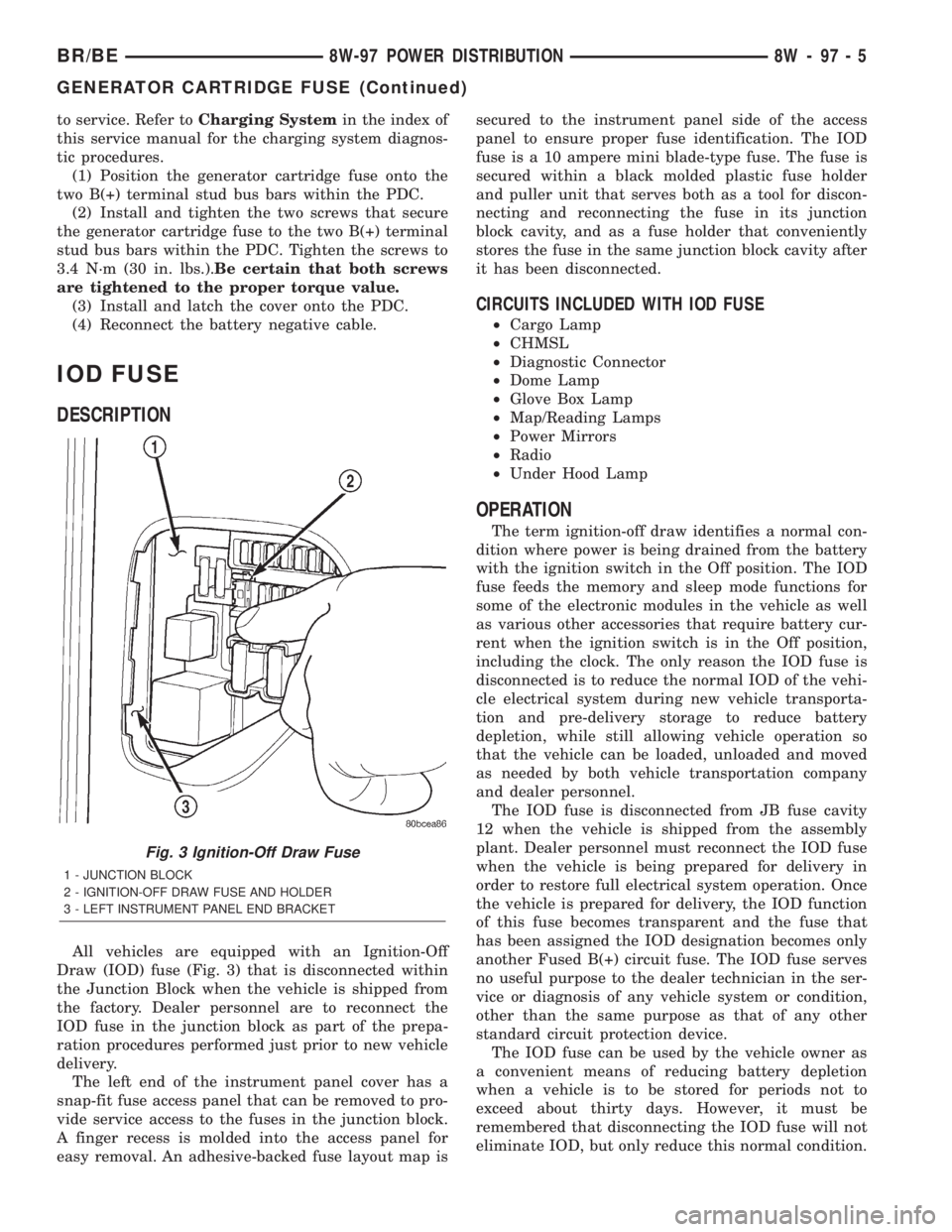
Draw (IOD) fuse (Fig. 3) that is disconnected within
the Junction Block when the vehicle is shipped from
the factory. Dealer personnel are to reconnect the
IOD fuse in the junction block as part of the prepa-
ration procedures performed just prior to new vehicle
delivery.
The left end of the instrument panel cover has a
snap-fit fuse access panel that can be removed to pro-
vide service access to the fuses in the junction block.
A finger recess is molded into the access panel for
easy removal. An adhesive-backed fuse layout map issecured to the instrument panel side of the access
panel to ensure proper fuse identification. The IOD
fuse is a 10 ampere mini blade-type fuse. The fuse is
secured within a black molded plastic fuse holder
and puller unit that serves both as a tool for discon-
necting and reconnecting the fuse in its junction
block cavity, and as a fuse holder that conveniently
stores the fuse in the same junction block cavity after
it has been disconnected.
CIRCUITS INCLUDED WITH IOD FUSE
²Cargo Lamp
²CHMSL
²Diagnostic Connector
²Dome Lamp
²Glove Box Lamp
²Map/Reading Lamps
²Power Mirrors
²Radio
²Under Hood Lamp
OPERATION
The term ignition-off draw identifies a normal con-
dition where power is being drained from the battery
with the ignition switch in the Off position. The IOD
fuse feeds the memory and sleep mode functions for
some of the electronic modules in the vehicle as well
as various other accessories that require battery cur-
rent when the ignition switch is in the Off position,
including the clock. The only reason the IOD fuse is
disconnected is to reduce the normal IOD of the vehi-
cle electrical system during new vehicle transporta-
tion and pre-delivery storage to reduce battery
depletion, while still allowing vehicle operation so
that the vehicle can be loaded, unloaded and moved
as needed by both vehicle transportation company
and dealer personnel.
The IOD fuse is disconnected from JB fuse cavity
12 when the vehicle is shipped from the assembly
plant. Dealer personnel must reconnect the IOD fuse
when the vehicle is being prepared for delivery in
order to restore full electrical system operation. Once
the vehicle is prepared for delivery, the IOD function
of this fuse becomes transparent and the fuse that
has been assigned the IOD designation becomes only
another Fused B(+) circuit fuse. The IOD fuse serves
no useful purpose to the dealer technician in the ser-
vice or diagnosis of any vehicle system or condition,
other than the same purpose as that of any other
standard circuit protection device.
The IOD fuse can be used by the vehicle owner as
a convenient means of reducing battery depletion
when a vehicle is to be stored for periods not to
exceed about thirty days. However, it must be
remembered that disconnecting the IOD fuse will not
eliminate IOD, but only reduce this normal condition.
Fig. 3 Ignition-Off Draw Fuse
1 - JUNCTION BLOCK
2 - IGNITION-OFF DRAW FUSE AND HOLDER
3 - LEFT INSTRUMENT PANEL END BRACKET
BR/BE8W-97 POWER DISTRIBUTION 8W - 97 - 5
GENERATOR CARTRIDGE FUSE (Continued)
Page 1066 of 2255
tor between many of the engine compartment, instru-
ment panel, and body wire harnesses. The JB houses
up to nineteen blade-type fuses (two standard-type
and seventeen mini-type), up to two blade-type auto-
matic resetting circuit breakers, the electronic combi-
nation turn signal and hazard warning flasher, and
one International Standards Organization (ISO)
micro-relay.
The molded plastic JB housing has integral mount-
ing brackets that are secured with two screws to the
left instrument panel end bracket. The left end of the
instrument panel cover has a snap-fit fuse access
panel that can be removed for service of the JB. A
fuse puller and spare fuse holders are located on the
back of the fuse access cover, as well as an adhesive-
backed fuse layout map to ensure proper fuse identi-
fication.
The JB unit cannot be repaired and is only ser-
viced as an assembly. If any internal circuit or the JB
housing is faulty or damaged, the entire JB unit
must be replaced.
OPERATION
All of the circuits entering and leaving the JB do
so through up to nine wire harness connectors, which
are connected to the JB through integral connector
receptacles molded into the JB housing. Internal con-
nection of all of the JB circuits is accomplished by an
intricate combination of hard wiring and bus bars.
Refer toWiring Diagramsfor the location of com-
plete JB circuit diagrams.
DIAGNOSIS AND TESTING - JUNCTION BLOCK
The junction block does not incorporate any self
diagnostic capability. Most of the electrical circuits
incorporated into the vehicle must pass through the
junction block at one point or another. The most effi-
cient means of diagnosing a suspected junction block
problem involves a simple continuity tester or ohm
meter. Using the Wiring Diagrams as a guide trace
the problem circuit to the proper junction block cav-
ity and test all circuits in the effected circuit for
proper continuity. A open or high resistance circuit is
a sign of a problem. Some other possible junction
block problems to look for are:
²Loose fuse receptacle terminals.
²Loose relay / circuit breaker receptacle termi-
nals.
²Bent or distorted electrical circuit pins.
²Incorrect size fuse installed in junction block
fuse cavity.
²Dark areas identifying a source of excess heat.
²Defective fuse, relay or circuit breaker installed
in junction block cavity.
REMOVAL
(1) Disconnect and isolate the battery negative
cable.
(2) Remove the fuse access bezel from the instru-
ment panel.
(3) Remove the steering column cover (Refer to 23
- BODY/INSTRUMENT PANEL/STEERING COL-
UMN OPENING COVER - REMOVAL).
(4) Remove the hood release handle retaining
screws and position the handle assembly out of the
way.
(5) Remove the lower knee blocker from the instru-
ment panel.
(6) Pull drivers side carpet down, out of the way.
(7) Remove the parking brake switch connector,
release linkage and retaining fasteners and position
the assembly out the drivers door opening.
(8) Remove the electrical ground connections,
located behind park brake mounting location.
(9) Remove the two junction block retaining
screws. To access the upper retaining screw a 15 inch
long #2 Phillips screwdriver will be required. Access
the upper screw through hole in dash support brace.
(10) Reach through the outboard side of the instru-
ment panel steering column opening to access and
disconnect all of the wire harness connectors from
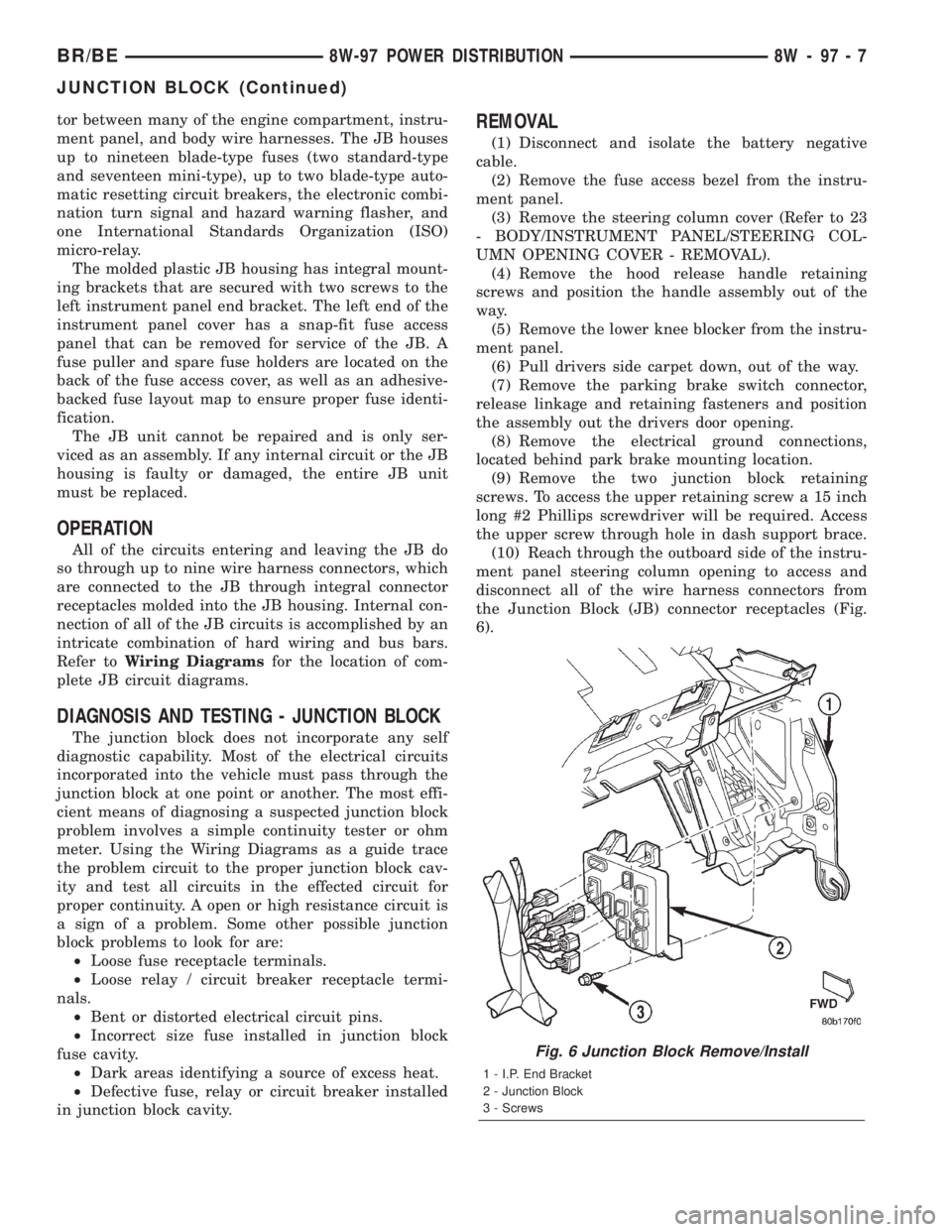
the Junction Block (JB) connector receptacles (Fig.
6).
Fig. 6 Junction Block Remove/Install
1 - I.P. End Bracket
2 - Junction Block
3 - Screws
BR/BE8W-97 POWER DISTRIBUTION 8W - 97 - 7
JUNCTION BLOCK (Continued)
Page 1067 of 2255
(11) Remove the junction block from under the
instrument panel.
INSTALLATION
NOTE: If the Junction Block (JB) is being replaced
with a new unit, be certain to transfer each of the
fuses, circuit breakers and relays from the faulty JB
to the proper cavities of the replacement JB. Refer
to Junction Block in the index of this service man-
ual for the location of complete circuit diagrams
and cavity assignments for the JB.
(1) Position the junction block under the instru-
ment panel.
(2) Connect all of the wire harness connectors on
the Junction Block (JB) connector receptacles.
(3) Install the two junction block retaining screws.
(4) Install the electrical ground connections,
located behind park brake mounting location.
(5) Install the parking brake switch connector,
release linkage and retaining fasteners.
(6) Reposition drivers side carpet.
(7) Install the lower knee blocker on the instru-
ment panel.
(8) Install the hood release handle retaining
screws.
(9) Install the steering column cover.
(10) Install the fuse access bezel on the instrument
panel.
(11) Connect the battery negative cable.
POWER DISTRIBUTION
CENTER
DESCRIPTION
All of the electrical current distributed throughout
this vehicle is directed through the standard equip-
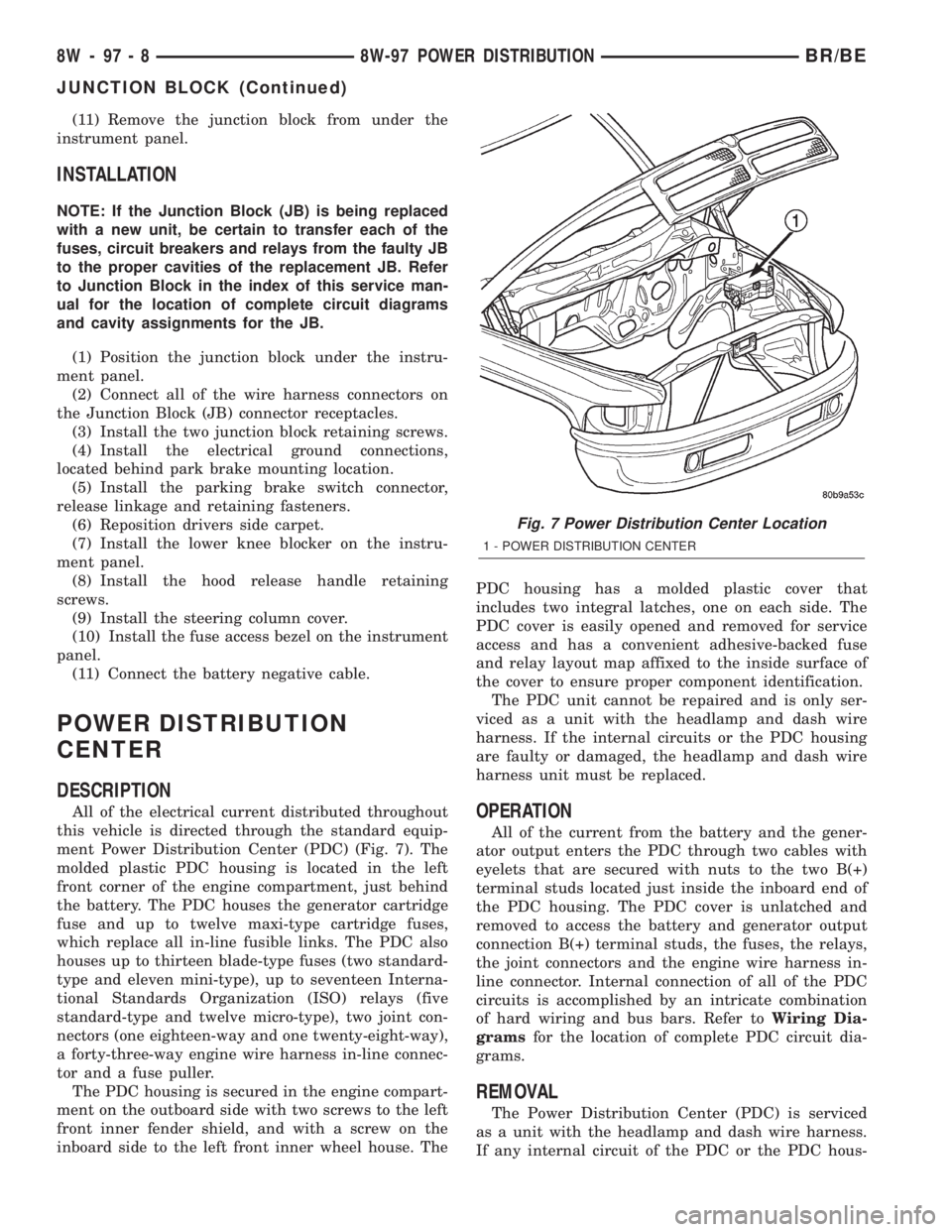
ment Power Distribution Center (PDC) (Fig. 7). The
molded plastic PDC housing is located in the left
front corner of the engine compartment, just behind
the battery. The PDC houses the generator cartridge
fuse and up to twelve maxi-type cartridge fuses,
which replace all in-line fusible links. The PDC also
houses up to thirteen blade-type fuses (two standard-
type and eleven mini-type), up to seventeen Interna-
tional Standards Organization (ISO) relays (five
standard-type and twelve micro-type), two joint con-
nectors (one eighteen-way and one twenty-eight-way),
a forty-three-way engine wire harness in-line connec-
tor and a fuse puller.
The PDC housing is secured in the engine compart-
ment on the outboard side with two screws to the left
front inner fender shield, and with a screw on the
inboard side to the left front inner wheel house. ThePDC housing has a molded plastic cover that
includes two integral latches, one on each side. The
PDC cover is easily opened and removed for service
access and has a convenient adhesive-backed fuse
and relay layout map affixed to the inside surface of
the cover to ensure proper component identification.
The PDC unit cannot be repaired and is only ser-
viced as a unit with the headlamp and dash wire
harness. If the internal circuits or the PDC housing
are faulty or damaged, the headlamp and dash wire
harness unit must be replaced.OPERATION
All of the current from the battery and the gener-
ator output enters the PDC through two cables with
eyelets that are secured with nuts to the two B(+)
terminal studs located just inside the inboard end of
the PDC housing. The PDC cover is unlatched and
removed to access the battery and generator output
connection B(+) terminal studs, the fuses, the relays,
the joint connectors and the engine wire harness in-
line connector. Internal connection of all of the PDC
circuits is accomplished by an intricate combination
of hard wiring and bus bars. Refer toWiring Dia-
gramsfor the location of complete PDC circuit dia-
grams.
REMOVAL
The Power Distribution Center (PDC) is serviced
as a unit with the headlamp and dash wire harness.
If any internal circuit of the PDC or the PDC hous-
Fig. 7 Power Distribution Center Location
1 - POWER DISTRIBUTION CENTER
8W - 97 - 8 8W-97 POWER DISTRIBUTIONBR/BE
JUNCTION BLOCK (Continued)
Page 1069 of 2255
INSTALLATION
The Power Distribution Center (PDC) is serviced
as a unit with the headlamp and dash wire harness.
If any internal circuit of the PDC or the PDC hous-
ing is faulty or damaged, the entire PDC and head-
lamp and dash wire harness unit must be replaced.
NOTE: If the PDC is being replaced with a new unit,
be certain to transfer each of the blade-type fuses,
cartridge fuses and relays from the faulty PDC to
the proper cavities of the replacement PDC. Refer
to Power Distribution in the index of this service
manual for the location of complete PDC circuit dia-
grams and cavity assignments.
(1) Position the PDC and the headlamp and dash
wire harness unit in the engine compartment.
(2) Install and tighten the two screws that secure
the PDC housing to the left front fender inner shield.
Tighten the screws to 8.4 N´m (75 in. lbs.).
(3) Install and tighten the screw that secures the
PDC housing to the left front fender wheel housing.
Tighten the screw to 2.2 N´m (20 in. lbs.).
(4) Install the eyelet of the battery positive cable
PDC take out onto the forward B(+) terminal stud in
the PDC.
(5) Install and tighten the nut that secures the
eyelet of the battery positive cable PDC take out to
the forward B(+) terminal stud in the PDC. Tighten
the nut to 8.4 N´m (75 in. lbs.).
(6) Install the eyelet of the battery negative cable
generator output take out onto the rearward B(+) ter-
minal stud in the PDC.
(7) Install and tighten the nut that secures the
eyelet of the battery negative cable generator output
take out to the rearward B(+) terminal stud in the
PDC. Tighten the nut to 75 in. lbs.
(8) Reconnect the engine wire harness in-line con-
nector to the PDC.
(9) Install and tighten the screw that secures the
engine wire harness in-line connector to the PDC.
Tighten the screw until a distinct audible click is
heard.
(10) Install and latch the cover onto the PDC.
(11) Engage each of the retainers that secure the
headlamp and dash wire harness to the vehicle body
and chassis components. Refer toConnector Loca-
tionsin Wiring for the location of more information
on the headlamp and dash wire harness retainer
locations.
(12) Install all of the fasteners that secure each of
the headlamp and dash wire harness ground eyelets
to the vehicle body and chassis components. Refer to
Connector Locationsin Wiring for the location of
more information on the ground eyelet locations.(13) Reconnect each of the headlamp and dash
wire harness connectors. Refer toConnector Loca-
tionsin Wiring for the location of more information
on the headlamp and dash wire harness connector
locations.
(14) Reconnect the battery negative cable.
POWER OUTLET
DESCRIPTION
Two power outlets are installed in the vehicle. One
in the instrument panel next to the cigar lighter and
the other in the right rear quarter trim panel. The
power outlet bases are secured by a snap fit within
the instrument panel or trim panel. A plastic protec-
tive cap snaps into the power outlet base when the
power outlet is not being used, and hangs from the
power outlet base mount by an integral bail strap
while the power outlet is in use.
The power outlet receptacle unit and the accessory
power outlet protective cap are available for service.
The power outlet receptacle cannot be repaired and,
if faulty or damaged, it must be replaced.
OPERATION
The power outlet base or receptacle shell is con-
nected to ground, and an insulated contact in the
bottom of the shell is connected to battery current.
The power outlet receives battery voltage from a fuse
in the Junction Block at all times.
While the power outlet is very similar to a cigar
lighter base unit, it does not include the two small
spring-clip retainers inside the bottom of the recepta-
cle shell that are used to secure the cigar lighter
heating element to the insulated contact.
DIAGNOSIS AND TESTING - POWER OUTLET
For complete circuit diagrams, refer toPower
Outletin Wiring Diagrams.
(1) Check the fused B(+) fuse in the junction block.
If OK, go to Step 2. If not OK, repair the shorted cir-
cuit or component as required and replace the faulty
fuse.
(2) Check for battery voltage at the fused B(+) fuse
in the junction block. If OK, go to Step 3. If not OK,
repair the open fused B(+) circuit to the battery as
required.
(3) Remove the plastic protective cap from the
power outlet receptacle. Check for continuity between
the inside circumference of the power outlet recepta-
cle and a good ground. There should be continuity. If
OK, go to Step 4. If not OK, go to Step 5.
(4) Check for battery voltage at the insulated con-
tact located at the back of the power outlet recepta-
cle. If not OK, go to Step 5.
8W - 97 - 10 8W-97 POWER DISTRIBUTIONBR/BE
POWER DISTRIBUTION CENTER (Continued)
Page 2073 of 2255
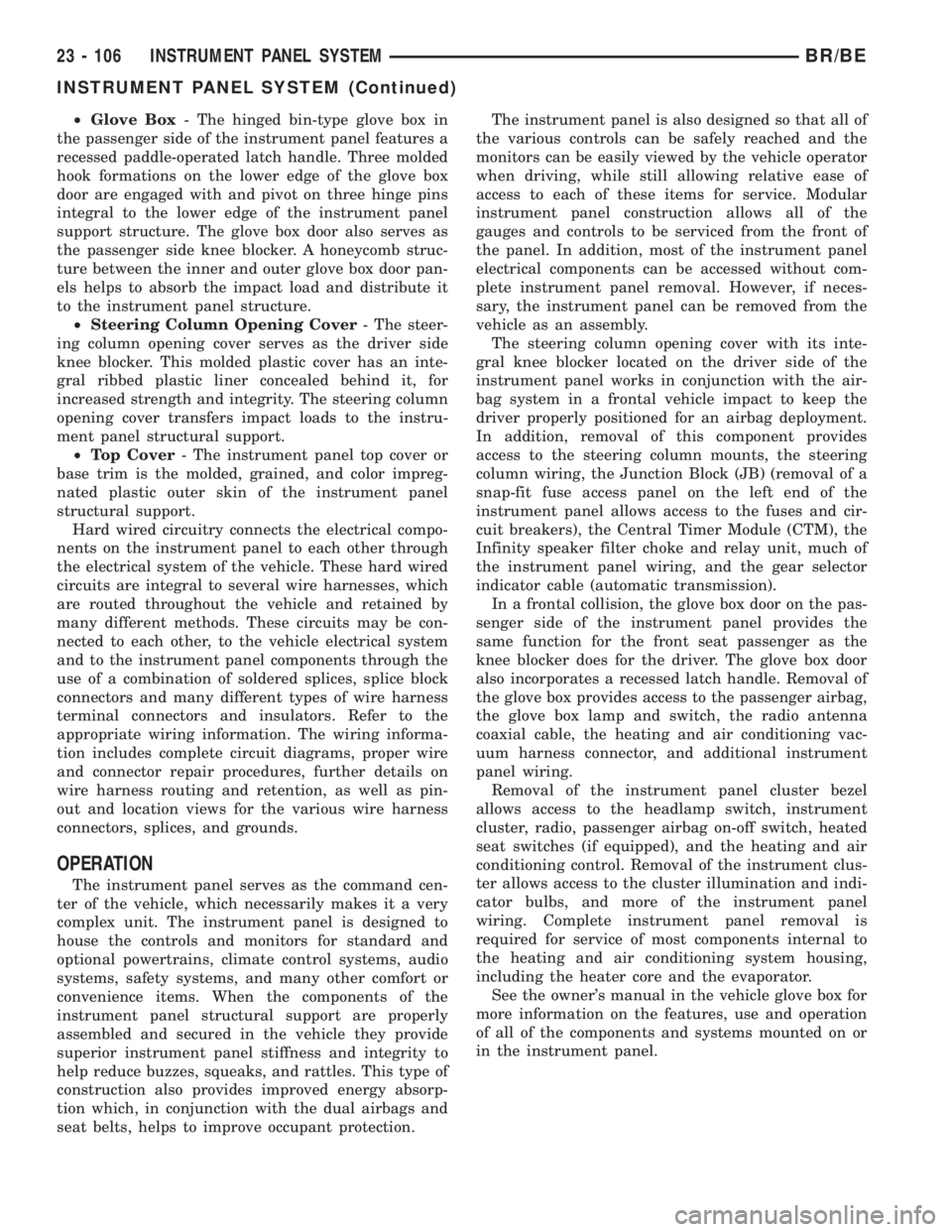
²Glove Box- The hinged bin-type glove box in
the passenger side of the instrument panel features a
recessed paddle-operated latch handle. Three molded
hook formations on the lower edge of the glove box
door are engaged with and pivot on three hinge pins
integral to the lower edge of the instrument panel
support structure. The glove box door also serves as
the passenger side knee blocker. A honeycomb struc-
ture between the inner and outer glove box door pan-
els helps to absorb the impact load and distribute it
to the instrument panel structure.
²Steering Column Opening Cover- The steer-
ing column opening cover serves as the driver side
knee blocker. This molded plastic cover has an inte-
gral ribbed plastic liner concealed behind it, for
increased strength and integrity. The steering column
opening cover transfers impact loads to the instru-
ment panel structural support.
²Top Cover- The instrument panel top cover or
base trim is the molded, grained, and color impreg-
nated plastic outer skin of the instrument panel
structural support.
Hard wired circuitry connects the electrical compo-
nents on the instrument panel to each other through
the electrical system of the vehicle. These hard wired
circuits are integral to several wire harnesses, which
are routed throughout the vehicle and retained by
many different methods. These circuits may be con-
nected to each other, to the vehicle electrical system
and to the instrument panel components through the
use of a combination of soldered splices, splice block
connectors and many different types of wire harness
terminal connectors and insulators. Refer to the
appropriate wiring information. The wiring informa-
tion includes complete circuit diagrams, proper wire
and connector repair procedures, further details on
wire harness routing and retention, as well as pin-
out and location views for the various wire harness
connectors, splices, and grounds.
OPERATION
The instrument panel serves as the command cen-
ter of the vehicle, which necessarily makes it a very
complex unit. The instrument panel is designed to
house the controls and monitors for standard and
optional powertrains, climate control systems, audio
systems, safety systems, and many other comfort or
convenience items. When the components of the
instrument panel structural support are properly
assembled and secured in the vehicle they provide
superior instrument panel stiffness and integrity to
help reduce buzzes, squeaks, and rattles. This type of
construction also provides improved energy absorp-
tion which, in conjunction with the dual airbags and
seat belts, helps to improve occupant protection.The instrument panel is also designed so that all of
the various controls can be safely reached and the
monitors can be easily viewed by the vehicle operator
when driving, while still allowing relative ease of
access to each of these items for service. Modular
instrument panel construction allows all of the
gauges and controls to be serviced from the front of
the panel. In addition, most of the instrument panel
electrical components can be accessed without com-
plete instrument panel removal. However, if neces-
sary, the instrument panel can be removed from the
vehicle as an assembly.
The steering column opening cover with its inte-
gral knee blocker located on the driver side of the
instrument panel works in conjunction with the air-
bag system in a frontal vehicle impact to keep the
driver properly positioned for an airbag deployment.
In addition, removal of this component provides
access to the steering column mounts, the steering
column wiring, the Junction Block (JB) (removal of a
snap-fit fuse access panel on the left end of the
instrument panel allows access to the fuses and cir-
cuit breakers), the Central Timer Module (CTM), the
Infinity speaker filter choke and relay unit, much of
the instrument panel wiring, and the gear selector
indicator cable (automatic transmission).
In a frontal collision, the glove box door on the pas-
senger side of the instrument panel provides the
same function for the front seat passenger as the
knee blocker does for the driver. The glove box door
also incorporates a recessed latch handle. Removal of
the glove box provides access to the passenger airbag,
the glove box lamp and switch, the radio antenna
coaxial cable, the heating and air conditioning vac-
uum harness connector, and additional instrument
panel wiring.
Removal of the instrument panel cluster bezel
allows access to the headlamp switch, instrument
cluster, radio, passenger airbag on-off switch, heated
seat switches (if equipped), and the heating and air
conditioning control. Removal of the instrument clus-
ter allows access to the cluster illumination and indi-
cator bulbs, and more of the instrument panel
wiring. Complete instrument panel removal is
required for service of most components internal to
the heating and air conditioning system housing,
including the heater core and the evaporator.
See the owner's manual in the vehicle glove box for
more information on the features, use and operation
of all of the components and systems mounted on or
in the instrument panel.
23 - 106 INSTRUMENT PANEL SYSTEMBR/BE
INSTRUMENT PANEL SYSTEM (Continued)
Page 2125 of 2255
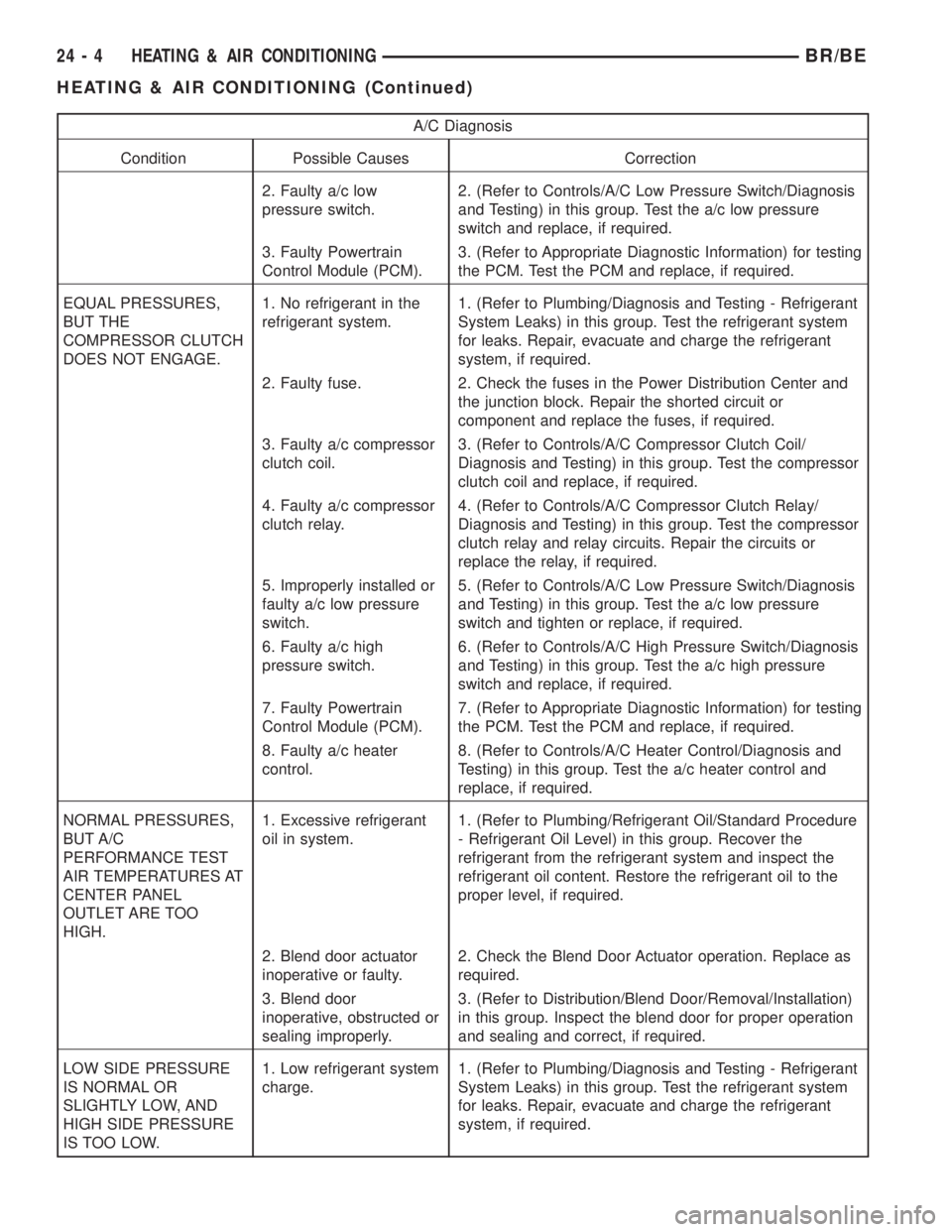
A/C Diagnosis
Condition Possible Causes Correction
2. Faulty a/c low
pressure switch.2. (Refer to Controls/A/C Low Pressure Switch/Diagnosis
and Testing) in this group. Test the a/c low pressure
switch and replace, if required.
3. Faulty Powertrain
Control Module (PCM).3. (Refer to Appropriate Diagnostic Information) for testing
the PCM. Test the PCM and replace, if required.
EQUAL PRESSURES,
BUT THE
COMPRESSOR CLUTCH
DOES NOT ENGAGE.1. No refrigerant in the
refrigerant system.1. (Refer to Plumbing/Diagnosis and Testing - Refrigerant
System Leaks) in this group. Test the refrigerant system
for leaks. Repair, evacuate and charge the refrigerant
system, if required.
2. Faulty fuse. 2. Check the fuses in the Power Distribution Center and
the junction block. Repair the shorted circuit or
component and replace the fuses, if required.
3. Faulty a/c compressor
clutch coil.3. (Refer to Controls/A/C Compressor Clutch Coil/
Diagnosis and Testing) in this group. Test the compressor
clutch coil and replace, if required.
4. Faulty a/c compressor
clutch relay.4. (Refer to Controls/A/C Compressor Clutch Relay/
Diagnosis and Testing) in this group. Test the compressor
clutch relay and relay circuits. Repair the circuits or
replace the relay, if required.
5. Improperly installed or
faulty a/c low pressure
switch.5. (Refer to Controls/A/C Low Pressure Switch/Diagnosis
and Testing) in this group. Test the a/c low pressure
switch and tighten or replace, if required.
6. Faulty a/c high
pressure switch.6. (Refer to Controls/A/C High Pressure Switch/Diagnosis
and Testing) in this group. Test the a/c high pressure
switch and replace, if required.
7. Faulty Powertrain
Control Module (PCM).7. (Refer to Appropriate Diagnostic Information) for testing
the PCM. Test the PCM and replace, if required.
8. Faulty a/c heater
control.8. (Refer to Controls/A/C Heater Control/Diagnosis and
Testing) in this group. Test the a/c heater control and
replace, if required.
NORMAL PRESSURES,
BUT A/C
PERFORMANCE TEST
AIR TEMPERATURES AT
CENTER PANEL
OUTLET ARE TOO
HIGH.1. Excessive refrigerant
oil in system.1. (Refer to Plumbing/Refrigerant Oil/Standard Procedure
- Refrigerant Oil Level) in this group. Recover the
refrigerant from the refrigerant system and inspect the
refrigerant oil content. Restore the refrigerant oil to the
proper level, if required.
2. Blend door actuator
inoperative or faulty.2. Check the Blend Door Actuator operation. Replace as
required.
3. Blend door
inoperative, obstructed or
sealing improperly.3. (Refer to Distribution/Blend Door/Removal/Installation)
in this group. Inspect the blend door for proper operation
and sealing and correct, if required.
LOW SIDE PRESSURE
IS NORMAL OR
SLIGHTLY LOW, AND
HIGH SIDE PRESSURE
IS TOO LOW.1. Low refrigerant system
charge.1. (Refer to Plumbing/Diagnosis and Testing - Refrigerant
System Leaks) in this group. Test the refrigerant system
for leaks. Repair, evacuate and charge the refrigerant
system, if required.
24 - 4 HEATING & AIR CONDITIONINGBR/BE
HEATING & AIR CONDITIONING (Continued)
Page 2134 of 2255
OPERATION
The compressor clutch assembly provides the
means to engage and disengage the compressor from
the engine serpentine accessory drive belt. When the
clutch coil is energized, it magnetically draws the
clutch into contact with the pulley and drives the
compressor shaft. When the coil is not energized, the
pulley freewheels on the clutch hub bearing, which is
part of the pulley. The compressor clutch and coil are
the only serviced parts on the compressor.
The compressor clutch engagement is controlled by
several components: the a/c heater mode control
switch, the a/c loss of charge switch, the a/c pressure
transducer, the compressor clutch relay, the evapora-
tor temperature sensor and the Powertrain Control
Module (PCM). The PCM may delay compressor
clutch engagement for up to thirty seconds(Refer to 8
- ELECTRICAL/ELECTRONIC CONTROL MOD-
ULES/POWERTRAIN CONTROL MODULE -
DESCRIPTION).
DIAGNOSIS AND TESTING - A/C COMPRESSOR
CLUTCH COIL
For circuit descriptions and diagrams, (Refer to
Appropriate Wiring Information). The battery must
be fully-charged before performing the following
tests. Refer to Battery for more information.
(1) Connect an ammeter (0 to 10 ampere scale) in
series with the clutch coil terminal. Use a voltmeter
(0 to 20 volt scale) with clip-type leads for measuring
the voltage across the battery and the compressor
clutch coil.(2) With the a/c heater mode control switch in any
A/C mode, and the blower motor switch in the lowest
speed position, start the engine and run it at normal
idle.
(3) The compressor clutch coil voltage should read
within 0.2 volts of the battery voltage. If there is
voltage at the clutch coil, but the reading is not
within 0.2 volts of the battery voltage, test the clutch
coil feed circuit for excessive voltage drop and repair
as required. If there is no voltage reading at the
clutch coil, use a DRB IIItscan tool and (Refer to
Appropriate Diagnostic Information) for testing of the
compressor clutch circuit. The following components
must be checked and repaired as required before you
can complete testing of the clutch coil:
²Fuses in the junction block and the Power Dis-
tribution Center (PDC)
²A/C Heater mode control switch
²Compressor clutch relay
²A/C High Pressure Switch
²A/C Low Pressure Switch
²Powertrain Control Module (PCM).
(4) The compressor clutch coil is acceptable if the
current draw measured at the clutch coil is 2.0 to 3.9
amperes with the electrical system voltage at 11.5 to
12.5 volts. This should only be checked with the work
area temperature at 21É C (70É F). If system voltage
is more than 12.5 volts, add electrical loads by turn-
ing on electrical accessories until the system voltage
drops below 12.5 volts.
(a) If the clutch coil current reading is four
amperes or more, the coil is shorted and should be
replaced.
(b) If the clutch coil current reading is zero, the
coil is open and should be replaced.
STANDARD PROCEDURE - A/C COMPRESSOR
CLUTCH BREAK-IN
After a new compressor clutch has been installed,
cycle the compressor clutch approximately twenty
times (five seconds on, then five seconds off). During
this procedure, set the A/C Heater control to the
Recirculation Mode, the blower motor switch in the
highest speed position, and the engine speed at 1500
to 2000 rpm. This procedure (burnishing) will seat
the opposing friction surfaces and provide a higher
compressor clutch torque capability.
REMOVAL
The refrigerant system can remain fully-charged
during compressor clutch, pulley, or coil replacement.
The compressor clutch can be serviced in the vehicle.
(1) Disconnect and isolate the battery negative
cable.
(2) On models with the diesel engine option,
remove the compressor from the engine. Do not
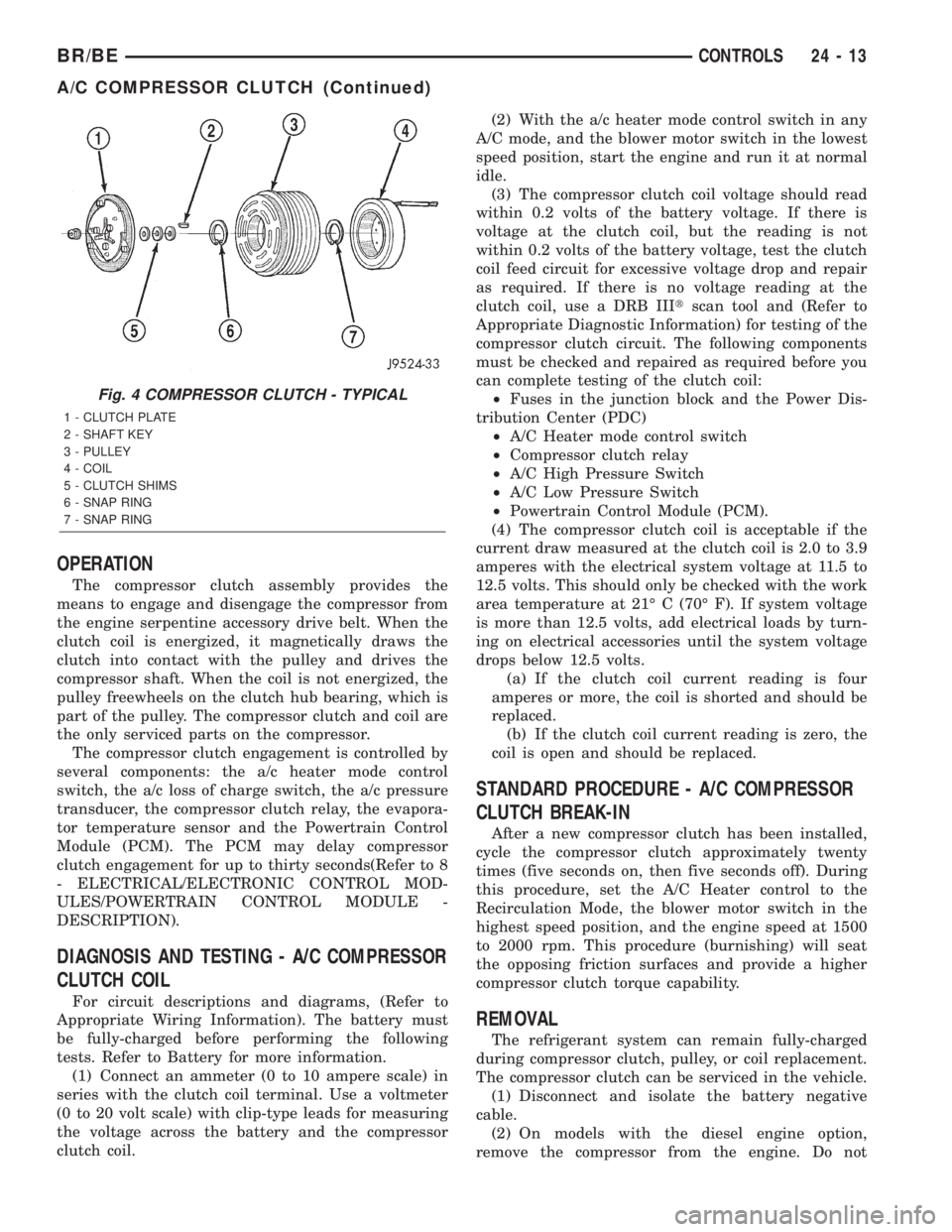
Fig. 4 COMPRESSOR CLUTCH - TYPICAL
1 - CLUTCH PLATE
2 - SHAFT KEY
3 - PULLEY
4 - COIL
5 - CLUTCH SHIMS
6 - SNAP RING
7 - SNAP RING
BR/BECONTROLS 24 - 13
A/C COMPRESSOR CLUTCH (Continued)
Page 2231 of 2255
FUEL INJECTION PUMP RELAY -
DESCRIPTION......................14-103
FUEL INJECTION PUMP RELAY -
OPERATION........................14-103
FUEL INJECTION PUMP TIMING -
DIAGNOSIS AND TESTING.............14-70
FUEL INJECTION SYSTEM -
DESCRIPTION, DIESEL................14-91
FUEL INJECTOR - DESCRIPTION....14-52,14-97
FUEL INJECTOR - DIAGNOSIS AND
TESTING...........................14-53
FUEL INJECTOR - INSTALLATION.......14-102
FUEL INJECTOR - OPERATION..........14-98
FUEL INJECTOR - REMOVAL...........14-101
FUEL INJECTOR FIRING ORDER, DIESEL . . 14-62
FUEL INJECTOR TEST - DIAGNOSIS AND
TESTING...........................14-99
FUEL LEVEL SENDING UNIT / SENSOR -
DESCRIPTION...................14-7,14-77
FUEL LEVEL SENDING UNIT / SENSOR -
INSTALLATION........................14-8
FUEL LEVEL SENDING UNIT / SENSOR -
OPERATION.....................14-7,14-77
FUEL LEVEL SENDING UNIT / SENSOR -
REMOVAL...........................14-7
FUEL LINE LEAKS - DIAGNOSIS AND
TESTING, HIGH-PRESSURE.............14-78
FUEL LINES - DESCRIPTION.............14-8
FUEL LINES - DESCRIPTION, HIGH
PRESSURE.........................14-78
FUEL LINES - OPERATION, HIGH
PRESSURE...........................14-78
FUEL PRESSURE LEAK DOWN TEST -
DIAGNOSIS AND TESTING..............14-2
FUEL PUMP - DESCRIPTION.............14-9
FUEL PUMP - OPERATION..............14-9
FUEL PUMP 235 H.P. - DESCRIPTION....14-69
FUEL PUMP 245 H.P. - DESCRIPTION....14-69
FUEL PUMP AMPERAGE TEST -
DIAGNOSIS AND TESTING.............14-10
FUEL PUMP CAPACITY TEST -
DIAGNOSIS AND TESTING..............14-9
FUEL PUMP MODULE - DESCRIPTION....14-12
FUEL PUMP MODULE - INSTALLATION . . . 14-13
FUEL PUMP MODULE - OPERATION......14-13
FUEL PUMP MODULE - REMOVAL.......14-13
FUEL PUMP PRESSURE TEST -
DIAGNOSIS AND TESTING..............14-9
FUEL PUMP RELAY - DESCRIPTION......14-40
FUEL PUMP RELAY - INSTALLATION.....14-40
FUEL PUMP RELAY - OPERATION........14-40
FUEL PUMP RELAY - REMOVAL.........14-40
FUEL PUMP RELAYS - DIAGNOSIS AND
TESTING, ASD........................8I-4
FUEL REQUIREMENTS - DIESEL ENGINE
- DESCRIPTION........................0-3
FUEL REQUIREMENTS - GAS ENGINES -
DESCRIPTION.........................0-2
FUEL SENSOR - DESCRIPTION, WATER
IN ................................14-89
FUEL SENSOR - OPERATION, WATER IN . . 14-89
FUEL SENSOR - REMOVAL, WATER IN....14-89
FUEL SUPPLY RESTRICTIONS -
DIAGNOSIS AND TESTING.............14-60
FUEL SYSTEM - DIAGNOSIS AND
TESTING, AIR IN.....................14-60
FUEL SYSTEM AIR LEAK VACUUM TEST
- DIAGNOSIS AND TESTING............14-57
FUEL SYSTEM PARTS - STANDARD
PROCEDURES, CLEANING..............14-61
FUEL SYSTEM PRESSURE - GAS
ENGINES - SPECIFICATIONS.............14-3
FUEL SYSTEM PRESSURE RELEASE -
STANDARD PROCEDURE................14-3
FUEL SYSTEM PRESSURES, DIESEL
ENGINES...........................14-62
FUEL SYSTEM, SPECIAL TOOLS.....14-35,14-4
FUEL SYSTEM, SPECIAL TOOLS -
DIESEL............................14-63
FUEL TANK - DESCRIPTION............14-18
FUEL TANK - DESCRIPTION, DIESEL.....14-82
FUEL TANK - INSTALLATION
............14-20
FUEL TANK - OPERATION
..............14-18
FUEL TANK - REMOVAL
...............14-18
FUEL TANK CHECK VALVE -
DESCRIPTION
.......................14-21
FUEL TANK CHECK VALVE -
INSTALLATION
.......................14-23FUEL TANK CHECK VALVE - REMOVAL....14-22
FUEL TANK MODULE - DESCRIPTION.....14-82
FUEL TANK MODULE - INSTALLATION....14-83
FUEL TANK MODULE - OPERATION......14-82
FUEL TANK MODULE - REMOVAL........14-83
FUEL TEMPERATURE SENSOR -
DESCRIPTION......................14-104
FUEL TEMPERATURE SENSOR -
OPERATION........................14-104
FUEL TRANSFER PUMP - DESCRIPTION . . 14-83
FUEL TRANSFER PUMP - INSTALLATION . . 14-87
FUEL TRANSFER PUMP - OPERATION....14-83
FUEL TRANSFER PUMP - REMOVAL......14-86
FUEL TRANSFER PUMP PRESSURE -
DIAGNOSIS AND TESTING.............14-84
FUSE - DESCRIPTION, GENERATOR
CARTRIDGE.......................8W-97-4
FUSE - DESCRIPTION, IOD...........8W-97-5
FUSE - INSTALLATION, GENERATOR
CARTRIDGE.......................8W-97-4
FUSE - INSTALLATION, IOD..........8W-97-6
FUSE - OPERATION, GENERATOR
CARTRIDGE.......................8W-97-4
FUSE - OPERATION, IOD.............8W-97-5
FUSE - REMOVAL, GENERATOR
CARTRIDGE.......................8W-97-4
FUSE - REMOVAL, IOD..............8W-97-6
FUSES POWERING SEVERAL LOADS -
STANDARD PROCEDURE, TESTING
FOR A SHORT TO GROUND ON.........8W-01-9
GAP AND FLUSH MEASUREMENTS,
SPECIFICATIONS - BODY...............23-56
GASKET - DESCRIPTION, CYLINDER
HEAD COVER.........................9-20
GASKET - OPERATION, CYLINDER HEAD
COVER..............................9-21
GASKET FAILURE - DIAGNOSIS AND
TESTING, CYLINDER HEAD..........9-21,9-76
GASKETS AND SEALERS - STANDARD
PROCEDURE, FORM-IN-PLACE . . 9-10,9-122,9-66
GASOLINE ENGINE - INSTALLATION......19-37
GASOLINE ENGINE - NEGATIVE CABLE
INSTALLATION.......................8F-22
GASOLINE ENGINE - NEGATIVE CABLE
REMOVAL..........................8F-22
GASOLINE ENGINE - POSITIVE CABLE
INSTALLATION.......................8F-22
GASOLINE ENGINE - POSITIVE CABLE
REMOVAL..........................8F-21
GASOLINE ENGINE - REMOVAL.........19-35
GAUGE - DESCRIPTION, ENGINE
TEMPERATURE......................8J-18
GAUGE - DESCRIPTION, FUEL...........8J-19
GAUGE - DESCRIPTION, OIL PRESSURE . . 8J-25
GAUGE - DESCRIPTION, VOLTAGE.......8J-33
GAUGE - OPERATION, ENGINE
TEMPERATURE......................8J-19
GAUGE - OPERATION, FUEL............8J-20
GAUGE - OPERATION, OIL PRESSURE....8J-25
GAUGE - OPERATION, VOLTAGE.........8J-33
GAUGE SENDING UNIT - DIAGNOSIS
AND TESTING, FUEL...................14-7
GAUGES - DIAGNOSIS AND TESTING,
PRESSURE..........................22-8
GAUGES INDICATOR - DESCRIPTION,
CHECK.............................8J-17
GAUGES INDICATOR - OPERATION,
CHECK.............................8J-17
GEAR - ADJUSTMENTS................19-18
GEAR - DESCRIPTION.................19-16
GEAR - INSTALLATION................19-18
GEAR - INSTALLATION, PINION
GEAR/RING..........................3-43
GEAR - OPERATION...................19-16
GEAR - REMOVAL....................19-18
GEAR - REMOVAL, PINION GEAR/RING....3-41
GEAR HOUSING - INSTALLATION........9-188
GEAR HOUSING - REMOVAL............9-187
GEAR HOUSING COVER - INSTALLATION . . 9-190
GEAR HOUSING COVER - REMOVAL
.....9-189
GEAR HOUSING PLUG - INSTALLATION,
STEERING
..........................19-30
GEAR HOUSING PLUG - REMOVAL,
STEERING
..........................19-29
GEAR LEAKAGE - DIAGNOSIS AND
TESTING, POWER STEERING
...........19-16
GEAR SELECTOR INDICATOR -
DESCRIPTION
.......................8J-20GEAR SELECTOR INDICATOR -
OPERATION.........................8J-21
GEAR SHIFT LEVER - INSTALLATION.....19-15
GEAR SHIFT LEVER - REMOVAL.........19-14
GEAR, SPECIAL TOOLS - POWER
STEERING..........................19-22
GEAR, SPECIFICATIONS - POWER
STEERING..........................19-21
GEAR/RING GEAR - INSTALLATION,
PINION.............................3-43
GEAR/RING GEAR - REMOVAL, PINION....3-41
GEAR/RING GEAR/TONE RING -
INSTALLATION, PINION.......3-104,3-132,3-75
GEAR/RING GEAR/TONE RING -
REMOVAL, PINION..........3-103,3-131,3-73
GEAR/TONE RING - INSTALLATION,
PINION GEAR/RING..........3-104,3-132,3-75
GEAR/TONE RING - REMOVAL, PINION
GEAR/RING................3-103,3-131,3-73
GEARTRAIN/OUTPUT SHAFT -
ASSEMBLY, PLANETARY........21-199,21-371
GEARTRAIN/OUTPUT SHAFT -
DESCRIPTION, PLANETARY......21-197,21-369
GEARTRAIN/OUTPUT SHAFT -
DISASSEMBLY, PLANETARY.....21-198,21-369
GEARTRAIN/OUTPUT SHAFT -
INSPECTION, PLANETARY.......21-199,21-371
GEARTRAIN/OUTPUT SHAFT -
OPERATION, PLANETARY.......21-197,21-369
GENERAL - WARNINGS.............8W-01-7
GENERATOR - DESCRIPTION...........8F-28
GENERATOR - INSTALLATION............8F-30
GENERATOR - OPERATION.............8F-28
GENERATOR - REMOVAL...............8F-28
GENERATOR CARTRIDGE FUSE -
DESCRIPTION.....................8W-97-4
GENERATOR CARTRIDGE FUSE -
INSTALLATION....................8W-97-4
GENERATOR CARTRIDGE FUSE -
OPERATION.......................8W-97-4
GENERATOR CARTRIDGE FUSE -
REMOVAL........................8W-97-4
GENERATOR RATINGS, SPECIFICATIONS . . 8F-26
GENERATOR/CHARGING SYSTEM -
SPECIFICATIONS, TORQUE.............8F-27
GLASS - DESCRIPTION, STATIONARY....23-145
GLASS - INSTALLATION, BACKLITE VENT . 23-146
GLASS - INSTALLATION, DOOR.........23-70
GLASS - INSTALLATION, SIDE VIEW
MIRROR...........................23-98
GLASS - OPERATION, STATIONARY.....23-145
GLASS - REMOVAL, BACKLITE VENT....23-146
GLASS - REMOVAL, DOOR.............23-70
GLASS - REMOVAL, SIDE VIEW MIRROR . . 23-98
GLASS RUN CHANNEL - INSTALLATION . . . 23-71
GLASS RUN CHANNEL - REMOVAL......23-71
GLASS RUN WEATHERSTRIP -
INSTALLATION, FRONT DOOR..........23-153
GLASS RUN WEATHERSTRIP -
REMOVAL, FRONT DOOR.............23-152
GLOVE BOX - ASSEMBLY.............23-111
GLOVE BOX - DISASSEMBLY..........23-110
GLOVE BOX LAMP AND SWITCH -
INSTALLATION.......................8L-36
GLOVE BOX LAMP AND SWITCH -
REMOVAL
..........................8L-35
GLOVE BOX LATCH STRIKER -
INSTALLATION
......................23-112
GLOVE BOX LATCH STRIKER - REMOVAL
. 23-111
GLOVE BOX OPENING UPPER TRIM -
INSTALLATION
......................23-112
GLOVE BOX OPENING UPPER TRIM -
REMOVAL
.........................23-112
GOVERNOR - DESCRIPTION,
ELECTRONIC
.................21-152,21-322
GOVERNOR - INSTALLATION,
ELECTRONIC
.................21-154,21-324
GOVERNOR - OPERATION, ELECTRONIC
. 21-153,
21-323
GOVERNOR - REMOVAL, ELECTRONIC
. . 21-154,
21-324
GRAB HANDLE - INSTALLATION,
A-PILLAR
..........................23-119
GRAB HANDLE - REMOVAL, A-PILLAR
. . . 23-119
GRADING - STANDARD PROCEDURE,
PISTON
............................9-166
GRID - DESCRIPTION, HEATED MIRROR
. . . 8G-4
14 INDEXBR/BE
Description Group-Page Description Group-Page Description Group-Page