Page 284 of 486
3-52 Rear Seat Audio (Vehicles without the
Entertainment System) (If Equipped)
This feature allows rear seat passengers to listen to and
control any of the music sources: AM
-FM, cassette tapes
and CDs. However, the rear seat passengers can only
control the music sources that the front seat passengers
are not listening to. For example, rear seat passengers
may listen to a cassette tape or CD through the two sets
of headphones, (provided in the glove box), while the
driver listens to the radio through the front speakers. The
rear seat passengers have control of the volume for each
set of headphones. Be aware that the front seat audio
controls always have priority over the RSA controls. If
the front seat passengers switch the source for the main
radio to a remote source, the RSA will play the same
remote source. The rear speakers will be muted when the
RSA power is turned on. You may operate the RSA
functions even when the main radio is off.
Primary Radio Controls
The following function is controlled by the knob on the
main radio:
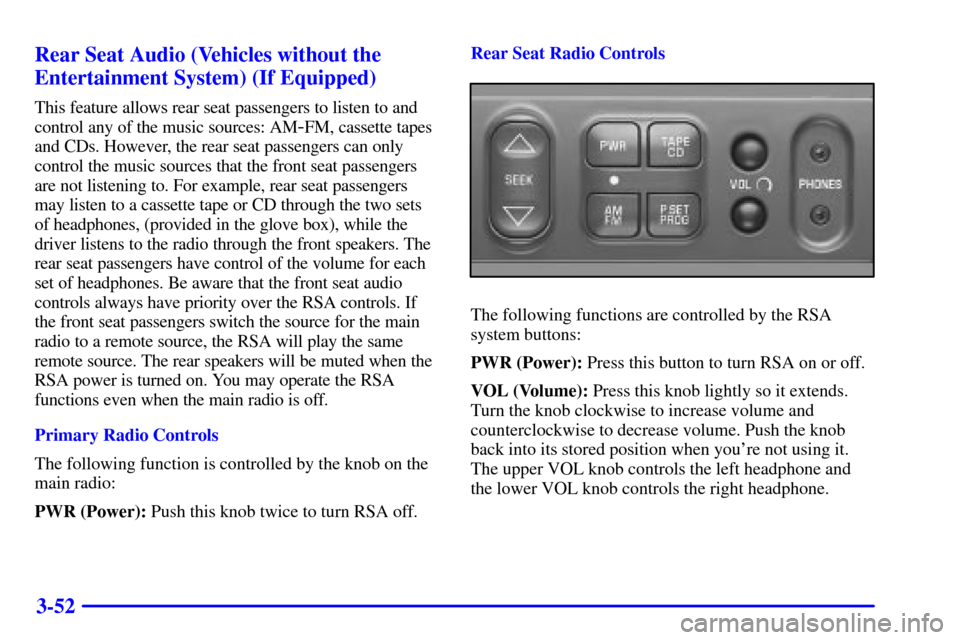
PWR (Power): Push this knob twice to turn RSA off.Rear Seat Radio Controls
The following functions are controlled by the RSA
system buttons:
PWR (Power): Press this button to turn RSA on or off.
VOL (Volume): Press this knob lightly so it extends.
Turn the knob clockwise to increase volume and
counterclockwise to decrease volume. Push the knob
back into its stored position when you're not using it.
The upper VOL knob controls the left headphone and
the lower VOL knob controls the right headphone.
Page 391 of 486
6-19
Passenger Compartment Air Filter
(If Equipped)
Passenger compartment air, both outside air and
recirculated air, is routed through a passenger
compartment filter, which is part of a two
-piece filter
system. The filter removes certain contaminants from
the air, including pollen and dust particles, as well as
odors such as exhaust or fuel fumes. Reductions in
airflow, which may occur more quickly in dusty areas,
indicate that the filter needs to be replaced early. For
how often to change the air filter, see ªScheduled
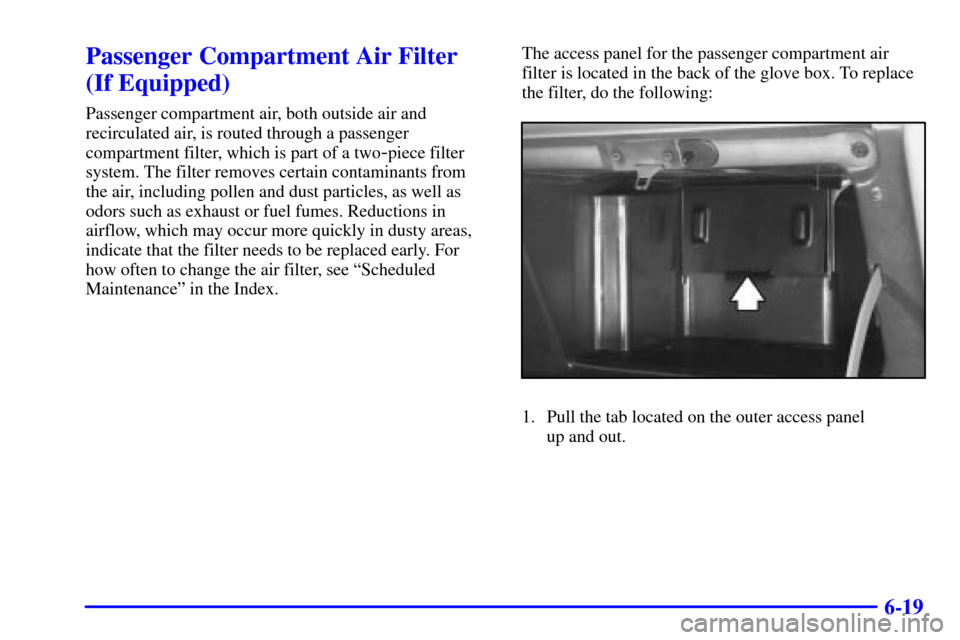
Maintenanceº in the Index.The access panel for the passenger compartment air
filter is located in the back of the glove box. To replace
the filter, do the following:
1. Pull the tab located on the outer access panel
up and out.
Page 392 of 486
6-20
2. Then push the tab, located on the left of the inner
access panel, to the right.
3. The first air filter will pull straight out. To remove
the second, reach in and slide it toward the opening.
Pull the second filter out.
4. Replace the filters by reversing Step 3. Make sure
the filters are inserted so that the sealing foam is
angled in the same direction on both filters. For the
type of filter to use, see ªNormal Maintenance
Replacement Partsº in the Index.
5. Close the inner access door, while squeezing the tab.
Be sure it is tightly closed.
6. Snap the outer access panel into the back of the
glove box.
Page 437 of 486
6-65 Fuses and Circuit Breakers
The wiring circuits in your vehicle are protected from
short circuits by a combination of fuses, circuit breakers
and fusible thermal links.
Look at the silver
-colored band inside the fuse. If the
band is broken or melted, replace the fuse. Be sure you
replace a bad fuse with a new one of the identical size
and rating.
If you ever have a problem on the road and don't have a
spare fuse, you can borrow one that has the same
amperage or use one of the spare fuses in the underhood
fuse block. Just pick some feature of your vehicle that
you can get along without
-- like the radio or cigarette
lighter
-- and use its fuse, if it is the right amperage.
Replace it as soon as you can.
There are two fuse blocks in your vehicle: the
instrument panel fuse block and the underhood
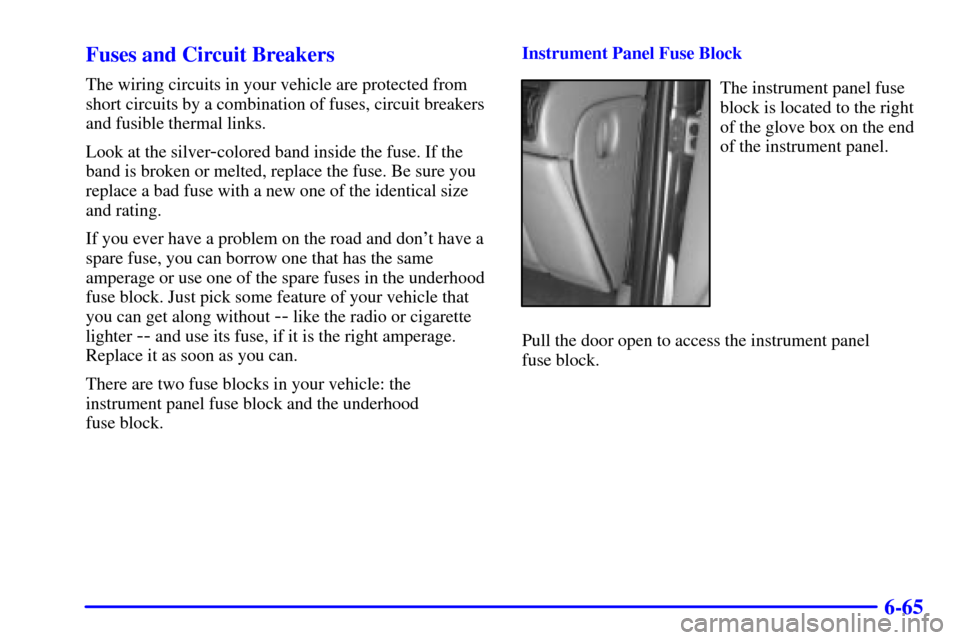
fuse block.Instrument Panel Fuse Block
The instrument panel fuse
block is located to the right
of the glove box on the end
of the instrument panel.
Pull the door open to access the instrument panel
fuse block.