Page 4 of 432
Table of Contents
Windows
Keys and Door Locks
Remote Keyless Entry System (If Equipped)
Liftgate/Liftglass
Automatic Transmission
Four-Wheel Drive (If Equipped)
Parking Brake
Tilt Wheel
Turn Signal/Multifunction Lever
Windshield WipersCruise Control
Exterior and Interior Lamps
Mirrors
Storage Compartments
Luggage Carrier
Accessory Power Outlets
OnStar® System (If Equipped)
Sunroof (Option)
HomeLink® Transmitter (If Equipped)
Instrument Panel, Warning Lights and Gages Seats and Seat Controls
Safety BeltsAir Bag Systems
Restraint Systems for Children
Section
1
Section
2
Seats and Restraint Systems
Features and Controls
ii
Page 41 of 432
1-29
What will you see after an air bag inflates?
After an air bag inflates, it quickly deflates, so quickly
that some people may not even realize the air bag
inflated. Some components of the air bag module
-- the
steering wheel hub for the driver's air bag, the
instrument panel for the right front passenger's bag, the
side of the seatback closest to the door for the driver and
right front passenger's side impact air bags
-- will be
hot for a short time. The parts of the bag that come into
contact with you may be warm, but not too hot to touch.
There will be some smoke and dust coming from the
vents in the deflated air bags. Air bag inflation doesn't
prevent the driver from seeing or being able to steer the
vehicle, nor does it stop people from leaving the vehicle.
CAUTION:
When an air bag inflates, there is dust in the
air. This dust could cause breathing problems
for people with a history of asthma or other
breathing trouble. To avoid this, everyone in the
vehicle should get out as soon as it is safe to do so.
If you have breathing problems but can't get out
of the vehicle after an air bag inflates, then get
fresh air by opening a window or a door.
Your vehicle has a feature that will automatically unlock
the doors and turn the interior lamps on when the air
bags inflate (if battery power is available). You can lock
the doors again and turn the interior lamps off by using
the door lock and interior lamp controls.
Page 53 of 432
1-41
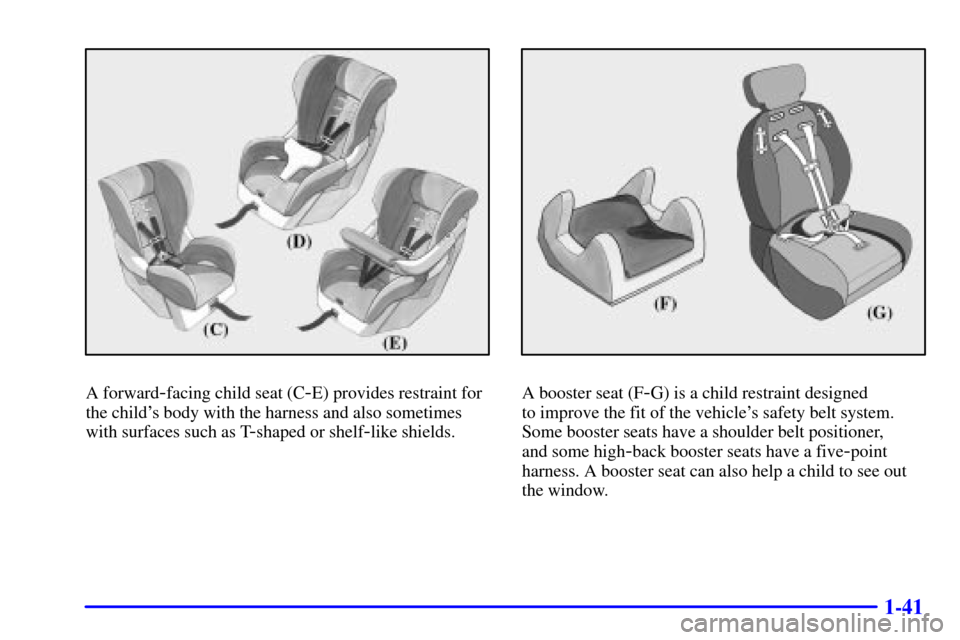
A forward-facing child seat (C-E) provides restraint for
the child's body with the harness and also sometimes
with surfaces such as T
-shaped or shelf-like shields.
A booster seat (F-G) is a child restraint designed
to improve the fit of the vehicle's safety belt system.
Some booster seats have a shoulder belt positioner,
and some high
-back booster seats have a five-point
harness. A booster seat can also help a child to see out
the window.
Page 67 of 432
1-55
CAUTION:
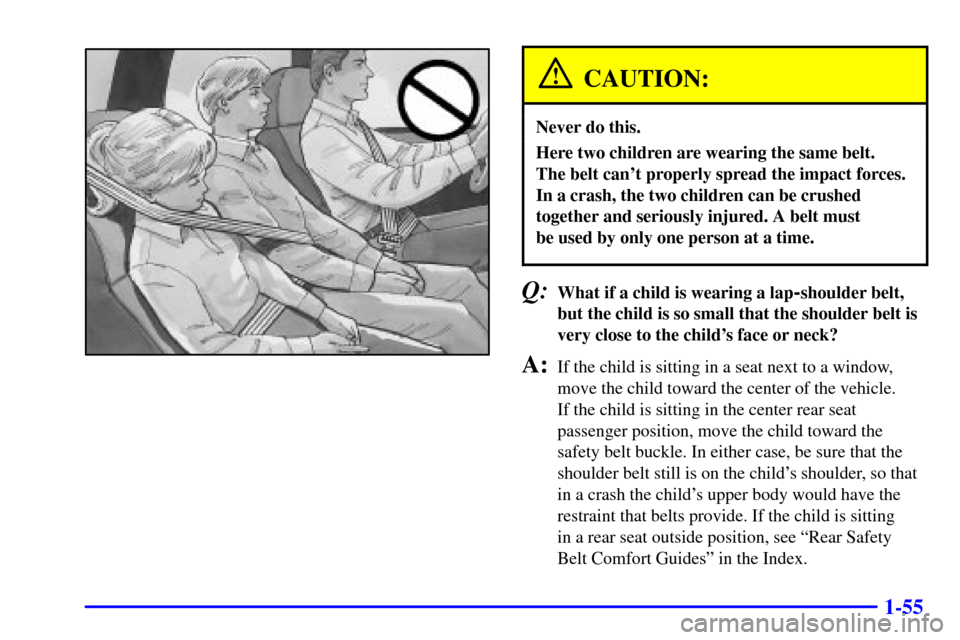
Never do this.
Here two children are wearing the same belt.
The belt can't properly spread the impact forces.
In a crash, the two children can be crushed
together and seriously injured. A belt must
be used by only one person at a time.
Q:What if a child is wearing a lap-shoulder belt,
but the child is so small that the shoulder belt is
very close to the child's face or neck?
A:If the child is sitting in a seat next to a window,
move the child toward the center of the vehicle.
If the child is sitting in the center rear seat
passenger position, move the child toward the
safety belt buckle. In either case, be sure that the
shoulder belt still is on the child's shoulder, so that
in a crash the child's upper body would have the
restraint that belts provide. If the child is sitting
in a rear seat outside position, see ªRear Safety
Belt Comfort Guidesº in the Index.
Page 70 of 432
2-
2-1
Section 2 Features and Controls
Here you can learn about the many standard and optional features on your vehicle, and information on starting,
shifting and braking. Also explained are the instrument panel and the warning systems that tell you if everything is
working properly
-- and what to do if you have a problem.
2
-2 Windows
2
-4 Keys
2
-6 Door Locks
2
-10 Remote Keyless Entry System (If Equipped)
2
-13 Liftgate/Liftglass
2
-14 Theft
2
-16 Content Theft-Deterrent (If Equipped)
2
-17 Passlock�
2-18 New Vehicle ªBreak-Inº
2
-19 Ignition Positions
2
-20 Starting Your Engine
2
-21 Engine Coolant Heater (If Equipped)
2
-22 Automatic Transmission Operation
2
-26 Four-Wheel Drive (If Equipped)
2
-30 Parking Brake
2
-31 Shifting Into PARK (P)
2
-33 Shifting Out of PARK (P)
2
-33 Parking Over Things That Burn
2
-34 Engine Exhaust2
-34 Running Your Engine While You're Parked
2
-35 Locking Rear Axle
2
-36 Tilt Wheel
2
-36 Turn Signal/Multifunction Lever
2
-44 Exterior Lamps
2
-47 Interior Lamps
2
-49 Mirrors
2
-56 Storage Compartments
2
-61 Ashtrays and Cigarette Lighter
2
-62 Accessory Power Outlets
2
-63 OnStar� System (If Equipped)
2
-66 Sunroof (Option)
2
-67 HomeLink� Transmitter (If Equipped)
2
-70 Instrument Panel -- Your Information System
2
-72 Instrument Panel Cluster
2
-74 Warning Lights, Gages and Indicators
2
-89 Driver Information Center (DIC)
(If Equipped)
Page 71 of 432
2-2
Windows
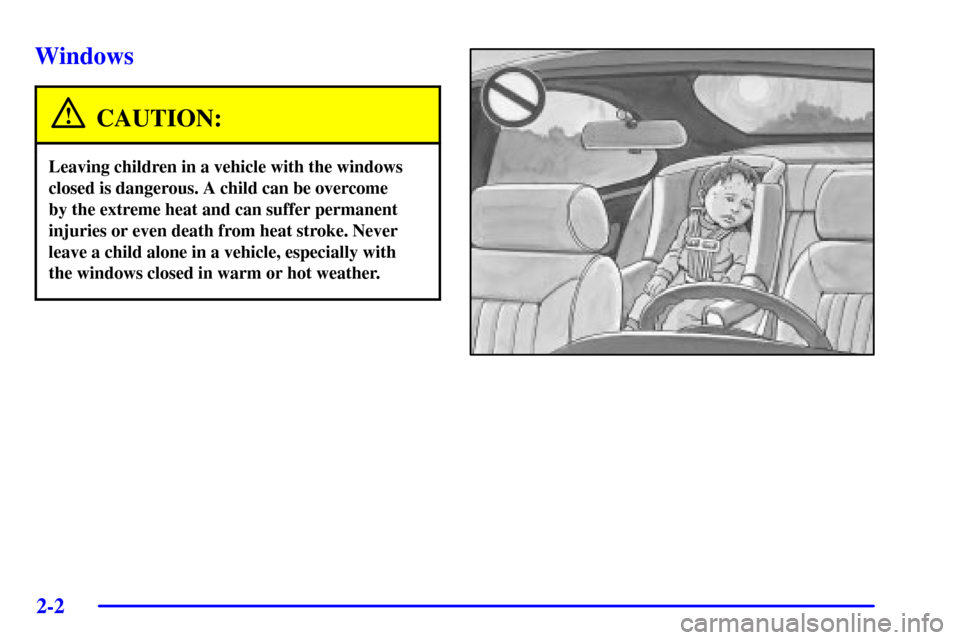
CAUTION:
Leaving children in a vehicle with the windows
closed is dangerous. A child can be overcome
by the extreme heat and can suffer permanent
injuries or even death from heat stroke. Never
leave a child alone in a vehicle, especially with
the windows closed in warm or hot weather.
Page 72 of 432
2-3
Power Windows
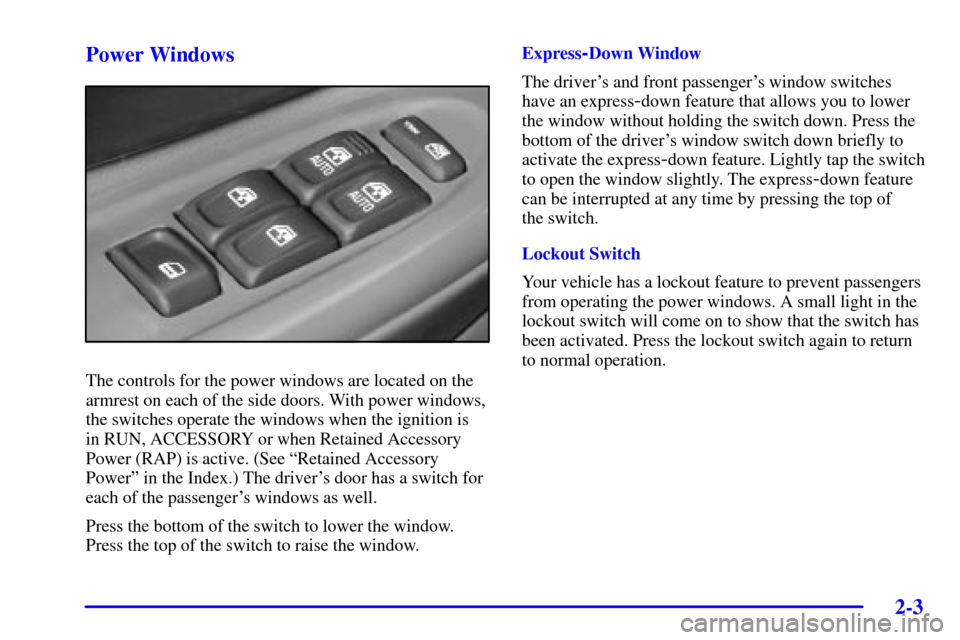
The controls for the power windows are located on the
armrest on each of the side doors. With power windows,
the switches operate the windows when the ignition is
in RUN, ACCESSORY or when Retained Accessory
Power (RAP) is active. (See ªRetained Accessory
Powerº in the Index.) The driver's door has a switch for
each of the passenger's windows as well.
Press the bottom of the switch to lower the window.
Press the top of the switch to raise the window.Express
-Down Window
The driver's and front passenger's window switches
have an express
-down feature that allows you to lower
the window without holding the switch down. Press the
bottom of the driver's window switch down briefly to
activate the express
-down feature. Lightly tap the switch
to open the window slightly. The express
-down feature
can be interrupted at any time by pressing the top of
the switch.
Lockout Switch
Your vehicle has a lockout feature to prevent passengers
from operating the power windows. A small light in the
lockout switch will come on to show that the switch has
been activated. Press the lockout switch again to return
to normal operation.
Page 73 of 432
2-4
Keys
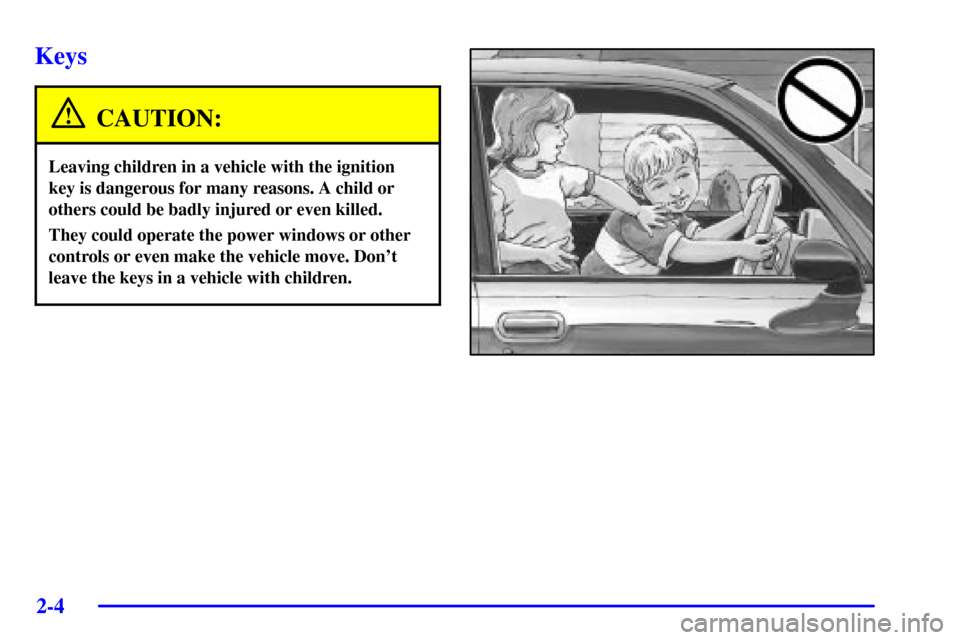
CAUTION:
Leaving children in a vehicle with the ignition
key is dangerous for many reasons. A child or
others could be badly injured or even killed.
They could operate the power windows or other
controls or even make the vehicle move. Don't
leave the keys in a vehicle with children.