Page 290 of 432
4-58 Parking on Hills
CAUTION:
You really should not park your vehicle, with a
trailer attached, on a hill. If something goes
wrong, your rig could start to move. People can
be injured, and both your vehicle and the trailer
can be damaged.
But if you ever have to park your rig on a hill, here's
how to do it:
1. Apply your regular brakes, but don't shift into
PARK (P) yet. When parking uphill, turn your
wheels away from the curb. When parking downhill,
turn your wheels into the curb.
2. Have someone place chocks under the trailer wheels.
3. When the wheel chocks are in place, release the
regular brakes until the chocks absorb the load.4. Reapply the regular brakes. Then apply your parking
brake, and then shift into PARK (P).
5. Release the regular brakes.
CAUTION:
It can be dangerous to get out of your vehicle if
the shift lever is not fully in PARK (P) with the
parking brake firmly set. Your vehicle can roll.
If you have left the engine running, the vehicle
can move suddenly. You or others could be
injured. To be sure your vehicle won't move,
even when you're on fairly level ground,
use the steps that follow.
Always put the shift lever fully in PARK (P)
with the parking brake firmly set.
If the transfer case on four-wheel drive vehicles
is in NEUTRAL, your vehicle will be free to roll,
even if your shift lever is in PARK (P). So, be
sure the transfer case is in a drive gear
-- not in
NEUTRAL. See ªFour
-Wheel Drive (Automatic
Transfer Case)º in the Index.
Page 296 of 432
5-4
1. Check the other vehicle. It must have a 12-volt
battery with a negative ground system.
NOTICE:
If the other system isn't a 12-volt system with a
negative ground, both vehicles can be damaged.
2. Get the vehicles close enough so the jumper cables
can reach, but be sure the vehicles aren't touching
each other. If they are, it could cause a ground
connection you don't want. You wouldn't be able
to start your vehicle, and the bad grounding could
damage the electrical systems.
To avoid the possibility of the vehicles rolling, set
the parking brake firmly on both vehicles involved
in the jump start procedure. Put an automatic
transmission in PARK (P) or a manual transmission
in NEUTRAL before setting the parking brake.
If you have a four
-wheel-drive vehicle, be sure
the transfer case is not in NEUTRAL (N).
NOTICE:
If you leave your radio on, it could be badly
damaged. The repairs wouldn't be covered by
your warranty.
3. Turn off the ignition on both vehicles. Unplug
unnecessary accessories plugged into the cigarette
lighter or accessory power outlets (if equipped). Turn
off the radio and all lamps that aren't needed. This
will avoid sparks and help to save both batteries.
And it could save your radio!
4. Open both hoods and locate the batteries. Find the
positive (+) and negative (
-) terminals on each
battery. Your vehicle has a remote negative (
-) jump
starting terminal. You should always use this remote
terminal instead of the terminal on the battery.
The remote negative (
-) terminal is located on the
front engine lift bracket and is marked ªGND.º
See ªEngine Compartment Overviewº in the Index
for more information on location.
Page 310 of 432
5-18
If a Tire Goes Flat
It's unusual for a tire to ªblow outº while you're driving,
especially if you maintain your tires properly. If air goes
out of a tire, it's much more likely to leak out slowly.
But if you should ever have a ªblowout,º here are a
few tips about what to expect and what to do:
If a front tire fails, the flat tire will create a drag that
pulls the vehicle toward that side. Take your foot off
the accelerator pedal and grip the steering wheel firmly.
Steer to maintain lane position, and then gently brake to
a stop well out of the traffic lane.
A rear blowout, particularly on a curve, acts much like a
skid and may require the same correction you'd use in
a skid. In any rear blowout, remove your foot from
the accelerator pedal. Get the vehicle under control by
steering the way you want the vehicle to go. It may be
very bumpy and noisy, but you can still steer. Gently
brake to a stop
-- well off the road if possible.
If a tire goes flat, the next part shows how to use your
jacking equipment to change a flat tire safely.
Changing a Flat Tire
If a tire goes flat, avoid further tire and wheel damage
by driving slowly to a level place. Turn on your hazard
warning flashers.
CAUTION:
Changing a tire can cause an injury. The vehicle
can slip off the jack and roll over you or other
people. You and they could be badly injured.
Find a level place to change your tire. To help
prevent the vehicle from moving:
1. Set the parking brake firmly.
2. Put the shift lever in PARK (P).
3. If you have a four
-wheel-drive vehicle,
be sure the transfer case is in a drive
gear
-- not in NEUTRAL.
4. Turn off the engine.
5. Put the wheel blocks at the front and rear of
the tire farthest away from the one being
changed. That would be the tire on the
other side of the vehicle, at the opposite end.
Page 312 of 432
5-20
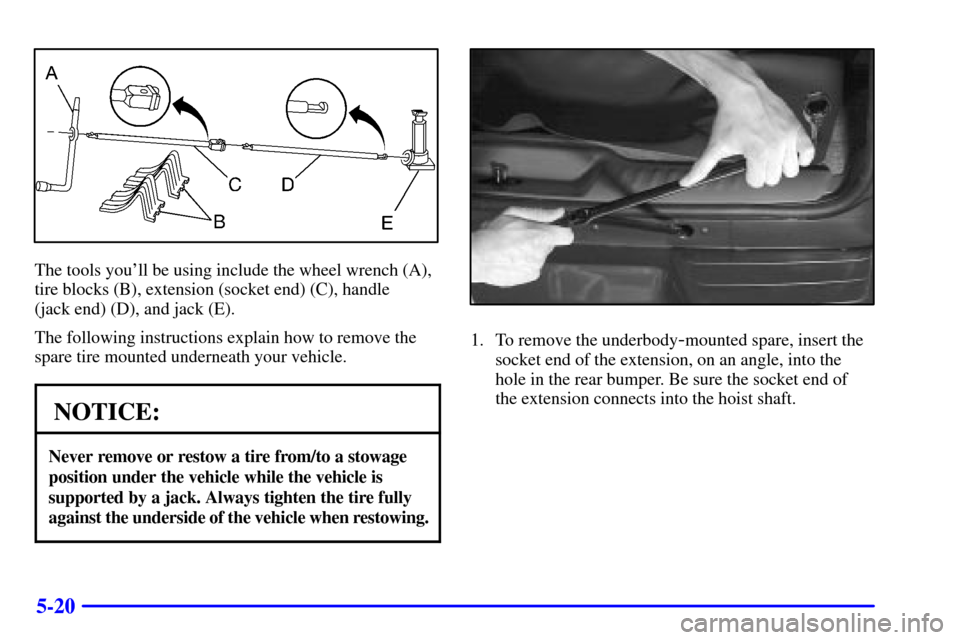
The tools you'll be using include the wheel wrench (A),
tire blocks (B), extension (socket end) (C), handle
(jack end) (D), and jack (E).
The following instructions explain how to remove the
spare tire mounted underneath your vehicle.
NOTICE:
Never remove or restow a tire from/to a stowage
position under the vehicle while the vehicle is
supported by a jack. Always tighten the tire fully
against the underside of the vehicle when restowing.
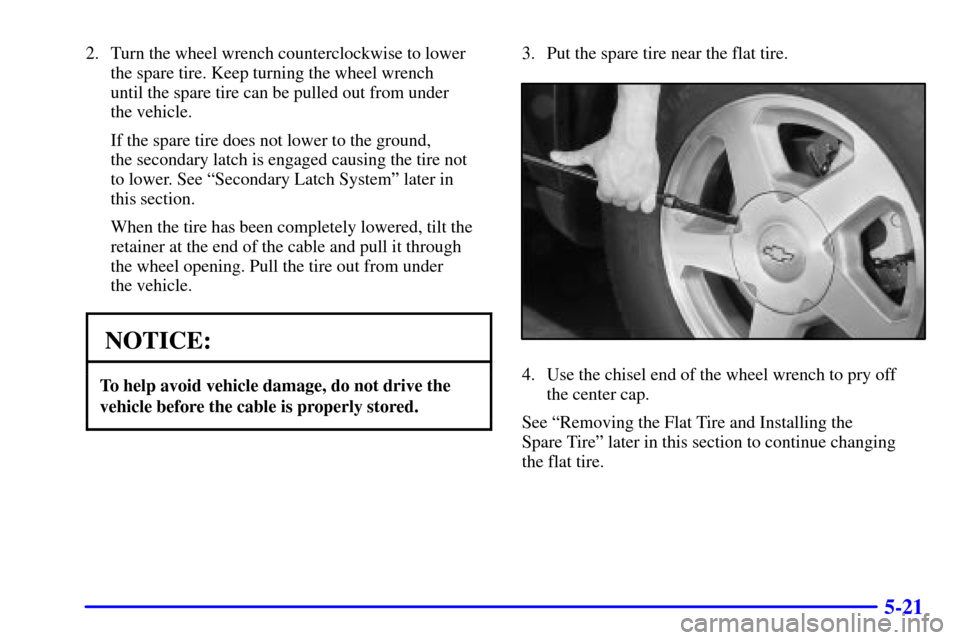
1. To remove the underbody-mounted spare, insert the
socket end of the extension, on an angle, into the
hole in the rear bumper. Be sure the socket end of
the extension connects into the hoist shaft.
Page 313 of 432
5-21
2. Turn the wheel wrench counterclockwise to lower
the spare tire. Keep turning the wheel wrench
until the spare tire can be pulled out from under
the vehicle.
If the spare tire does not lower to the ground,
the secondary latch is engaged causing the tire not
to lower. See ªSecondary Latch Systemº later in
this section.
When the tire has been completely lowered, tilt the
retainer at the end of the cable and pull it through
the wheel opening. Pull the tire out from under
the vehicle.
NOTICE:
To help avoid vehicle damage, do not drive the
vehicle before the cable is properly stored.
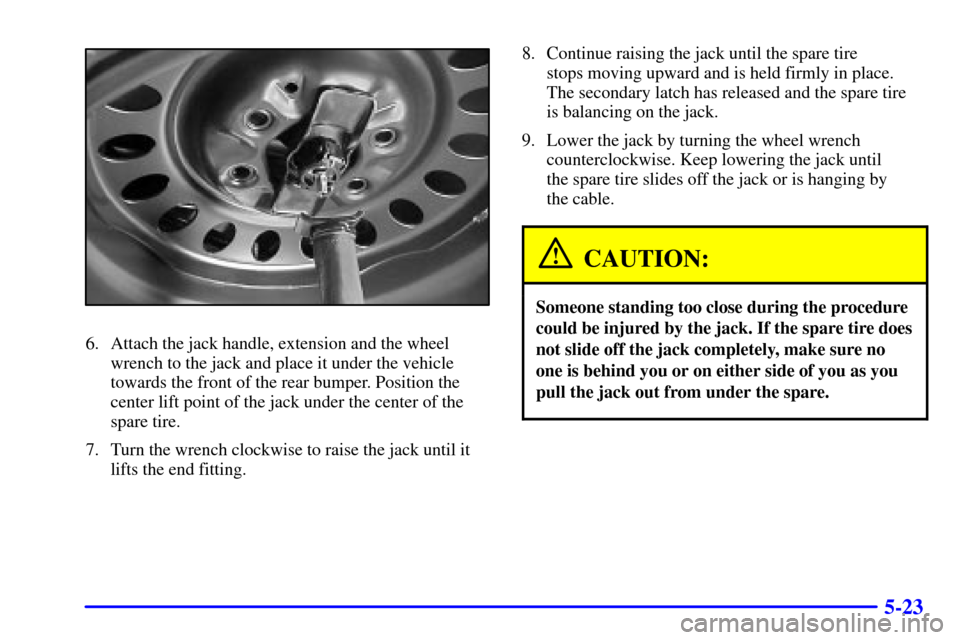
3. Put the spare tire near the flat tire.
4. Use the chisel end of the wheel wrench to pry off
the center cap.
See ªRemoving the Flat Tire and Installing the
Spare Tireº later in this section to continue changing
the flat tire.
Page 314 of 432
5-22
Secondary Latch System
The spare tire hoist assembly is equipped with a
secondary latch system. It's designed to stop the spare
tire from suddenly falling off your vehicle. For the
secondary latch to work, the spare tire must be stored
with the valve stem pointing up. See ªStoring a Flat or
Spare Tire and Toolsº in the Index for instructions on
storing the spare tire correctly.
CAUTION:
Before beginning this procedure, read all the
instructions. Failure to read and follow the
instructions could damage the hoist assembly
and you and others could get hurt. Read and
follow the instructions listed below.
To release the spare tire from the secondary latch
do the following:
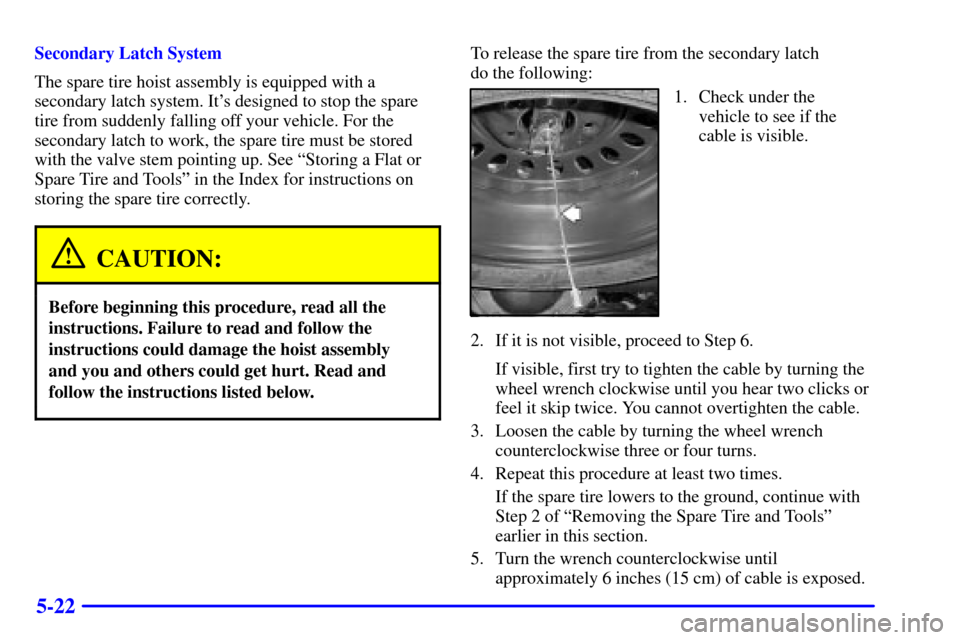
1. Check under the
vehicle to see if the
cable is visible.
2. If it is not visible, proceed to Step 6.
If visible, first try to tighten the cable by turning the
wheel wrench clockwise until you hear two clicks or
feel it skip twice. You cannot overtighten the cable.
3. Loosen the cable by turning the wheel wrench
counterclockwise three or four turns.
4. Repeat this procedure at least two times.
If the spare tire lowers to the ground, continue with
Step 2 of ªRemoving the Spare Tire and Toolsº
earlier in this section.
5. Turn the wrench counterclockwise until
approximately 6 inches (15 cm) of cable is exposed.
Page 315 of 432
5-23
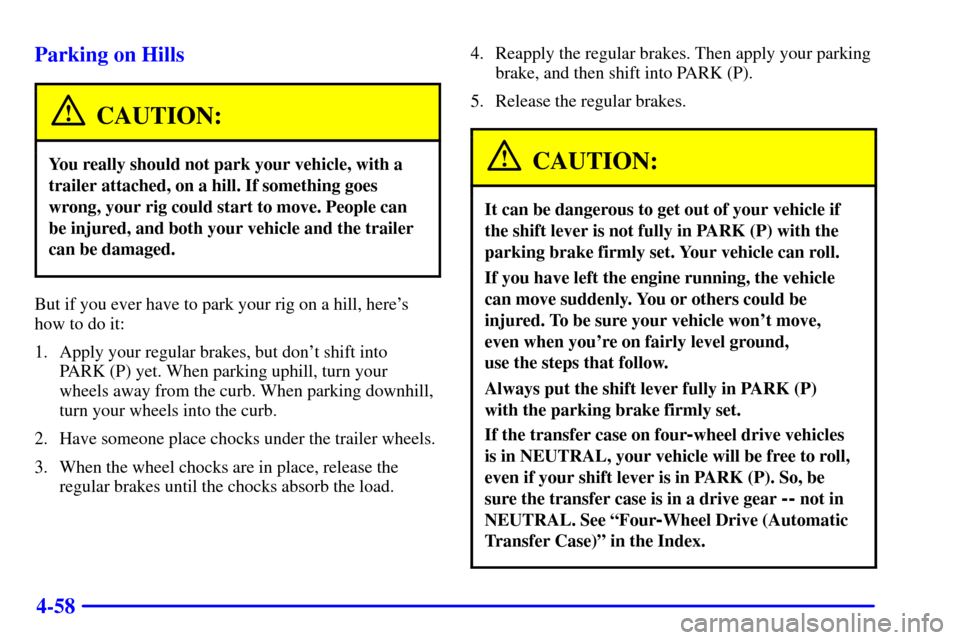
6. Attach the jack handle, extension and the wheel
wrench to the jack and place it under the vehicle
towards the front of the rear bumper. Position the
center lift point of the jack under the center of the
spare tire.
7. Turn the wrench clockwise to raise the jack until it
lifts the end fitting.8. Continue raising the jack until the spare tire
stops moving upward and is held firmly in place.
The secondary latch has released and the spare tire
is balancing on the jack.
9. Lower the jack by turning the wheel wrench
counterclockwise. Keep lowering the jack until
the spare tire slides off the jack or is hanging by
the cable.
CAUTION:
Someone standing too close during the procedure
could be injured by the jack. If the spare tire does
not slide off the jack completely, make sure no
one is behind you or on either side of you as you
pull the jack out from under the spare.
Page 316 of 432
5-24
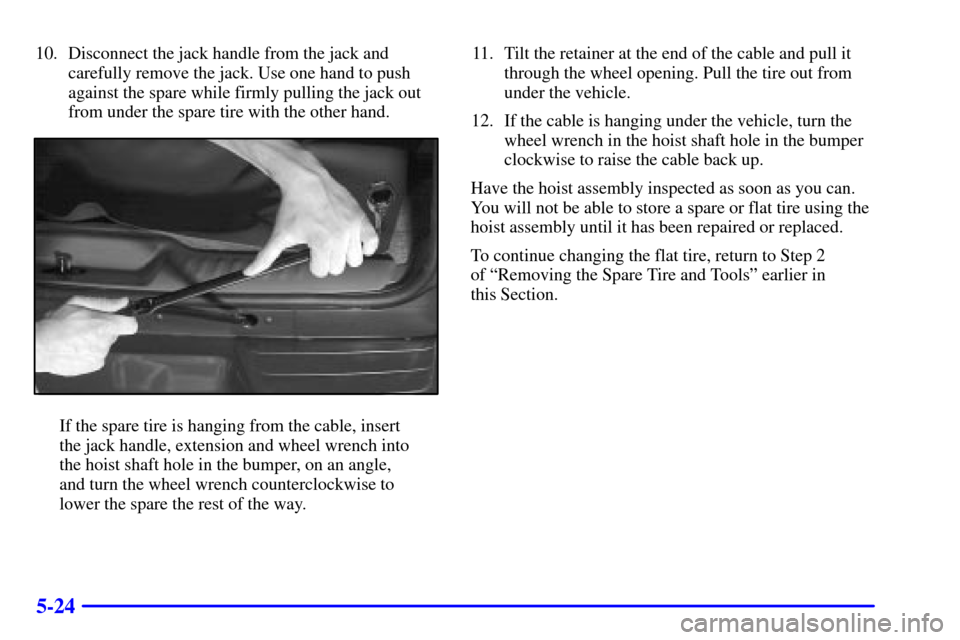
10. Disconnect the jack handle from the jack and
carefully remove the jack. Use one hand to push
against the spare while firmly pulling the jack out
from under the spare tire with the other hand.
If the spare tire is hanging from the cable, insert
the jack handle, extension and wheel wrench into
the hoist shaft hole in the bumper, on an angle,
and turn the wheel wrench counterclockwise to
lower the spare the rest of the way.11. Tilt the retainer at the end of the cable and pull it
through the wheel opening. Pull the tire out from
under the vehicle.
12. If the cable is hanging under the vehicle, turn the
wheel wrench in the hoist shaft hole in the bumper
clockwise to raise the cable back up.
Have the hoist assembly inspected as soon as you can.
You will not be able to store a spare or flat tire using the
hoist assembly until it has been repaired or replaced.
To continue changing the flat tire, return to Step 2
of ªRemoving the Spare Tire and Toolsº earlier in
this Section.