Page 53 of 432
1-41
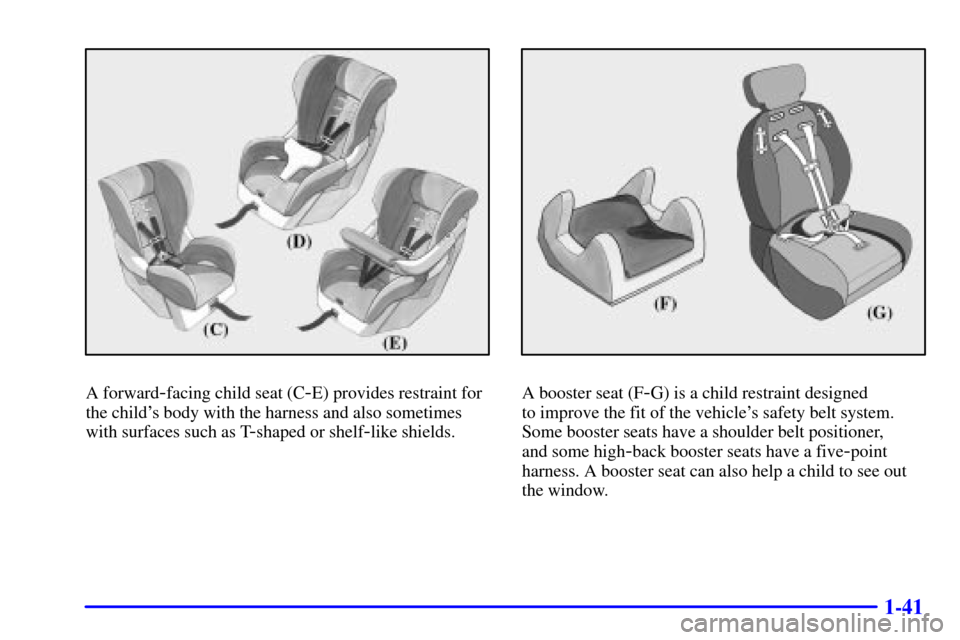
A forward-facing child seat (C-E) provides restraint for
the child's body with the harness and also sometimes
with surfaces such as T
-shaped or shelf-like shields.
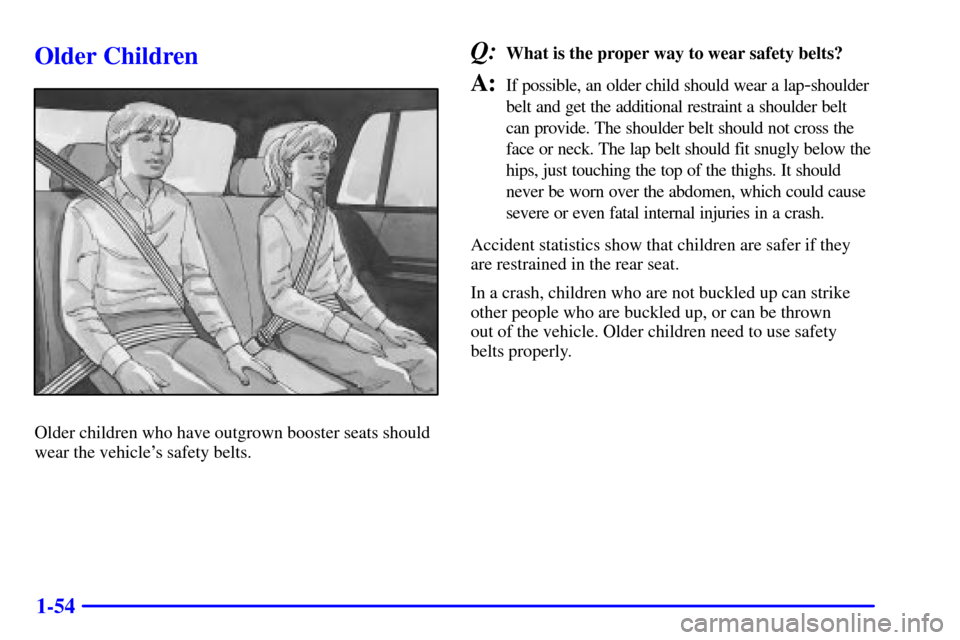
A booster seat (F-G) is a child restraint designed
to improve the fit of the vehicle's safety belt system.
Some booster seats have a shoulder belt positioner,
and some high
-back booster seats have a five-point
harness. A booster seat can also help a child to see out
the window.
Page 63 of 432
1-51
CAUTION:
A child in a rear-facing child restraint can be
seriously injured or killed if the right front
passenger's air bag inflates. This is because the
back of the rear
-facing child restraint would be
very close to the inflating air bag. Always secure
a rear
-facing child restraint in the rear seat.
Although a rear seat is a safer place, you can secure a
forward
-facing child restraint in the right front seat.You'll be using the lap
-shoulder belt. See the earlier
part about the top strap if the child restraint has one.
Be sure to follow the instructions that came with the
child restraint. Secure the child in the child restraint
when and as the instructions say.
1. Because your vehicle has a right front passenger air
bag, always move the seat as far back as it will go
before securing a forward
-facing child restraint.
See ªSeatsº in the Index.
2. Put the restraint on the seat.
3. Pick up the latch plate, and run the lap and shoulder
portions of the vehicle's safety belt through or
around the restraint. The child restraint instructions
will show you how.
If the shoulder belt goes in front of the child's face
or neck, put it behind the child restraint.
Page 66 of 432
1-54
Older Children
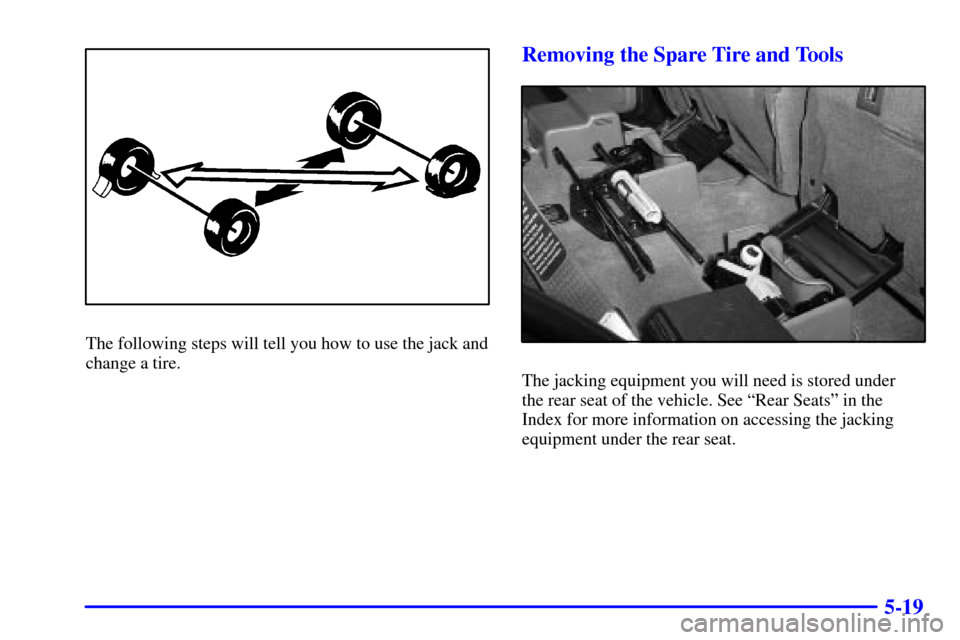
Older children who have outgrown booster seats should
wear the vehicle's safety belts.
Q:What is the proper way to wear safety belts?
A:If possible, an older child should wear a lap-shoulder
belt and get the additional restraint a shoulder belt
can provide. The shoulder belt should not cross the
face or neck. The lap belt should fit snugly below the
hips, just touching the top of the thighs. It should
never be worn over the abdomen, which could cause
severe or even fatal internal injuries in a crash.
Accident statistics show that children are safer if they
are restrained in the rear seat.
In a crash, children who are not buckled up can strike
other people who are buckled up, or can be thrown
out of the vehicle. Older children need to use safety
belts properly.
Page 174 of 432
3-2
Comfort Controls
This section tells you how to use the comfort controls.
With these systems, you can control the heating, cooling
and ventilation in your vehicle.
Comfort Controls Personalization
(If Equipped)
If your vehicle is equipped with the automatic comfort
control system and memory seats and mirrors, you
can store and recall the climate control settings for
temperature, air delivery mode and fan speed for
two different drivers. The personal choice settings
recalled are determined by the transmitter used to enter
the vehicle. After the button with the unlock symbol on
a remote keyless entry transmitter is pressed, the climate
control will adjust to the last settings of the identified
driver. The settings can also be changed by pressing one
of the memory buttons (1 or 2) located on the driver's
door. When adjustments are made, the new settings are
automatically saved for that driver.
Manual Dual Zone Comfort Controls
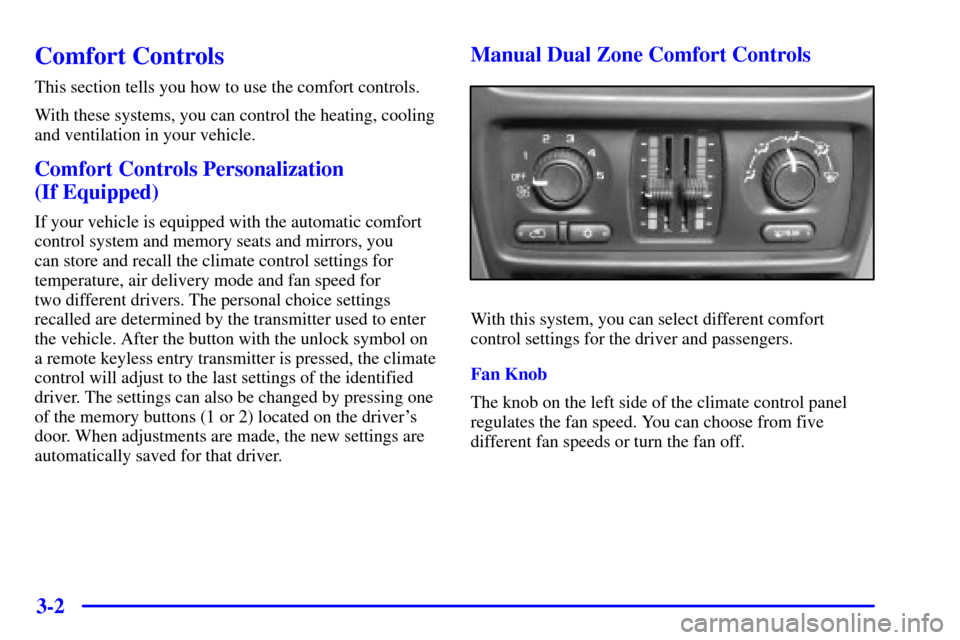
With this system, you can select different comfort
control settings for the driver and passengers.
Fan Knob
The knob on the left side of the climate control panel
regulates the fan speed. You can choose from five
different fan speeds or turn the fan off.
Page 184 of 432
3-12
Ventilation Tips
�Keep the hood and front air inlet free of ice, snow or
any other obstruction such as leaves. The heater and
defroster will work better, reducing the chance of
fogging your windows.
�In cool damp weather, minimize your use of
recirculation to reduce the chance of fogging
your windows.
�When you enter a vehicle with the manual system in
cold weather, select floor mode to supply air through
the floor outlets. Then turn the fan on high for a few
moments before driving away. This will blow moist
air from the intake outlets toward the floor, not the
windshield. It reduces the chance of fogging your
windows. If you have the automatic system, the
AUTO setting will do this for you. Manual operation
of the automatic system in the floor mode will also
supply air through the floor outlets.
�Keep the air path under the front seats clear of
objects. This helps air to circulate throughout
your vehicle.Comfort Control Steering Wheel Controls
(If Equipped)
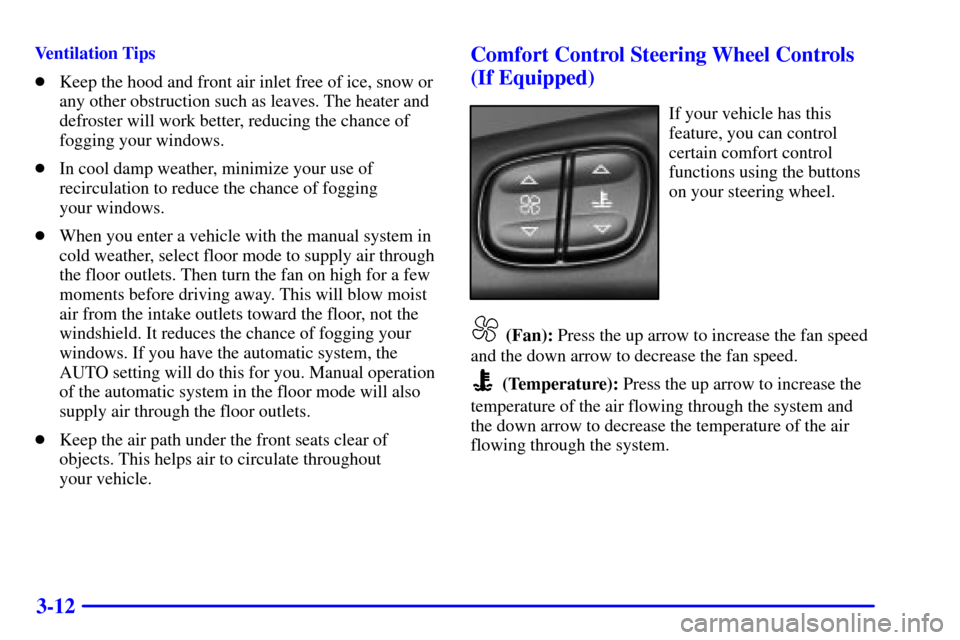
If your vehicle has this
feature, you can control
certain comfort control
functions using the buttons
on your steering wheel.
(Fan): Press the up arrow to increase the fan speed
and the down arrow to decrease the fan speed.
(Temperature): Press the up arrow to increase the
temperature of the air flowing through the system and
the down arrow to decrease the temperature of the air
flowing through the system.
Page 281 of 432
4-49
CAUTION:
Do not load your vehicle any heavier than the
GVWR, or either the maximum front or rear
GAWR. If you do, parts on your vehicle can
break, and it can change the way your vehicle
handles. These could cause you to lose control
and crash. Also, overloading can shorten the life
of your vehicle.
Using heavier suspension components to get added
durability might not change your weight ratings. Ask
your dealer to help you load your vehicle the right way.
NOTICE:
Your warranty does not cover parts or
components that fail because of overloading.
If you put things inside your vehicle -- like suitcases,
tools, packages, or anything else
-- they will go as fast
as the vehicle goes. If you have to stop or turn quickly,
or if there is a crash, they'll keep going.
CAUTION:
Things you put inside your vehicle can strike
and injure people in a sudden stop or turn,
or in a crash.
�Put things in the cargo area of your vehicle.
Try to spread the weight evenly.
�Never stack heavier things, like suitcases,
inside the vehicle so that some of them are
above the tops of the seats.
�Don't leave an unsecured child restraint in
your vehicle.
�When you carry something inside the
vehicle, secure it whenever you can.
�Don't leave a seat folded down unless you
need to.
There's also important loading information for off-road
driving in this manual. See ªLoading Your Vehicle for
Off
-Road Drivingº in the Index.
Page 311 of 432
5-19
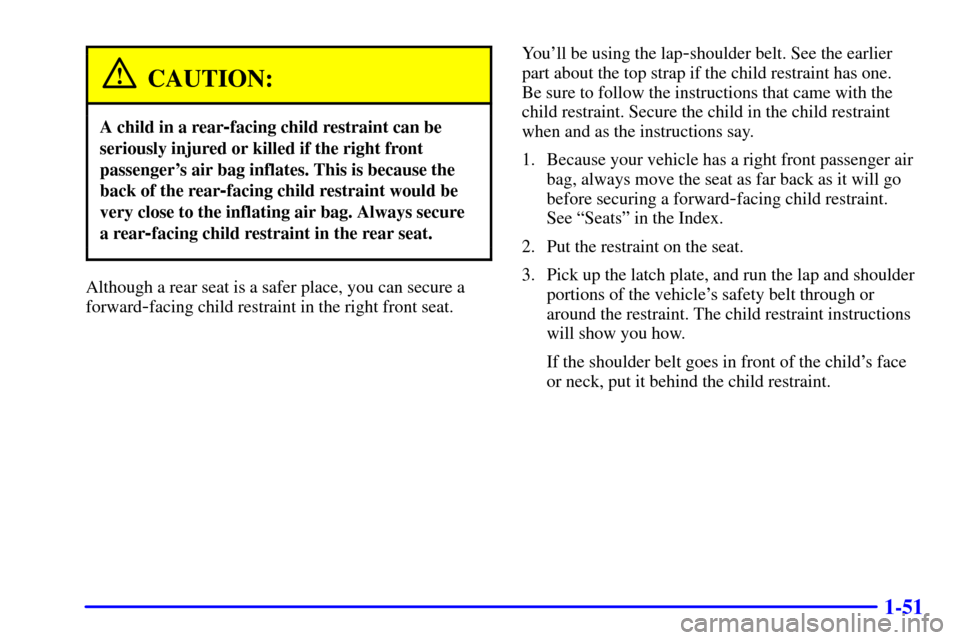
The following steps will tell you how to use the jack and
change a tire.
Removing the Spare Tire and Tools
The jacking equipment you will need is stored under
the rear seat of the vehicle. See ªRear Seatsº in the
Index for more information on accessing the jacking
equipment under the rear seat.
Page 387 of 432
6-61
Fuse Usage
01 Right Door Control Module
02 Left Door Control Module
03 LGM 2
04 TBC 3
05 Rear Fog Lamps
06 LGM/DSM
07 TBC 2
08 Power Seats
09 Blank
10 DDM
11 AMP
12 PDM
13 Rear Climate Controls
14 Left Rear Parking Lamps
15 Auxiliary Power 2
16 VEH CHMSL