Page 124 of 497
2-44
Manual Selectable Ride (If Equipped)
The main function of this system is to provide superior
ride comfort while trailering or fully loaded, as well as
for unloaded driving. This system also helps to provide:
�Improved trailering stability
�Improved handling response when trailering or
fully loaded
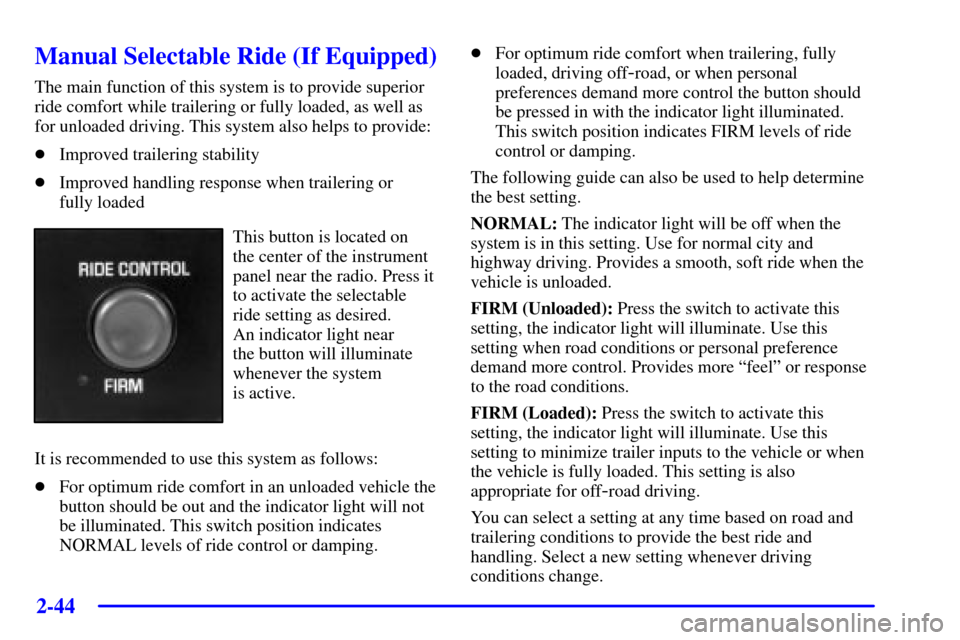
This button is located on
the center of the instrument
panel near the radio. Press it
to activate the selectable
ride setting as desired.
An indicator light near
the button will illuminate
whenever the system
is active.
It is recommended to use this system as follows:
�For optimum ride comfort in an unloaded vehicle the
button should be out and the indicator light will not
be illuminated. This switch position indicates
NORMAL levels of ride control or damping.�For optimum ride comfort when trailering, fully
loaded, driving off
-road, or when personal
preferences demand more control the button should
be pressed in with the indicator light illuminated.
This switch position indicates FIRM levels of ride
control or damping.
The following guide can also be used to help determine
the best setting.
NORMAL: The indicator light will be off when the
system is in this setting. Use for normal city and
highway driving. Provides a smooth, soft ride when the
vehicle is unloaded.
FIRM (Unloaded): Press the switch to activate this
setting, the indicator light will illuminate. Use this
setting when road conditions or personal preference
demand more control. Provides more ªfeelº or response
to the road conditions.
FIRM (Loaded): Press the switch to activate this
setting, the indicator light will illuminate. Use this
setting to minimize trailer inputs to the vehicle or when
the vehicle is fully loaded. This setting is also
appropriate for off
-road driving.
You can select a setting at any time based on road and
trailering conditions to provide the best ride and
handling. Select a new setting whenever driving
conditions change.
Page 147 of 497

2-67
Automatic Headlamp System
When it is dark enough outside, your automatic
headlamp system will turn on your headlamps at the
normal brightness along with other lamps such as the
taillamps, sidemarker, parking lamps and the instrument
panel lights. The radio lights will also be dim.
Your vehicle is equipped with a light sensor located on
the top of the instrument panel in the defroster grille. Be
sure it is not covered, or the system will be on whenever
the ignition is on.
The system may also turn on your headlamps when
driving through a parking garage, heavy overcast
weather or a tunnel. This is normal.
There is a delay in the transition between the daytime
and nighttime operation of the Daytime Running
Lamps (DRL) and the automatic headlamp systems so
that driving under bridges or bright overhead street
lights does not affect the system. The DRL and
automatic headlamp system will only be affected when
the light sensor sees a change in lighting lasting longer
than the delay.To idle your vehicle with the automatic headlamp
system off, set the parking brake while the ignition is
off. Then start your vehicle. The automatic headlamp
system will stay off until you release the parking brake.
You may be able to turn off your automatic headlamp
system. See ªDaytime Running Lamps (DRL)º later in
this section for more information.
As with any vehicle, you should turn on the regular
headlamp system when you need them.
Lamps On Reminder
A reminder chime will sound when your headlamps or
parking lamps are manually turned on and your ignition
is in OFF, LOCK or ACCESSORY. To disable the
chime, turn the thumbwheel all the way down. In the
automatic mode, the headlamps turn off once the
ignition key is in OFF.
Page 330 of 497
5-4
2. If you have a vehicle with a diesel engine with two
batteries (or more), you should know before you
begin that, especially in cold weather, you may not
be able to get enough power from a single battery in
another vehicle to start your diesel engine.
If your vehicle has more than one battery, use the
battery that's closer to the starter
-- this will reduce
electrical resistance.
3. Get the vehicles close enough so the jumper cables
can reach, but be sure the vehicles aren't touching
each other. If they are, it could cause a ground
connection you don't want. You wouldn't be able to
start your vehicle, and the bad grounding could
damage the electrical systems.
To avoid the possibility of the vehicles rolling, set
the parking brake firmly on both vehicles involved
in the jump start procedure. Put an automatic
transmission in PARK (P) or a manual transmission
in NEUTRAL before setting the parking brake. If
you have a four
-wheel-drive vehicle, be sure the
transfer case is in a drive gear not in NEUTRAL.
NOTICE:
If you leave your radio on, it could be badly
damaged. The repairs wouldn't be covered by
your warranty.
4. Turn off the ignition on both vehicles. Unplug
unnecessary accessories plugged into the cigarette
lighter or accessory power outlets. Turn off the radio
and all lamps that aren't needed. This will avoid
sparks and help save both batteries. And it could
save your radio!