Page 270 of 497
4-42
Hill and Mountain Roads
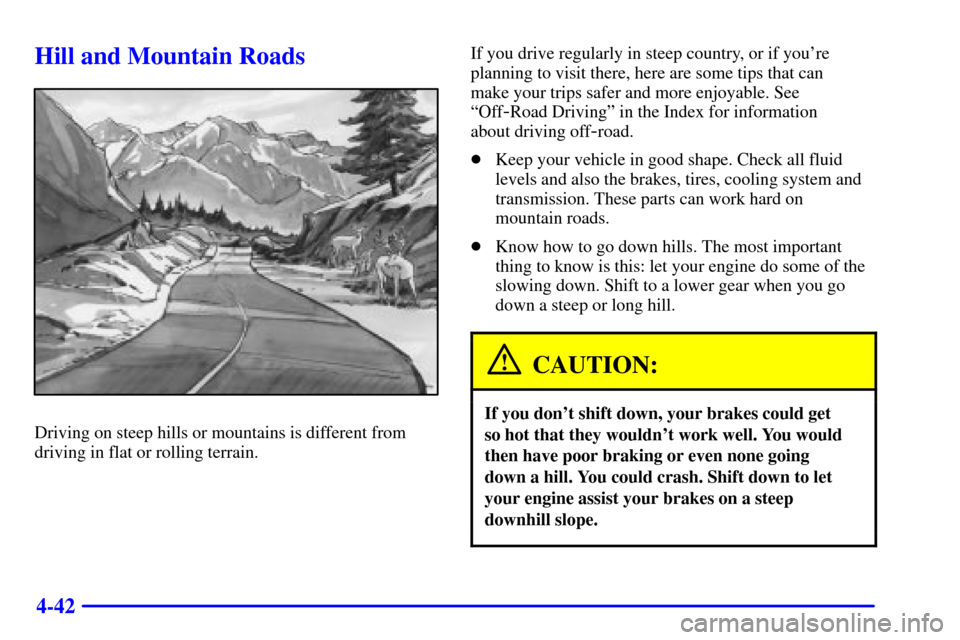
Driving on steep hills or mountains is different from
driving in flat or rolling terrain.If you drive regularly in steep country, or if you're
planning to visit there, here are some tips that can
make your trips safer and more enjoyable. See
ªOff
-Road Drivingº in the Index for information
about driving off
-road.
�Keep your vehicle in good shape. Check all fluid
levels and also the brakes, tires, cooling system and
transmission. These parts can work hard on
mountain roads.
�Know how to go down hills. The most important
thing to know is this: let your engine do some of the
slowing down. Shift to a lower gear when you go
down a steep or long hill.
CAUTION:
If you don't shift down, your brakes could get
so hot that they wouldn't work well. You would
then have poor braking or even none going
down a hill. You could crash. Shift down to let
your engine assist your brakes on a steep
downhill slope.
Page 271 of 497
4-43
CAUTION:
Coasting downhill in NEUTRAL (N) or with the
ignition off is dangerous. Your brakes will have
to do all the work of slowing down. They could
get so hot that they wouldn't work well. You
would then have poor braking or even none going
down a hill. You could crash. Always have your
engine running and your vehicle in gear when
you go downhill.
�Know how to go uphill. You may want to shift
down to a lower gear. The lower gears help cool
your engine and transmission, and you can climb
the hill better.
�Stay in your own lane when driving on two
-lane
roads in hills or mountains. Don't swing wide or cut
across the center of the road. Drive at speeds that let
you stay in your own lane.
�As you go over the top of a hill, be alert. There
could be something in your lane, like a stalled car
or an accident.
�You may see highway signs on mountains that
warn of special problems. Examples are long grades,
passing or no
-passing zones, a falling rocks area
or winding roads. Be alert to these and take
appropriate action.
Page 275 of 497
4-47
�Tie a red cloth to your vehicle to alert police that
you've been stopped by the snow.
�Put on extra clothing or wrap a blanket around you.
If you have no blankets or extra clothing, make body
insulators from newspapers, burlap bags, rags, floor
mats
-- anything you can wrap around yourself or
tuck under your clothing to keep warm.
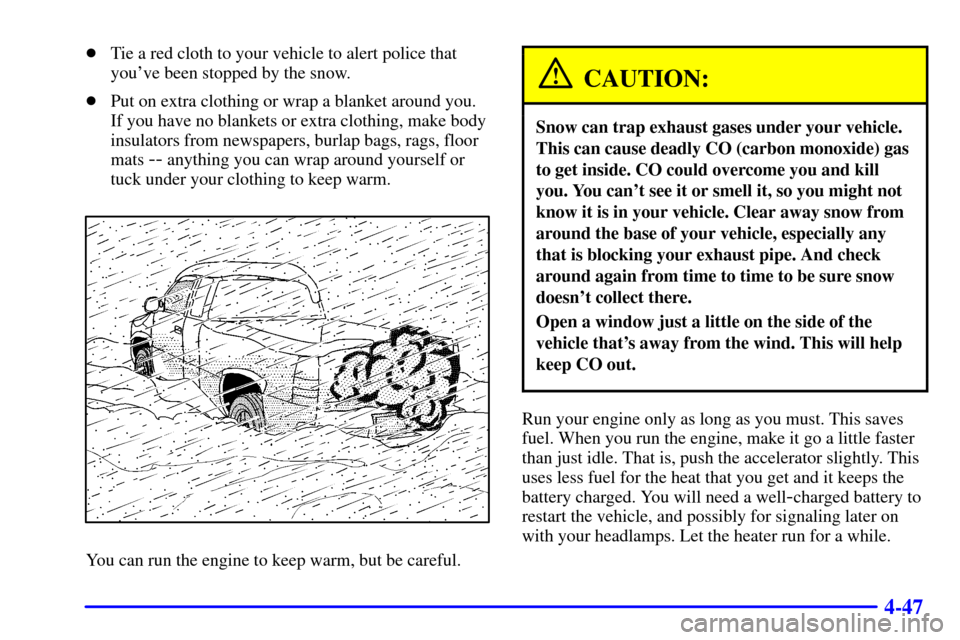
You can run the engine to keep warm, but be careful.
CAUTION:
Snow can trap exhaust gases under your vehicle.
This can cause deadly CO (carbon monoxide) gas
to get inside. CO could overcome you and kill
you. You can't see it or smell it, so you might not
know it is in your vehicle. Clear away snow from
around the base of your vehicle, especially any
that is blocking your exhaust pipe. And check
around again from time to time to be sure snow
doesn't collect there.
Open a window just a little on the side of the
vehicle that's away from the wind. This will help
keep CO out.
Run your engine only as long as you must. This saves
fuel. When you run the engine, make it go a little faster
than just idle. That is, push the accelerator slightly. This
uses less fuel for the heat that you get and it keeps the
battery charged. You will need a well
-charged battery to
restart the vehicle, and possibly for signaling later on
with your headlamps. Let the heater run for a while.
Page 276 of 497

4-48
Then, shut the engine off and close the window almost
all the way to preserve the heat. Start the engine again
and repeat this only when you feel really uncomfortable
from the cold. But do it as little as possible. Preserve the
fuel as long as you can. To help keep warm, you can get
out of the vehicle and do some fairly vigorous exercises
every half hour or so until help comes.
Recreational Vehicle Towing
Recreational vehicle towing means towing your
vehicle behind another vehicle
-- such as behind a
motorhome. The two most common types of
recreational vehicle towing are known as ªdinghy
towingº (towing your vehicle with all four wheels on
the ground) and ªdolly towingº (towing your vehicle
with two wheels on the ground and two wheels up on
a device known as a ªdollyº).
With the proper preparation and equipment, many
vehicles can be towed in these ways. See ªDinghy
Towingº and ªDolly Towing,º following.Here are some important things to consider before you
do recreational vehicle towing:
�What's the towing capacity of the towing vehicle?
Be sure you read the tow vehicle manufacturer's
recommendations.
�How far will you tow? Some vehicles have
restrictions on how far and how long they can tow.
�Do you have the proper towing equipment? See your
dealer or trailering professional for additional advice
and equipment recommendations.
�Is your vehicle ready to be towed? Just as you would
prepare your vehicle for a long trip, you'll want to
make sure your vehicle is prepared to be towed. See
ªBefore Leaving on a Long Tripº in the Index.
Page 292 of 497

4-64 If You Do Decide To Pull A Trailer
If you do, here are some important points:
�There are many different laws, including speed limit
restrictions, having to do with trailering. Make sure
your rig will be legal, not only where you live but
also where you'll be driving. A good source for this
information can be state or provincial police.
�Consider using a sway control if your trailer will
weigh less than 5,000 lbs. (2 270 kg) for light duty
vehicles, or less than 7,500 lbs. (3 405 kg) for heavy
duty vehicles. You should always use a sway control
if your trailer will weigh more than these limits.
You can ask a hitch dealer about sway controls.
�Don't tow a trailer at all during the first 500 miles
(800 km) your new vehicle is driven. Your engine,
axle or other parts could be damaged.�Then, during the first 500 miles (800 km) that you
tow a trailer, don't drive over 50 mph (80 km/h) and
don't make starts at full throttle. This helps your
engine and other parts of your vehicle wear in at the
heavier loads.
�If you have an automatic transmission, you can
tow in DRIVE (D). You may want to shift the
transmission to THIRD (3) or, if necessary, a lower
gear selection if the transmission shifts too often
(e.g., under heavy loads and/or hilly conditions).
If you have a manual transmission and you are
towing a trailer, it's better not to use the highest gear.
See ªTow/Haul Modeº in the Index.
Three important considerations have to do with weight:
�the weight of the trailer,
�the weight of the trailer tongue
�and the weight on your vehicle's tires.
Page 293 of 497

4-65
Tow/Haul Mode (If Equipped)
Tow/haul is a feature on automatic transmission
equipped vehicles that assists when pulling a heavy
trailer or a large or heavy load. The purpose of the
tow/haul mode is to:
�Reduce the frequency and improve the predictability
of transmission shifts when pulling a heavy trailer or
a large or heavy load.
�Provide the same solid shift feel when pulling a
heavy trailer or a large or heavy load as when the
vehicle is unloaded.
�Improve control of vehicle speed while requiring less
throttle pedal activity when pulling a heavy trailer or
a large or heavy load.
Automatic transmission equipped vehicles are provided
with a button at the end of the shift lever which when
pressed enables tow/haul. When the button is pressed,
a light on the instrument panel will illuminate to indicate
that tow/haul has been selected. Tow/haul may be turned
off by pressing the button again, at which time the
indicator light on the instrument panel will turn off.
The vehicle will automatically turn off tow/haul every
time it is started.Tow/haul is designed to be most effective when the
vehicle and trailer combined weight is at least 75% of
the vehicle's Gross Combined Weight Rating (GCWR).
See ªWeight of the Trailerº later in the section.
Tow/haul is most useful under the following
driving conditions:
�When pulling a heavy trailer or a large or heavy load
through rolling terrain.
�When pulling a heavy trailer or a large or heavy load
in stop and go traffic.
�When pulling a heavy trailer or a large or heavy load
in busy parking lots where improved low speed
control of the vehicle is desired.
Operating the vehicle in tow/haul when lightly loaded or
with no trailer at all will not cause damage. However,
there is no benefit to the selection of tow/haul when the
vehicle is unloaded. Such a selection when unloaded
may result in unpleasant engine and transmission
driving characteristics and reduced fuel economy.
Tow/haul is recommended only when pulling a heavy
trailer or a large or heavy load.
Page 294 of 497

4-66 Weight of the Trailer
How heavy can a trailer safely be?
It depends on how you plan to use your rig. For
example, speed, altitude, road grades, outside
temperature and how much your vehicle is used to pull a
trailer are all important. And, it can also depend on any
special equipment that you have on your vehicle.
Use one of the following charts to determine how much
your vehicle can weigh, based upon your vehicle model
and options.
Maximum trailer weight is calculated assuming the
driver and one passenger are in the tow vehicle and it
has all the required trailering equipment. The weight of
additional optional equipment, passengers and cargo in
the tow vehicle must be subtracted from the maximum
trailer weight.Above the 5,000 lbs. (2 268 kg) trailer rating, the
handling/trailering suspension is required on
C-1500 models and the handling/trailering or off-road
suspension is required on K
-1500 models. The engine
oil cooler is required on C/K
-2500 models with the
VORTEC 6000 engine. Refer to the Trailering Guide for
oil cooler recommendations.
The Gross Combination Weight Rating (GCWR) is the
total allowable weight of the completely loaded vehicle
and trailer including any passengers, cargo, equipment
and conversions. The GCWR for your vehicle should
not be exceeded.
Page 295 of 497
4-67
C-1500 Regular Cab Short Box (2WD)*
Engine (Trans.) Axle Ratio Max. Trailer Wt. GCWR
4300 V6 (Auto) 3.08 4,600 lbs. (2 088 kg) 9,000 lbs. (4 086 kg)
3.42 5,100 lbs. (2 315 kg) 9,500 lbs. (4 313 kg)
4300 V6 (Manual) 3.08 3,600 lbs. (1 634 kg) 8,000 lbs. (3 632 kg)
3.42 4,100 lbs. (1 861 kg) 8,500 lbs. (3 859 kg)
4800 V8 (Auto) 3.42 6,500 lbs. (2 951 kg) 11,000 lbs. (4 994 kg)
3.73 7,500 lbs. (3 405 kg) 12,000 lbs. (5 448 kg)
4800 V8 (Manual) 3.42 4,500 lbs. (2 043 kg) 9,000 lbs. (4 086 kg)
3.73 5,500 lbs. (2 497 kg) 10,000 lbs. (4 540 kg)
5300 V8 3.42 7,500 lbs. (3 405 kg) 12,000 lbs. (5 448 kg)
3.73 8,500 lbs. (3 859 kg) 13,000 lbs. (5 902 kg)
* Weight
-distributing hitch tongue weight 10 percent to 15 percent of hitch pulling weight 1,000 lb. (454 kg) maximum.
Fifth
-wheel hitch tongue weight 15 percent to 25 percent of hitch pulling weight 1,500 lb (680 kg) maximum.