Page 316 of 497

4-88 Driving On Grades
Reduce speed and shift to a lower gear before you start
down a long or steep downgrade. If you don't shift
down, you might have to use your brakes so much that
they would get hot and no longer work well.
If you have an automatic transmission, you can tow in
DRIVE (D). You may want to shift the transmission to
THIRD (3) or, if necessary, a lower gear selection if the
transmission shifts too often (e.g., under heavy loads
and/or hilly conditions).
You may also want to activate the tow/haul mode if the
transmission shifts too often. See ªTow/Haul Modeº in
the Index.
If you have a 5
-speed manual transmission and you are
towing a trailer, it's better not to use FIFTH (5) gear.
Just drive in FOURTH (4) gear (or, as you need to, a
lower gear).If you have a 6
-speed manual transmission and you
are towing a trailer, it's better not to use SIXTH (6)
gear. Drive in FIFTH (5) gear (or, as you need to, a
lower gear).
When towing at high altitude on steep uphill grades,
consider the following: Engine coolant will boil at a
lower temperature than at normal altitudes. If you turn
your engine off immediately after towing at high altitude
on steep uphill grades, your vehicle may show signs
similar to engine overheating. To avoid this, let the
engine run while parked (preferably on level ground)
with the automatic transmission in PARK (P) (or the
manual transmission out of gear and the parking brake
applied) for a few minutes before turning the engine off.
If you do get the overheat warning, see ªEngine
Overheatingº in the Index.
Page 317 of 497

4-89 Parking on Hills
CAUTION:
You really should not park your vehicle, with a
trailer attached, on a hill. If something goes
wrong, your rig could start to move. People can
be injured, and both your vehicle and the trailer
can be damaged.
But if you ever have to park your rig on a hill, here's
how to do it:
1. Apply your regular brakes, but don't shift into
PARK (P) yet for an automatic transmission, or into
gear for a manual transmission.
2. Have someone place chocks under the trailer wheels.
3. When the wheel chocks are in place, release the
regular brakes until the chocks absorb the load.
4. Reapply the regular brakes. Then apply your
parking brake and shift into PARK (P) for an
automatic transmission, or REVERSE (R) for a
manual transmission.5. If you have a four
-wheel-drive vehicle, be
sure the transfer case is in a drive gear and not
in NEUTRAL.
6. Release the regular brakes.
CAUTION:
It can be dangerous to get out of your vehicle if
the shift lever is not fully in PARK (P) with the
parking brake firmly set. Your vehicle can roll.
If you have left the engine running, the vehicle
can move suddenly. You or others could be
injured. To be sure your vehicle won't move, even
when you're on fairly level ground, use the steps
that follow.
Always put the shift lever fully in PARK (P) with
the parking brake firmly set.
If the transfer case on four-wheel drive vehicles is
in NEUTRAL, your vehicle will be free to roll,
even if your shift lever is in PARK (P). So, be
sure the transfer case is in a drive gear
-- not
in NEUTRAL.
Page 318 of 497
4-90 When You Are Ready to Leave After
Parking on a Hill
1. Apply your regular brakes and hold the pedal down
while you:
�start your engine,
�shift into a gear, and
�release the parking brake.
2. Let up on the brake pedal.
3. Drive slowly until the trailer is clear of the chocks.
4. Stop and have someone pick up and store the chocks.
Maintenance When Trailer Towing
Your vehicle will need service more often when you're
pulling a trailer. See the Maintenance Schedule for more
on this. Things that are especially important in trailer
operation are automatic transmission fluid (don't
overfill), engine oil, axle lubricant, belt, cooling system
and brake system. Each of these is covered in this
manual, and the Index will help you find them quickly.
If you're trailering, it's a good idea to review these
sections before you start your trip.
Check periodically to see that all hitch nuts and bolts
are tight.
Page 324 of 497
4-96 Power Winches
If you wish to use a power winch on your vehicle, only
use it when your vehicle is stationary or anchored.
NOTICE:
Using a power winch with the transmission in
gear may damage the transmission. When
operating a power winch, always leave the
transmission in NEUTRAL (N).
Use the regular brakes, set the parking brake, or block
the wheels to keep your vehicle from rolling.
Power Take-Off (PTO) (If Equipped)
Before using a PTO, refer to the manufacturer's or
installer's instructions.
To engage a PTO on a vehicle with a manual
transmission do the following:
1. Hold the clutch pedal down.
2. Set the parking brake.3. Shift the transmission into NEUTRAL (N).
4. Engage the PTO. Refer to the manufacturer's
or installer's for instructions on electrically
engaged PTOs.
5. For mobile operations, shift the transmission into the
gear you want, apply the regular brakes and release
the parking brake. For stationary operations, leave
the parking brake applied.
6. Release the clutch and regular brakes as you
normally would. When the clutch is released, the
PTO will start.
7. Turn the PTO rotary switch to ON.
To engage a PTO on a vehicle with an automatic
transmission do the following:
1. For stationary use shift the transmission
into PARK (P).
2. Turn the PTO rotary switch ON.
3. If the engine speed is below the PTO engage speed
limit, the PTO will start. The blinking LED on the
PTO control switch indicates PTO engage is
requested. When PTO engages the LED will switch
from blinking to a steady light.
Page 325 of 497

4-97
To use PTO speed control in Preset Mode (Factory
Setting) do the following:
1. Engage the PTO
2. Select PARK (P) or NEUTRAL (N) range. Apply the
parking brake if NEUTRAL (N) is selected. Torque
Converter Clutch (TCC) is not available in
NEUTRAL (N) and is available only in PARK (P)
when engine speed is above 1100 rpm.
3. Make sure your foot is off the brake pedal
(and off the clutch on vehicles equipped with
a manual transmission).
4. Select the desired engine speed for PTO operation.
Read the following preset mode information
regarding operation.Preset Mode: PTO speed control mode is used for
stationary applications. (PTO will remain engaged while
mobile in the preset mode, however PTO set and resume
speed controls will be inoperative). This mode provides
a default standby speed of 800 or 850 rpm (depending
on the engine/transmission combination) and
two default PTO control speeds which follow:
1. PTO Set Speed of 1250 rpm, or
2. PTO Resume Speed of 1700 rpm.
Please note that the standby speed (800/850 rpm) is
not to be used as a PTO control speed. Vehicles not
equipped with cruise control will not have the resume
speed capability.
To use PTO speed control in variable mode
(while mobile) do the following:
1. Engage the PTO.
2. Vehicle speed must be greater than 5 mph.
3. Make sure your foot is off the brake pedal
(and off the clutch for vehicles equipped with
a manual transmission).
4. Select the desired engine speed by using the foot
pedal, and select SET on the PTO switch or the
cruise control.
Page 326 of 497
4-98
To use PTO speed control in variable mode
(while stationary) do the following:
1. Engage the PTO.
2. Vehicle speed must be less than 5 mph.
3. Make sure your foot is off the brake pedal
(and off the clutch for vehicles equipped with
a manual transmission).
4. Select the desired engine speed by using the foot
pedal, and select SET on the PTO switch or the
cruise control.
Variable Mode: PTO speed control mode can be used
for both stationary and mobile applications. This mode
allows PTO to be controlled in a fashion similar to how
cruise control sets vehicle speed. The operator can set to
an rpm (between 800 and 2200) with the cruise control
feature or with the SET position on the PTO switch.
The operator is then able to increase rpm in increments
of 100, or ªtap upº, with the resume position on the
cruise control. Or, the operator can decrease rpm in
increments of 100 with the SET switch on the PTO or
the cruise control. Vehicles not equipped with cruise
control will not have the ªtap upº capability.All engine speed values listed above are factory preset
values. With the exception of the TCC lockup speed
(1100 rpm) and the ªtapº increment (100 rpm), all
of these values are programmable and can be adjusted
by your dealer or body upfitter. If the PTO software
settings do not match the settings shown here, then
they may have already been altered in order to satisfy
the requirements of the installed PTO system and
body equipment.
Step-Bumper Pad
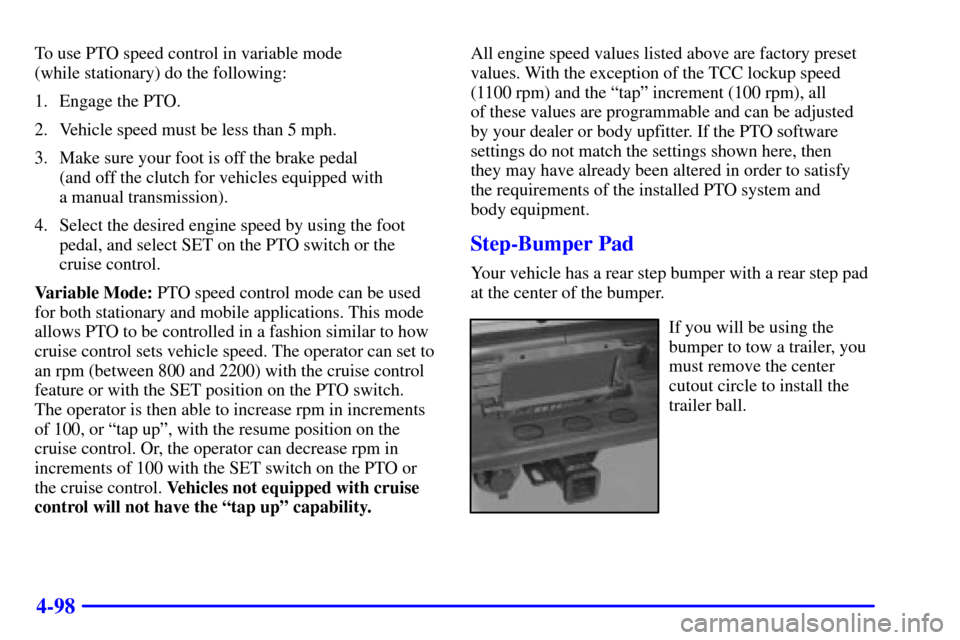
Your vehicle has a rear step bumper with a rear step pad
at the center of the bumper.
If you will be using the
bumper to tow a trailer, you
must remove the center
cutout circle to install the
trailer ball.
Page 327 of 497
5-
5-1
Section 5 Problems on the Road
Here you'll find what to do about some problems that can occur on the road.
5
-2 Hazard Warning Flashers
5
-2 Other Warning Devices
5
-3 Jump Starting
5
-9 Towing Your Vehicle
5
-10 Engine Overheating (Gasoline Engine)5
-13 Cooling System (Gasoline Engine)
5
-20 Engine Fan Noise
5
-20 If a Tire Goes Flat
5
-21 Changing a Flat Tire
5
-36 If You're Stuck: In Sand, Mud, Ice or Snow
Page 330 of 497
5-4
2. If you have a vehicle with a diesel engine with two
batteries (or more), you should know before you
begin that, especially in cold weather, you may not
be able to get enough power from a single battery in
another vehicle to start your diesel engine.
If your vehicle has more than one battery, use the
battery that's closer to the starter
-- this will reduce
electrical resistance.
3. Get the vehicles close enough so the jumper cables
can reach, but be sure the vehicles aren't touching
each other. If they are, it could cause a ground
connection you don't want. You wouldn't be able to
start your vehicle, and the bad grounding could
damage the electrical systems.
To avoid the possibility of the vehicles rolling, set
the parking brake firmly on both vehicles involved
in the jump start procedure. Put an automatic
transmission in PARK (P) or a manual transmission
in NEUTRAL before setting the parking brake. If
you have a four
-wheel-drive vehicle, be sure the
transfer case is in a drive gear not in NEUTRAL.
NOTICE:
If you leave your radio on, it could be badly
damaged. The repairs wouldn't be covered by
your warranty.
4. Turn off the ignition on both vehicles. Unplug
unnecessary accessories plugged into the cigarette
lighter or accessory power outlets. Turn off the radio
and all lamps that aren't needed. This will avoid
sparks and help save both batteries. And it could
save your radio!