Page 272 of 497
4-44
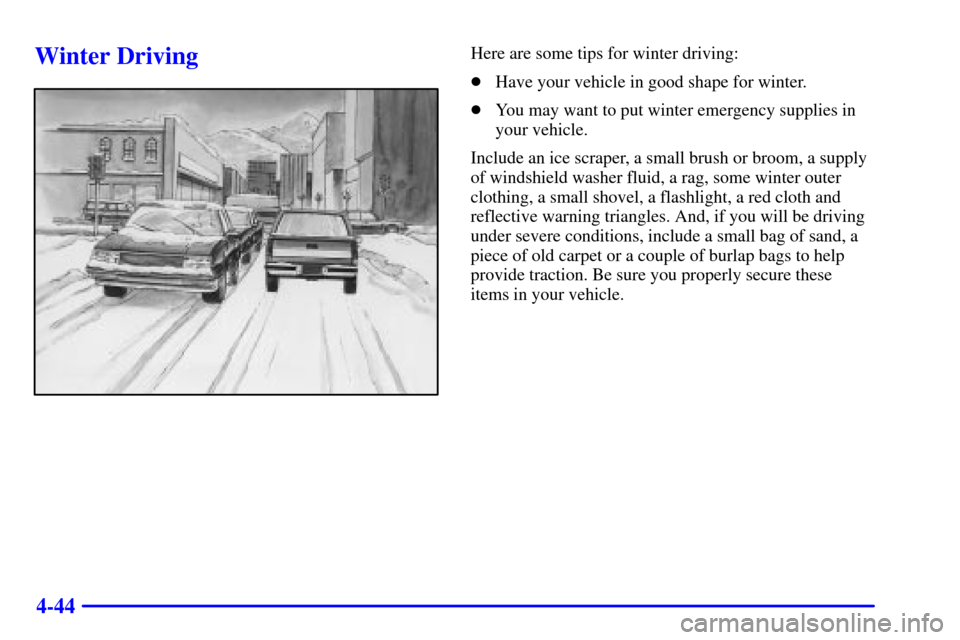
Winter DrivingHere are some tips for winter driving:
�Have your vehicle in good shape for winter.
�You may want to put winter emergency supplies in
your vehicle.
Include an ice scraper, a small brush or broom, a supply
of windshield washer fluid, a rag, some winter outer
clothing, a small shovel, a flashlight, a red cloth and
reflective warning triangles. And, if you will be driving
under severe conditions, include a small bag of sand, a
piece of old carpet or a couple of burlap bags to help
provide traction. Be sure you properly secure these
items in your vehicle.
Page 278 of 497
4-50
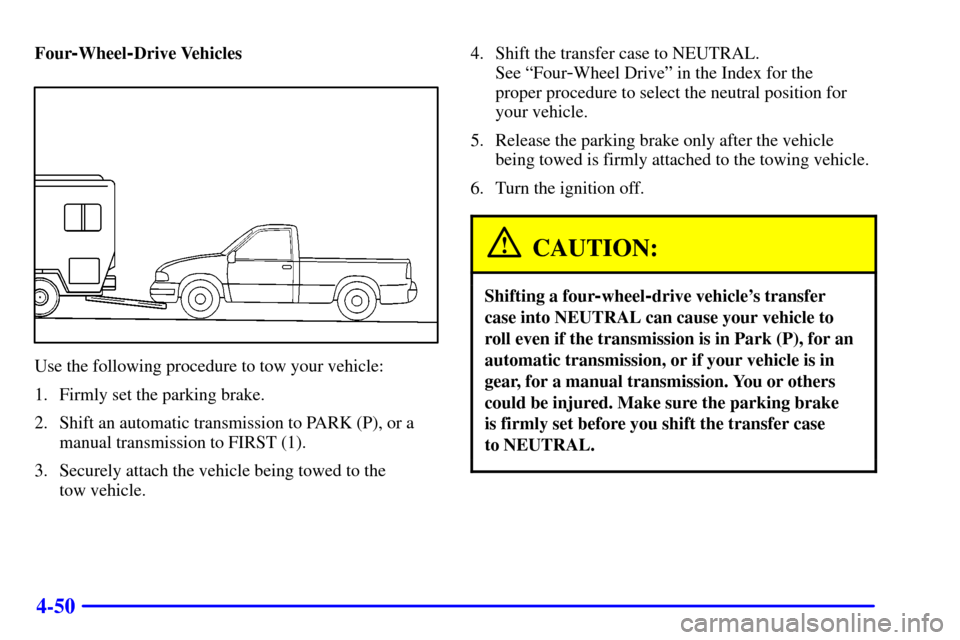
Four-Wheel-Drive Vehicles
Use the following procedure to tow your vehicle:
1. Firmly set the parking brake.
2. Shift an automatic transmission to PARK (P), or a
manual transmission to FIRST (1).
3. Securely attach the vehicle being towed to the
tow vehicle.4. Shift the transfer case to NEUTRAL.
See ªFour
-Wheel Driveº in the Index for the
proper procedure to select the neutral position for
your vehicle.
5. Release the parking brake only after the vehicle
being towed is firmly attached to the towing vehicle.
6. Turn the ignition off.
CAUTION:
Shifting a four-wheel-drive vehicle's transfer
case into NEUTRAL can cause your vehicle to
roll even if the transmission is in Park (P), for an
automatic transmission, or if your vehicle is in
gear, for a manual transmission. You or others
could be injured. Make sure the parking brake
is firmly set before you shift the transfer case
to NEUTRAL.
Page 280 of 497

4-52
Loading Your Vehicle
The Certification/Tire label is found on the rear edge of
the driver's door or in the Incomplete Vehicle Document
in the cab.
The label shows the size of your original tires and the
inflation pressures needed to obtain the gross weight
capacity of your vehicle. This is called the GVWR
(Gross Vehicle Weight Rating). The GVWR includes the
weight of the vehicle, all occupants, fuel and cargo.The Certification/Tire label also tells you the maximum
weights for the front and rear axles, called Gross Axle
Weight Rating (GAWR). To find out the actual loads
on your front and rear axles, you need to go to a weigh
station and weigh your vehicle. Your dealer can help
you with this. Be sure to spread out your load equally
on both sides of the centerline.
Never exceed the GVWR for your vehicle, or the
GAWR for either the front or rear axle.
The Certification/Tire label also contains information
about your Front Axle Reserve Capacity. See ªFront
Axle Reserve Capacityº later in this section.
And, if you do have a heavy load, you should spread
it out.CAUTION:
In the case of a sudden stop or collision, things
carried in the bed of your truck could shift
forward and come into the passenger area,
injuring you and others. If you put things in the
bed of your truck, you should make sure they are
properly secured.
Page 281 of 497
4-53
CAUTION:
Do not load your vehicle any heavier than the
GVWR, or either the maximum front or rear
GAWR. If you do, parts on your vehicle can
break, and it can change the way your vehicle
handles. These could cause you to lose control
and crash. Also, overloading can shorten the life
of your vehicle.
NOTICE:
Your warranty does not cover parts or
components that fail because of overloading.
This will help you decide how much cargo and installed
equipment your truck can carry.
Using heavier suspension components to get added
durability might not change your weight ratings. Ask
your dealer to help you load your vehicle the right way.If you put things inside your vehicle
-- like suitcases,
tools, packages, or anything else
-- they go as fast as the
vehicle goes. If you have to stop or turn quickly, or if
there is a crash, they'll keep going.
CAUTION:
Things you put inside your vehicle can strike
and injure people in a sudden stop or turn, or in
a crash.
�Put things in the cargo area of your vehicle.
Try to spread the weight evenly.
�Never stack heavier things, like suitcases,
inside the vehicle so that some of them are
above the tops of the seats.
�Don't leave an unsecured child restraint in
your vehicle.
�When you carry something inside the
vehicle, secure it whenever you can.
�Don't leave a seat folded down unless you
need to.
There's also important loading information for off-road
driving in this manual. See ªLoading Your Vehicle for
Off
-Road Drivingº in the Index.
Page 282 of 497

4-54 Payload
The payload capacity is shown on the Certification/Tire
label. This is the maximum load capacity that your
vehicle can carry. Be sure to include the weight of the
occupants as part of your load. If you added any
accessories or equipment after your vehicle left the
factory, remember to subtract the weight of these things
from the payload. Your dealer can help you with this.
Remember not to exceed the Gross Axle Weight Rating
(GAWR) of the front or rear axle. See ªLoading Your
Vehicleº in the Index.
2-Tiered Loading
By positioning four 2, x 6, wooden planks across the
width of the pickup box, you can create an upper load
platform. The planks must be inserted in the pickup box
depressions. The length of the planks must allow for at
least a 3/4 inch (2 cm) bearing surface on each end of
the plank.
When using this upper load platform, be sure the load
is securely tied down to prevent it from shifting. The
load's center of gravity should be positioned in a zone
over the rear axle. The zone is located in the area
between the front of each wheel well and the rear of
each wheel well. The center of gravity height must not
extend above the top of the pickup box flareboard.
Any load that extends beyond the vehicle's taillamp
area must be properly marked according to local laws
and regulations.
Remember not to exceed the Gross Axle Weight Rating
(GAWR) of the front or rear axle. See ªLoading Your
Vehicleº in the Index.
Page 284 of 497

4-56
Q:How do I know if my vehicle can handle a
snow plow?
A:Some vehicles are built with a special package,
called RPO VYU (snow plow prep package). If
your vehicle has this option, you can add a plow to
it, provided certain weights, such as the weights on
the vehicle's axles and the GVW, aren't exceeded.
Q:How heavy can a snow plow safely be?
A:The plow your vehicle can carry depends on many
things, such as:
�The options your vehicle came with, and the weight
of those options,
�The weight and number of passengers you intend
to carry,
�The weight of items you've added to your vehicle,
like a tool box or truck cap,
�The total weight of any additional cargo you intend
to carry.
Say, for example, you have a 700 lb. (318 kg) snow
plow. The total weight of all occupants and cargo
inside the cab should not exceed 300 lb. (135 kg).This means that you may only be able to carry
one passenger. But, even this may be too much if
you've got other equipment already adding to the
weight of your vehicle.
Here are some guidelines for safely carrying a
snow plow on your vehicle:
�Make sure the weight on the front and rear axles
doesn't exceed the axle rating for each.
�For the front axle, if more cargo or passengers must
be carried, appropriate counter ballast must be
installed rear of the rear axle. Counter ballast must
be properly secured so it won't move during driving.
�Follow the snow plow manufacturer's
recommendations regarding rear ballast. Rear ballast
may be required to ensure a proper front and rear
weight distribution ratio, even though the actual weight
at the front axle may be less than the front axle rating.
�The snow plow manufacturer or installer can assist
you in determining the amount of rear ballast
required, to help make sure your snowplow/vehicle
combination does not exceed the GVW rating, the
front and rear axle ratings, and the front and rear
weight distribution ratio.
�The total vehicle must not exceed the GVW rating.
Page 314 of 497

4-86 Trailer Brakes
If your trailer weighs more than 2,000 lbs. (900 kg)
loaded, then it needs its own brakes
-- and they must be
adequate. Be sure to read and follow the instructions for
the trailer brakes so you'll be able to install, adjust and
maintain them properly.
Your trailer brake system can tap into the vehicle's
hydraulic brake system only if:
�The trailer parts can withstand 3,000 psi
(20 650 kPa) of pressure.
�The trailer's brake system will use less than
0.02 cubic inch (0.3 cc) of fluid from your vehicle's
master cylinder. Otherwise, both braking systems
won't work well. You could even lose your brakes.
If everything checks out this far, make the brake tap
at the port on the master cylinder that sends the fluid
to the rear brakes. But don't use copper tubing for this.
If you do, it will bend and finally break off. Use steel
brake tubing.
Driving with a Trailer
Towing a trailer requires a certain amount of experience.
Before setting out for the open road, you'll want to get
to know your rig. Acquaint yourself with the feel of
handling and braking with the added weight of the
trailer. And always keep in mind that the vehicle you are
driving is now a good deal longer and not nearly as
responsive as your vehicle is by itself.
Before you start, check the trailer hitch and platform
(and attachments), safety chains, electrical connector,
lamps, tires and mirror adjustment. If the trailer has
electric brakes, start your vehicle and trailer moving and
then apply the trailer brake controller by hand to be sure
the brakes are working. This lets you check your
electrical connection at the same time.
During your trip, check occasionally to be sure that the
load is secure, and that the lamps and any trailer brakes
are still working.
While towing a trailer or when exposed to long periods
of sunshine, the floor of the truck bed may become very
warm. Avoid putting items in the truck bed that might be
affected by high ambient temperatures.
Page 355 of 497
5-29
Rear Position
3. Make sure the jack head is positioned so that the rear
axle is resting securely between the grooves that are
on the jack head. Turn the wheel wrench clockwise
to raise the vehicle. Raise the vehicle far enough off
the ground so there is enough room for the spare tire
to fit under the wheel well.
4. Remove all the wheel
nuts and take off the
flat tire.
5. Remove any rust or dirt
from the wheel bolts,
mounting surfaces and
spare wheel.