Page 279 of 497
4-51 Dolly Towing (Two-Wheel Drive Vehicles)
Tw o-Wheel-Drive Vehicles
Tw o
-wheel-drive vehicles, should not be towed
with the rear wheels on the ground. Two
-wheel-drive
transmissions have no provisions for internal lubrication
while being towed. To properly tow these vehicles, they
should be placed on a platform trailer with all four
wheels off the ground.
In rare cases when it's unavoidable that a
two
-wheel-drive vehicle is to be towed with the rear
wheels on the ground, the propeller shaft to axle yoke
orientation should be marked and the propeller shaft
removed following the applicable service manual
removal/installation procedure.
Dust or dirt can enter the back of the transmission
through the opening created by removing the propeller
shaft if proper protection is not provided. Also, check
the transmission fluid level before driving the truck.
When the vehicle is properly attached to the tow vehicle
and is ready to be towed, turn the ignition to LOCK.
Clamp the steering wheel in a straight
-ahead position
with a clamping device designed for towing.Four
-Wheel-Drive Vehicles
Four
-wheel-drive vehicles are not designed to be
dolly towed.
If you need to tow a four
-wheel-drive vehicle see
ªDinghy Towingº earlier in this section.
NOTICE:
Dolly towing a four-wheel-drive vehicle will
damage drivetrain components. Don't dolly tow
a four
-wheel-drive vehicle.
Page 315 of 497
4-87 Following Distance
Stay at least twice as far behind the vehicle ahead as you
would when driving your vehicle without a trailer. This
can help you avoid situations that require heavy braking
and sudden turns.
Passing
You'll need more passing distance up ahead when
you're towing a trailer. And, because you're a good deal
longer, you'll need to go much farther beyond the
passed vehicle before you can return to your lane.
Backing Up
Hold the bottom of the steering wheel with one hand.
Then, to move the trailer to the left, just move that hand
to the left. To move the trailer to the right, move your
hand to the right. Always back up slowly and, if
possible, have someone guide you.
Making Turns
NOTICE:
Making very sharp turns while trailering could
cause the trailer to come in contact with the
vehicle. Your vehicle could be damaged. Avoid
making very sharp turns while trailering.
When you're turning with a trailer, make wider turns than
normal. Do this so your trailer won't strike soft shoulders,
curbs, road signs, trees or other objects. Avoid jerky or
sudden maneuvers. Signal well in advance.
Turn Signals When Towing a Trailer
The arrows on your instrument panel will flash
whenever you signal a turn or lane change. Properly
hooked up, the trailer lamps will also flash, telling other
drivers you're about to turn, change lanes or stop.
When towing a trailer, the arrows on your instrument
panel will flash for turns even if the bulbs on the trailer
are burned out. Thus, you may think drivers behind you
are seeing your signal when they are not. It's important
to check occasionally to be sure the trailer bulbs are
still working.
Page 346 of 497

5-20
Engine Fan Noise
Your vehicle has a clutched engine cooling fan. When
the clutch is engaged, the fan spins faster to provide
more air to cool the engine. In most everyday driving
conditions, the fan is spinning slower and the clutch is
not fully engaged. This improves fuel economy and
reduces fan noise. Under heavy vehicle loading, trailer
towing and/or high outside temperatures, the fan speed
increases as the clutch more fully engages. So you may
hear an increase in fan noise. This is normal and should
not be mistaken as the transmission slipping or making
extra shifts. It is merely the cooling system functioning
properly. The fan will slow down when additional
cooling is not required and the clutch disengages.
You may also hear this fan noise when you start
the engine. It will go away as the fan clutch
partially disengages.
If a Tire Goes Flat
It's unusual for a tire to ªblow outº while you're driving,
especially if you maintain your tires properly. If air goes
out of a tire, it's much more likely to leak out slowly.
But if you should ever have a ªblowout,º here are a few
tips about what to expect and what to do:
If a front tire fails, the flat tire will create a drag that
pulls the vehicle toward that side. Take your foot off the
accelerator pedal and grip the steering wheel firmly.
Steer to maintain lane position, and then gently brake to
a stop well out of the traffic lane.
A rear blowout, particularly on a curve, acts much like a
skid and may require the same correction you'd use in a
skid. In any rear blowout, remove your foot from the
accelerator pedal. Get the vehicle under control by
steering the way you want the vehicle to go. It may be
very bumpy and noisy, but you can still steer. Gently
brake to a stop
-- well off the road if possible.
If a tire goes flat, the next part shows how to use your
jacking equipment to change a flat tire safely.
Page 352 of 497
5-26
If your vehicle has wheel
nut caps, loosen them by
turning the wheel wrench
counterclockwise. If you
have a center cap with
wheel nut caps, the wheel
nut caps are designed to
remain with the center cap.
Remove the center cap.
If the wheel has a smooth center piece, place the chisel
end of the wheel wrench in the slot on the wheel and
gently pry out.Removing the Flat Tire and Installing the
Spare Tire
1. Use the wheel wrench
to loosen all the wheel
nuts. Turn the wheel
wrench counterclockwise
to loosen the wheel nuts.
Don't remove the wheel
nuts yet.
NOTICE:
If your vehicle is equipped with QUADRASTEER�
do not use the rear axle or steering gear for jacking
the vehicle.
Page 363 of 497
5-37
NOTICE:
Spinning your wheels can destroy parts of your
vehicle as well as the tires. If you spin the wheels
too fast while shifting your transmission back
and forth, you can destroy your transmission.
For information about using tire chains on your vehicle,
see ªTire Chainsº in the Index.
Rocking Your Vehicle To Get It Out
First, turn your steering wheel left and right. That will
clear the area around your front wheels. If you have a
four
-wheel-drive vehicle, shift into 4HI. If your vehicle
has the Traction Assist System, you should turn it off
by pressing the TAS on/off button. Then shift back
and forth between REVERSE (R) and a forward gear
(or with a manual transmission, between FIRST (1) or
SECOND (2) and REVERSE (R)), spinning the wheels
as little as possible. Release the accelerator pedal while
you shift, and press lightly on the accelerator pedal
when the transmission is in gear. By slowly spinning
your wheels in the forward and reverse directions, you
will cause a rocking motion that may free your vehicle.
If that doesn't get you out after a few tries, you may
need to be towed out. Or, you can use your recovery
hooks if your vehicle has them. If you do need to be
towed out, see ªTowing Your Vehicleº in the Index.
Page 366 of 497
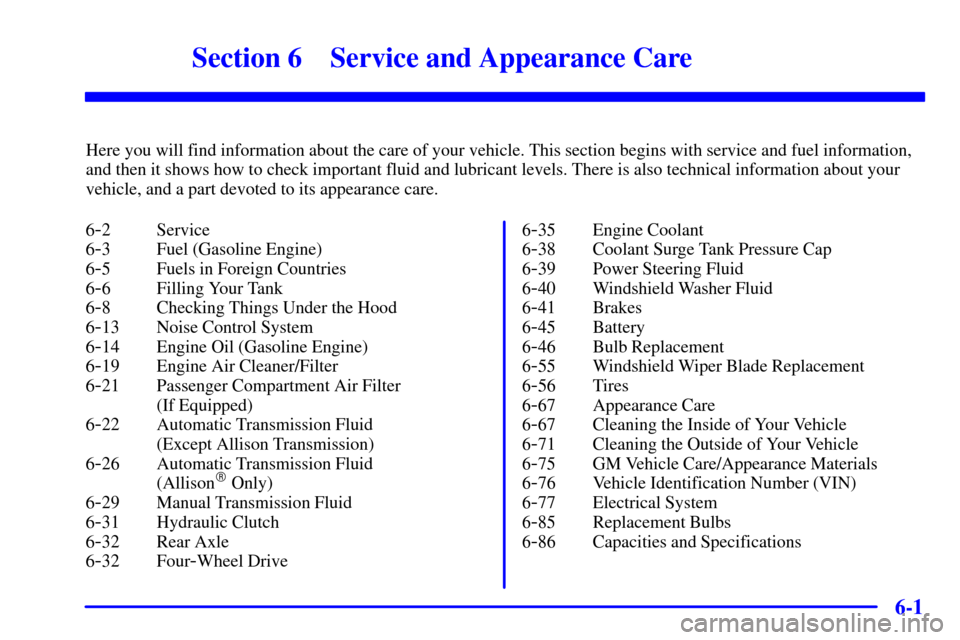
6-
6-1
Section 6 Service and Appearance Care
Here you will find information about the care of your vehicle. This section begins with service and fuel information,
and then it shows how to check important fluid and lubricant levels. There is also technical information about your
vehicle, and a part devoted to its appearance care.
6
-2 Service
6
-3 Fuel (Gasoline Engine)
6
-5 Fuels in Foreign Countries
6
-6 Filling Your Tank
6
-8 Checking Things Under the Hood
6
-13 Noise Control System
6
-14 Engine Oil (Gasoline Engine)
6
-19 Engine Air Cleaner/Filter
6
-21 Passenger Compartment Air Filter
(If Equipped)
6
-22 Automatic Transmission Fluid
(Except Allison Transmission)
6
-26 Automatic Transmission Fluid
(Allison� Only)
6
-29 Manual Transmission Fluid
6
-31 Hydraulic Clutch
6
-32 Rear Axle
6
-32 Four-Wheel Drive6
-35 Engine Coolant
6
-38 Coolant Surge Tank Pressure Cap
6
-39 Power Steering Fluid
6
-40 Windshield Washer Fluid
6
-41 Brakes
6
-45 Battery
6
-46 Bulb Replacement
6
-55 Windshield Wiper Blade Replacement
6
-56 Tires
6
-67 Appearance Care
6
-67 Cleaning the Inside of Your Vehicle
6
-71 Cleaning the Outside of Your Vehicle
6
-75 GM Vehicle Care/Appearance Materials
6
-76 Vehicle Identification Number (VIN)
6
-77 Electrical System
6
-85 Replacement Bulbs
6
-86 Capacities and Specifications
Page 374 of 497
6-9 Hood Release
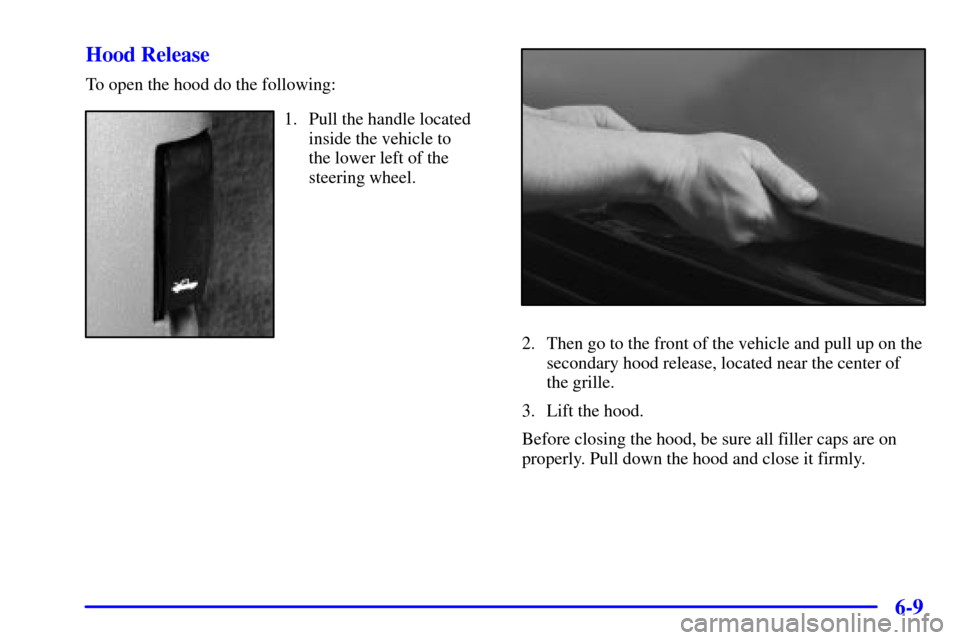
To open the hood do the following:
1. Pull the handle located
inside the vehicle to
the lower left of the
steering wheel.
2. Then go to the front of the vehicle and pull up on the
secondary hood release, located near the center of
the grille.
3. Lift the hood.
Before closing the hood, be sure all filler caps are on
properly. Pull down the hood and close it firmly.