Page 51 of 387
1-45
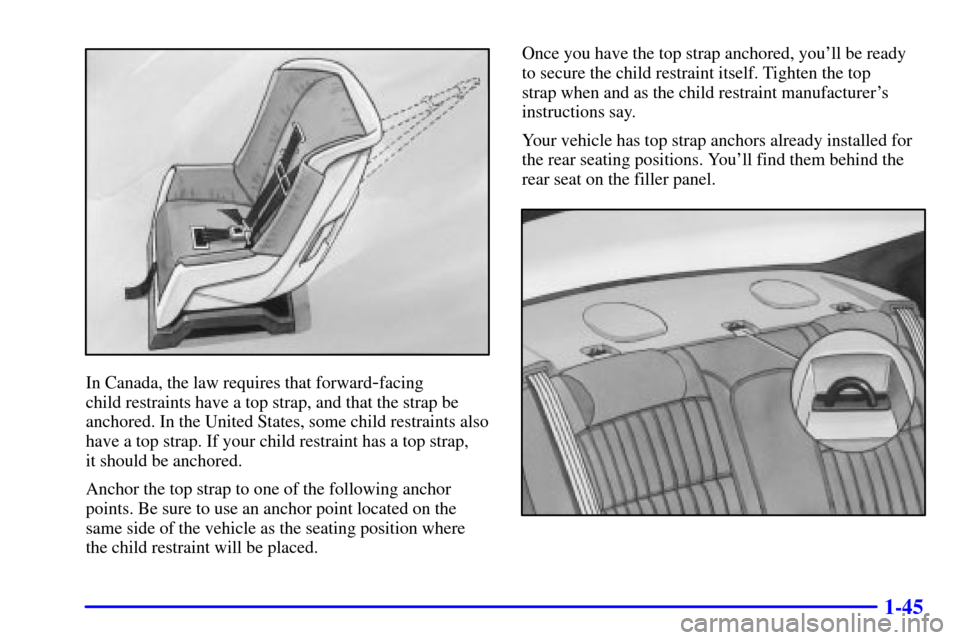
In Canada, the law requires that forward-facing
child restraints have a top strap, and that the strap be
anchored. In the United States, some child restraints also
have a top strap. If your child restraint has a top strap,
it should be anchored.
Anchor the top strap to one of the following anchor
points. Be sure to use an anchor point located on the
same side of the vehicle as the seating position where
the child restraint will be placed.Once you have the top strap anchored, you'll be ready
to secure the child restraint itself. Tighten the top
strap when and as the child restraint manufacturer's
instructions say.
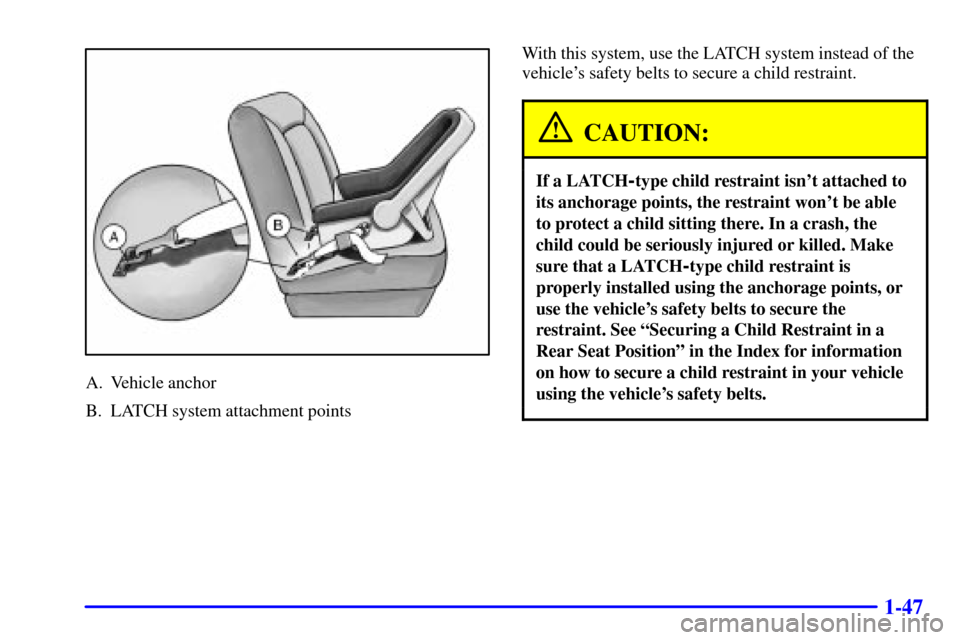
Your vehicle has top strap anchors already installed for
the rear seating positions. You'll find them behind the
rear seat on the filler panel.
Page 53 of 387
1-47
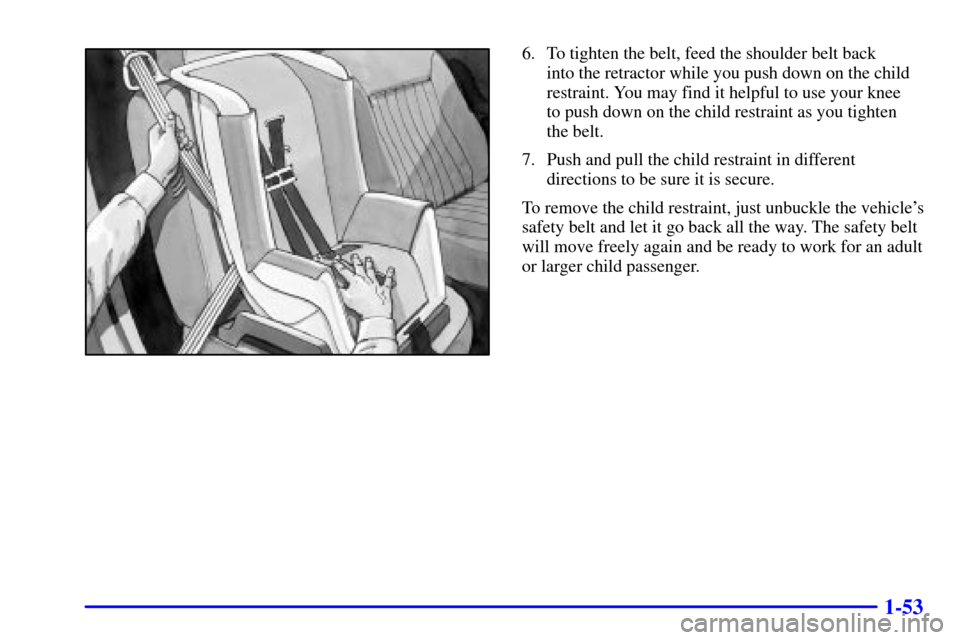
A. Vehicle anchor
B. LATCH system attachment pointsWith this system, use the LATCH system instead of the
vehicle's safety belts to secure a child restraint.
CAUTION:
If a LATCH-type child restraint isn't attached to
its anchorage points, the restraint won't be able
to protect a child sitting there. In a crash, the
child could be seriously injured or killed. Make
sure that a LATCH
-type child restraint is
properly installed using the anchorage points, or
use the vehicle's safety belts to secure the
restraint. See ªSecuring a Child Restraint in a
Rear Seat Positionº in the Index for information
on how to secure a child restraint in your vehicle
using the vehicle's safety belts.
Page 54 of 387
1-48
Securing a Child Restraint Designed for the
LATCH System
1. Find the anchors for the seating position you want to
use, where the bottom of the seatback meets the back
of the seat cushion.
2. Put the child restraint on the seat.
3. Attach the anchor points on the child restraint to the
anchors in the vehicle. The child restraint
instructions will show you how.
4. If the child restraint is forward
-facing, attach the top
strap to the top strap anchor. See ªTop Strapº in the
Index. Tighten the top strap according to the child
restraint instructions.
5. Push and pull the child restraint in different
directions to be sure it is secure.
To remove the child restraint, simply unhook the top
strap from the top tether anchor and then disconnect
the anchor points.
Securing a Child Restraint in a Rear
Seat Position
If your child restraint is equipped with the LATCH
system, see ªLower Anchorages and Top Tethers for
Children (LATCH)º in the Index.
You'll be using the lap
-shoulder belt. See the earlier
part about the top strap if the child restraint has one.
Be sure to follow the instructions that came with the
child restraint. Secure the child in the child restraint
when and as the instructions say.
1. Put the restraint on the seat.
2. Pick up the latch plate, and run the lap and shoulder
portions of the vehicle's safety belt through or
around the restraint. The child restraint instructions
will show you how.
Page 56 of 387
1-50
5. To tighten the belt, feed the shoulder belt back
into the retractor while you push down on the
child restraint. If you're using a forward
-facing
child restraint, you may find it helpful to use your
knee to push down on the child restraint as you
tighten the belt.
6. Push and pull the child restraint in different
directions to be sure it is secure.
To remove the child restraint, just unbuckle the vehicle's
safety belt and let it go back all the way. The safety belt
will move freely again and be ready to work for an adult
or larger child passenger.
Page 57 of 387
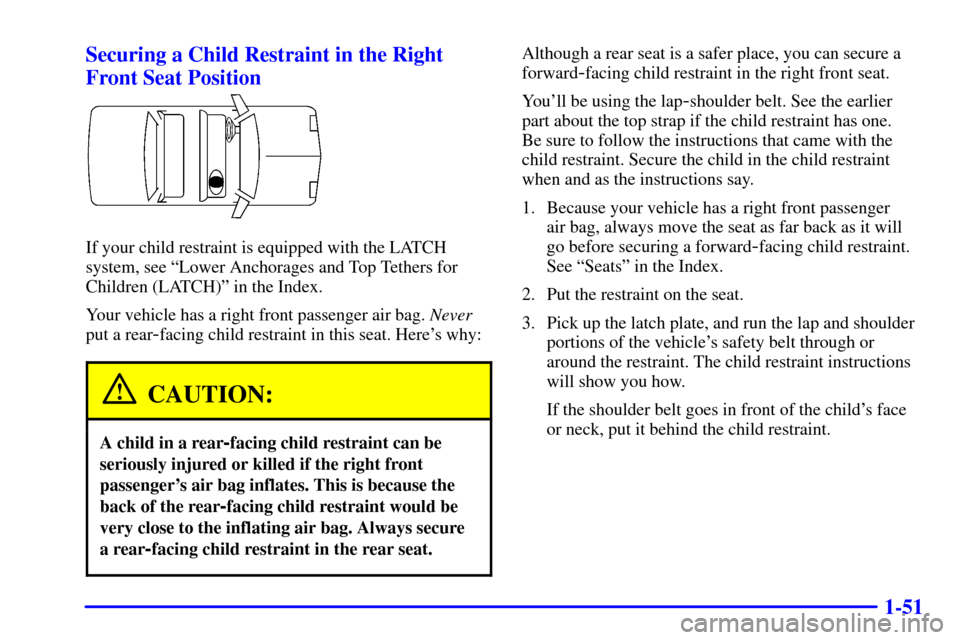
1-51 Securing a Child Restraint in the Right
Front Seat Position
If your child restraint is equipped with the LATCH
system, see ªLower Anchorages and Top Tethers for
Children (LATCH)º in the Index.
Your vehicle has a right front passenger air bag. Never
put a rear
-facing child restraint in this seat. Here's why:
CAUTION:
A child in a rear-facing child restraint can be
seriously injured or killed if the right front
passenger's air bag inflates. This is because the
back of the rear
-facing child restraint would be
very close to the inflating air bag. Always secure
a rear
-facing child restraint in the rear seat.
Although a rear seat is a safer place, you can secure a
forward
-facing child restraint in the right front seat.
You'll be using the lap
-shoulder belt. See the earlier
part about the top strap if the child restraint has one.
Be sure to follow the instructions that came with the
child restraint. Secure the child in the child restraint
when and as the instructions say.
1. Because your vehicle has a right front passenger
air bag, always move the seat as far back as it will
go before securing a forward
-facing child restraint.
See ªSeatsº in the Index.
2. Put the restraint on the seat.
3. Pick up the latch plate, and run the lap and shoulder
portions of the vehicle's safety belt through or
around the restraint. The child restraint instructions
will show you how.
If the shoulder belt goes in front of the child's face
or neck, put it behind the child restraint.
Page 59 of 387
1-53
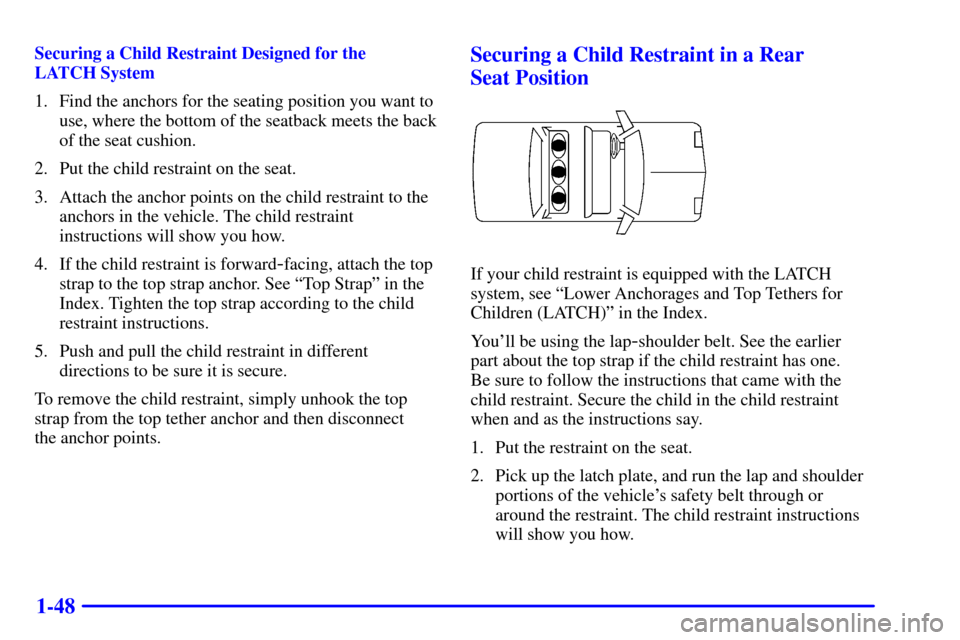
6. To tighten the belt, feed the shoulder belt back
into the retractor while you push down on the child
restraint. You may find it helpful to use your knee
to push down on the child restraint as you tighten
the belt.
7. Push and pull the child restraint in different
directions to be sure it is secure.
To remove the child restraint, just unbuckle the vehicle's
safety belt and let it go back all the way. The safety belt
will move freely again and be ready to work for an adult
or larger child passenger.
Page 71 of 387

2-7
Power Door Locks
A power door lock switch is
located on each front door
above the armrest.
Press the top part of the switch to unlock both doors, or
press the bottom part of the switch to lock both doors.
If your vehicle has the optional content theft
-deterrent
system and it is armed, the power door lock switches
will be disabled. You must use your remote keyless
entry transmitter (if equipped) or your key to unlock the
doors when the system is armed.
Programmable Automatic Power Door Locks
Programmable automatic power door locks are a standard
feature that is intended to provide enhanced security and
convenience by automatically locking and unlocking doors.
Programmable Modes
Mode 1: No automatic door lock or unlock.
Mode 2: Automatic all
-door lock when the transaxle is
shifted out of PARK (P); no automatic door unlock.
Mode 3: Automatic all
-door lock when the transaxle is
shifted out of PARK (P); automatic unlock for the driver's
door only when the transaxle is shifted into PARK (P).
Mode 4: Automatic all
-door lock when the transaxle
is shifted out of PARK (P); automatic all
-door unlock
when the transaxle is shifted into PARK (P).
Before your vehicle was shipped from the factory, it was
programmed to Mode 4. The mode to which the vehicle
was programmed may have been changed since it left
the factory. To determine the mode to which your
vehicle is programmed or to program your vehicle to a
different mode, see ªVehicle Customization Settingsº
in the Index.
Disconnecting the vehicle's battery for up to a year will
not change any previously programmed modes.
Page 74 of 387

2-10
Transmitter Verification (If Equipped)
This feature provides feedback to the holder of the remote
keyless entry transmitter that a command has been
received by the keyless entry receiver. The headlamps and
back
-up lamps will flash on every lock and the first unlock
command, and the horn will sound once for every lock
and twice for the first unlock command. Silent operation
and other options may be selected for this feature. See
ªVehicle Customization Settingsº in the Index.
If your vehicle has the optional content theft
-deterrent
system, the first time the remote unlock is received, three
flashes will be seen and three horn chirps heard to indicate
an alarm condition has occurred since last arming. See
ªContent Theft
-Deterrent Systemº in the Index.
Illumination on Remote Activation
This feature provides interior illumination when a
remote keyless entry door unlock command is received
and executed, the trunk release button is pressed or
when the panic alarm is activated. The interior lamps
will illuminate until the ignition is turned to ON or until
an illumination period of 40 seconds has elapsed or the
doors are locked with the power door lock switch or the
remote keyless entry transmitter. If a door is opened
during the illumination period, the timed illumination
will be canceled, and the interior lamps will remain on.
Matching Transmitter(s) to Your Vehicle
Each remote keyless entry transmitter is coded to
prevent another transmitter from unlocking your vehicle.
If a transmitter is lost or stolen, a replacement can be
purchased through your dealer. Remember to bring any
remaining transmitters with you when you go to your
dealer. When the dealer matches the replacement
transmitter to your vehicle, any remaining transmitters
must also be matched. Once your dealer has coded the
new transmitter, the lost transmitter will not unlock your
vehicle. Each vehicle can have a maximum of four
transmitters matched to it.
If you prefer, you can complete this procedure yourself.
See ªVehicle Customization Settingsº in the Index for
more information.
Battery Replacement
Under normal use, the battery in your remote keyless
entry transmitter should last about three years.
You can tell the battery is weak if the transmitter won't
work at the normal range in any location. If you have to
get close to your vehicle before the transmitter works,
it's probably time to change the battery.