Page 77 of 387
2-13
Trunk Assist Handle
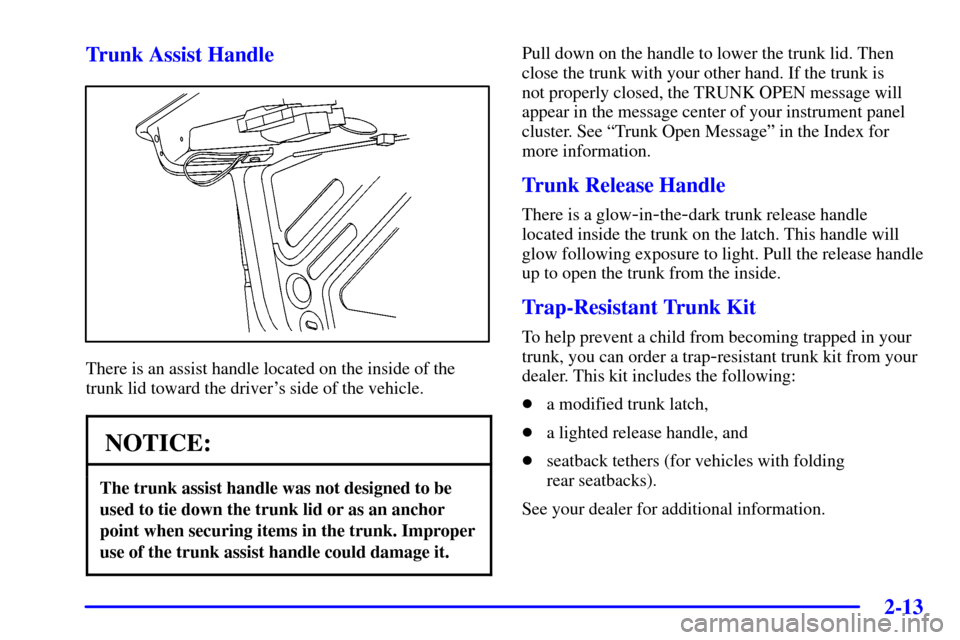
There is an assist handle located on the inside of the
trunk lid toward the driver's side of the vehicle.
NOTICE:
The trunk assist handle was not designed to be
used to tie down the trunk lid or as an anchor
point when securing items in the trunk. Improper
use of the trunk assist handle could damage it.
Pull down on the handle to lower the trunk lid. Then
close the trunk with your other hand. If the trunk is
not properly closed, the TRUNK OPEN message will
appear in the message center of your instrument panel
cluster. See ªTrunk Open Messageº in the Index for
more information.
Trunk Release Handle
There is a glow-in-the-dark trunk release handle
located inside the trunk on the latch. This handle will
glow following exposure to light. Pull the release handle
up to open the trunk from the inside.
Trap-Resistant Trunk Kit
To help prevent a child from becoming trapped in your
trunk, you can order a trap
-resistant trunk kit from your
dealer. This kit includes the following:
�a modified trunk latch,
�a lighted release handle, and
�seatback tethers (for vehicles with folding
rear seatbacks).
See your dealer for additional information.
Page 78 of 387

2-14 Trunk Release Sensor TrapAlert� System
(If Equipped)
Your vehicle may have a sensor located on the underside
of the filler panel inside the trunk.
If your vehicle has this feature, the sensor is designed
to open the trunk automatically under certain conditions.
If the sensor detects motion and a difference in
temperature in the trunk, the sensor will sound the horn
if the ignition is in OFF. There will be three short chirps
and a pause repeated for up to two minutes. After one
minute, the trunk latch will release. If the ignition is not
in OFF, the trunk latch will not release automatically
and the horn will not sound.
To cancel the horn alarm and automatically release the
trunk lid before two minutes are up, turn the ignition
to ON.
Do not cover the sensor with items you put into the
trunk or with add
-on accessory equipment. If the
sensor's field of view is blocked, it will not detect
motion and will not function properly.
Be sure to secure items in your trunk so that they
won't move around and cause the trunk to open.
Page 91 of 387

2-27
Passlock�
Your vehicle is equipped with the Passlock
theft
-deterrent system.
Passlock is a passive theft
-deterrent system. Passlock
enables fuel if the ignition lock cylinder is turned with a
valid key. If a correct key is not used or the ignition lock
cylinder is tampered with, fuel is disabled and the
engine will not start.
During normal operation, the SECURITY message will
be displayed after the key is turned to the ON ignition
position. See ªMessage Center, Securityº in the Index.
If the engine stalls and the SECURITY message flashes,
wait until the light stops flashing before trying to restart
the engine.
If the engine is running and the SECURITY message
comes on, you will be able to restart the engine if you turn
the engine off. However, your Passlock system is not
working properly and must be serviced by your dealer.
Your vehicle is not protected by Passlock at this time.
You may also want to check the fuse. See ªFuses and
Circuit Breakersº in the Index. See your dealer for service.
In an emergency, contact Chevrolet Roadside
Assistance. See ªRoadside Assistanceº in the Index
for more information.
New Vehicle ªBreak-Inº
NOTICE:
Your vehicle doesn't need an elaborate
ªbreak
-in.º But it will perform better in
the long run if you follow these guidelines:
�Don't drive at any one speed -- fast or
slow
-- for the first 500 miles (805 km).
Don't make full
-throttle starts.
�Avoid making hard stops for the first
200 miles (322 km) or so. During this time
your new brake linings aren't yet broken
in. Hard stops with new linings can mean
premature wear and earlier replacement.
Follow this breaking
-in guideline every
time you get new brake linings.
�Don't tow a trailer during break
-in.
See ªTowing a Trailerº in the Index for
more information.
Page 128 of 387

2-64
Cellular Antenna
The cellular antenna on the outside of your vehicle is
critical to effective communications using the OnStar
system. Optimum cellular reception can be obtained
when the mast is straight up and down.
OnStar Services
The following services are available within OnStar service
plans. Your vehicle comes with a specific one
-year service
plan that allows use of some of all of the following services.
�Automatic Notification of Air Bag Deployment :
If an air bag deploys, a priority emergency signal is
automatically sent to the center. An advisor will locate
your vehicle's position, try to contact you and assist
you in the situation. If the center is unable to contact
you, an emergency service provider will be contacted.
�Stolen Vehicle Tracking: Call the center at
1
-888-4-ONSTAR (1-888-466-7827) to report
your vehicle stolen, the system can then attempt to
locate and track your vehicle and the advisor will
assist the proper authorities.
�Roadside Assistance with Location: For vehicle
breakdowns, press the OnStar Services button.
An advisor will contact the appropriate help.�Remote Diagnostics: If an instrument panel
light comes on, press the OnStar services button.
An advisor can perform a check of the engine
on
-board computer, and recommend what
action needs to be taken.
�OnStar MED
-NET: Med-Net can store your
personal medical history and provide it to emergency
personnel if necessary. (Requires activation and
additional fee).
�Accident Assist: An advisor can provide
step
-by-step guidance following an accident.
�Remote Door Unlock: To contact the center,
call 1
-888-4-ONSTAR. You will be required to
provide your security information. An advisor will
send a command to your vehicle to unlock itself.
The advisor can delay unlocking your vehicle.
Remote Door Unlock is disabled 48 hours after the
vehicle is parked to maintain the battery charge.
�Vehicle Locator Service: To contact the center,
call 1
-888-4-ONSTAR. You will be required to
provide your security information. An advisor will
send a command to your vehicle to sound the horn
and/or flash the lamps.
Page 155 of 387
2-91
Door Ajar
United States Canada
This message will appear if the driver's door or the
passenger's door is not completely closed and the
ignition is in ON.
If you are in a forward or reverse gear position you
will also hear four chimes.Security United States Canada
This message is displayed to monitor the
Passlock
� system.
If the security message is displayed continuously while
driving and stays on, there may be a problem with the
Passlock system. Your vehicle will not be protected by
Passlock, and you should see your dealer for service.
Page 226 of 387
4-26
Winter Driving
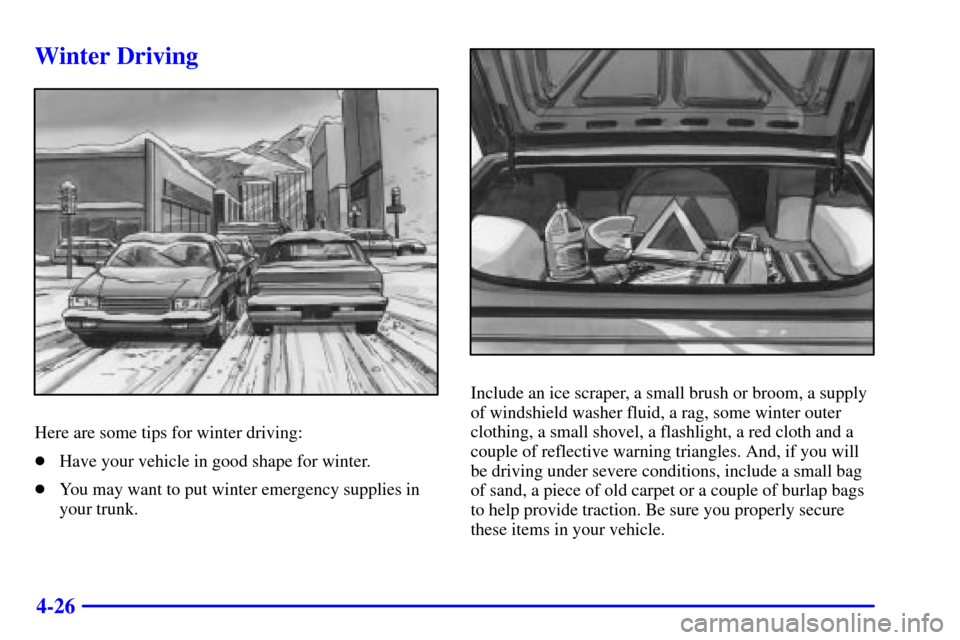
Here are some tips for winter driving:
�Have your vehicle in good shape for winter.
�You may want to put winter emergency supplies in
your trunk.
Include an ice scraper, a small brush or broom, a supply
of windshield washer fluid, a rag, some winter outer
clothing, a small shovel, a flashlight, a red cloth and a
couple of reflective warning triangles. And, if you will
be driving under severe conditions, include a small bag
of sand, a piece of old carpet or a couple of burlap bags
to help provide traction. Be sure you properly secure
these items in your vehicle.
Page 232 of 387
4-32
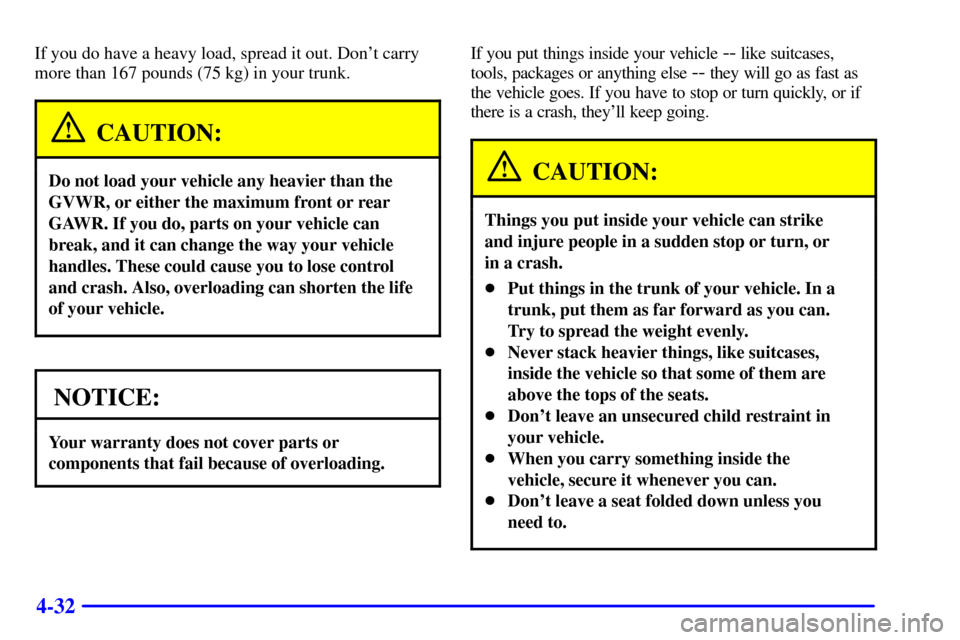
If you do have a heavy load, spread it out. Don't carry
more than 167 pounds (75 kg) in your trunk.
CAUTION:
Do not load your vehicle any heavier than the
GVWR, or either the maximum front or rear
GAWR. If you do, parts on your vehicle can
break, and it can change the way your vehicle
handles. These could cause you to lose control
and crash. Also, overloading can shorten the life
of your vehicle.
NOTICE:
Your warranty does not cover parts or
components that fail because of overloading.
If you put things inside your vehicle -- like suitcases,
tools, packages or anything else
-- they will go as fast as
the vehicle goes. If you have to stop or turn quickly, or if
there is a crash, they'll keep going.
CAUTION:
Things you put inside your vehicle can strike
and injure people in a sudden stop or turn, or
in a crash.
�Put things in the trunk of your vehicle. In a
trunk, put them as far forward as you can.
Try to spread the weight evenly.
�Never stack heavier things, like suitcases,
inside the vehicle so that some of them are
above the tops of the seats.
�Don't leave an unsecured child restraint in
your vehicle.
�When you carry something inside the
vehicle, secure it whenever you can.
�Don't leave a seat folded down unless you
need to.
Page 237 of 387

4-37 Driving with a Trailer
Towing a trailer requires a certain amount of experience.
Before setting out for the open road, you'll want to get
to know your rig. Acquaint yourself with the feel of
handling and braking with the added weight of the
trailer. And always keep in mind that the vehicle you are
driving is now a good deal longer and not nearly as
responsive as your vehicle is by itself.
Before you start, check the trailer hitch and platform
(and attachments), safety chains, electrical connector,
lamps, tires and mirror adjustment. If the trailer has
electric brakes, start your vehicle and trailer moving and
then apply the trailer brake controller by hand to be sure
the brakes are working. This lets you check your
electrical connection at the same time.
During your trip, check occasionally to be sure that the
load is secure, and that the lamps and any trailer brakes
are still working.
Following Distance
Stay at least twice as far behind the vehicle ahead as you
would when driving your vehicle without a trailer. This
can help you avoid situations that require heavy braking
and sudden turns.
Passing
You'll need more passing distance up ahead when
you're towing a trailer. And, because you're a good
deal longer, you'll need to go much farther beyond
the passed vehicle before you can return to your lane.
Backing Up
Hold the bottom of the steering wheel with one hand.
Then, to move the trailer to the left, just move that hand
to the left. To move the trailer to the right, move your
hand to the right. Always back up slowly and, if
possible, have someone guide you.