Page 206 of 341
5-5
CAUTION:
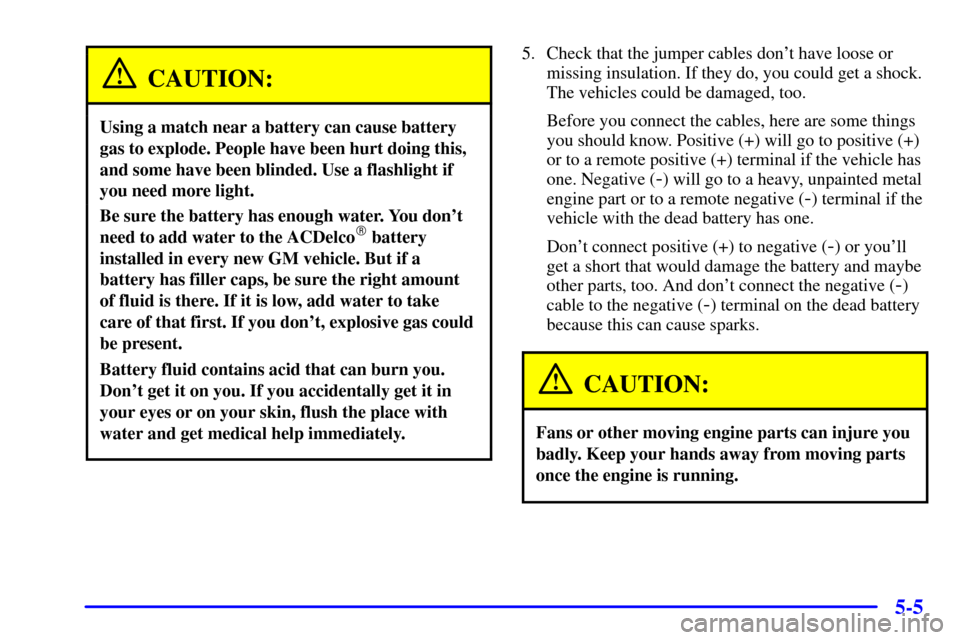
Using a match near a battery can cause battery
gas to explode. People have been hurt doing this,
and some have been blinded. Use a flashlight if
you need more light.
Be sure the battery has enough water. You don't
need to add water to the ACDelco� battery
installed in every new GM vehicle. But if a
battery has filler caps, be sure the right amount
of fluid is there. If it is low, add water to take
care of that first. If you don't, explosive gas could
be present.
Battery fluid contains acid that can burn you.
Don't get it on you. If you accidentally get it in
your eyes or on your skin, flush the place with
water and get medical help immediately.
5. Check that the jumper cables don't have loose or
missing insulation. If they do, you could get a shock.
The vehicles could be damaged, too.
Before you connect the cables, here are some things
you should know. Positive (+) will go to positive (+)
or to a remote positive (+) terminal if the vehicle has
one. Negative (
-) will go to a heavy, unpainted metal
engine part or to a remote negative (
-) terminal if the
vehicle with the dead battery has one.
Don't connect positive (+) to negative (
-) or you'll
get a short that would damage the battery and maybe
other parts, too. And don't connect the negative (
-)
cable to the negative (
-) terminal on the dead battery
because this can cause sparks.
CAUTION:
Fans or other moving engine parts can injure you
badly. Keep your hands away from moving parts
once the engine is running.
Page 215 of 341
5-14 How to Add Coolant to the Coolant
Surge Tank
NOTICE:
This vehicle has a specific coolant fill procedure.
Failure to follow this procedure could cause your
engine to overheat and be severely damaged.
If you haven't found a problem yet, check to see if
coolant is visible in the surge tank. If coolant is visible
but the coolant level isn't at the FULL COLD mark or
slightly higher, add a 50/50 mixture of clean, drinkable
water and DEX
-COOL� coolant at the coolant surge
tank, but be sure the cooling system, including the
coolant surge tank pressure cap, is cool before you do it.
See ªEngine Coolantº in the Index for more
information.
If no coolant is visible in the surge tank, add coolant
as follows:
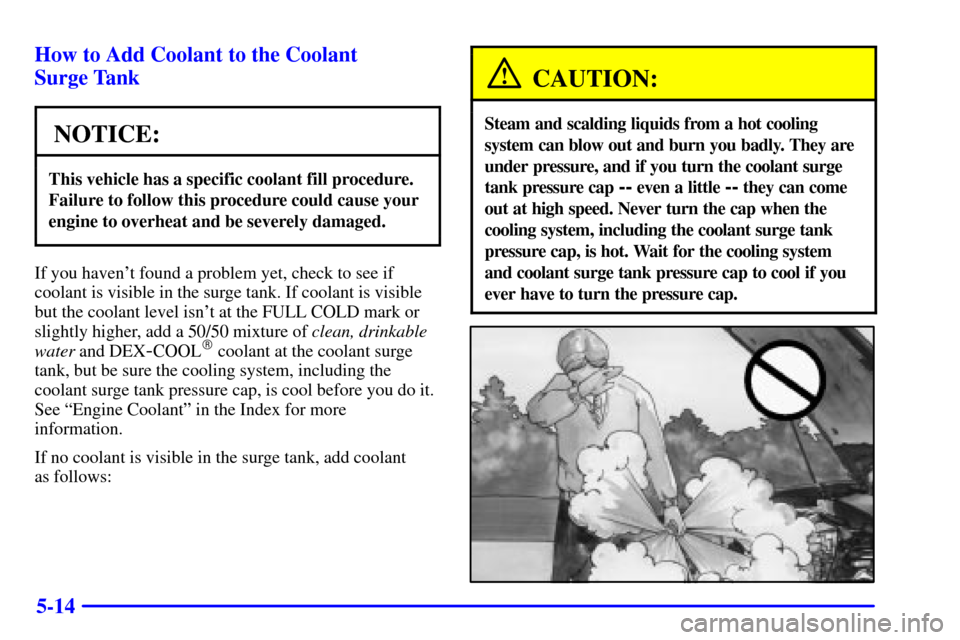
CAUTION:
Steam and scalding liquids from a hot cooling
system can blow out and burn you badly. They are
under pressure, and if you turn the coolant surge
tank pressure cap
-- even a little -- they can come
out at high speed. Never turn the cap when the
cooling system, including the coolant surge tank
pressure cap, is hot. Wait for the cooling system
and coolant surge tank pressure cap to cool if you
ever have to turn the pressure cap.
Page 243 of 341
6-12
Engine Oil
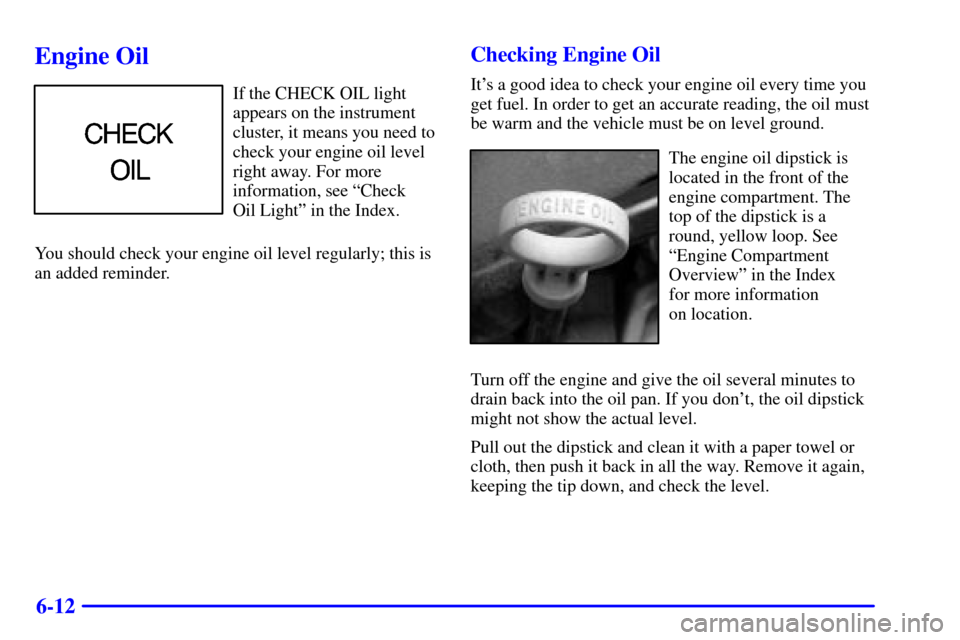
If the CHECK OIL light
appears on the instrument
cluster, it means you need to
check your engine oil level
right away. For more
information, see ªCheck
Oil Lightº in the Index.
You should check your engine oil level regularly; this is
an added reminder.
Checking Engine Oil
It's a good idea to check your engine oil every time you
get fuel. In order to get an accurate reading, the oil must
be warm and the vehicle must be on level ground.
The engine oil dipstick is
located in the front of the
engine compartment. The
top of the dipstick is a
round, yellow loop. See
ªEngine Compartment
Overviewº in the Index
for more information
on location.
Turn off the engine and give the oil several minutes to
drain back into the oil pan. If you don't, the oil dipstick
might not show the actual level.
Pull out the dipstick and clean it with a paper towel or
cloth, then push it back in all the way. Remove it again,
keeping the tip down, and check the level.