Page 57 of 341
1-51 Securing a Child Restraint in the Right
Front Seat Position
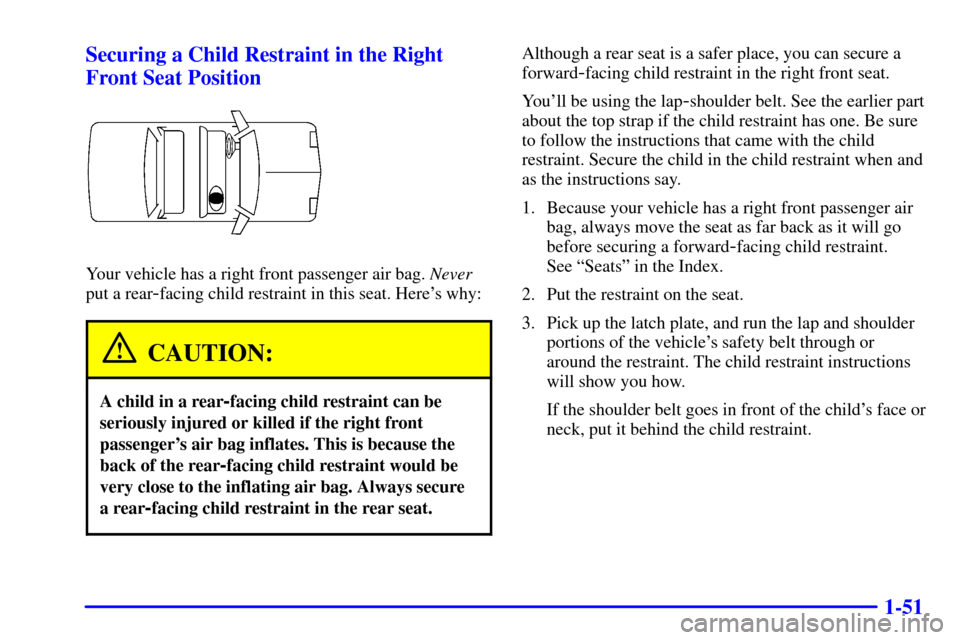
Your vehicle has a right front passenger air bag. Never
put a rear
-facing child restraint in this seat. Here's why:
CAUTION:
A child in a rear-facing child restraint can be
seriously injured or killed if the right front
passenger's air bag inflates. This is because the
back of the rear
-facing child restraint would be
very close to the inflating air bag. Always secure
a rear
-facing child restraint in the rear seat.
Although a rear seat is a safer place, you can secure a
forward
-facing child restraint in the right front seat.
You'll be using the lap
-shoulder belt. See the earlier part
about the top strap if the child restraint has one. Be sure
to follow the instructions that came with the child
restraint. Secure the child in the child restraint when and
as the instructions say.
1. Because your vehicle has a right front passenger air
bag, always move the seat as far back as it will go
before securing a forward
-facing child restraint.
See ªSeatsº in the Index.
2. Put the restraint on the seat.
3. Pick up the latch plate, and run the lap and shoulder
portions of the vehicle's safety belt through or
around the restraint. The child restraint instructions
will show you how.
If the shoulder belt goes in front of the child's face or
neck, put it behind the child restraint.
Page 110 of 341

2-47
Storage Compartments
Glove Box
To open, pull the handle to the left and pull the glove
box door down until it stops and is fully open.
Instrument Panel Cupholder
The instrument panel cupholder is located to the left of
the steering wheel. To use it, pull it out until the rubber
insert is revealed.
Center Console Storage Area
The center console has two separate storage areas.
The upper compartment, which is also the armrest,
can be used to store maps, gloves, etc. To open,
pull up on the driver's side of the lid.
The lower area can be used to store cassette tapes
or compact discs. To open the lower compartment,
pull up on the armrest.
Center Console Cupholder
The console provides space for holding a cup or soft
drink container. The cupholder is located at the rear
of the shift lever.
Rear Seat Cupholders
Pull down the door on the rear of the center console to
use the rear seat cupholders.
Convenience Net (If Equipped)
Your vehicle may have a convenience net. You'll see it
just inside the back wall of the trunk.
Put small loads, like grocery bags, behind the net.
It can help keep them from falling over during sharp
turns or quick starts and stops.
The net isn't for larger, heavier loads. Store them in
the trunk as far forward as you can.
You can unhook the net so that it will lie flat when
you're not using it.
Page 192 of 341

4-32
Loading Your Vehicle
Two labels on your vehicle show how much weight it
may properly carry. The Tire
-Loading Information label
found on the rear edge of the driver's side door tells you
the proper size, speed rating and recommended inflation
pressures for the tires on your vehicle. It also gives you
important information about the number of people that
can be in your vehicle and the total weight that you can
carry. This weight is called the Vehicle Capacity Weight,
and includes the weight of all occupants, cargo and all
nonfactory
-installed options.
The other label is the Certification label, found on the rear
edge of the driver's side door. It tells you the gross weight
capacity of your vehicle, called the Gross Vehicle Weight
Rating (GVWR). The GVWR includes the weight of the
vehicle, all occupants, fuel and cargo. Never exceed the
GVWR for your vehicle, or the Gross Axle Weight Rating
(GAWR) for either the front or rear axle.
And, if you do have a heavy load, you should spread
it out. Don't carry more than 132 lbs. (60 kg) in
your trunk.
Page 227 of 341
5-26
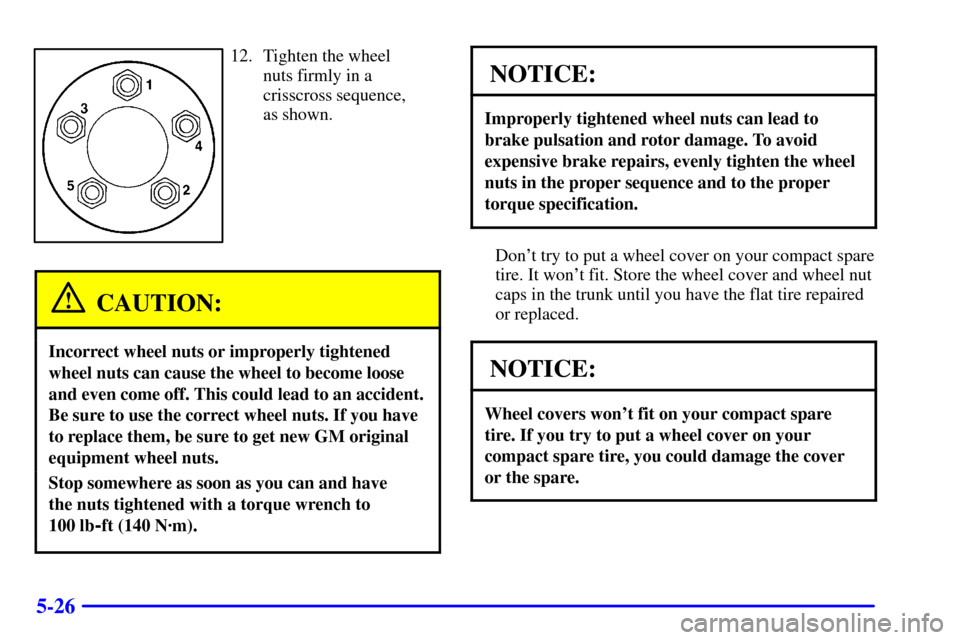
12. Tighten the wheel
nuts firmly in a
crisscross sequence,
as shown.
CAUTION:
Incorrect wheel nuts or improperly tightened
wheel nuts can cause the wheel to become loose
and even come off. This could lead to an accident.
Be sure to use the correct wheel nuts. If you have
to replace them, be sure to get new GM original
equipment wheel nuts.
Stop somewhere as soon as you can and have
the nuts tightened with a torque wrench to
100 lb
-ft (140 N´m).
NOTICE:
Improperly tightened wheel nuts can lead to
brake pulsation and rotor damage. To avoid
expensive brake repairs, evenly tighten the wheel
nuts in the proper sequence and to the proper
torque specification.
Don't try to put a wheel cover on your compact spare
tire. It won't fit. Store the wheel cover and wheel nut
caps in the trunk until you have the flat tire repaired
or replaced.
NOTICE:
Wheel covers won't fit on your compact spare
tire. If you try to put a wheel cover on your
compact spare tire, you could damage the cover
or the spare.