Page 75 of 341
2-12 Operation
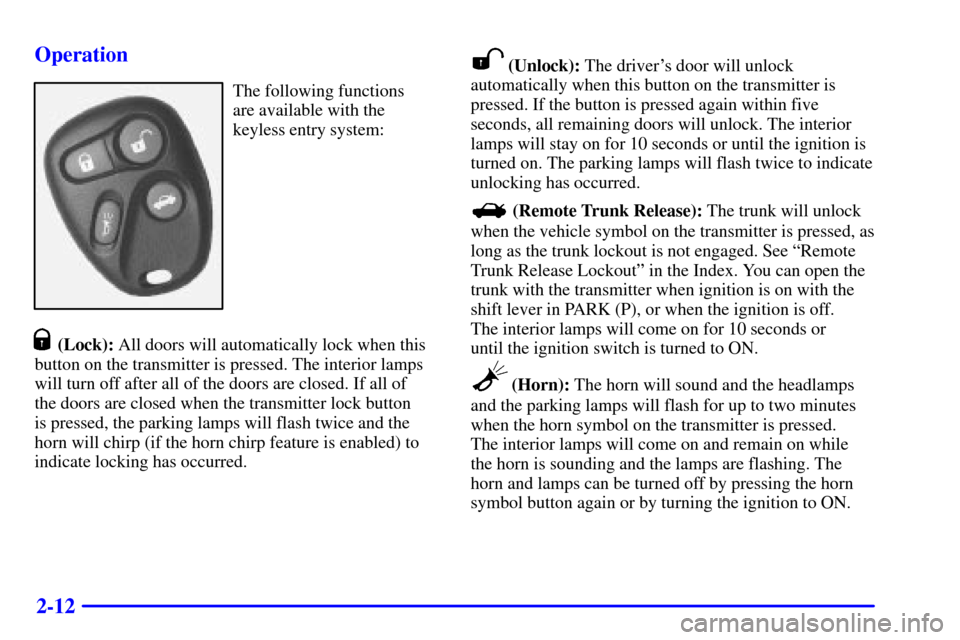
The following functions
are available with the
keyless entry system:
(Lock): All doors will automatically lock when this
button on the transmitter is pressed. The interior lamps
will turn off after all of the doors are closed. If all of
the doors are closed when the transmitter lock button
is pressed, the parking lamps will flash twice and the
horn will chirp (if the horn chirp feature is enabled) to
indicate locking has occurred.
(Unlock): The driver's door will unlock
automatically when this button on the transmitter is
pressed. If the button is pressed again within five
seconds, all remaining doors will unlock. The interior
lamps will stay on for 10 seconds or until the ignition is
turned on. The parking lamps will flash twice to indicate
unlocking has occurred.
(Remote Trunk Release): The trunk will unlock
when the vehicle symbol on the transmitter is pressed, as
long as the trunk lockout is not engaged. See ªRemote
Trunk Release Lockoutº in the Index. You can open the
trunk with the transmitter when ignition is on with the
shift lever in PARK (P), or when the ignition is off.
The interior lamps will come on for 10 seconds or
until the ignition switch is turned to ON.
(Horn): The horn will sound and the headlamps
and the parking lamps will flash for up to two minutes
when the horn symbol on the transmitter is pressed.
The interior lamps will come on and remain on while
the horn is sounding and the lamps are flashing. The
horn and lamps can be turned off by pressing the horn
symbol button again or by turning the ignition to ON.
Page 97 of 341
2-34
Turn Signal/Multifunction Lever
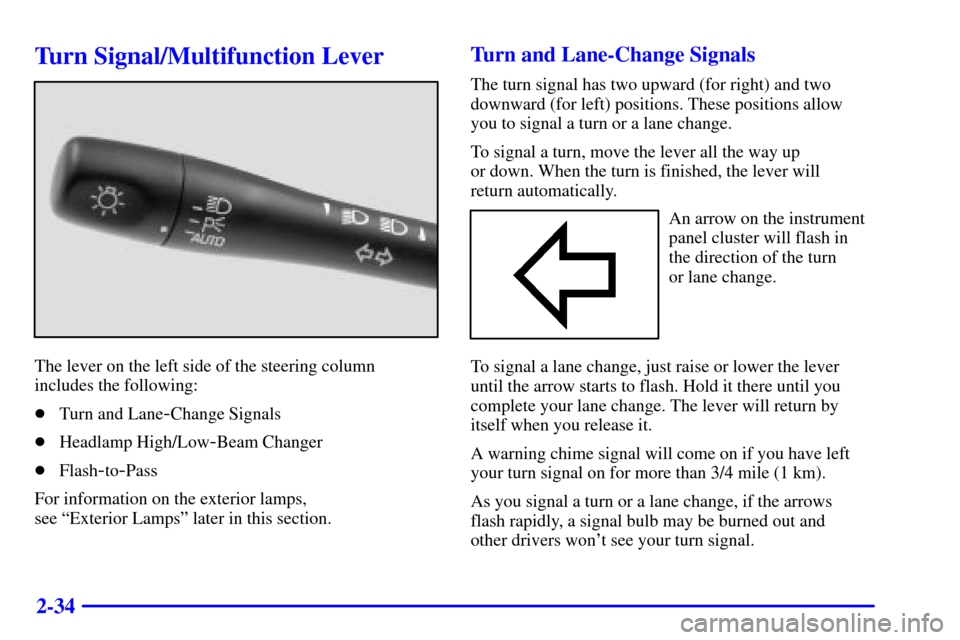
The lever on the left side of the steering column
includes the following:
�Turn and Lane
-Change Signals
�Headlamp High/Low
-Beam Changer
�Flash
-to-Pass
For information on the exterior lamps,
see ªExterior Lampsº later in this section.
Turn and Lane-Change Signals
The turn signal has two upward (for right) and two
downward (for left) positions. These positions allow
you to signal a turn or a lane change.
To signal a turn, move the lever all the way up
or down. When the turn is finished, the lever will
return automatically.
An arrow on the instrument
panel cluster will flash in
the direction of the turn
or lane change.
To signal a lane change, just raise or lower the lever
until the arrow starts to flash. Hold it there until you
complete your lane change. The lever will return by
itself when you release it.
A warning chime signal will come on if you have left
your turn signal on for more than 3/4 mile (1 km).
As you signal a turn or a lane change, if the arrows
flash rapidly, a signal bulb may be burned out and
other drivers won't see your turn signal.
Page 98 of 341
2-35
If a bulb is burned out, replace it to help avoid an
accident. If the arrows don't go on at all when you
signal a turn, check for burned
-out bulbs and then check
the fuse. See ªFuses and Circuit Breakersº in the Index.
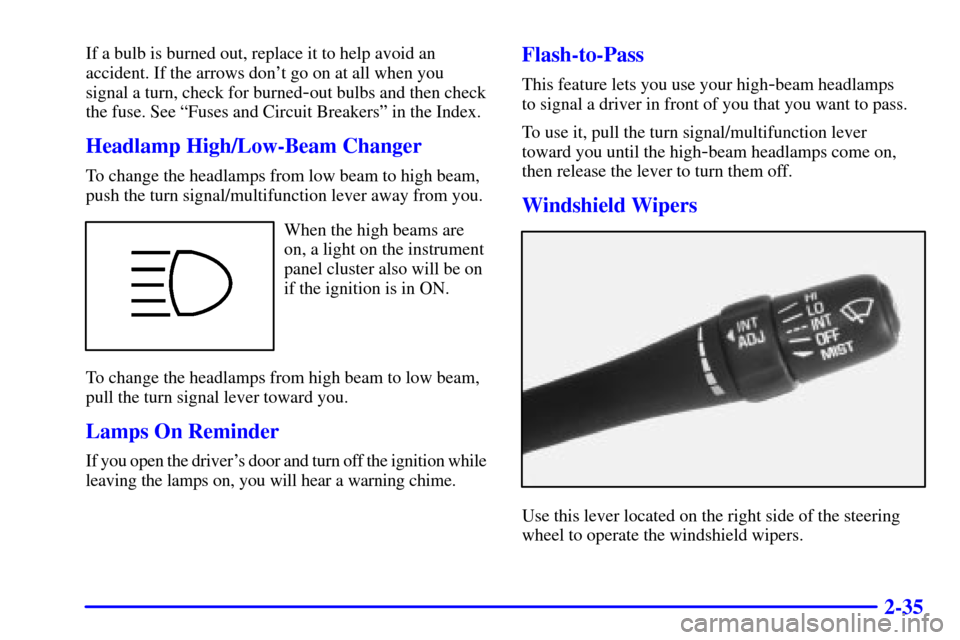
Headlamp High/Low-Beam Changer
To change the headlamps from low beam to high beam,
push the turn signal/multifunction lever away from you.
When the high beams are
on, a light on the instrument
panel cluster also will be on
if the ignition is in ON.
To change the headlamps from high beam to low beam,
pull the turn signal lever toward you.
Lamps On Reminder
If you open the driver's door and turn off the ignition while
leaving the lamps on, you will hear a warning chime.
Flash-to-Pass
This feature lets you use your high-beam headlamps
to signal a driver in front of you that you want to pass.
To use it, pull the turn signal/multifunction lever
toward you until the high
-beam headlamps come on,
then release the lever to turn them off.
Windshield Wipers
Use this lever located on the right side of the steering
wheel to operate the windshield wipers.
Page 103 of 341
2-40
Exterior Lamps
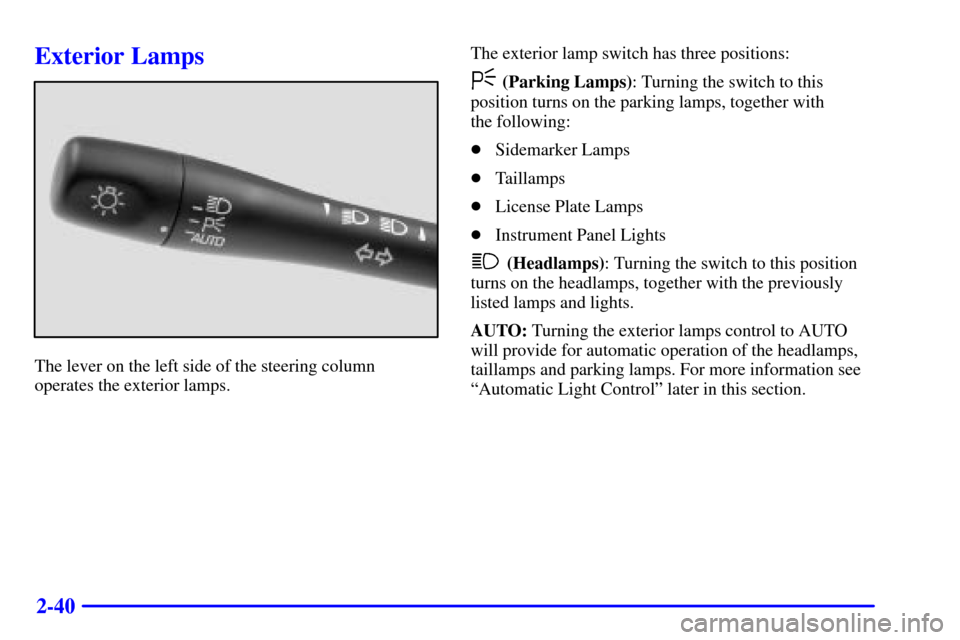
The lever on the left side of the steering column
operates the exterior lamps.The exterior lamp switch has three positions:
(Parking Lamps): Turning the switch to this
position turns on the parking lamps, together with
the following:
�Sidemarker Lamps
�Taillamps
�License Plate Lamps
�Instrument Panel Lights
(Headlamps): Turning the switch to this position
turns on the headlamps, together with the previously
listed lamps and lights.
AUTO: Turning the exterior lamps control to AUTO
will provide for automatic operation of the headlamps,
taillamps and parking lamps. For more information see
ªAutomatic Light Controlº later in this section.
Page 104 of 341

2-41 Daytime Running Lamps
Daytime Running Lamps (DRL) can make it easier
for others to see the front of your vehicle during
the day. DRL can be helpful in many different driving
conditions, but they can be especially helpful in the
short periods after dawn and before sunset. Fully
functional daytime running lamps are required on all
vehicles first sold in Canada.
The DRL system will make your low
-beam headlamps
come on at a reduced brightness when the following
conditions are met:
�The ignition is on,
�the exterior lamps control is to AUTO or you have
turned on your parking lamps,
�the light sensor detects daytime light,
�the parking brake is released, and
�the shift lever is not in PARK (P).When the DRL system is on, the taillamps, sidemarker
lamps, parking lamps and instrument panel lights will
not be illuminated unless you have turned the exterior
lamps control to the parking lamp or headlamp position.
The DRL system will remain off any time your vehicle
is in PARK (P) or the parking brake is engaged and the
vehicle speed is less than 8 mph (13 km/h).
As with any vehicle, you should turn on the regular
headlamp system when you need it.
Automatic Light Control (ALC)
When it is dark enough outside, your Automatic Light
Control (ALC) will turn on your headlamps at the
normal brightness along with other lamps such as the
taillamps, sidemarker, parking lamps and the instrument
panel lights. The radio lights will also be dim.
Your vehicle is equipped with a light sensor on the
top of the instrument panel under the defroster grill,
so be sure it is not covered which will cause the ALC
system to be on whenever the ignition is on.
Page 105 of 341

2-42
The ALC system may also be on when driving through
a parking garage, heavy overcast weather or a tunnel.
This is normal.
There is a delay in the transition between the daytime
and nighttime operation of the DRL and the ALC
systems so that driving under bridges or bright overhead
street lights does not affect the system. The DRL and
ALC systems will only be affected when the light sensor
sees a change in lighting lasting longer than this delay.
To idle your vehicle with the ALC system off, set the
park brake while the ignition is off. Then start the
vehicle. The ALC system will stay off until you release
the park brake.
As with any vehicle, you should turn on the regular
headlamps when you need them.Headlamps Dim to Park
This feature works when the ignition is on and it is
dark outside. To turn the headlamps off when it is dark
outside, turn the exterior lamps control to the parking
lamp position. In this position, the parking lamps,
sidemarker lamps, taillamps, license plate lamps and
instrument panel lights will be on, but the headlamps
will be off.
To turn on the headlamps along with the other lamps
when it is dark outside, turn the exterior lamps control
to the AUTO or headlamp position.
Delayed Headlamps
The delayed headlamps feature will continue to
illuminate the headlamps for 20 seconds after the
key is turned to OFF at night. Then the headlamps
will automatically turn off.
To override the 20 second delayed headlamp feature
while it is active turn the switch at the end of the turn
signal/multifunction lever up one position and then
back to AUTO.
Page 106 of 341
2-43 Fog Lamps (If Equipped)
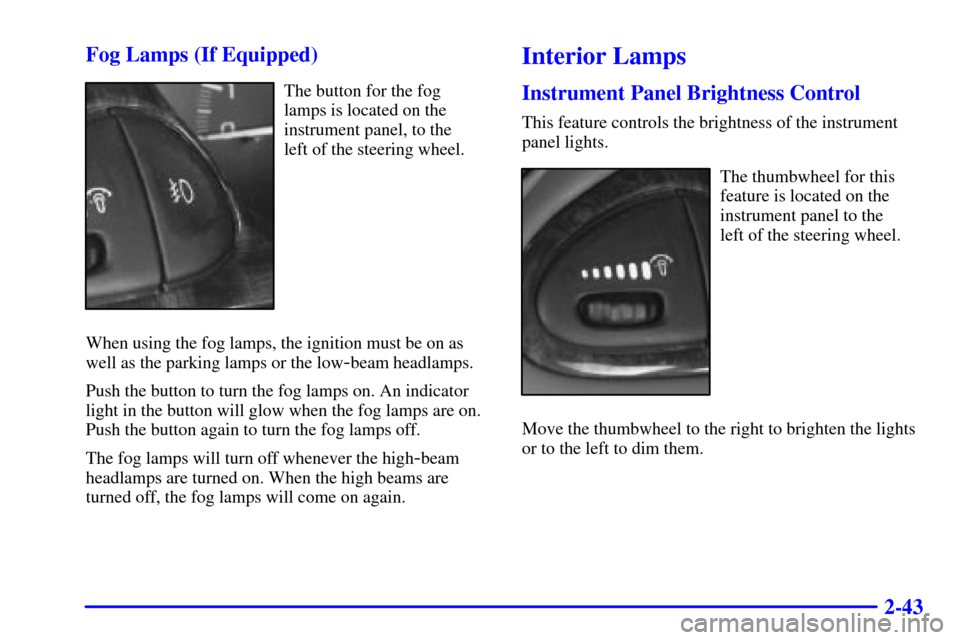
The button for the fog
lamps is located on the
instrument panel, to the
left of the steering wheel.
When using the fog lamps, the ignition must be on as
well as the parking lamps or the low
-beam headlamps.
Push the button to turn the fog lamps on. An indicator
light in the button will glow when the fog lamps are on.
Push the button again to turn the fog lamps off.
The fog lamps will turn off whenever the high
-beam
headlamps are turned on. When the high beams are
turned off, the fog lamps will come on again.
Interior Lamps
Instrument Panel Brightness Control
This feature controls the brightness of the instrument
panel lights.
The thumbwheel for this
feature is located on the
instrument panel to the
left of the steering wheel.
Move the thumbwheel to the right to brighten the lights
or to the left to dim them.
Page 174 of 341

4-14
Driving at Night
Night driving is more dangerous than day driving.
One reason is that some drivers are likely to be
impaired
-- by alcohol or drugs, with night vision
problems, or by fatigue.Here are some tips on night driving.
�Drive defensively.
�Don't drink and drive.
�Adjust your inside rearview mirror to reduce the
glare from headlamps behind you.
�Since you can't see as well, you may need to
slow down and keep more space between you and
other vehicles.
�Slow down, especially on higher speed roads. Your
headlamps can light up only so much road ahead.
�In remote areas, watch for animals.
�If you're tired, pull off the road in a safe place
and rest.
No one can see as well at night as in the daytime. But as
we get older these differences increase. A 50
-year-old
driver may require at least twice as much light to see the
same thing at night as a 20
-year-old.
What you do in the daytime can also affect your night
vision. For example, if you spend the day in bright
sunshine you are wise to wear sunglasses. Your eyes will
have less trouble adjusting to night. But if you're
driving, don't wear sunglasses at night. They may cut
down on glare from headlamps, but they also make a lot
of things invisible.