Page 5 of 397
iv
Vehicle Damage Warnings
Also, in this book you will find these notices:
NOTICE:
These mean there is something that could damage
your vehicle.
In the notice area, we tell you about something that
can damage your vehicle. Many times, this damage
would not be covered by your warranty, and it could
be costly. But the notice will tell you what to do to help
avoid the damage.
When you read other manuals, you might see
CAUTION and NOTICE warnings in different
colors or in different words.
You'll also see warning labels on your vehicle.
They use the same words, CAUTION or NOTICE.
Vehicle Symbols
Your vehicle may be equipped with components and
labels that use symbols instead of text. Symbols,
used on your vehicle, are shown along with the text
describing the operation or information relating to a
specific component, control, message, gage or indicator.
If you need help figuring out a specific name of a
component, gage or indicator reference the following
topics in the Index:
�ªEngine Compartment Overviewº
�ªInstrument Panelº
�ªComfort Controlsº
�ªAudio Systemsº
Also see ªWarning Lights and Gagesº in the Index.
Page 67 of 397

2-
2-1
Section 2 Features and Controls
Here you can learn about the many standard and optional features on your vehicle, and information on starting,
shifting and braking. Also explained are the instrument panel and the warning systems that tell you if everything is
working properly
-- and what to do if you have a problem.
2
-2 Windows
2
-4 Keys
2
-6 Door Locks
2
-9 Remote Keyless Entry (If Equipped)
2
-13 Trunk
2
-18 Theft
2
-19 Content Theft-Deterrent (Option)
2
-20 Vehicle Customization Settings
2
-30 Passlock�
2-30 New Vehicle ªBreak-Inº
2
-31 Ignition Positions
2
-32 Starting Your Engine
2
-34 Engine Coolant Heater (Option)
2
-36 Automatic Transaxle Operation
2
-40 Parking Brake
2
-41 Shifting Into PARK (P)
2
-44 Shifting Out of PARK (P)
2
-45 Parking Over Things That Burn2
-45 Engine Exhaust
2
-46 Running Your Engine While You're Parked
2
-47 Tilt Wheel
2
-47 Turn Signal/Multifunction Lever
2
-54 Exterior Lamps
2
-57 Interior Lamps
2
-59 Mirrors
2
-66 Accessory Power Outlet
2
-68 Auxiliary Power Connection (Power Drop)
2
-69 OnStar� System (If Equipped)
2
-73 Power Sunroof (Option)
2
-74 HomeLink� Transmitter (Option)
2
-78 The Instrument Panel -- Your
Information System
2
-80 Instrument Panel Cluster
2
-83 Warning Lights, Gages and Indicators
2
-94 Message Center
2
-103 Driver Information Center (DIC) (Option)
Page 97 of 397
2-31
Ignition Positions
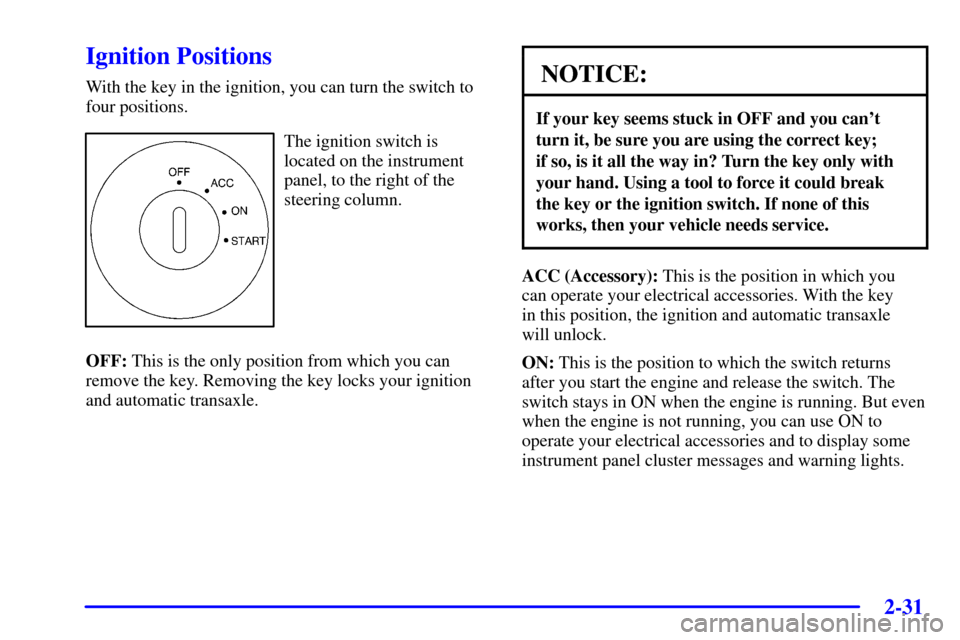
With the key in the ignition, you can turn the switch to
four positions.
The ignition switch is
located on the instrument
panel, to the right of the
steering column.
OFF: This is the only position from which you can
remove the key. Removing the key locks your ignition
and automatic transaxle.
NOTICE:
If your key seems stuck in OFF and you can't
turn it, be sure you are using the correct key;
if so, is it all the way in? Turn the key only with
your hand. Using a tool to force it could break
the key or the ignition switch. If none of this
works, then your vehicle needs service.
ACC (Accessory): This is the position in which you
can operate your electrical accessories. With the key
in this position, the ignition and automatic transaxle
will unlock.
ON: This is the position to which the switch returns
after you start the engine and release the switch. The
switch stays in ON when the engine is running. But even
when the engine is not running, you can use ON to
operate your electrical accessories and to display some
instrument panel cluster messages and warning lights.
Page 98 of 397
2-32
START: This position starts the engine. When the
engine starts, release the key. The ignition switch will
return to ON for normal driving.
When the engine is not running, ACC and ON allow you
to operate your electrical accessories, such as the radio.
A warning chime will sound if you open the driver's
door while the ignition is in OFF or ACC and the key is
in the ignition.
Retained Accessory Power (RAP)
With Retained Accessory Power (RAP), your power
windows, audio system and sunroof (option) will
continue to work for up to 10 minutes after the ignition
is turned to OFF and none of the doors is opened.
Starting Your Engine
Move your shift lever to PARK (P) or NEUTRAL (N).
Your engine won't start in any other position
-- that's a
safety feature. To restart when you're already moving,
use NEUTRAL (N) only.
NOTICE:
Don't try to shift to PARK (P) if your vehicle is
moving. If you do, you could damage the
transaxle. Shift to PARK (P) only when your
vehicle is stopped.
Starting Your 3400 V6 Engine
1. With your foot off the accelerator pedal, turn your
ignition key to START. When the engine starts, let
go of the key. The idle speed will go down as your
engine warms up.
NOTICE:
Holding your key in START for longer than
15 seconds at a time will cause your battery to
be drained much sooner. And the excessive heat
can damage your starter motor. Wait about
15 seconds between each try to help avoid
draining your battery or damaging your starter.
Page 107 of 397
2-41
A warning chime will sound if the parking brake is set,
the ignition is on and the shift lever is not in PARK (P).
NOTICE:
Driving with the parking brake on can cause
your rear brakes to overheat. You may have to
replace them, and you could also damage other
parts of your vehicle.
If you are towing a trailer and parking on any hill, see
ªTowing a Trailerº in the Index. That section shows
what to do first to keep the trailer from moving.
Shifting Into PARK (P)
CAUTION:
It can be dangerous to get out of your vehicle if
the shift lever is not fully in PARK (P) with the
parking brake firmly set. Your vehicle can roll. If
you have left the engine running, the vehicle can
move suddenly. You or others could be injured.
To be sure your vehicle won't move, even when
you're on fairly level ground, use the steps that
follow. If you're pulling a trailer, see ªTowing a
Trailerº in the Index.
Page 121 of 397

2-55
The exterior lamps control has three positions:
OFF:Pushing the control all the way in turns off the
exterior lamps.
Parking Lamps:Pulling the control out halfway will
turn on the parking lamps together with the following:
�Taillamps
�LIcense Plate Lamps
�Instrument Panel Lights
Headlamps: Pulling the control all the way out turns on
the headlamps together with the previously listed lamps
and lights. See ªInterior Lampsº later in this section for
information on the instrument panel brightness control
and on the dome lamps. A warning chime will sound if
you open the driver's door when the ignition switch is
off and the headlamps are on.
Daytime Running Lamps / Automatic
Headlamp Control
Daytime Running Lamps (DRL) can make it easier for
others to see the front of your vehicle during the day.
DRL can be helpful in many different driving
conditions, but they can be especially helpful in the
short periods after dawn and before sunset. Fully
functional daytime running lamps are required on all
vehicles first sold in Canada.A light sensor on top of the instrument panel makes the
DRL work, so be sure it isn't covered.
The DRL system's automatic headlamp control will
make your high
-beam headlamps come on at a reduced
brightness when the following conditions are met:
�The ignition is on,
�the exterior lamps control is off and
�the gearshift is not in PARK (P).
When the DRL are on, only your high
-beam
headlamps, at a reduced level of brightness, will be on.
The headlamps, taillamps, sidemarker and other lamps
won't be on. Your instrument panel and cluster won't be
lit up either.
When it's dark enough outside, your high
-beam
headlamps will turn off and the headlamps and parking
lamps will turn on. The other lamps that come on with
your headlamps will also come on.
When it's bright enough outside, your headlamps will go
off and your DRL will come on.
As with any vehicle, you should turn on the regular
headlamp system when you need it.
Page 145 of 397
2-79
The main components of your instrument panel are listed here:
A. Instrument Panel Fuse Block
B. Traction Control On/Off Button (If Equipped)
C. Multifunction Lever
D. Audio Steering Wheel Controls (Option)
E. Hazard Warning Flasher Button
F. Audio System
G. Air Vent
H. Exterior Lamps ControlI. Remote Trunk Release Button
J. Tilt Steering Wheel Lever
K. Hood Release
L. Steering Wheel Cruise Control (If Equipped)
M. Ignition Switch
N. Center Console Shift Lever (If Equipped)
O. Climate Controls
P. Glove Box
Page 149 of 397
2-83
Tachometer (If Equipped)
The tachometer displays
the engine speed in
thousands of revolutions
per minute (rpm).
3800 V6 Engine shown
NOTICE:
Do not operate the engine with the tachometer in
the shaded area, or engine damage may occur.
Warning Lights, Gages
and Indicators
This part describes the warning lights and gages that
may be on your vehicle. The pictures will help you
locate them.
Warning lights and gages can signal that something is
wrong before it becomes serious enough to cause an
expensive repair or replacement. Paying attention to
your warning lights and gages could also save you or
others from injury.
Warning lights come on when there may be or is a
problem with one of your vehicle's functions. As you
will see in the details on the next few pages, some
warning lights come on briefly when you start the
engine just to let you know they're working. If you are
familiar with this section, you should not be alarmed
when this happens.