Page 150 of 397

2-84
Gages can indicate when there may be or is a problem
with one of your vehicle's functions. Often gages and
warning lights work together to let you know when
there's a problem with your vehicle.
When one of the warning lights comes on and stays on
when you are driving, or when one of the gages shows
there may be a problem, check the section that tells you
what to do about it. Please follow this manual's advice.
Waiting to do repairs can be costly
-- and even
dangerous. So please get to know your warning lights
and gages. They're a big help.
Your vehicle may also have a Driver Information Center
(DIC) that works along with the warning lights and
gages. See ªDriver Information Center (DIC)º in
the Index.
Safety Belt Reminder Light
When the key is turned to ON, a chime will come
on for about eight seconds to remind people to fasten
their safety belts, unless the driver's safety belt is
already buckled.
The safety belt light will
also come on and stay
on for about 20 seconds,
then it will flash for
about 55 seconds.
Page 152 of 397
2-86 Brake System Warning Light
Your vehicle's hydraulic brake system is divided into
two parts. If one part isn't working, the other part can
still work and stop you. For good braking, though, you
need both parts working well.
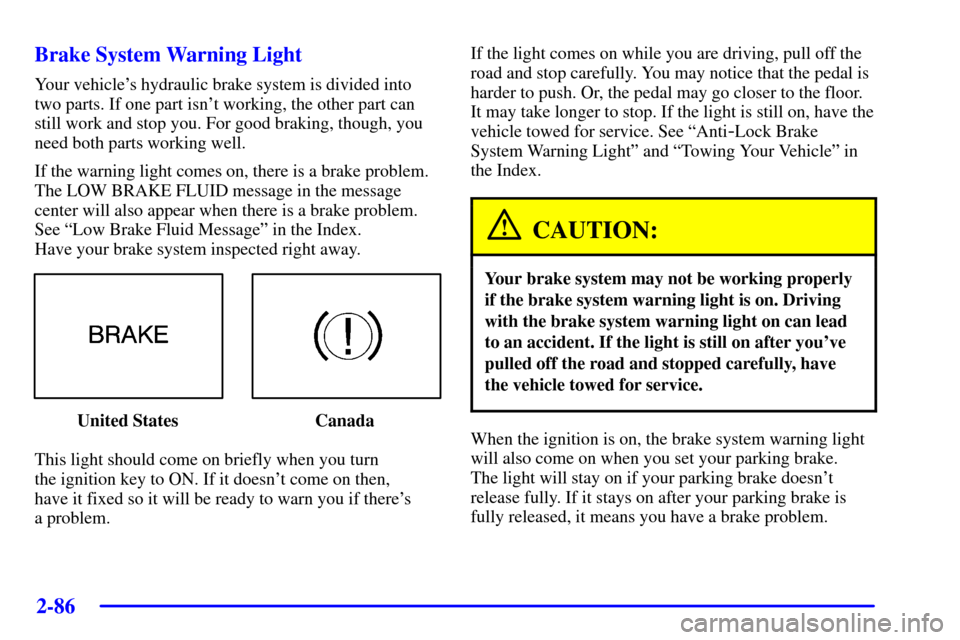
If the warning light comes on, there is a brake problem.
The LOW BRAKE FLUID message in the message
center will also appear when there is a brake problem.
See ªLow Brake Fluid Messageº in the Index.
Have your brake system inspected right away.
United States Canada
This light should come on briefly when you turn
the ignition key to ON. If it doesn't come on then,
have it fixed so it will be ready to warn you if there's
a problem.If the light comes on while you are driving, pull off the
road and stop carefully. You may notice that the pedal is
harder to push. Or, the pedal may go closer to the floor.
It may take longer to stop. If the light is still on, have the
vehicle towed for service. See ªAnti
-Lock Brake
System Warning Lightº and ªTowing Your Vehicleº in
the Index.
CAUTION:
Your brake system may not be working properly
if the brake system warning light is on. Driving
with the brake system warning light on can lead
to an accident. If the light is still on after you've
pulled off the road and stopped carefully, have
the vehicle towed for service.
When the ignition is on, the brake system warning light
will also come on when you set your parking brake.
The light will stay on if your parking brake doesn't
release fully. If it stays on after your parking brake is
fully released, it means you have a brake problem.
Page 153 of 397

2-87
Anti-Lock Brake System Warning Light
(If Equipped)
The anti-lock brake system
warning light should come
on for a few seconds when
you turn the ignition key
to ON.
If the anti
-lock brake system warning light stays on
longer than normal after you've started your engine, turn
the ignition off. Or, if the light comes on and stays on
when you're driving, stop as soon as possible and turn
the ignition off. Then start the engine again to reset the
system. If the light still stays on, or comes on again
while you're driving, the anti
-lock brake system needs
service and you don't have anti
-lock brakes.
The anti
-lock brake system warning light should
come on briefly when you turn the ignition key to ON.
If the light doesn't come on then, have it fixed so it will
be ready to warn you if there is a problem.
Traction Control System Warning Light
The traction control system
warning light may come on
for the following reasons:
�If you turn the system off by pressing the TRAC OFF
button located on the instrument panel, a chime will
sound and the warning light will come on and stay on.
To turn the system back on, press the button again.
The warning light should go off. See ªTraction
Control Systemº in the Index for more information.
�If there's a brake system problem that is specifically
related to traction control, the traction control system
will turn off and the warning light will come on. If
your brakes begin to overheat, the traction control
system will turn off and the warning light will come
on until your brakes cool down.
If the traction control system warning light comes on
and stays on for an extended period of time when the
system is turned on, your vehicle needs service.
Page 165 of 397
2-99
Security
United States Canada
This message is displayed to monitor the
Passlock
� system.
If the security message is displayed continuously while
driving and stays on, there may be a problem with the
Passlock system. Your vehicle will not be protected by
Passlock, and you should see your dealer for service.Low Brake Fluid
United States Canada
This message will be displayed when your vehicle has a
brake problem. The brake system warning light will also
be illuminated.
If this message appears, the brakes aren't working
properly. You should have your vehicle serviced
immediately. See ªBrake System Warning Lightº in the
Index for more information.
Page 167 of 397
2-101
Low Tire Pressure (If Equipped)
United States Canada
The low tire pressure system monitors the inflation
pressure of the tires.
After the system has learned tire pressure with properly
inflated tires, the LOW TIRE PRESSURE message will
be displayed and four warning chimes will sound if the
tire pressure in one tire becomes 12 psi (83 kPa) lower
than the other three tires.
When you have checked the tire pressures, be sure to
reset the tire inflation monitor. See ªTiresº in the Index.Service Vehicle SoonUnited States Canada
This message will come on if you have engine problems.
These problems may not be obvious and may not
affect vehicle performance or durability. Consult a
qualified dealership for necessary repairs to maintain
top vehicle performance.
This message may also appear if there are electrical
problems with the trunk release sensor. See ªTrunk
Release Sensorº in the Index for more information.
Page 219 of 397

4-7
Avoid needless heavy braking. Some people drive in
spurts
-- heavy acceleration followed by heavy
braking
-- rather than keeping pace with traffic.
This is a mistake. Your brakes may not have time to
cool between hard stops. Your brakes will wear out
much faster if you do a lot of heavy braking. If you
keep pace with the traffic and allow realistic following
distances, you will eliminate a lot of unnecessary
braking. That means better braking and longer
brake life.
If your engine ever stops while you're driving, brake
normally but don't pump your brakes. If you do, the
pedal may get harder to push down. If your engine
stops, you will still have some power brake assist.
But you will use it when you brake. Once the power
assist is used up, it may take longer to stop and the
brake pedal will be harder to push.
Anti-Lock Brake System (If Equipped)
Your vehicle may have anti-lock brakes. ABS is an
advanced electronic braking system that will help
prevent a braking skid.
If your vehicle has anti-lock
brakes, this warning light
on the instrument panel will
come on briefly when you
start your vehicle.
When you start your engine, or when you begin to
drive away, your anti
-lock brake system will check
itself. You may hear a momentary motor or clicking
noise while this test is going on, and you may even
notice that your brake pedal moves or pulses a little.
This is normal.
If there's a problem with the anti
-lock brake system,
the anti
-lock brake system warning light will stay on.
See ªAnti
-Lock Brake System Warning Lightº in
the Index.
Page 222 of 397

4-10
United States Canada
This light will come on when your Traction Control
System is limiting wheel spin. See ªTraction Control
System Active Lightº in the Index.
You may feel or hear the system working, but this
is normal.
If your vehicle is in cruise control when the traction
control system begins to limit wheel spin, the cruise
control will automatically disengage. When road
conditions allow you to safely use it again, you may
re
-engage the cruise control. See ªCruise Controlº
in the Index.The Traction Control System operates in all transaxle
shift lever positions. But the system can upshift the
transaxle only as high as the shift lever position you've
chosen, so you should use the lower gears only when
necessary. See ªAutomatic Transaxleº in the Index.
When the system is on,
this warning light will come
on to let you know if there's
a problem.
See ªTraction Control System Warning Lightº in the
Index. When this warning light is on, the system will
not limit wheel spin. Adjust your driving accordingly.
To limit wheel spin, especially in slippery road
conditions, you should always leave the Traction
Control System on. But you can turn the system
off if you ever need to. You should turn the system
off if your vehicle ever gets stuck in sand, mud or snow
and rocking the vehicle is required. See ªRocking Your
Vehicleº in the Index.
Page 223 of 397
4-11
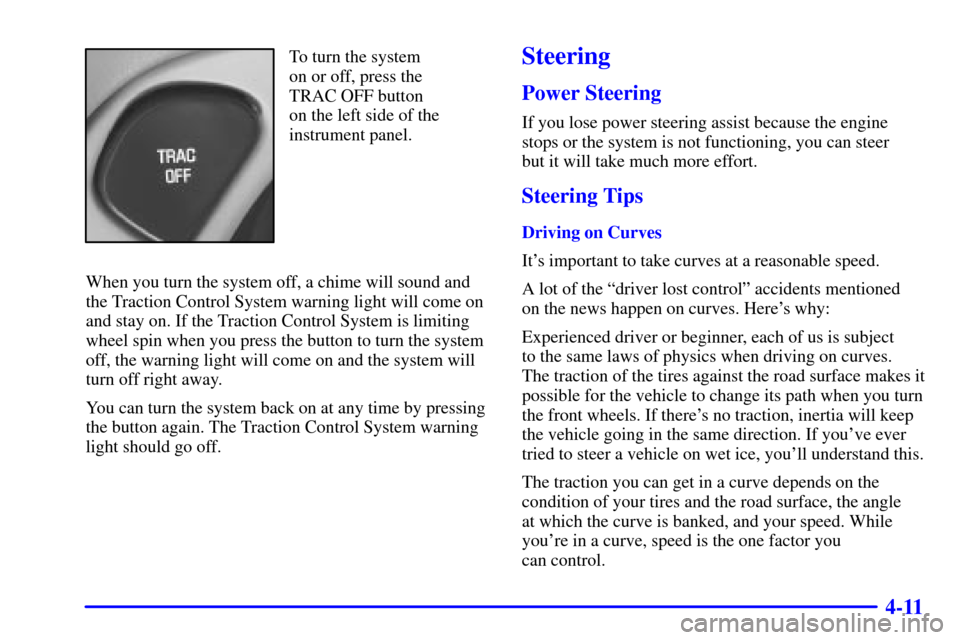
To turn the system
on or off, press the
TRAC OFF button
on the left side of the
instrument panel.
When you turn the system off, a chime will sound and
the Traction Control System warning light will come on
and stay on. If the Traction Control System is limiting
wheel spin when you press the button to turn the system
off, the warning light will come on and the system will
turn off right away.
You can turn the system back on at any time by pressing
the button again. The Traction Control System warning
light should go off.Steering
Power Steering
If you lose power steering assist because the engine
stops or the system is not functioning, you can steer
but it will take much more effort.
Steering Tips
Driving on Curves
It's important to take curves at a reasonable speed.
A lot of the ªdriver lost controlº accidents mentioned
on the news happen on curves. Here's why:
Experienced driver or beginner, each of us is subject
to the same laws of physics when driving on curves.
The traction of the tires against the road surface makes it
possible for the vehicle to change its path when you turn
the front wheels. If there's no traction, inertia will keep
the vehicle going in the same direction. If you've ever
tried to steer a vehicle on wet ice, you'll understand this.
The traction you can get in a curve depends on the
condition of your tires and the road surface, the angle
at which the curve is banked, and your speed. While
you're in a curve, speed is the one factor you
can control.