Page 4 of 384
iii
Corvette: The American
Dream Machine
In the early '50s, it was only a designer's dream.
Today the Corvette stands alone as America's dream
car
-- a testament to its unmistakable charisma and
the excitement it inspires. Unique styling, powerful
performance and an undeniable panache have made
Corvette one of the most celebrated sports cars in
the world.
In 1953, Corvette produced 300 new lightweight
fiberglass roadsters. A handful went to project engineers,
General Motors managers, and a select group of movie
stars and celebrities. With a two
-speed Powerglide
automatic transmission, Blue Flame six
-cylinder engine,
and gleaming Polo White exterior, the Corvette began its
drive into the heart of America.
Designers freshened up the 'Vette in 1956 by adding a
removable hardtop and the famous Corvette ªcoves.º
The sculptured body enhanced its sporty look, and a
standard 210
-horsepower Chevy V8 engine solidified
Corvette's reputation as a production race car.
Page 7 of 384

vi
In 1984, the fourth generation of America's favorite
sports car anticipated the future with a sleek look and
advanced technology that provided superior handling
and performance. Windshield angle was the sheerest of
any domestic vehicle, cornering ability the tightest of
any production car. In short, the 1984 redesign enhanced
the Corvette's reputation as a leader in the world sports
car market.
After 44 years of production, Corvette only got better.
The fifth
-generation Corvette arrived in 1997, featuring
a completely restyled body and a new, all
-aluminum,
5.7 Liter, 345
-horsepower LS1 V8 engine.The structure of the fifth
-generation redesign is
the stiffest ever developed in 44 years of Corvette
production, resulting in unparalleled ride quality and
outstanding handling. Also unique to the new Corvette
is a rear
-mounted transmission.
Available as a Coupe for 1997, the new Corvette
offered such standard features as extended
-mobility
tires, a Bose� audio system, and a new, latch-operated
roof designed for easy removal.
With many design cues inspired by the classic models
of the 1960s, the new fifth-generation Corvette is
an impressive combination of sleek styling and
world
-class sports car performance. For 1998, in
addition to the Coupe, a convertible was reintroduced.
The fifth-generation Corvette rollout was completed in
1999 with the introduction of the hardtop model.
For 2001, all hardtop models became the higher
performance Z06. The Z06 model featured the
performance enhanced LS6 engine, specific suspension
components and exterior/interior differentiation.
Page 59 of 384

2-
2-1
Section 2 Features and Controls
Here you can learn about the many standard and optional features on your vehicle, and information on starting,
shifting and braking. Also explained are the instrument panel and the warning systems that tell you if everything is
working properly
-- and what to do if you have a problem.
2
-2 Windows
2
-4 Keys
2
-6 Door Locks
2
-8 Memory (Option)
2
-9 Remote Keyless Entry (RKE) System
2
-14 Hatch/Trunk
2
-19 Theft-Deterrent System
2
-20 PASS-Key�
2-21 New Vehicle ªBreak-Inº
2
-22 Ignition Switch
2
-24 Starting Your Engine
2
-26 Engine Coolant Heater (Canada Only)
2
-28 Automatic Transmission Operation
2
-31 Manual Transmission Operation
2
-35 Parking Brake
2
-36 Shifting Into PARK (P)
(Automatic Transmission Only)
2
-38 Shifting Out of PARK (P)
(Automatic Transmission)2
-38 Parking Your Vehicle
(Manual Transmission Models Only)
2
-39 Parking Over Things That Burn
2
-39 Engine Exhaust
2
-40 Running Your Engine While You're Parked
(Automatic Transmission)
2
-40 Limited-Slip Rear Axle
2
-41 Selective Real Time Damping (Option)
2
-43 Turn Signal/Multifunction Lever
2
-49 Exterior Lamps
2
-53 Interior Lamps
2
-54 Mirrors
2
-57 Storage Compartments
2
-62 Roof Panel (If Equipped)
2
-69 Convertible Top (Option)
2
-76 The Instrument Panel -- Your
Information System
2
-80 Warning Lights, Gages and Messages
2
-94 Driver Information Center (DIC)
Page 73 of 384
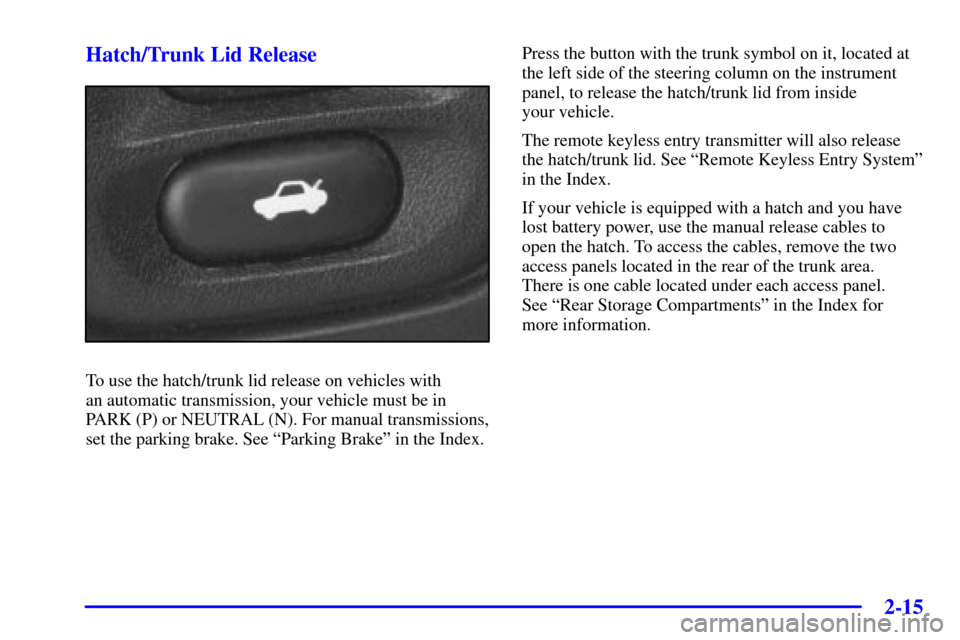
2-15 Hatch/Trunk Lid Release
To use the hatch/trunk lid release on vehicles with
an automatic transmission, your vehicle must be in
PARK (P) or NEUTRAL (N). For manual transmissions,
set the parking brake. See ªParking Brakeº in the Index.Press the button with the trunk symbol on it, located at
the left side of the steering column on the instrument
panel, to release the hatch/trunk lid from inside
your vehicle.
The remote keyless entry transmitter will also release
the hatch/trunk lid. See ªRemote Keyless Entry Systemº
in the Index.
If your vehicle is equipped with a hatch and you have
lost battery power, use the manual release cables to
open the hatch. To access the cables, remove the two
access panels located in the rear of the trunk area.
There is one cable located under each access panel.
See ªRear Storage Compartmentsº in the Index for
more information.
Page 76 of 384

2-18
Theft
Vehicle theft is big business, especially in some cities.
Although your vehicle has a number of theft
-deterrent
features, we know that nothing we put on it can make
it impossible to steal. However, there are ways you
can help.
Key in the Ignition
If you leave your vehicle with the keys inside, it's an
easy target for joy riders or professional thieves
-- so
don't do it.
When you park your vehicle and open the driver's door,
you'll hear a chime reminding you to remove your key
from the ignition and take it with you. Always do this.
Your ignition will be locked. If you have an automatic
transmission, it will be locked. If you have a manual
transmission, the steering wheel will also be locked.
And remember to lock the doors.
Parking at Night
Park in a lighted spot, close all windows and lock your
vehicle. Remember to keep your valuables out of sight.
Put them in a storage area, or take them with you.
Parking Lots
Even if you park in a lot where someone will be
watching your vehicle, it's still best to lock it up and
take your keys. But what if you have to leave your key?
Do not leave valuables in your vehicle, since there
would be no place to secure them.
Page 80 of 384
2-22
Front Air Dam
Your vehicle is equipped with a front air dam which has
minimal ground clearance for aerodynamics. For this
reason, the air dam has a spring
-loaded hinge provided
and it will retract with road contact.
Under normal operation, the air dam will occasionally
contact some road surfaces (speed bumps, driveway
ramps, etc.). This can be heard inside the vehicle as a
scraping noise. This is normal and does not indicate
a problem.
Use care when approaching bumps or objects on road
surfaces and avoid them when possible.
Ignition Switch
With the key in the ignition
switch, you can turn it to
four different positions.
OFF: This is the only position from which you can
remove the key.
If you have an automatic transmission, the ignition
switch can't be turned to OFF unless the shift lever
is in PARK (P).
ACC (Accessory): This is the position in which you
can operate your electrical accessories.
Page 81 of 384

2-23
CAUTION:
If you have a manual transmission, removing the
key from the ignition switch will lock the steering
column and result in a loss of ability to steer the
vehicle. This could cause a collision. If you need
to turn the engine off while the vehicle is moving,
turn the key to ACC.
NOTICE:
If your key seems stuck in OFF and you can't
turn it, be sure you are using the correct key;
if so, is it all the way in? Turn the key only with
your hand. Using a tool to force it could break
the key or the ignition switch. If none of this
works, then your vehicle needs service.
ON: This is the position to which the switch
returns after you start the engine and release the key.
The switch stays in ON when the engine is running.
But even when the engine is not running, you can use
ON to operate your electrical accessories and to display
some instrument panel cluster messages and telltales.
START: This position starts the engine. When the
engine starts, release the key. The ignition switch will
return to ON for normal driving.
When the engine is not running, ACC and ON allow you
to operate your electrical accessories, such as the radio.
A warning tone will sound if you open the driver's door
when the ignition is in OFF or ACC and the key is in
the ignition.
Retained Accessory Power (RAP)
With RAP, your power windows and the audio system
will continue to work for up to 15 minutes after the
ignition key is turned to OFF and neither door is
opened. If a door is opened, the power windows and
audio system will shut off.
Page 82 of 384

2-24
Starting Your Engine
This vehicle has a computer system that monitors
engine speed, throttle and pedal position, and records
the current status.
Automatic Transmission
Move your shift lever to PARK (P) or NEUTRAL (N).
Your engine won't start in any other position
-- that's
a safety feature. To restart when you're already moving,
use NEUTRAL (N) only.
NOTICE:
Don't try to shift to PARK (P) if your vehicle
is moving. If you do, you could damage the
transmission. Shift to PARK (P) only when
your vehicle is stopped.
Manual Transmission
The gear selector should be in neutral and the parking
brake engaged. Hold the clutch pedal to the floor and
start the engine. Your vehicle won't start if the clutch
pedal is not all the way down
-- that's a safety feature.
1. With your foot off the accelerator pedal, turn the
ignition key to START. When the engine starts,
let go of the key. The idle speed will go down as
your engine gets warm.
NOTICE:
Holding your key in START for longer than
15 seconds at a time will cause your battery to
be drained much sooner. And the excessive heat
can damage your starter motor. Wait about
15 seconds between each try to help avoid
draining your battery or damaging your starter.