Page 128 of 384
2-70
Lowering the Convertible Top
NOTICE:
Don't leave the convertible out with the top down
for any long periods of time. The sun and rain
can damage the seat material and other things
inside the vehicle.
1. Set the parking brake firmly. Shift an automatic
transmission into PARK (P). Shift a manual
transmission into REVERSE (R).
2. Turn the ignition key to OFF. Lower both sun visors
and turn them toward the door glass.
NOTICE:
Before lowering the convertible top into the
storage area, be sure there are no objects in the
way of the folded, stored top. The weight of a
stored top on items in the storage area may
cause the convertible top back glass to break.
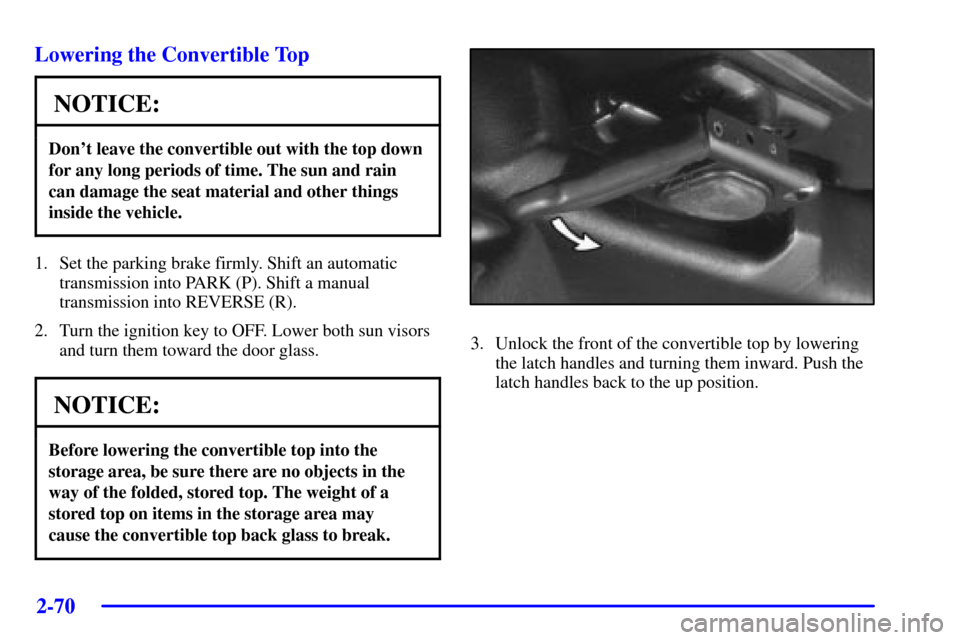
3. Unlock the front of the convertible top by lowering
the latch handles and turning them inward. Push the
latch handles back to the up position.
Page 132 of 384
2-74
Raising the Convertible Top
1. Park on a level surface, set the parking brake firmly
and shift an automatic transmission into PARK (P).
Shift a manual transmission into REVERSE (R).
Lower both windows and sun visors and turn the
ignition key to OFF.
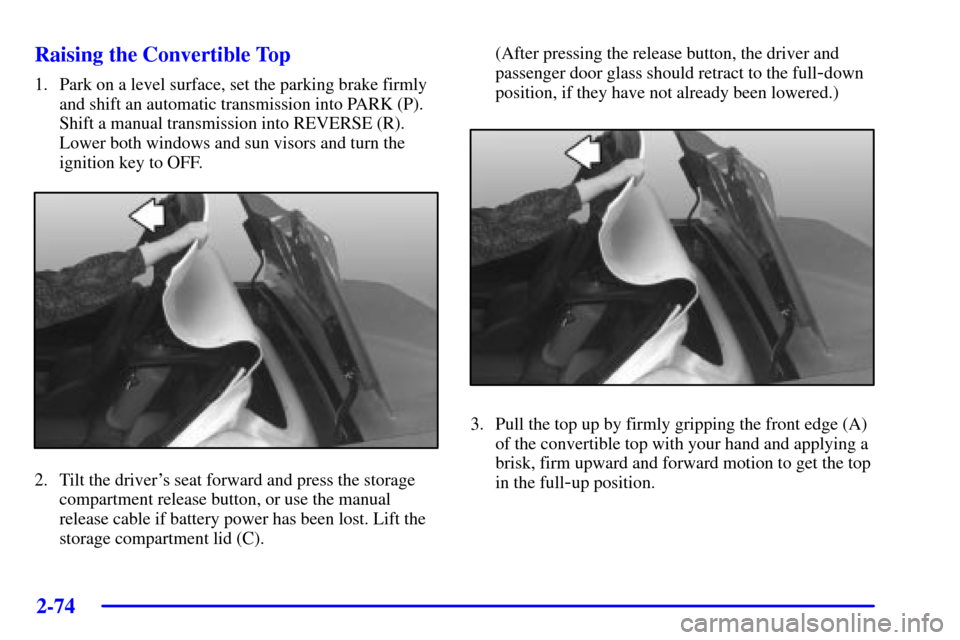
2. Tilt the driver's seat forward and press the storage
compartment release button, or use the manual
release cable if battery power has been lost. Lift the
storage compartment lid (C). (After pressing the release button, the driver and
passenger door glass should retract to the full
-down
position, if they have not already been lowered.)
3. Pull the top up by firmly gripping the front edge (A)
of the convertible top with your hand and applying a
brisk, firm upward and forward motion to get the top
in the full
-up position.
Page 135 of 384

2-77
The main components of your instrument panel are the following:
A. Instrument Panel Brightness Control
B. Head
-Up Display Controls (Option)
C. Turn Signal/Multifunction Lever
D. Driver Information Center (DIC)
(Located in the Instrument Cluster)
E. Instrument Panel Cluster
F. Windshield Wiper/Washer Lever
G. Driver Information Center (DIC) Buttons
H. Hazard Warning Flasher Button
I. Center Air Vents
J. Audio System
K. Comfort Controls
L. Fog Lamp Button (If Equipped)
M. Remote Hatch Release Button (Coupe) or
Remote Trunk Release Button (Convertible/Z06)
N. Ignition SwitchO. Shift Lever (Automatic Shown)
P. Traction Control System (TCS)
Button/Active Handling Button
Q. Accessory Power Outlet
(Located in the Center Console)
R. Selective Real Time Damping (Option)
S. Air Bag Off Light
T. Instrument Panel Cupholder
U. Remote Fuel Door Release Button
(Located in the Center Console)
V. Ashtray and Cigarette Lighter
W. Parking Brake
X. Glove Box
Y. Instrument Panel Fuse Block
(Located behind the Toe
-Board)
Z. Air Bag Off Switch (Located in Glove Box)
Page 137 of 384

2-79 Speedometer and Odometer
Your speedometer lets you see your speed in either
miles per hour (mph) or kilometers per hour (km/h).
There is only one scale for mph and km/h. When you
press the E/M (English/metric) button on the Driver
Information Center (DIC), the cluster will calculate
the proper speed and move the needle to the correct
position. Either the MPH or the km/h telltale will
illuminate, depending on which measurement
you choose.
To read the odometer with the ignition off, turn on
the parking lamps.
You may wonder what happens if your vehicle needs a
new odometer installed. The mileage total of the new
odometer will be set to the original miles (kilometers)
of the old odometer. See your dealer if a new odometer
must be replaced in your vehicle.
Tachometer
The tachometer displays the engine speed in thousands
of revolutions per minute (rpm).
Fuel will shut off at about 6200 rpm (6500 rpm for Z06).
If you continue to drive your vehicle at the fuel shut off
rpm, you could damage your engine. Be sure to operate
your vehicle below the fuel shut off rpm or reduce your
rpm quickly when the fuel shuts off.
Page 139 of 384

2-81 Air Bag Readiness Light
There is an air bag readiness light on the instrument
panel, which shows a deployed air bag symbol.
The system checks the air bag's electrical system
for malfunctions. The light tells you if there is an
electrical problem. The system check includes the air
bag modules, the wiring and the diagnostic module.
For more information on the air bag system,
see ªAir Bagº in the Index.
This light will come on
when you start your vehicle,
and it will flash for a few
seconds. Then the light
should go out. This means
the system is ready.
If the air bag readiness light stays on after you start the
vehicle or comes on when you are driving, your air bag
system may not work properly. Have your vehicle
serviced right away.
CAUTION:
If the air bag readiness light stays on after you
start your vehicle, it means the air bag system
may not be working properly. The air bags in
your vehicle may not inflate in a crash, or they
could even inflate without a crash. To help avoid
injury to yourself or others, have your vehicle
serviced right away if the air bag readiness light
stays on after you start your vehicle.
The air bag readiness light should flash for a few
seconds when you turn the ignition key to ON. If the
light doesn't come on then, have it fixed so it will be
ready to warn you if there is a problem.
Page 142 of 384
2-84
Brake System Warning Light
Your vehicle's hydraulic brake system is divided into
two parts. If one part isn't working, the other part can
still work and stop you. For good braking, though,
you need both parts working well.
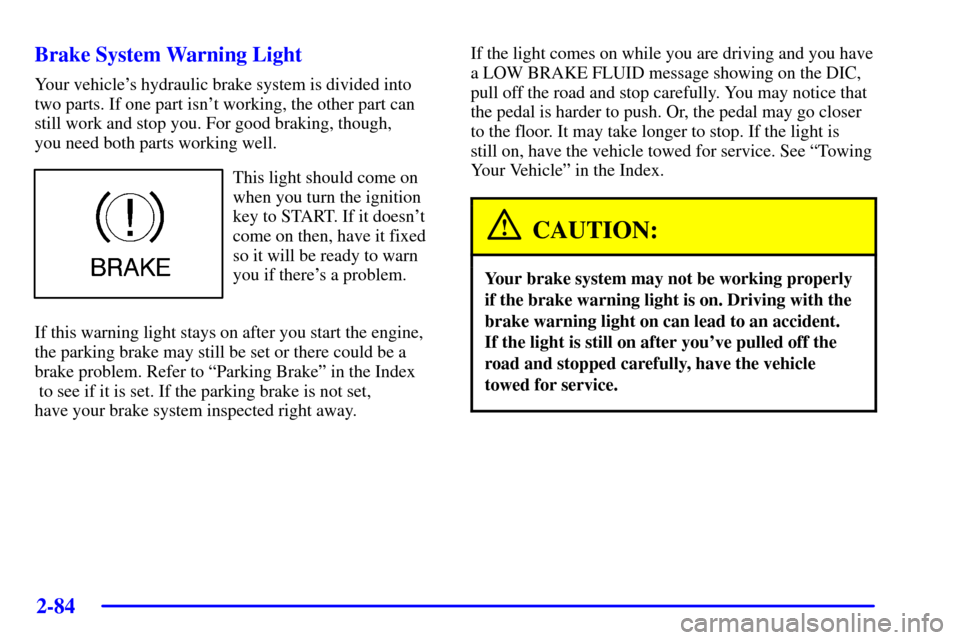
This light should come on
when you turn the ignition
key to START. If it doesn't
come on then, have it fixed
so it will be ready to warn
you if there's a problem.
If this warning light stays on after you start the engine,
the parking brake may still be set or there could be a
brake problem. Refer to ªParking Brakeº in the Index
to see if it is set. If the parking brake is not set,
have your brake system inspected right away.If the light comes on while you are driving and you have
a LOW BRAKE FLUID message showing on the DIC,
pull off the road and stop carefully. You may notice that
the pedal is harder to push. Or, the pedal may go closer
to the floor. It may take longer to stop. If the light is
still on, have the vehicle towed for service. See ªTowing
Your Vehicleº in the Index.
CAUTION:
Your brake system may not be working properly
if the brake warning light is on. Driving with the
brake warning light on can lead to an accident.
If the light is still on after you've pulled off the
road and stopped carefully, have the vehicle
towed for service.
Page 143 of 384

2-85 Anti-Lock Brake System Warning Light
With the anti-lock brake
system, the light will
come on when your
engine is started and may
stay on for several seconds.
That's normal.
If the light stays on, turn the ignition to OFF. Or, if the
light comes on when you're driving, stop as soon as
possible and turn the ignition off. Then start the engine
again to reset the system. If the light still stays on, or
comes on again while you're driving, your vehicle needs
service. If the regular brake system warning light isn't
on, you still have brakes, but you don't have anti
-lock
brakes. If the regular brake system warning light is
also on, you don't have anti
-lock brakes and there's a
problem with your regular brakes. See ªBrake System
Warning Lightº earlier in this section. Also see ªService
ABSº under ªDriver Information Center (DIC)
Messagesº in the Index.
The anti
-lock brake system warning light should
come on briefly when you turn the ignition key to ON.
If the light doesn't come on then, have it fixed so it will
be ready to warn you if there is a problem.
Traction Control System (TCS) Light
This light should come on
briefly as you start the
engine. If the light doesn't
come on then, have it fixed
so it will be ready to warn
you if there's a problem.
If it stays on, or comes on and the DIC shows a
SERVICE TRACTION SYSTEM message when
you're driving, there's a problem with your TCS system
and your vehicle needs service. When this light is on,
the system will not limit wheel spin. Adjust your
driving accordingly. If the driver turns off the Traction
Control System by pressing the button on the console,
the TCS system light will come on and the TRACTION
SYSTEM OFF message will show on the DIC.
Page 145 of 384

2-87 Engine Coolant Temperature Gage
United States Canada
This gage shows the engine coolant temperature. If the
gage pointer moves into the shaded area, your engine
is too hot.
This means that your engine coolant has overheated.
If you have been operating your vehicle under normal
driving conditions, you should pull off the road, stop
your vehicle and turn off the engine as soon as possible.
(The larger tic marks are in increments of 30� below
220�F (104�C) and in increments of 10� above
220�F (104�C).)
See ªEngine Overheatingº in the Index for
more information.
Malfunction Indicator Lamp
(Check Engine Light)
Your vehicle is equipped
with a computer which
monitors operation of the
fuel, ignition and emission
control systems.
This system is called OBD II (On
-Board
Diagnostics
-Second Generation) and is intended
to assure that emissions are at acceptable levels for
the life of the vehicle, helping to produce a cleaner
environment. The CHECK ENGINE light comes on to
indicate that there is a problem and service is required.
Malfunctions often will be indicated by the system
before any problem is apparent. This may prevent
more serious damage to your vehicle. This system
is also designed to assist your service technician in
correctly diagnosing any malfunction.