Page 252 of 384
5-7
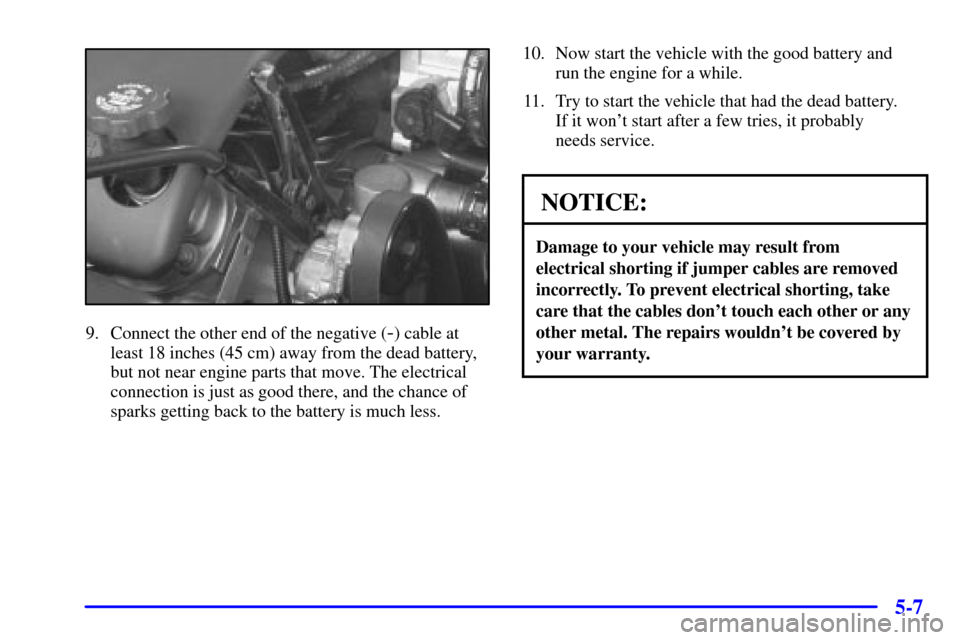
9. Connect the other end of the negative (-) cable at
least 18 inches (45 cm) away from the dead battery,
but not near engine parts that move. The electrical
connection is just as good there, and the chance of
sparks getting back to the battery is much less.10. Now start the vehicle with the good battery and
run the engine for a while.
11. Try to start the vehicle that had the dead battery.
If it won't start after a few tries, it probably
needs service.
NOTICE:
Damage to your vehicle may result from
electrical shorting if jumper cables are removed
incorrectly. To prevent electrical shorting, take
care that the cables don't touch each other or any
other metal. The repairs wouldn't be covered by
your warranty.
Page 253 of 384
5-8
Jumper Cable Removal
A. Heavy, Unpainted Metal Engine Part
B. Good Battery
C. Dead BatteryTo disconnect the jumper cables from both vehicles,
do the following:
1. Disconnect the black negative (
-) cable from the
vehicle that had the dead battery.
2. Disconnect the black negative (
-) cable from the
vehicle with the good battery.
3. Disconnect the red positive (+) cable from the
vehicle with the good battery.
4. Disconnect the red positive (+) cable from the
other vehicle.
Towing Your Vehicle
Consult your dealer or a professional towing service
if you need to have your disabled vehicle towed.
See ªRoadside Assistanceº in the Index.
Page 268 of 384
5-23
NOTICE:
The car engine must be running to avoid draining
the battery while running the air compressor.
Follow the proper steps to be sure your vehicle won't
move. See ªParking Your Vehicle, Manual Transmissionº
in the Index.
CAUTION:
It can be dangerous to get out of your vehicle
with the engine running, if the shift lever is not in
NEUTRAL (N) with the parking brake firmly set
(manual transmission). Your vehicle can roll or
move suddenly even when on fairly level ground.
To be sure your vehicle won't move, always set
your parking brake and move the shift lever to
NEUTRAL (N) when you start or idle your engine.
CAUTION:
Idling the engine in a closed-in place or with
the climate control system off can cause deadly
carbon monoxide (CO). See ªEngine Exhaustº in
the Index.
CAUTION:
Inflating something too much can make it
explode, and you or others could be injured.
Be sure to read the inflator instructions, and
inflate the tire to its recommended pressure.
Do not exceed 36 psi (248 kPa).
Page 273 of 384
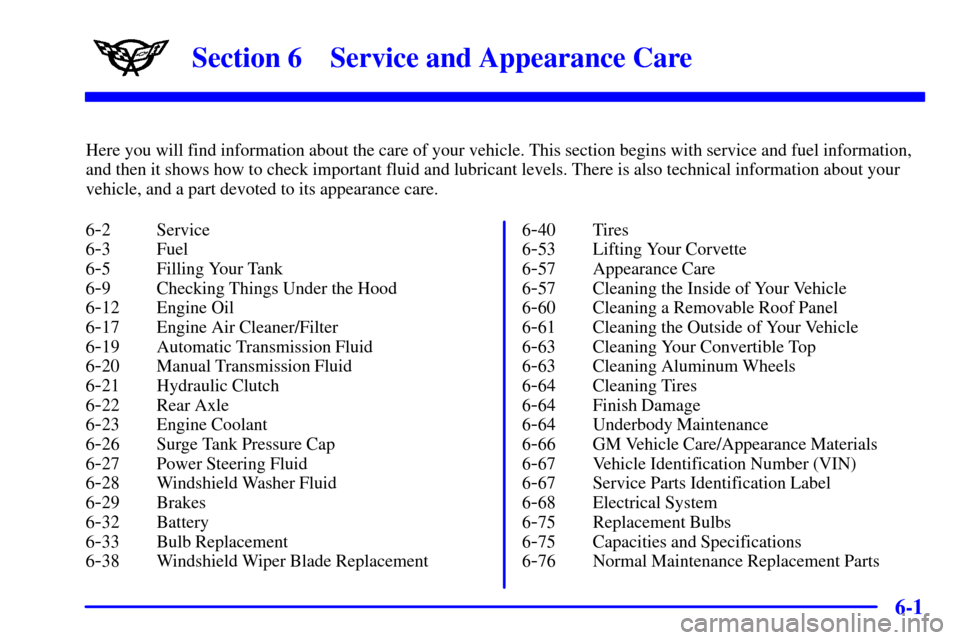
6-
6-1
Section 6 Service and Appearance Care
Here you will find information about the care of your vehicle. This section begins with service and fuel information,
and then it shows how to check important fluid and lubricant levels. There is also technical information about your
vehicle, and a part devoted to its appearance care.
6
-2 Service
6
-3 Fuel
6
-5 Filling Your Tank
6
-9 Checking Things Under the Hood
6
-12 Engine Oil
6
-17 Engine Air Cleaner/Filter
6
-19 Automatic Transmission Fluid
6
-20 Manual Transmission Fluid
6
-21 Hydraulic Clutch
6
-22 Rear Axle
6
-23 Engine Coolant
6
-26 Surge Tank Pressure Cap
6
-27 Power Steering Fluid
6
-28 Windshield Washer Fluid
6
-29 Brakes
6
-32 Battery
6
-33 Bulb Replacement
6
-38 Windshield Wiper Blade Replacement6
-40 Tires
6
-53 Lifting Your Corvette
6
-57 Appearance Care
6
-57 Cleaning the Inside of Your Vehicle
6
-60 Cleaning a Removable Roof Panel
6
-61 Cleaning the Outside of Your Vehicle
6
-63 Cleaning Your Convertible Top
6
-63 Cleaning Aluminum Wheels
6
-64 Cleaning Tires
6
-64 Finish Damage
6
-64 Underbody Maintenance
6
-66 GM Vehicle Care/Appearance Materials
6
-67 Vehicle Identification Number (VIN)
6
-67 Service Parts Identification Label
6
-68 Electrical System
6
-75 Replacement Bulbs
6
-75 Capacities and Specifications
6
-76 Normal Maintenance Replacement Parts
Page 283 of 384
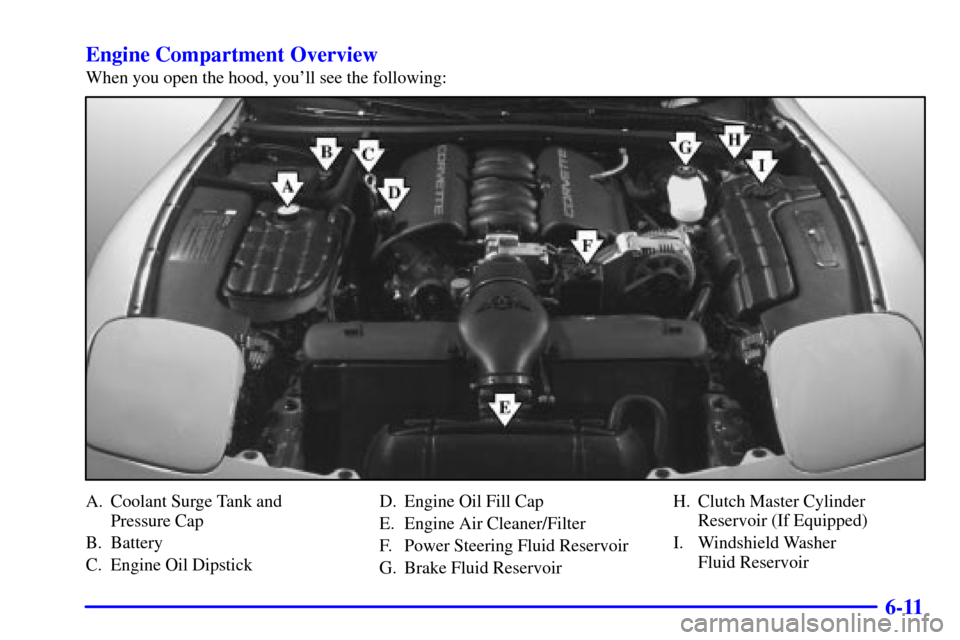
6-11 Engine Compartment Overview
When you open the hood, you'll see the following:
A. Coolant Surge Tank and
Pressure Cap
B. Battery
C. Engine Oil DipstickD. Engine Oil Fill Cap
E. Engine Air Cleaner/Filter
F. Power Steering Fluid Reservoir
G. Brake Fluid ReservoirH. Clutch Master Cylinder
Reservoir (If Equipped)
I. Windshield Washer
Fluid Reservoir
Page 304 of 384

6-32 Brake Adjustment
As you make brake stops, your disc brakes
automatically adjust for wear.
Replacing Brake System Parts
The braking system on a vehicle is complex.
Its many parts have to be of top quality and work
well together if the vehicle is to have really good
braking. Your vehicle was designed and tested with
top
-quality GM brake parts. When you replace parts
of your braking system
-- for example, when your brake
linings wear down and you need new ones put in
-- be
sure you get new approved GM replacement parts.
If you don't, your brakes may no longer work properly.
For example, if someone puts in brake linings that are
wrong for your vehicle, the balance between your
front and rear brakes can change
-- for the worse.
The braking performance you've come to expect can
change in many other ways if someone puts in the
wrong replacement brake parts.
Battery
Your new vehicle comes with a maintenance free
ACDelco� battery. When it's time for a new battery,
get one that has the replacement number shown on the
original battery's label. We recommend an ACDelco
battery. For battery replacement, see your dealer or
the service manual. To purchase a service manual,
see ªService and Owner Publicationsº in the Index.
WARNING: Battery posts, terminals and related
accessories contain lead and lead compounds, chemicals
known to the State of California to cause cancer and
reproductive harm. Wash hands after handling.
Page 305 of 384
6-33 Vehicle Storage
If you're not going to drive your vehicle for 25 days
or more, remove the black, negative (
-) cable from
the battery. This will help keep your battery from
running down.
CAUTION:
Batteries have acid that can burn you and gas
that can explode. You can be badly hurt if you
aren't careful. See ªJump Startingº in the Index
for tips on working around a battery without
getting hurt.
Contact your dealer to learn how to prepare your vehicle
for longer storage periods.
Also, for your audio system, see ªTheft
-Deterrent
Featureº in the Index.
Bulb Replacement
For the proper type of replacement bulb,
see ªReplacement Bulbsº in the Index.
For any bulb changing procedure not listed in
this section, contact your Chevrolet dealer's
service department.
Halogen Bulbs
CAUTION:
Halogen bulbs have pressurized gas inside
and can burst if you drop or scratch the bulb.
You or others could be injured. Be sure to read
and follow the instructions on the bulb package.
Page 341 of 384

6-69
The plug has the following three separate wires:
�The orange wire connects to battery power.
�The yellow wire connects to ignition power.
(Power is only available when the ignition is in ON.)
�The black wire connects to ground.
NOTICE:
When using the accessory power plug:
�DO NOT splice wires directly into the
vehicle electrical wire harness. If done
incorrectly, splicing may cause damage to
your electrical system and would not be
covered by the vehicle's warranty.
�The maximum load of any electrical
equipment should not exceed 15 amps.
NOTICE: (Continued)
NOTICE: (Continued)
�Be sure to turn off any electrical equipment
when not in use. Leaving electrical equipment
on for extended periods of time can drain
your battery.
�DO NOT use this plug if the electrical
equipment requires frequent connecting and
disconnecting. This may cause excessive wear
on the accessory power plug and damage
your electrical system and the damage would
not be covered by your warranty.
Headlamps
The headlamp wiring is protected by a circuit breaker.
An electrical overload will cause the lamps to go on and
off, or in some cases to remain off. If this happens, have
your headlamp wiring checked right away.