Page 283 of 384
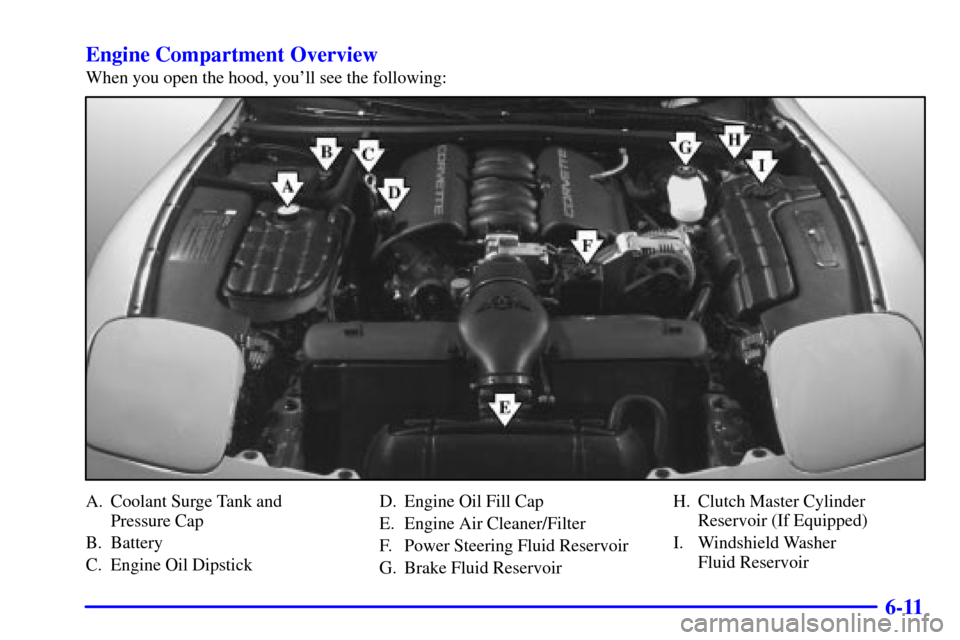
6-11 Engine Compartment Overview
When you open the hood, you'll see the following:
A. Coolant Surge Tank and
Pressure Cap
B. Battery
C. Engine Oil DipstickD. Engine Oil Fill Cap
E. Engine Air Cleaner/Filter
F. Power Steering Fluid Reservoir
G. Brake Fluid ReservoirH. Clutch Master Cylinder
Reservoir (If Equipped)
I. Windshield Washer
Fluid Reservoir
Page 300 of 384

6-28
Windshield Washer Fluid
What to Use
When you need windshield washer fluid, be sure to read
the manufacturer's instructions before use. If you will be
operating your vehicle in an area where the temperature
may fall below freezing, use a fluid that has sufficient
protection against freezing. See ªEngine Compartment
Overviewº in the Index for reservoir location.
Adding Washer Fluid
Open the cap with the
washer symbol on it.
Add washer fluid until
the tank is full.
NOTICE:
�When using concentrated washer fluid,
follow the manufacturer's instructions for
adding water.
�Don't mix water with ready
-to-use washer
fluid. Water can cause the solution to freeze
and damage your washer fluid tank and
other parts of the washer system. Also,
water doesn't clean as well as washer fluid.
�Fill your washer fluid tank only
three
-quarters full when it's very cold.
This allows for expansion if freezing
occurs, which could damage the tank if
it is completely full.
�Don't use engine coolant (antifreeze) in
your windshield washer. It can damage
your washer system and paint.
Page 332 of 384
6-60
Cleaning the Outside of the
Windshield and Wiper Blades
If the windshield is not clear after using the windshield
washer, or if the wiper blade chatters when running,
wax, sap or other material may be on the blade
or windshield.
Clean the outside of the windshield with a full
-strength
glass cleaning liquid. The windshield is clean if beads
do not form when you rinse it with water.
If you use a glass treatment or conditioner containing
ethyl alcohol or ethyl sulfate on your glass, be sure
to remove the acrylic roof panel, if so equipped.
These products may damage the panel.
Grime from the windshield will stick to the wiper blades
and affect their performance. Clean the blade by wiping
vigorously with a cloth soaked in full
-strength
windshield washer solvent. Then rinse the blade
with water.
Check the wiper blades and clean them as necessary;
replace blades that look worn.
Weatherstrips
Silicone grease on weatherstrips will make them last
longer, seal better, and not stick or squeak. Apply
silicone grease with a clean cloth at least every six
months. During very cold, damp weather more frequent
application may be required. See ªRecommended Fluids
and Lubricantsº in the Index.
Cleaning a Removable Roof Panel
Special care is necessary when cleaning, removing
and/or storing the roof panel.
�Flush with water to remove dust and dirt,
then dry the panel.
�Clean the panel with GM Glass Cleaner.
Leave the cleaner on the panel for one minute,
then wipe the panel with a soft, lint
-free cloth.
�Don't use abrasive cleaning materials.
Page 361 of 384
7-13
Part B: Owner Checks and Services
Listed in this part are owner checks and services which
should be performed at the intervals specified to help
ensure the safety, dependability and emission control
performance of your vehicle.
Be sure any necessary repairs are completed at once.
Whenever any fluids or lubricants are added to your
vehicle, make sure they are the proper ones, as shown
in Part D.
At Each Fuel Fill
It is important for you or a service station attendant
to perform these underhood checks at each fuel fill.
Engine Oil Level Check
Check the engine oil level and add the proper oil
if necessary. See ªEngine Oilº in the Index for
further details.
Engine Coolant Level Check
Check the engine coolant level and add DEX
-COOL�
coolant mixture if necessary. See ªEngine Coolantº in
the Index for further details.Windshield Washer Fluid Level Check
Check the windshield washer fluid level in the
windshield washer tank and add the proper fluid if
necessary. See ªWindshield Washer Fluidº in the
Index for further details.
At Least Once a Month
Tire Inflation Check
Make sure tires are inflated to the correct pressures.
See ªTiresº in the Index for further details.
Cassette Deck Service
Clean cassette deck. Cleaning should be done every
50 hours of tape play. See ªAudio Systemsº in the
Index for further details.
Power Antenna Service
Clean power antenna mast. See ªAudio Systemsº in
the Index for further details.
Page 367 of 384

7-19
Part D: Recommended Fluids
and Lubricants
Fluids and lubricants identified below by name,
part number or specification may be obtained from
your dealer.
USAGE
FLUID/LUBRICANT
Engine OilThe engine requires a special
engine oil meeting GM Standard
GM4718M. Oils meeting this
standard may be identified as
synthetic, and should also be
identified with the American
Petroleum Institute Certified
for Gasoline Engines starburst
symbol. However, not all
synthetic API oils with the
starburst symbol will meet this
GM standard. You should look
for and use only an oil that meets
GM Standard GM4718M. For the
proper viscosity, see ªEngine Oilº
in the Index.
USAGEFLUID/LUBRICANT
Engine Coolant50/50 mixture of clean,
drinkable water and use only
GM Goodwrench
� DEX-COOL�
or Havoline� DEX-COOL�
Coolant. See ªEngine Coolantº
in the Index.
Hydraulic
Brake SystemDelco Supreme 11� Brake Fluid
(GM Part No. 12377967 or
equivalent DOT
-3 brake fluid).
Windshield
Washer SolventGM Optikleen� Washer Solvent
(GM Part No. 1051515)
or equivalent.
Hydraulic
Clutch SystemHydraulic Clutch Fluid
(GM Part No. 12345347 or
equivalent DOT
-3 brake fluid).
Power
Steering SystemGM Power Steering Fluid
(GM Part No. 1052884
- 1 pint,
1050017
- 1 quart, or equivalent).
Manual
TransmissionDEXRON�-III Automatic
Transmission Fluid.