Page 198 of 360
4-33
Loading Your Vehicle
Two labels on your vehicle show how much weight it
may properly carry. The Tire
-Loading Information label
found on the rear edge of the driver's door tells you the
proper size, speed rating and recommended inflation
pressures for the tires on your vehicle. It also gives you
important information about the number of people that
can be in your vehicle and the total weight that you can
carry. This weight is called the Vehicle Capacity Weight,
and includes the weight of all occupants, cargo and all
nonfactory
-installed options.
The other label is the Certification label, found on the
rear edge of the driver's door. It tells you the gross
weight capacity of your vehicle, called the Gross
Vehicle Weight Rating (GVWR). The GVWR includes
the weight of the vehicle, all occupants, fuel and cargo.
Never exceed the GVWR for your vehicle, or the Gross
Axle Weight Rating (GAWR) for either the front or
rear axle.
Page 200 of 360
4-35
Towing a Trailer
(Models with 2.4L L4 (LD9) or
2.2L L4 ECOTEC�(L61) Engine
and Automatic Transaxle)
CAUTION:
If you don't use the correct equipment and drive
properly, you can lose control when you pull a
trailer. For example, if the trailer is too heavy,
the brakes may not work well
-- or even at all.
You and your passengers could be seriously
injured. You may also damage your vehicle; the
resulting repairs would not be covered by your
warranty. Pull a trailer only if you have followed
all the steps in this section. Ask your dealer for
advice and information about towing a trailer
with your vehicle.
Your vehicle can tow a trailer if it is equipped with a
2.4L L4 (LD9) or a 2.2L L4 ECOTEC (L61) engine
and automatic transaxle and the proper trailer towing
equipment. If your vehicle is not equipped as stated
above, or if your vehicle is a Z24 model, do not tow a
trailer. To identify what the vehicle trailering capacity is
for your vehicle, you should read the information in
ªWeight of the Trailerº that appears later in this section.
But trailering is different than just driving your vehicle by
itself. Trailering means changes in handling, durability
and fuel economy. Successful, safe trailering takes
correct equipment, and it has to be used properly.
That's the reason for this part. In it are many
time
-tested, important trailering tips and safety
rules. Many of these are important for your safety
and that of your passengers. So please read this
section carefully before you pull a trailer.
Load
-pulling components such as the engine, transaxle,
wheel assemblies and tires are forced to work harder
against the drag of the added weight. The engine is
required to operate at relatively higher speeds and under
greater loads, generating extra heat. What's more, the
trailer adds considerably to wind resistance, increasing
the pulling requirements.
Page 240 of 360

6-
6-1
Section 6 Service and Appearance Care
Here you will find information about the care of your vehicle. This section begins with service and fuel information,
and then it shows how to check important fluid and lubricant levels. There is also technical information about your
vehicle, and a part devoted to its appearance care.
6
-2 Service
6
-3 Fuel
6
-5 Fuels in Foreign Countries
6
-6 Filling Your Tank
6
-8 Filling a Portable Fuel Container
6
-9 Checking Things Under the Hood
6
-14 Engine Oil
6
-21 Engine Air Cleaner/Filter
6
-23 Automatic Transaxle Fluid
6
-24 Manual Transaxle Fluid
6
-24 Hydraulic Clutch
6
-25 Engine Coolant
6
-28 Surge Tank Pressure Cap
6
-29 Power Steering Fluid6
-29 Windshield Washer Fluid
6
-31 Brakes
6
-35 Battery
6
-36 Bulb Replacement
6
-43 Tires
6
-51 Appearance Care
6
-52 Cleaning the Inside of Your Vehicle
6
-54 Care of Safety Belts
6
-55 Cleaning the Outside of Your Vehicle
6
-60 Vehicle Identification Number (VIN)
6
-61 Electrical System
6
-66 Replacement Bulbs
6
-66 Capacities and Specifications
6
-67 Normal Maintenance Replacement Parts
Page 242 of 360
6-3
CAUTION:
You can be injured and your vehicle could be
damaged if you try to do service work on a
vehicle without knowing enough about it.
�Be sure you have sufficient knowledge,
experience, the proper replacement parts
and tools before you attempt any vehicle
maintenance task.
�Be sure to use the proper nuts, bolts and
other fasteners. ªEnglishº and ªmetricº
fasteners can be easily confused. If you use
the wrong fasteners, parts can later break
or fall off. You could be hurt.
Adding Equipment to the Outside of
Your Vehicle
Things you might add to the outside of your vehicle can
affect the airflow around it. This may cause wind noise
and affect windshield washer performance. Check with
your dealer before adding equipment to the outside of
your vehicle.
Fuel
Gasoline Octane
Use regular unleaded gasoline with a posted octane of
87 or higher. If the octane is less than 87, you may get a
heavy knocking noise when you drive. If it is bad
enough, it can damage your engine. A little pinging
noise when you accelerate or drive uphill is considered
normal. This does not indicate a problem exists or that a
higher
-octane fuel is necessary.
Gasoline Specifications
It is recommended that gasoline meet specifications
which were developed by the American Automobile
Manufacturers Association and endorsed by the
Canadian Vehicle Manufacturers' Association for better
vehicle performance and engine protection. Gasolines
meeting these specifications could provide improved
driveability and emission control system performance
compared to other gasolines.
Page 243 of 360
6-4
In Canada, look for
the ªAuto Makers'
Choiceº label on
the pump.
Canada OnlyCalifornia Fuel
If your vehicle is certified to meet California Emission
Standards (see the underhood emission control label), it
is designed to operate on fuels that meet California
specifications. If this fuel is not available in states
adopting California emissions standards, your vehicle
will operate satisfactorily on fuels meeting federal
specifications, but emission control system performance
may be affected. The malfunction indicator lamp may
turn on (see ªMalfunction Indicator Lampº in the Index)
and your vehicle may fail a smog
-check test. If this
occurs, return to your authorized GM dealer for
diagnosis. If it is determined that the condition is caused
by the type of fuel used, repairs may not be covered by
your warranty.
Page 244 of 360
6-5 Additives
Some gasolines that are not reformulated for low
emissions may contain an octane
-enhancing additive
called methylcyclopentadienyl manganese tricarbonyl
(MMT); ask the attendant where you buy gasoline
whether the fuel contains MMT. General Motors does
not recommend the use of such gasolines. Fuels
containing MMT can reduce the life of spark plugs and
the performance of the emission control system may be
affected. The malfunction indicator lamp may turn on.
If this occurs, return to your authorized GM dealer
for service.
To provide cleaner air, all gasolines in the United States
are now required to contain additives that will help
prevent engine and fuel system deposits from forming,
allowing your emission control system to work properly.
You should not have to add anything to your fuel.
Gasolines containing oxygenates, such as ethers and
ethanol, and reformulated gasolines may be available in
your area to contribute to clean air. General Motors
recommends that you use these gasolines, particularly if
they comply with the specifications described earlier.
NOTICE:
Your vehicle was not designed for fuel that
contains methanol. Don't use fuel containing
methanol. It can corrode metal parts in your
fuel system and also damage plastic and rubber
parts. That damage wouldn't be covered under
your warranty.
Fuels in Foreign Countries
If you plan on driving in another country outside the
United States or Canada, the proper fuel may be hard to
find. Never use leaded gasoline or any other fuel not
recommended in the previous text on fuel. Costly repairs
caused by use of improper fuel wouldn't be covered by
your warranty.
To check on fuel availability, ask an auto club, or
contact a major oil company that does business in the
country where you'll be driving.
Page 245 of 360
6-6
Filling Your Tank
CAUTION:
Gasoline vapor is highly flammable. It burns
violently, and that can cause very bad injuries.
Don't smoke if you're near gasoline or refueling
your vehicle. Keep sparks, flames and smoking
materials away from gasoline.
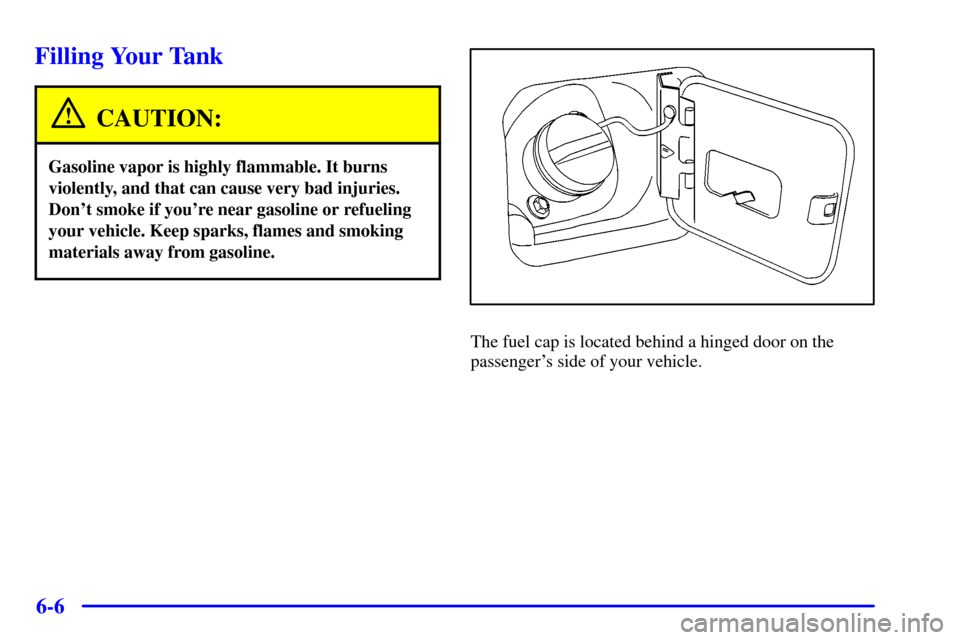
The fuel cap is located behind a hinged door on the
passenger's side of your vehicle.
Page 246 of 360
6-7
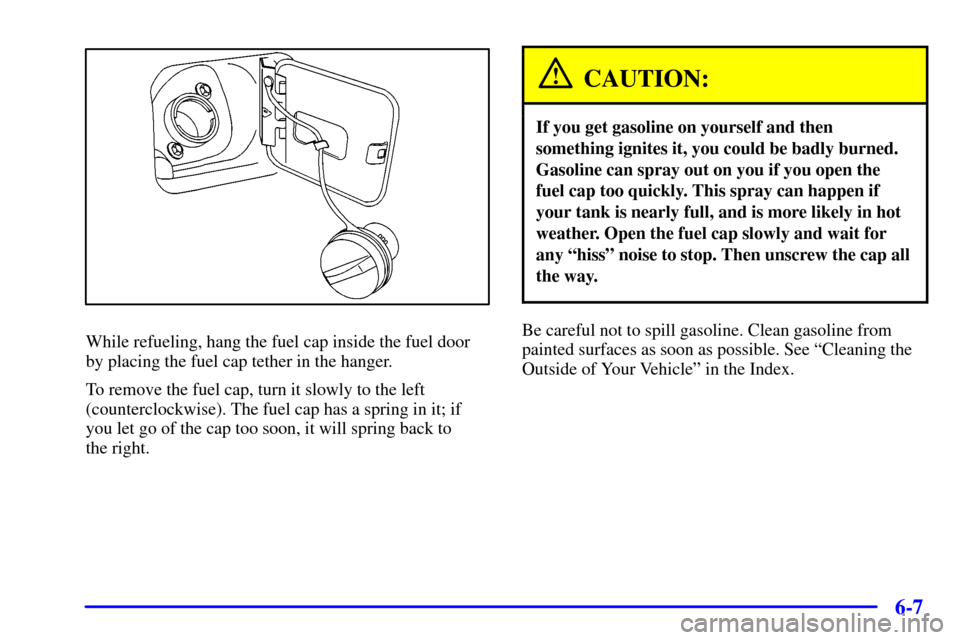
While refueling, hang the fuel cap inside the fuel door
by placing the fuel cap tether in the hanger.
To remove the fuel cap, turn it slowly to the left
(counterclockwise). The fuel cap has a spring in it; if
you let go of the cap too soon, it will spring back to
the right.
CAUTION:
If you get gasoline on yourself and then
something ignites it, you could be badly burned.
Gasoline can spray out on you if you open the
fuel cap too quickly. This spray can happen if
your tank is nearly full, and is more likely in hot
weather. Open the fuel cap slowly and wait for
any ªhissº noise to stop. Then unscrew the cap all
the way.
Be careful not to spill gasoline. Clean gasoline from
painted surfaces as soon as possible. See ªCleaning the
Outside of Your Vehicleº in the Index.