Page 100 of 360
2-39
Tilt Wheel (If Equipped)
A tilt wheel allows you to adjust the steering wheel
before you drive. You can raise it to the highest level
to give your legs more room when you exit and enter
the vehicle.
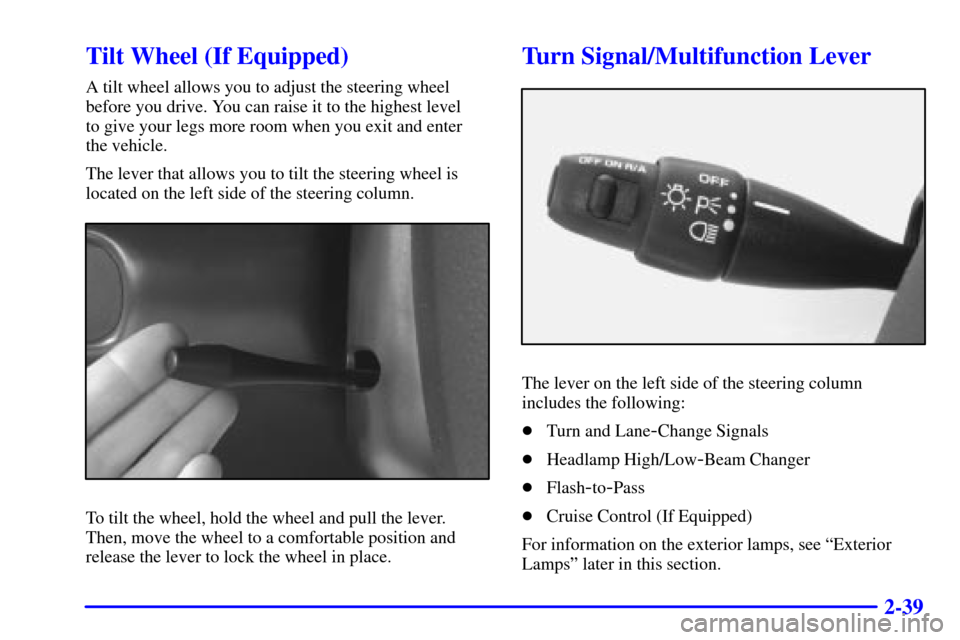
The lever that allows you to tilt the steering wheel is
located on the left side of the steering column.
To tilt the wheel, hold the wheel and pull the lever.
Then, move the wheel to a comfortable position and
release the lever to lock the wheel in place.
Turn Signal/Multifunction Lever
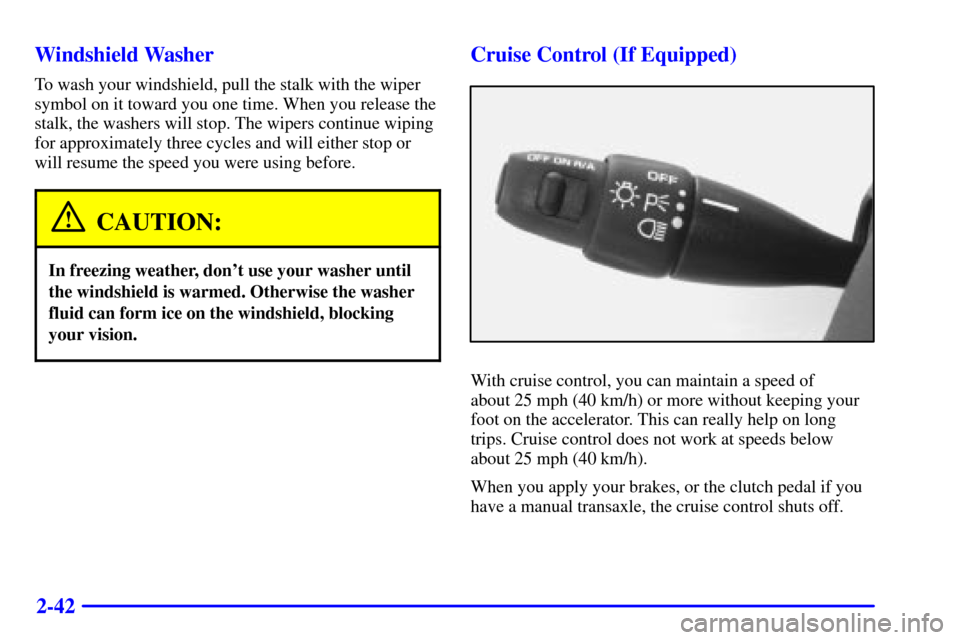
The lever on the left side of the steering column
includes the following:
�Turn and Lane
-Change Signals
�Headlamp High/Low
-Beam Changer
�Flash
-to-Pass
�Cruise Control (If Equipped)
For information on the exterior lamps, see ªExterior
Lampsº later in this section.
Page 103 of 360
2-42 Windshield Washer
To wash your windshield, pull the stalk with the wiper
symbol on it toward you one time. When you release the
stalk, the washers will stop. The wipers continue wiping
for approximately three cycles and will either stop or
will resume the speed you were using before.
CAUTION:
In freezing weather, don't use your washer until
the windshield is warmed. Otherwise the washer
fluid can form ice on the windshield, blocking
your vision.
Cruise Control (If Equipped)
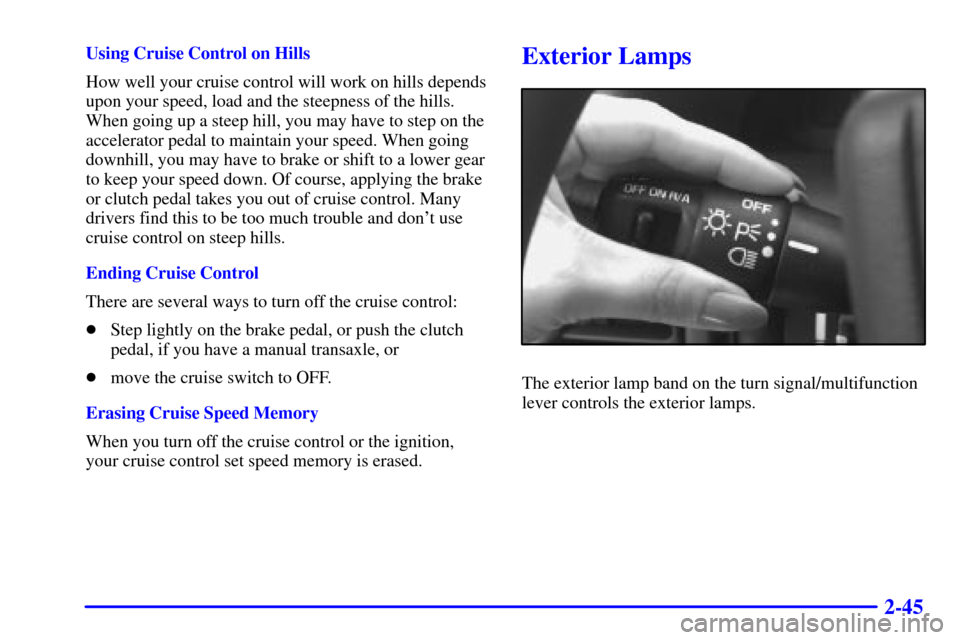
With cruise control, you can maintain a speed of
about 25 mph (40 km/h) or more without keeping your
foot on the accelerator. This can really help on long
trips. Cruise control does not work at speeds below
about 25 mph (40 km/h).
When you apply your brakes, or the clutch pedal if you
have a manual transaxle, the cruise control shuts off.
Page 104 of 360

2-43
CAUTION:
�Cruise control can be dangerous where you
can't drive safely at a steady speed. So,
don't use your cruise control on winding
roads or in heavy traffic.
�Cruise control can be dangerous on
slippery roads. On such roads, fast changes
in tire traction can cause needless wheel
spinning, and you could lose control. Don't
use cruise control on slippery roads.
If your vehicle is in cruise control when the optional
enhanced traction system begins to limit wheel spin, the
cruise control will automatically disengage. See
ªEnhanced Traction Systemº in the Index. When road
conditions allow you to safely use it again, you may turn
the cruise control back on.Setting Cruise Control
CAUTION:
If you leave your cruise control switch on when
you're not using cruise, you might hit a button
and go into cruise when you don't want to. You
could be startled and even lose control. Keep the
cruise control switch off until you want to use
cruise control.
1. Move the cruise control switch to ON.
2. Get up to the speed you want.
3. Push the SET button at the end of the lever and
release it.
4. Take your foot off the accelerator pedal.
Page 105 of 360
2-44
Resuming a Set Speed
Suppose you set your cruise control at a desired speed
and then you apply the brake or clutch pedal. This, of
course, shuts off the cruise control. But you don't need
to reset it. Once you're going about 25 mph (40 km/h)
or more, you can briefly move the cruise control switch
from ON to R/A.
You'll go right back up to your chosen speed and
stay there.
If you hold the switch at R/A longer, the vehicle will
keep going faster until you release the switch or apply
the brake or clutch pedal. So unless you want to go
faster, don't hold the switch at R/A.
Increasing Speed While Using Cruise Control
There are two ways to go to a higher speed:
�Use the accelerator pedal to get to a higher speed.
Push the SET button at the end of the lever, then
release the button and the accelerator pedal. You'll
now cruise at the higher speed.�Move the cruise control switch from ON to R/A.
Hold it there until you get up to the speed you want,
and then release the switch. To increase your speed
in very small amounts, briefly move the switch to
R/A then release it. Each time you do this, your
vehicle will go about 1 mph (1.6 km/h) faster.
Reducing Speed While Using Cruise Control
There are two ways to reduce your speed while using
cruise control:
�Push in the button at the end of the lever until you
reach the lower speed you want, then release it.
�To slow down in very small amounts, briefly
press the button. Each time you do this, you'll go
about 1 mph (1.6 km/h) slower.
Passing Another Vehicle While Using Cruise Control
Use the accelerator pedal to increase your speed. When
you take your foot off the pedal, your vehicle will slow
down to the cruise control speed you set earlier.
Page 106 of 360
2-45
Using Cruise Control on Hills
How well your cruise control will work on hills depends
upon your speed, load and the steepness of the hills.
When going up a steep hill, you may have to step on the
accelerator pedal to maintain your speed. When going
downhill, you may have to brake or shift to a lower gear
to keep your speed down. Of course, applying the brake
or clutch pedal takes you out of cruise control. Many
drivers find this to be too much trouble and don't use
cruise control on steep hills.
Ending Cruise Control
There are several ways to turn off the cruise control:
�Step lightly on the brake pedal, or push the clutch
pedal, if you have a manual transaxle, or
�move the cruise switch to OFF.
Erasing Cruise Speed Memory
When you turn off the cruise control or the ignition,
your cruise control set speed memory is erased.Exterior Lamps
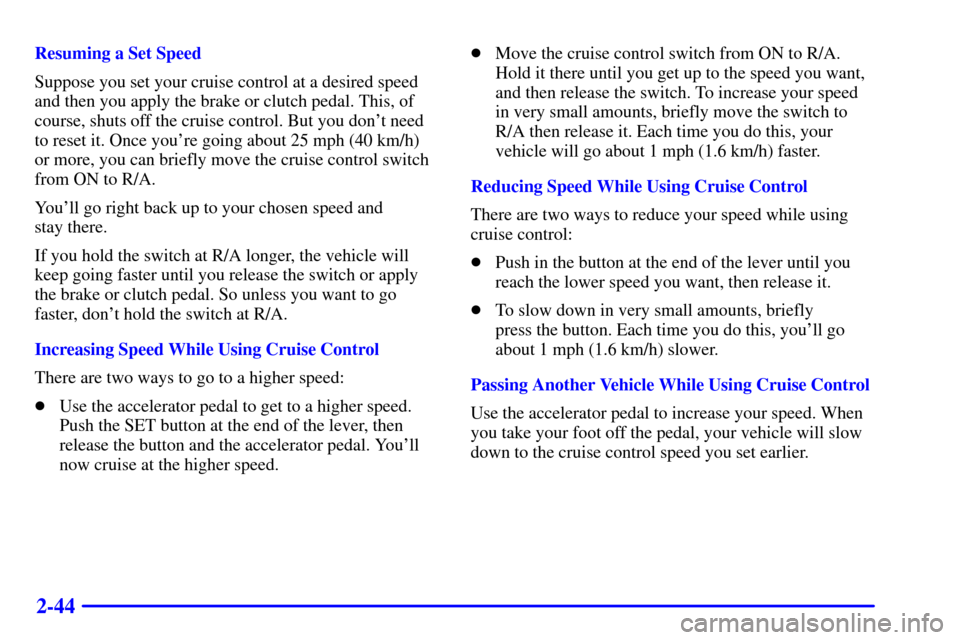
The exterior lamp band on the turn signal/multifunction
lever controls the exterior lamps.
Page 302 of 360
6-63
Fuse Usage
TURN
-B/U Turn Signals, Back-Up Lamps
ERLS Engine Relays
BCM/CLU Body Control Module, Instrument
Panel Cluster
PCM Powertrain Control ModuleFuse Usage
IGN MDL Ignition Module
F/P
-INJ Fuel Pump, Fuel Injectors
AIR BG Air Bag
CRUISE Cruise Control Module/Switch
ABS Anti
-Lock Brake (Ignition)
APO Accessory Power Outlet
RFA BATT Remote Keyless Entry System
MIR/DLC Power Mirror/Diagnostic Link
Connector
LT HDLP Left Headlamp
RDO/INTLP Radio, Interior Lamps
RT HDLP Right Headlamp
CLSTR Instrument Panel Cluster
EXT LP Exterior Lamps
CIG Cigarette Lighter
Page 341 of 360
7-35
Part C: Periodic
Maintenance Inspections
Listed in this part are inspections and services which
should be performed at least twice a year (for instance,
each spring and fall). You should let your dealer's
service department or other qualified service center
do these jobs. Make sure any necessary repairs are
completed at once.
Proper procedures to perform these services may be
found in a service manual. See ªService and Owner
Publicationsº in the Index.
Steering, Suspension and Front Drive
Axle Boot and Seal Inspection
Inspect the front and rear suspension and steering
system for damaged, loose or missing parts, signs of
wear or lack of lubrication. Inspect the power steering
lines and hoses for proper hook
-up, binding, leaks,
cracks, chafing, etc. Clean and then inspect the
drive axle boot seals for damage, tears or leakage.
Replace seals if necessary.
Exhaust System Inspection
Inspect the complete exhaust system. Inspect the body
near the exhaust system. Look for broken, damaged,
missing or out
-of-position parts as well as open seams,
holes, loose connections or other conditions which could
cause a heat build
-up in the floor pan or could let exhaust
fumes into the vehicle. See ªEngine Exhaustº in the Index.
Fuel System Inspection
Inspect the complete fuel system for damage or leaks.
Engine Cooling System Inspection
Inspect the hoses and have them replaced if they are
cracked, swollen or deteriorated. Inspect all pipes, fittings
and clamps; replace as needed. Clean the outside of the
radiator and air conditioning condenser. To help ensure
proper operation, a pressure test of the cooling system
and pressure cap is recommended at least once a year.
Throttle System Inspection
Inspect the throttle system for interference or binding,
and for damaged or missing parts. Replace parts as
needed. Replace any components that have high effort
or excessive wear. Do not lubricate accelerator and
cruise control cables.