Page 80 of 356

2-27
Before your vehicle was shipped from the factory, it was
programmed in Mode 4. The mode to which the vehicle
has been programmed may have been changed since it
left the factory. To determine the mode to which your
vehicle is programmed or to program your vehicle to a
different mode, do the following:
1. Turn the parking lamps on and off.
2. Count the number of chimes you hear. The number
of chimes tells you which mode your vehicle is set
for. (If you do not wish to change the current mode,
you can either exit the programming mode by
following the instructions later in this section or
program the next feature available on your vehicle.)
3. Turn the parking lamps on and off again until you
hear the number of chimes that corresponds to the
mode selection you want.
The mode you selected is now set. You can either exit
the programming mode by following the instructions
later in this section or program the next feature available
on your vehicle.
Exiting Programming Mode
When programming is complete, turn the ignition to
OFF and reinstall the RADIO fuse.PASS-Key� II
Your vehicle is equipped
with the PASS
-Key II
(Personalized Automotive
Security System)
theft
-deterrent system.
PASS
-Key II is a passive
theft
-deterrent system.
It works when you insert
or remove the key from
the ignition.
PASS
-Key II uses a resistor pellet in the ignition key
that matches a decoder in your vehicle.
When the PASS
-Key II system senses that someone is
using the wrong key, it shuts down the vehicle's starter
and fuel systems. For about three minutes, the starter
won't work and fuel won't go to the engine. If someone
tries to start your vehicle again or uses another key
during this time, the vehicle will not start. This
discourages someone from randomly trying different
keys with different resistor pellets in an attempt to
make a match.
Page 88 of 356
2-35
Engine Coolant Heater (Canada Only)
In very cold weather, 0�F (-18�C) or colder, the engine
coolant heater can help. You'll get easier starting and
better fuel economy during engine warm
-up. Usually, the
coolant heater should be plugged in a minimum of four
hours prior to starting your vehicle. At temperatures above
32�F (0�C), use of the coolant heater is not required.
To Use the Engine Coolant Heater
1. Turn off the engine.
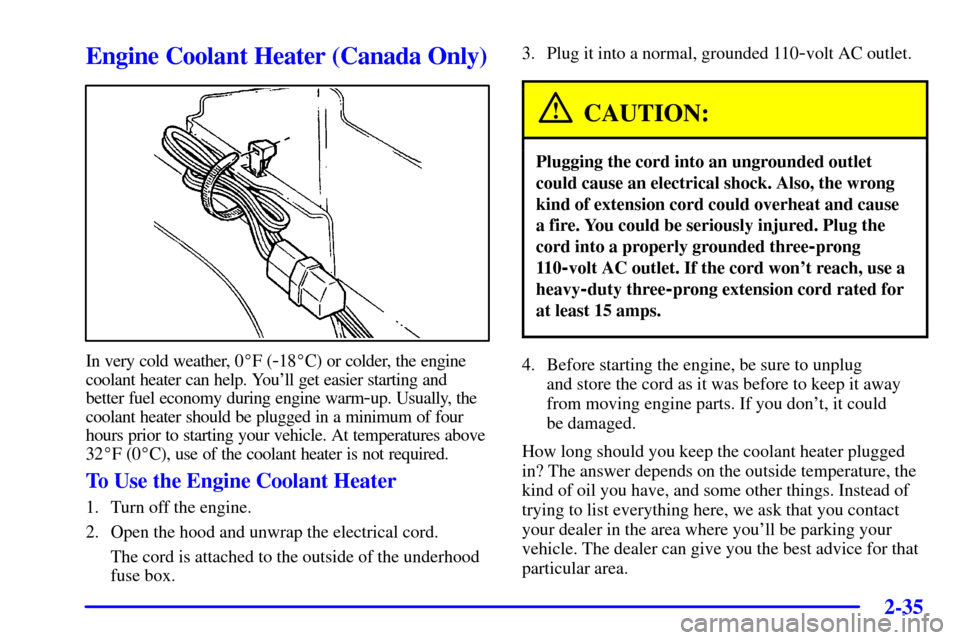
2. Open the hood and unwrap the electrical cord.
The cord is attached to the outside of the underhood
fuse box.3. Plug it into a normal, grounded 110
-volt AC outlet.
CAUTION:
Plugging the cord into an ungrounded outlet
could cause an electrical shock. Also, the wrong
kind of extension cord could overheat and cause
a fire. You could be seriously injured. Plug the
cord into a properly grounded three
-prong
11 0
-volt AC outlet. If the cord won't reach, use a
heavy
-duty three-prong extension cord rated for
at least 15 amps.
4. Before starting the engine, be sure to unplug
and store the cord as it was before to keep it away
from moving engine parts. If you don't, it could
be damaged.
How long should you keep the coolant heater plugged
in? The answer depends on the outside temperature, the
kind of oil you have, and some other things. Instead of
trying to list everything here, we ask that you contact
your dealer in the area where you'll be parking your
vehicle. The dealer can give you the best advice for that
particular area.
Page 91 of 356

2-38
AUTOMATIC OVERDRIVE (�): This position is
for normal driving. If you need more power for passing,
and you're:
�Going less than about 35 mph (55 km/h), push your
accelerator pedal about halfway down.
�Going about 35 mph (55 km/h) or more, push the
accelerator all the way down.
You'll shift down to the next gear and have more power.
DRIVE (D): This position is also used for normal
driving, however, it offers more power and lower fuel
economy than AUTOMATIC OVERDRIVE (�).
Here are some times you might choose DRIVE (D)
instead of AUTOMATIC OVERDRIVE (�):
�When driving on hilly, winding roads.
�When towing a trailer, so there is less shifting
between gears.
�When going down a steep hill.SECOND (2): This position gives you more power but
lower fuel economy. You can use SECOND (2) on hills.
It can help control your speed as you go down steep
mountain roads, but then you would also want to use
your brakes off and on.
If you have a 5.7L V8 engine and manually
select SECOND (2) when you start the vehicle,
the transmission will drive (and stay) in second gear.
You may use this feature for reducing torque to the
rear wheels when you are trying to start your vehicle
from a stop on slippery road surfaces, or for preventing
the transmission from downshifting into FIRST (1) in
situations where a downshift would be undesirable.
NOTICE:
Don't drive in SECOND (2) for more than
25 miles (40 km), or at speeds over 55 mph
(90 km/h), or you can damage your transmission.
Use AUTOMATIC OVERDRIVE (�) or
DRIVE (D) as much as possible.
Don't shift into SECOND (2) unless you are going
slower than 65 mph (105 km/h), or you can
damage your engine.
Page 92 of 356
2-39
FIRST (1): This position gives you even more power
(but lower fuel economy) than SECOND (2). You can
use it on very steep hills, or in deep snow or mud. If the
gearshift lever is put in FIRST (1) gear, the transmission
won't shift into first gear until the vehicle is going
slow enough.
NOTICE:
If your rear wheels can't turn, don't try to drive.
This might happen if you were stuck in very deep
sand or mud or were up against a solid object.
You could damage your transmission.
Also, if you stop when going uphill, don't hold
your vehicle there with only the accelerator
pedal. This could overheat and damage the
transmission. Use your brakes or shift into
PARK (P) to hold your vehicle in position
on a hill.
Maximum engine speed is limited to protect driveline
components from improper operation.
Manual Transmission Operation
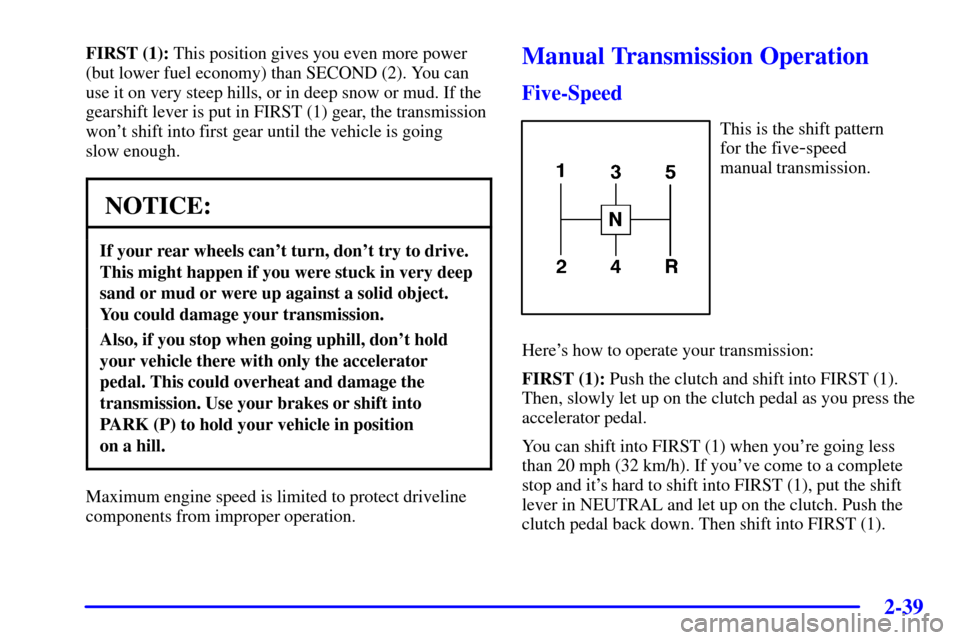
Five-Speed
This is the shift pattern
for the five
-speed
manual transmission.
Here's how to operate your transmission:
FIRST (1): Push the clutch and shift into FIRST (1).
Then, slowly let up on the clutch pedal as you press the
accelerator pedal.
You can shift into FIRST (1) when you're going less
than 20 mph (32 km/h). If you've come to a complete
stop and it's hard to shift into FIRST (1), put the shift
lever in NEUTRAL and let up on the clutch. Push the
clutch pedal back down. Then shift into FIRST (1).
Page 95 of 356
2-42
REVERSE (R): To back up, push down the clutch
pedal and shift into REVERSE (R). Let up on the clutch
pedal slowly while pressing the accelerator pedal. If you
shift from SIXTH (6) into REVERSE (R), the shift lever
must be first placed in the NEUTRAL position centered
between SECOND (2) and THIRD (3) prior to shifting
into REVERSE (R).
Your six
-speed manual transmission has a feature that
allows you to safely shift into REVERSE (R) while the
vehicle is rolling at less than 5 mph (8 km/h).
If you have turned your ignition off and want to
park your vehicle in REVERSE (R), you will have to
move the shift lever quickly to the right, then forward
into gear.
Shift Speeds
CAUTION:
If you skip a gear when you downshift, you could
lose control of your vehicle. You could injure
yourself or others. Don't shift down more than
one gear at a time when you downshift.
This chart shows when to shift to the next higher gear
for best fuel economy.
Page 97 of 356
2-44
This feature helps you to get the best possible
fuel economy.
It will come on under these conditions:
�The engine coolant temperature is greater
than 170�F (77�C),
�you are going 15 to 20 mph (24 to 32 km/h) and
�you are at 35 percent throttle or less.
Follow the shift speeds listed below when the SKIP
SHIFT light is on.
Computer
-Aided Manual Transmission Shift Speeds
�1st to 4th @ 15 mph (24 km/h)
�4th to 5th @ 25 mph (40 km/h)*
�5th to 6th @ 49 mph (64 km/h)**
Each time you come to a stop, the engine's Powertrain
Control Module (PCM) determines when to activate
the skip shift upshift system. The skip shift upshift
system is bypassed when you accelerate with more
than 35 percent throttle.
*30 mph (48 km/h) when accelerating to
highway speeds.
**45 mph (72 km/h) when accelerating to
highway speeds.
Parking Brake
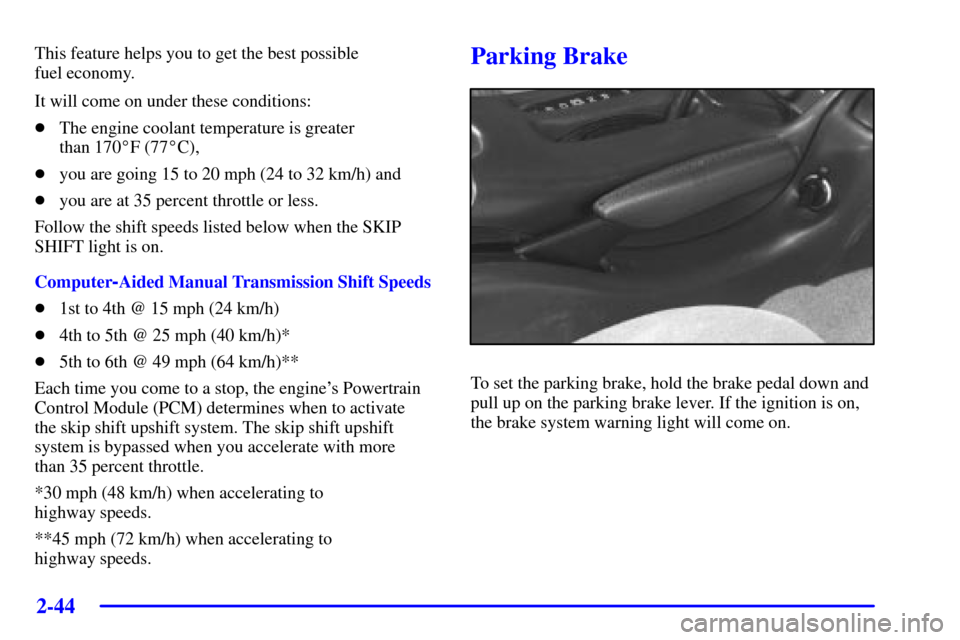
To set the parking brake, hold the brake pedal down and
pull up on the parking brake lever. If the ignition is on,
the brake system warning light will come on.
Page 137 of 356
2-84
Instrument Panel Cluster
Your instrument panel cluster is designed to let you know at a glance how your vehicle is running. You'll know how
fast you're going, your engine's rpms, about how much fuel you have left and many other things you'll need to know
to drive safely and economically.
5.7L V8 Engine shown, 3800 V6 Engine similar (United States shown, Canada similar)
Page 144 of 356

2-91
Engine Coolant Temperature Gage
United States Canada
This gage shows the engine coolant temperature. If the
gage pointer moves into the red area, your engine is
approaching an overheating condition.
If you have been operating your vehicle under normal
driving conditions, you should pull off the road, stop
your vehicle and turn off the engine as soon as possible.
See ªEngine Overheatingº in the Index.
Malfunction Indicator Lamp (Service
Engine Soon Light in the United States or
Check Engine Light in Canada)
United States Canada
Your vehicle is equipped with a computer which
monitors operation of the fuel, ignition and emission
control systems.
This system is called OBD II (On
-Board
Diagnostics
-Second Generation) and is intended to assure
that emissions are at acceptable levels for the life of the
vehicle, helping to produce a cleaner environment. The
SERVICE ENGINE SOON or CHECK ENGINE light
comes on to indicate that there is a problem and service is
required. Malfunctions often will be indicated by the
system before any problem is apparent. This may prevent
more serious damage to your vehicle. This system is also
designed to assist your service technician in correctly
diagnosing any malfunction.