Page 143 of 356

2-90 Acceleration Slip Regulation (ASR) System
Warning Light (Option)
This warning light should
come on briefly as you start
the engine. If the warning
light doesn't come on then,
have it fixed so it will be
ready to warn you if there's
a problem.
If it stays on, or comes on when you're driving, there
may be a problem with your ASR system and your
vehicle may need service. When this warning light is
on, the system will not limit wheel spin. Adjust your
driving accordingly.
The ASR system warning light will come on if you turn
the system off by pressing the ASR button located on
the instrument panel and the warning light will come on
and stay on. To turn the system back on, press the button
again. The warning light should go off. See ªASR
Systemº in the Index for more information.
If the ASR system warning light comes on and stays on
for an extended period of time when the system is
turned on, your vehicle needs service.
Low Traction Light
When your anti-lock system
is adjusting brake pressure
to help avoid a braking skid,
this light will come on.
If you have the ASR system, this light will also come on
when the system is limiting wheel spin. You may feel or
hear the system working, but this is normal. Slippery
road conditions may exist if the low traction light comes
on, so adjust your driving accordingly. The light will
stay on for a few seconds after the ASR system stops
limiting wheel spin.
The low traction light also comes on briefly when you
turn the ignition key to RUN. If the light doesn't come
on then, have it fixed so it will be there to tell you when
the anti
-lock brake system or ASR system is active.
Page 149 of 356

2-96 Low Oil Light
This warning light should
come on briefly while you
are starting your engine.
If the light doesn't come on,
have it repaired.
If the light stays on after starting your engine, your
engine oil level may be too low. You may need to add
oil. See ªEngine Oilº in the Index.
NOTICE:
The oil level monitoring system only checks
the oil level when you are starting your engine.
It does not keep monitoring the level once the
engine is running. Also, the oil level check only
works when the engine has been turned off long
enough for the oil to drain back into the oil pan.
Oil Change Light
This OIL CHANGE light
should come on briefly as a
bulb check when you start
the engine. If the OIL
CHANGE light doesn't
come on, have it serviced.
If the OIL CHANGE light comes on and stays on
for 60 seconds after you start the engine, have the
oil changed.
For additional information, see ªEngine Oil, When to
Changeº in the Index. After changing the engine oil, the
system must be reset. See ªHow to Reset the Oil Change
Lightº in the Index.
Page 150 of 356
2-97
Service Vehicle Light
This warning light should
come on in your instrument
panel cluster for a
three
-second bulb check
when you first start your
vehicle. If the light doesn't
come on, have it serviced.
This light will stay on steady if you have certain
non
-emission related vehicle problems. These problems
may not be obvious and may affect vehicle performance
or durability. Consult a qualified dealer for necessary
repairs to maintain top vehicle performance.
Check Gages Light
This warning light will
come on briefly when
you start the engine.
If the light comes on and stays on while you are driving,
check your gages to see if they are in the warning areas.
Hatch Ajar Light
This warning light should
come on in your instrument
panel cluster for a
three
-second bulb check
when you first start your
vehicle. If the light doesn't
come on, have it serviced.
This light will stay on steady if your hatch is open or
ajar and the ignition key is in RUN.
Page 152 of 356
2-99
Low Fuel Light
If your fuel is low, your vehicle's CHECK GAGES light
on your instrument panel cluster will come on. See
ªCheck Gages Lightº in the Index.
Reduced Engine Power Light
(V6 Engine Only)
The REDUCED ENG PWR
warning light should come
on in your instrument panel
cluster for a three
-second
bulb check when you first
start your vehicle.If the light doesn't come on, have it serviced.
If the REDUCED ENG PWR warning light comes on,
a noticeable reduction in the vehicle's performance may
occur. The vehicle may be driven at a reduced speed
while the REDUCED ENG PWR light is on, but
acceleration and speed may be reduced. Anytime this
warning light stays on, the vehicle should be taken to
an authorized Chevrolet dealer as soon as possible for
diagnosis and repair.
Page 178 of 356

4-7
Avoid needless heavy braking. Some people drive
in spurts
-- heavy acceleration followed by heavy
braking
-- rather than keeping pace with traffic.
This is a mistake. Your brakes may not have time to
cool between hard stops. Your brakes will wear out
much faster if you do a lot of heavy braking. If you
keep pace with the traffic and allow realistic following
distances, you will eliminate a lot of unnecessary
braking. That means better braking and longer
brake life.
If your engine ever stops while you're driving,
brake normally but don't pump your brakes.
If you do, the pedal may get harder to push down.
If your engine stops, you will still have some power
brake assist. But you will use it when you brake.
Once the power assist is used up, it may take longer
to stop and the brake pedal will be harder to push.
Anti-Lock Brake System (ABS)
Your vehicle has anti-lock brakes. ABS is an
advanced electronic braking system that will help
prevent a braking skid.
When you start your engine, or when you begin to
drive away, your anti
-lock brake system will check
itself. You may hear a momentary motor or clicking
noise while this test is going on, and you may even
notice that your brake pedal moves or pulses a little.
This is normal.
United States Canada
If there's a problem with the anti
-lock brake system,
this warning light will stay on. See ªAnti
-Lock Brake
System Warning Lightº in the Index.
Page 181 of 356

4-10
If your vehicle is in cruise control when the ASR system
begins to limit wheel spin, the cruise control will
automatically disengage. When road conditions allow
you to safely use it again, you may re
-engage the cruise
control. See ªCruise Controlº in the Index.
When the system is on,
this warning light will
come on to let you know if
there's a problem with your
ASR system. See ªASR
System Warning Lightº in
the Index.
When this warning light is on, the system will not limit
wheel spin. Adjust your driving accordingly.
The ASR system automatically comes on whenever
you start your vehicle. To limit wheel spin, especially
in slippery road conditions, you should always leave
the system on. But you can turn the ASR system off
if you ever need to. You should turn the system off if
your vehicle ever gets stuck in sand, mud or snow and
rocking the vehicle is required. See ªRocking Your
Vehicleº in the Index.
To turn the system off, press
the ASR button located on
the instrument panel.
The ASR system warning light will come on and stay
on. If the ASR system is limiting wheel spin when you
press the button, the warning light will come on
-- but
the system won't turn off right away. It will wait until
there's no longer a current need to limit wheel spin.
You can turn the system back on at any time by
pressing the button again. The ASR system warning
light should go off.
Page 186 of 356

4-15
Loss of Control
Let's review what driving experts say about what happens
when the three control systems (brakes, steering and
acceleration) don't have enough friction where the tires
meet the road to do what the driver has asked.
In any emergency, don't give up. Keep trying to steer and
constantly seek an escape route or area of less danger.
Skidding
In a skid, a driver can lose control of the vehicle.
Defensive drivers avoid most skids by taking reasonable
care suited to existing conditions, and by not ªoverdrivingº
those conditions. But skids are always possible.
The three types of skids correspond to your vehicle's
three control systems. In the braking skid, your wheels
aren't rolling. In the steering or cornering skid, too
much speed or steering in a curve causes tires to slip
and lose cornering force. And in the acceleration skid,
too much throttle causes the driving wheels to spin.
A cornering skid is best handled by easing your foot
off the accelerator pedal.
If you have the ASR system, remember: It helps avoid
only the acceleration skid.If you do not have ASR, or if the system is off,
then an acceleration skid is also best handled by
easing your foot off the accelerator pedal.
If your vehicle starts to slide, ease your foot off the
accelerator pedal and quickly steer the way you want
the vehicle to go. If you start steering quickly enough,
your vehicle may straighten out. Always be ready for a
second skid if it occurs.
Of course, traction is reduced when water, snow, ice,
gravel or other material is on the road. For safety,
you'll want to slow down and adjust your driving to
these conditions. It is important to slow down on
slippery surfaces because stopping distance will be
longer and vehicle control more limited.
While driving on a surface with reduced traction,
try your best to avoid sudden steering, acceleration or
braking (including engine braking by shifting to a
lower gear). Any sudden changes could cause the tires
to slide. You may not realize the surface is slippery until
your vehicle is skidding. Learn to recognize warning
clues
-- such as enough water, ice or packed snow on
the road to make a ªmirrored surfaceº
-- and slow down
when you have any doubt.
Remember: Any anti
-lock brake system (ABS) helps
avoid only the braking skid.
Page 191 of 356
4-20 Driving Through Flowing Water
CAUTION:
Flowing or rushing water creates strong forces.
If you try to drive through flowing water, as you
might at a low water crossing, your vehicle can
be carried away. As little as six inches of flowing
water can carry away a smaller vehicle. If this
happens, you and other vehicle occupants could
drown. Don't ignore police warning signs, and
otherwise be very cautious about trying to drive
through flowing water.
Some Other Rainy Weather Tips
�Besides slowing down, allow some extra following
distance. And be especially careful when you pass
another vehicle. Allow yourself more clear room
ahead, and be prepared to have your view restricted
by road spray.
�Have good tires with proper tread depth.
See ªTiresº in the Index.
City Driving
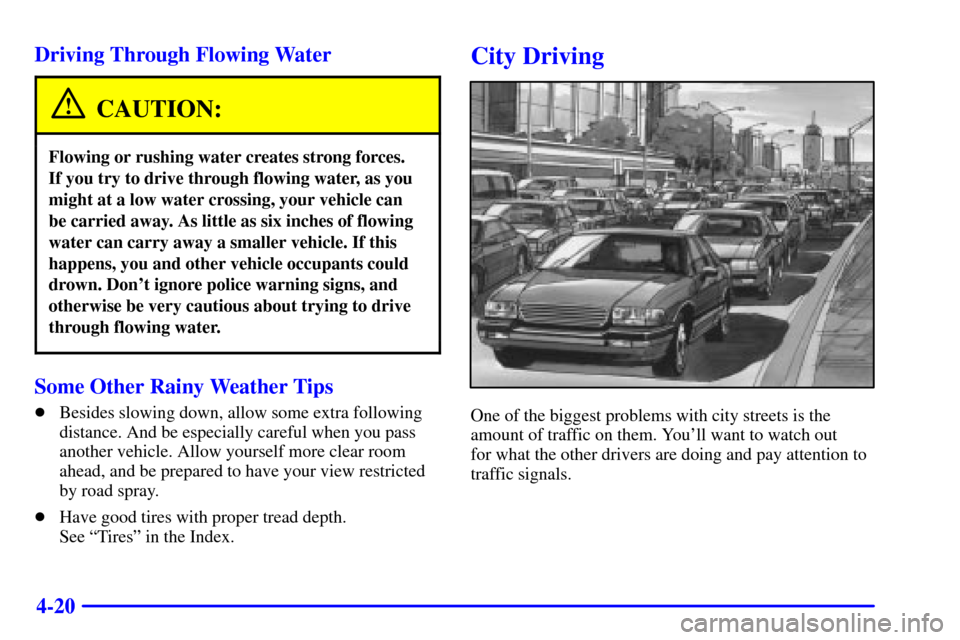
One of the biggest problems with city streets is the
amount of traffic on them. You'll want to watch out
for what the other drivers are doing and pay attention to
traffic signals.