Page 192 of 356
4-21
Here are ways to increase your safety in city driving:
�Know the best way to get to where you are
going. Get a city map and plan your trip into an
unknown part of the city just as you would for a
cross
-country trip.
�Try to use the freeways that rim and crisscross
most large cities. You'll save time and energy.
See the next part, ªFreeway Driving.º
�Treat a green light as a warning signal. A traffic light
is there because the corner is busy enough to need it.
When a light turns green, and just before you start
to move, check both ways for vehicles that have
not cleared the intersection or may be running the
red light.
Freeway Driving
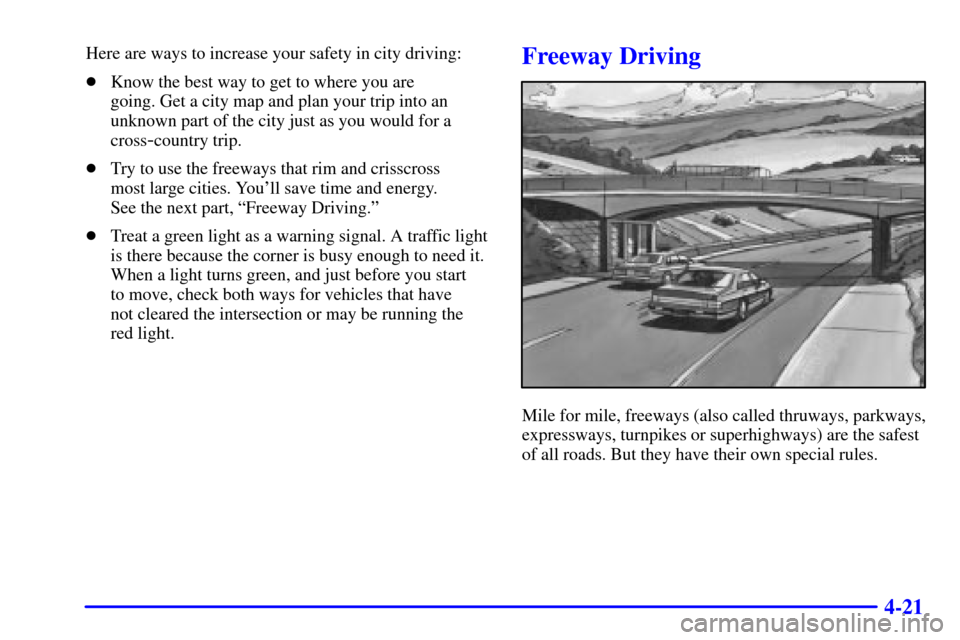
Mile for mile, freeways (also called thruways, parkways,
expressways, turnpikes or superhighways) are the safest
of all roads. But they have their own special rules.
Page 197 of 356
4-26
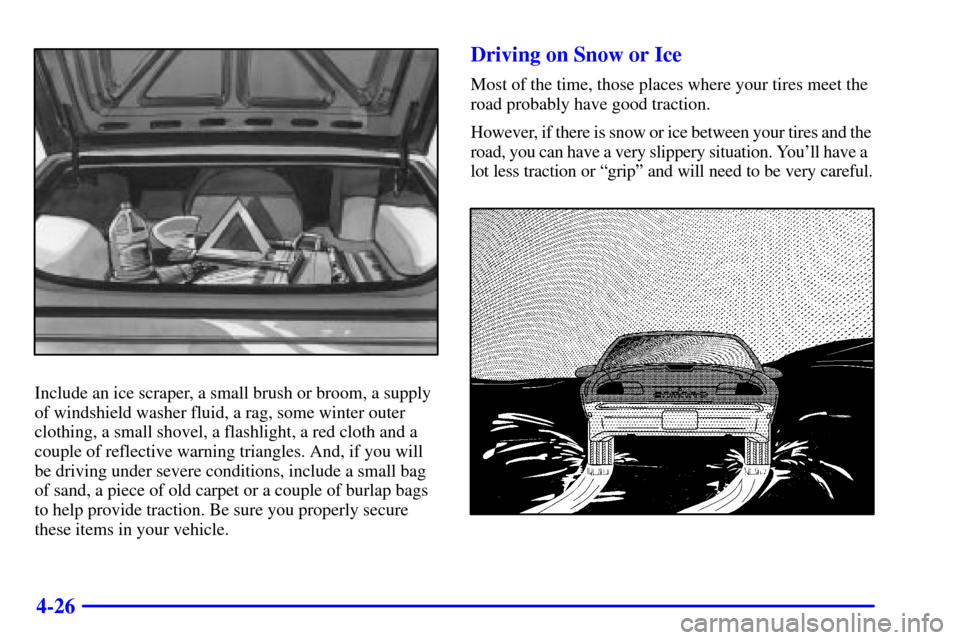
Include an ice scraper, a small brush or broom, a supply
of windshield washer fluid, a rag, some winter outer
clothing, a small shovel, a flashlight, a red cloth and a
couple of reflective warning triangles. And, if you will
be driving under severe conditions, include a small bag
of sand, a piece of old carpet or a couple of burlap bags
to help provide traction. Be sure you properly secure
these items in your vehicle.
Driving on Snow or Ice
Most of the time, those places where your tires meet the
road probably have good traction.
However, if there is snow or ice between your tires and the
road, you can have a very slippery situation. You'll have a
lot less traction or ªgripº and will need to be very careful.
Page 211 of 356
5-
5-1
Section 5 Problems on the Road
Here you'll find what to do about some problems that can occur on the road.
5
-2 Hazard Warning Flashers
5
-3 Other Warning Devices
5
-3 Jump Starting
5
-8 Towing Your Vehicle
5
-9 Engine Overheating5
-12 Cooling System
5
-22 If a Tire Goes Flat
5
-23 Changing a Flat Tire
5
-35 Compact Spare Tire
5
-36 If You're Stuck: In Sand, Mud, Ice or Snow
Page 212 of 356
5-2
Hazard Warning Flashers
Your hazard warning flashers let you warn others. They
also let police know you have a problem. Your front and
rear turn signal lamps will flash on and off.
The hazard warning flasher button is located on the
steering column.
Press the button in to make
the front and rear turn signal
lamps flash on and off.
Pull out on the collar to turn
the flashers off.
Your hazard warning flashers work no matter what
position your key is in, and even if the key isn't in.
When the hazard warning flashers are on, your turn
signals won't work.
Page 213 of 356
5-3
Other Warning Devices
If you carry reflective triangles, you can set one up at
the side of the road about 300 feet (100 m) behind
your vehicle.
Jump Starting
If your battery has run down, you may want to use
another vehicle and some jumper cables to start your
vehicle. Be sure to follow the steps below to do it safely.
CAUTION:
Batteries can hurt you. They can be
dangerous because:
�They contain acid that can burn you.
�They contain gas that can explode or ignite.
�They contain enough electricity to burn you.
If you don't follow these steps exactly, some or
all of these things can hurt you.
NOTICE:
Ignoring these steps could result in costly
damage to your vehicle that wouldn't be
covered by your warranty.
The ACDelco� battery in your vehicle has a
built
-in hydrometer. Do not charge, test or
jump start the battery if the hydrometer looks
clear or light yellow. Replace the battery when
there is a clear or light yellow hydrometer and a
cranking complaint.
Trying to start your vehicle by pushing or pulling
it won't work, and it could damage your vehicle.
1. Check the other vehicle. It must have a 12-volt
battery with a negative ground system.
NOTICE:
If the other system isn't a 12-volt system with a
negative ground, both vehicles can be damaged.
Page 221 of 356
5-11
NOTICE:
If your engine catches fire because you keep
driving with no coolant, your vehicle can be
badly damaged. The costly repairs would not be
covered by your warranty. See ªOverheated
Engine Protection Operating Modeº in the Index.
If No Steam Is Coming From Your Engine
If you get an engine overheat warning but see or hear no
steam, the problem may not be too serious. Sometimes
the engine can get a little too hot when you:
�Climb a long hill on a hot day.
�Stop after high
-speed driving.
�Idle for long periods in traffic.
�Tow a trailer.If you get the overheat warning with no sign of steam,
try this for a minute or so:
1. If your air conditioner is on, turn it off.
2. Turn on your heater to full hot at the highest fan
speed and open the window as necessary.
3. If you're in a traffic jam, shift to NEUTRAL (N);
otherwise, shift to the highest gear while
driving
-- AUTOMATIC OVERDRIVE (�) or
DRIVE (D) for automatic transmissions.
If you no longer have the overheat warning, you can drive.
Just to be safe, drive slower for about 10 minutes. If the
warning doesn't come back on, you can drive normally.
If the warning continues, pull over, stop, and park your
vehicle right away.
If there's still no sign of steam, idle the engine for
three minutes while you're parked. If you still have the
warning, turn off the engine and get everyone out of
the vehicle until it cools down. Also, see ªOverheated
Engine Protection Operating Modeº listed previously in
this section.
You may decide not to lift the hood but to get service
help right away.
Page 224 of 356
5-14 How to Add Coolant to the Coolant
Recovery Tank
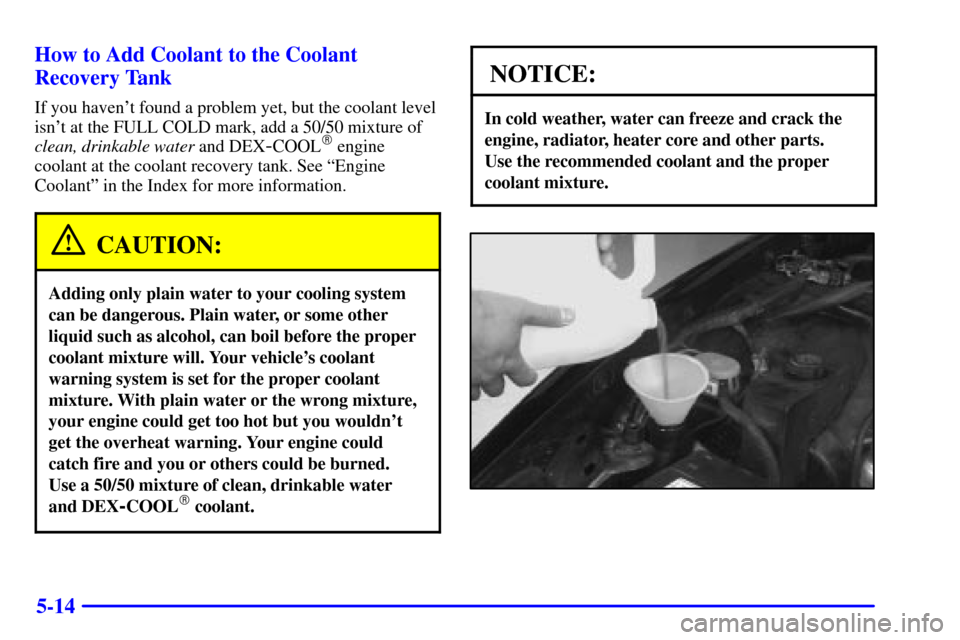
If you haven't found a problem yet, but the coolant level
isn't at the FULL COLD mark, add a 50/50 mixture of
clean, drinkable water and DEX
-COOL� engine
coolant at the coolant recovery tank. See ªEngine
Coolantº in the Index for more information.
CAUTION:
Adding only plain water to your cooling system
can be dangerous. Plain water, or some other
liquid such as alcohol, can boil before the proper
coolant mixture will. Your vehicle's coolant
warning system is set for the proper coolant
mixture. With plain water or the wrong mixture,
your engine could get too hot but you wouldn't
get the overheat warning. Your engine could
catch fire and you or others could be burned.
Use a 50/50 mixture of clean, drinkable water
and DEX
-COOL� coolant.
NOTICE:
In cold weather, water can freeze and crack the
engine, radiator, heater core and other parts.
Use the recommended coolant and the proper
coolant mixture.
Page 225 of 356
5-15
CAUTION:
You can be burned if you spill coolant on hot
engine parts. Coolant contains ethylene glycol
and it will burn if the engine parts are hot
enough. Don't spill coolant on a hot engine.
When the coolant in the coolant recovery tank is at the
FULL COLD mark, start your vehicle.
If the overheat warning continues, there's one more
thing you can try. You can add the proper coolant
mixture directly to the radiator, but be sure the
cooling system is cool before you do it.
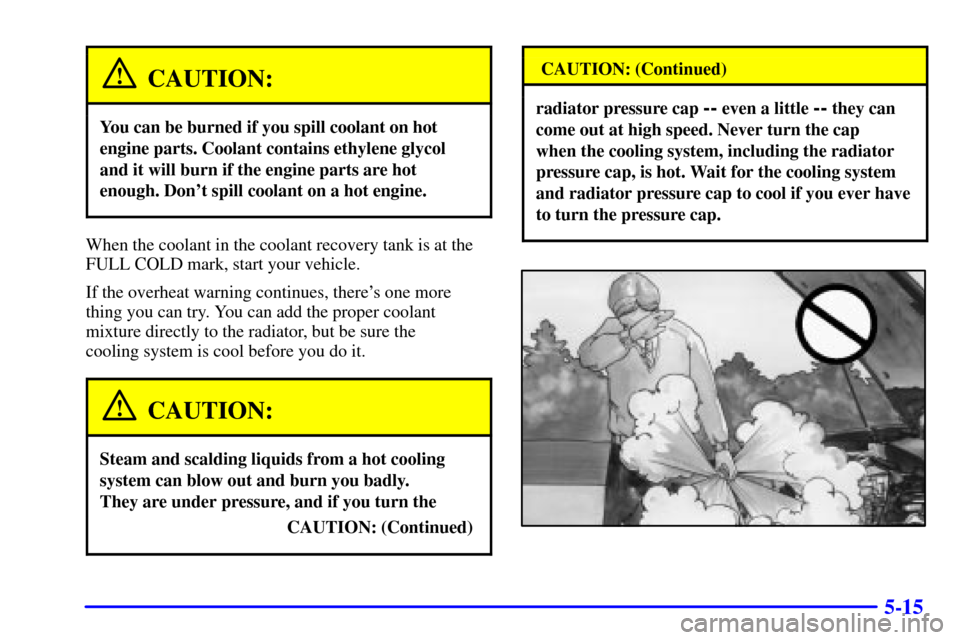
CAUTION:
Steam and scalding liquids from a hot cooling
system can blow out and burn you badly.
They are under pressure, and if you turn the
CAUTION: (Continued)
CAUTION: (Continued)
radiator pressure cap -- even a little -- they can
come out at high speed. Never turn the cap
when the cooling system, including the radiator
pressure cap, is hot. Wait for the cooling system
and radiator pressure cap to cool if you ever have
to turn the pressure cap.