Page 76 of 331
2-33 Windshield Washer
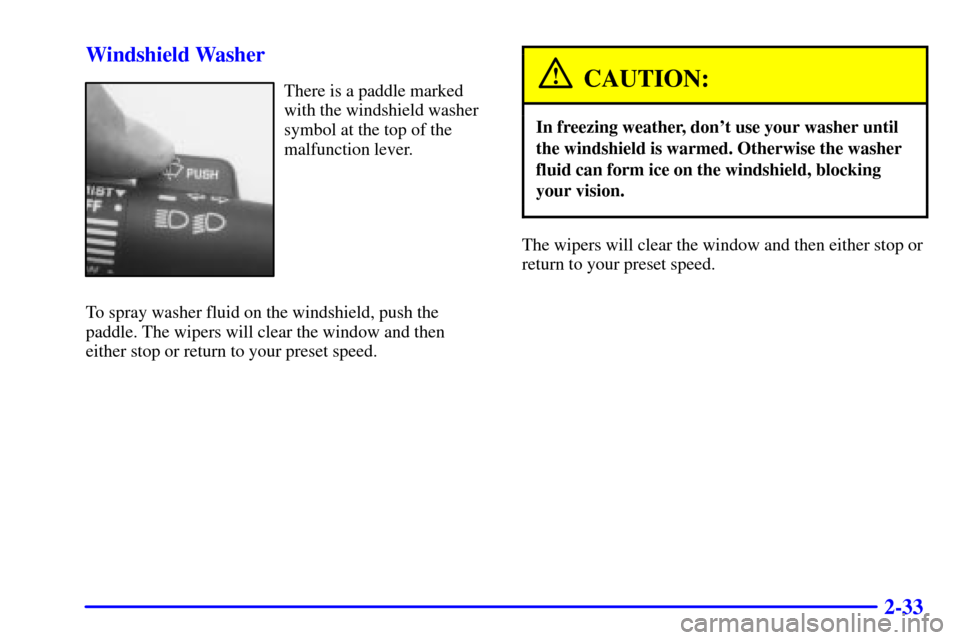
There is a paddle marked
with the windshield washer
symbol at the top of the
malfunction lever.
To spray washer fluid on the windshield, push the
paddle. The wipers will clear the window and then
either stop or return to your preset speed.CAUTION:
In freezing weather, don't use your washer until
the windshield is warmed. Otherwise the washer
fluid can form ice on the windshield, blocking
your vision.
The wipers will clear the window and then either stop or
return to your preset speed.
Page 148 of 331

4-16
Driving in Rain and on Wet RoadsRain and wet roads can mean driving trouble. On a wet
road, you can't stop, accelerate or turn as well because
your tire
-to-road traction isn't as good as on dry roads.
And, if your tires don't have much tread left, you'll get
even less traction. It's always wise to go slower and be
cautious if rain starts to fall while you are driving.
The surface may get wet suddenly when your reflexes
are tuned for driving on dry pavement.
The heavier the rain, the harder it is to see. Even if your
windshield wiper blades are in good shape, a heavy rain
can make it harder to see road signs and traffic signals,
pavement markings, the edge of the road and even
people walking.
It's wise to keep your wiping equipment in good
shape and keep your windshield washer tank filled
with washer fluid. Replace your windshield wiper
inserts when they show signs of streaking or missing
areas on the windshield, or when strips of rubber start
to separate from the inserts.
Page 153 of 331

4-21
The exit ramp can be curved, sometimes quite sharply.
The exit speed is usually posted.
Reduce your speed according to your speedometer, not
to your sense of motion. After driving for any distance
at higher speeds, you may tend to think you are going
slower than you actually are.
Before Leaving on a Long Trip
Make sure you're ready. Try to be well rested. If you
must start when you're not fresh
-- such as after a day's
work
-- don't plan to make too many miles that first part
of the journey. Wear comfortable clothing and shoes you
can easily drive in.
Is your vehicle ready for a long trip? If you keep it
serviced and maintained, it's ready to go. If it needs
service, have it done before starting out. Of course,
you'll find experienced and able service experts
in GM dealerships all across North America.
They'll be ready and willing to help if you need it.Here are some things you can check before a trip:
�Windshield Washer Fluid: Is the reservoir full?
Are all windows clean inside and outside?
�Wiper Blades: Are they in good shape?
�Fuel, Engine Oil, Other Fluids: Have you checked
all levels?
�Lamps: Are they all working? Are the lenses clean?
�Tires: They are vitally important to a safe,
trouble
-free trip. Is the tread good enough for
long
-distance driving? Are the tires all inflated to
the recommended pressure?
�Weather Forecasts: What's the weather outlook
along your route? Should you delay your trip a
short time to avoid a major storm system?
�Maps: Do you have up
-to-date maps?
Page 156 of 331
4-24
Winter Driving
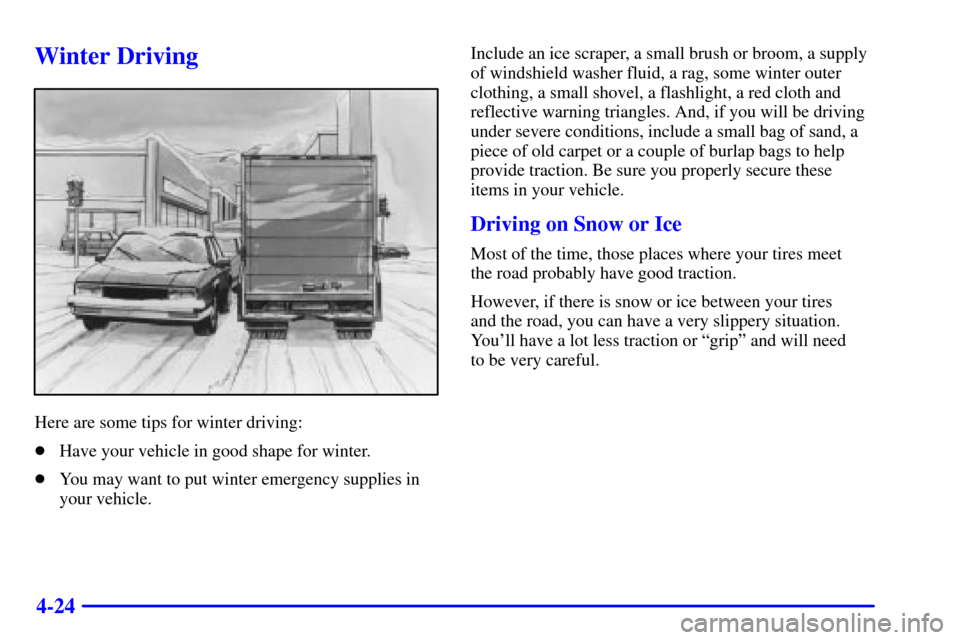
Here are some tips for winter driving:
�Have your vehicle in good shape for winter.
�You may want to put winter emergency supplies in
your vehicle.Include an ice scraper, a small brush or broom, a supply
of windshield washer fluid, a rag, some winter outer
clothing, a small shovel, a flashlight, a red cloth and
reflective warning triangles. And, if you will be driving
under severe conditions, include a small bag of sand, a
piece of old carpet or a couple of burlap bags to help
provide traction. Be sure you properly secure these
items in your vehicle.
Driving on Snow or Ice
Most of the time, those places where your tires meet
the road probably have good traction.
However, if there is snow or ice between your tires
and the road, you can have a very slippery situation.
You'll have a lot less traction or ªgripº and will need
to be very careful.
Page 196 of 331
6-
6-1
Section 6 Service and Appearance Care
Here you will find information about the care of your vehicle. This section begins with service and fuel information,
and then it shows how to check important fluid and lubricant levels. There is also technical information about your
vehicle, and a part devoted to its appearance care.
6
-2 Service
6
-3 Fuel (Gasoline Engine)
6
-5 Fuels in Foreign Countries (Gasoline Engines)
6
-5 Filling Your Tank (Gasoline Engine)
6
-7 Filling a Portable Fuel Container
6
-7 Checking Things Under the Hood
6
-10 Noise Control System
6
-11 Engine Oil (Gasoline Engine)
6
-15 Engine Air Cleaner/Filter (Gasoline Engines)
6
-17 Automatic Transmission Fluid
6
-20 Manual Transmission Fluid
6
-22 Hydraulic Clutch
6
-23 Rear Axle
6
-24 Engine Coolant
6
-27 Radiator Pressure Cap (Gasoline Engine)
6
-28 Power Steering Fluid6
-29 Windshield Washer Fluid
6
-30 Brakes
6
-34 Battery
6
-35 Bulb Replacement
6
-39 Windshield Wiper Blade Replacement
6
-40 Tires
6
-50 Appearance Care
6
-51 Cleaning the Inside of Your Vehicle
6
-54 Cleaning the Outside of Your Vehicle
6
-58 GM Vehicle Care/Appearance Materials
6
-59 Vehicle Identification Number (VIN)
6
-60 Electrical System
6
-66 Replacement Bulbs
6
-66 Capacities and Specifications
6
-68 Normal Maintenance Replacement Parts
Page 202 of 331
6-7
Filling a Portable Fuel Container
CAUTION:
Never fill a portable fuel container while it is in
your vehicle. Static electricity discharge from the
container can ignite the gasoline vapor. You can
be badly burned and your vehicle damaged if this
occurs. To help avoid injury to you and others:
�Dispense gasoline only into approved
containers.
�Do not fill a container while it is inside a
vehicle, in a vehicle's trunk, pickup bed
or on any surface other than the ground.
�Bring the fill nozzle in contact with the
inside of the fill opening before operating
the nozzle. Contact should be maintained
until the filling is complete.
�Don't smoke while pumping gasoline.
Checking Things Under the Hood
CAUTION:
If your vehicle has air conditioning, the auxiliary
engine fan under the hood can start up and
injure you even when the engine is not running.
Keep hands, clothing and tools away from any
underhood electric fan.
CAUTION:
Things that burn can get on hot engine parts and
start a fire. These include liquids like fuel, oil,
coolant, brake fluid, windshield washer and other
fluids, and plastic or rubber. You or others could
be burned. Be careful not to drop or spill things
that will burn onto a hot engine.
Page 204 of 331
6-9 Engine Compartment Overview
When you open the hood you will see the following:
A. Battery
B. Air Filter Restriction Indicator
C. Engine Air Cleaner/Filter
D. Coolant Recovery Tank
E. Radiator Pressure CapF. Engine Oil Dipstick
G. Automatic Transmission Dipstick
(If Equipped)
H. Engine Oil Fill
I. Engine Cooling FanJ. Power Steering Fluid Reservoir
K. Brake Master Cylinder Reservoir
L. Clutch Master Cylinder Reservoir
M. Windshield Washer Fluid Reservoir
N. Underhood Fuse/Block
Page 224 of 331
6-29
Windshield Washer Fluid
What to Use
When you need windshield washer fluid, be sure to read
the manufacturer's instructions before use. If you will be
operating your vehicle in an area where the temperature
may fall below freezing, use a fluid that has sufficient
protection against freezing.
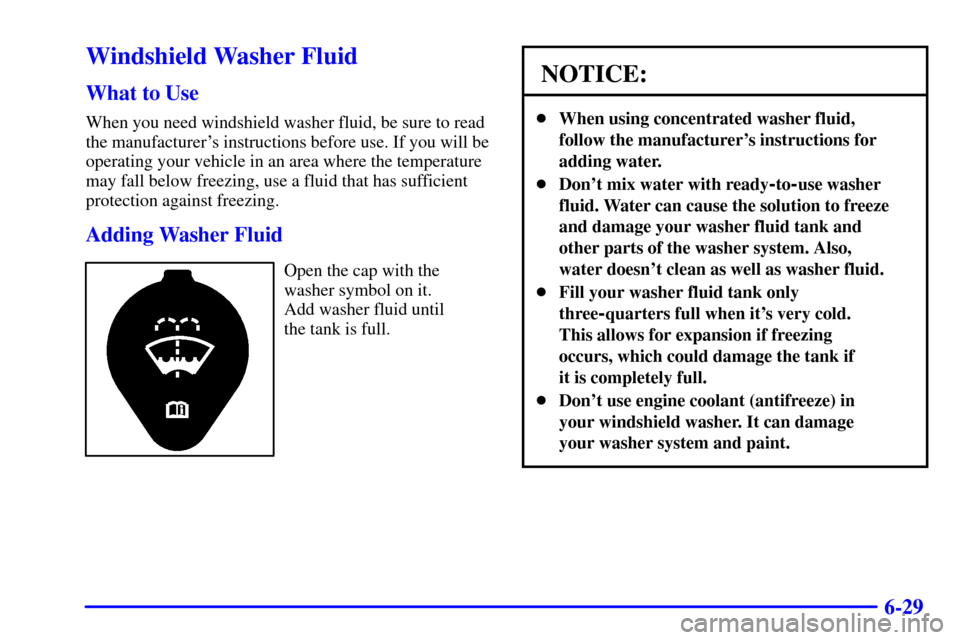
Adding Washer Fluid
Open the cap with the
washer symbol on it.
Add washer fluid until
the tank is full.
NOTICE:
�When using concentrated washer fluid,
follow the manufacturer's instructions for
adding water.
�Don't mix water with ready
-to-use washer
fluid. Water can cause the solution to freeze
and damage your washer fluid tank and
other parts of the washer system. Also,
water doesn't clean as well as washer fluid.
�Fill your washer fluid tank only
three
-quarters full when it's very cold.
This allows for expansion if freezing
occurs, which could damage the tank if
it is completely full.
�Don't use engine coolant (antifreeze) in
your windshield washer. It can damage
your washer system and paint.