Page 153 of 331

4-21
The exit ramp can be curved, sometimes quite sharply.
The exit speed is usually posted.
Reduce your speed according to your speedometer, not
to your sense of motion. After driving for any distance
at higher speeds, you may tend to think you are going
slower than you actually are.
Before Leaving on a Long Trip
Make sure you're ready. Try to be well rested. If you
must start when you're not fresh
-- such as after a day's
work
-- don't plan to make too many miles that first part
of the journey. Wear comfortable clothing and shoes you
can easily drive in.
Is your vehicle ready for a long trip? If you keep it
serviced and maintained, it's ready to go. If it needs
service, have it done before starting out. Of course,
you'll find experienced and able service experts
in GM dealerships all across North America.
They'll be ready and willing to help if you need it.Here are some things you can check before a trip:
�Windshield Washer Fluid: Is the reservoir full?
Are all windows clean inside and outside?
�Wiper Blades: Are they in good shape?
�Fuel, Engine Oil, Other Fluids: Have you checked
all levels?
�Lamps: Are they all working? Are the lenses clean?
�Tires: They are vitally important to a safe,
trouble
-free trip. Is the tread good enough for
long
-distance driving? Are the tires all inflated to
the recommended pressure?
�Weather Forecasts: What's the weather outlook
along your route? Should you delay your trip a
short time to avoid a major storm system?
�Maps: Do you have up
-to-date maps?
Page 154 of 331

4-22
Highway Hypnosis
Is there actually such a condition as ªhighway hypnosisº?
Or is it just plain falling asleep at the wheel? Call it
highway hypnosis, lack of awareness, or whatever.
There is something about an easy stretch of road with
the same scenery, along with the hum of the tires on the
road, the drone of the engine, and the rush of the wind
against the vehicle that can make you sleepy. Don't let it
happen to you! If it does, your vehicle can leave the
road in less than a second, and you could crash and
be injured.
What can you do about highway hypnosis?
First, be aware that it can happen.
Then here are some tips:
�Make sure your vehicle is well ventilated,
with a comfortably cool interior.
�Keep your eyes moving. Scan the road ahead
and to the sides. Check your mirrors and your
instruments frequently.
�If you get sleepy, pull off the road into a rest,
service or parking area and take a nap, get some
exercise, or both. For safety, treat drowsiness on
the highway as an emergency.
Hill and Mountain Roads
Driving on steep hills or mountains is different from
driving in flat or rolling terrain.
Page 160 of 331
4-28
Loading Your Vehicle
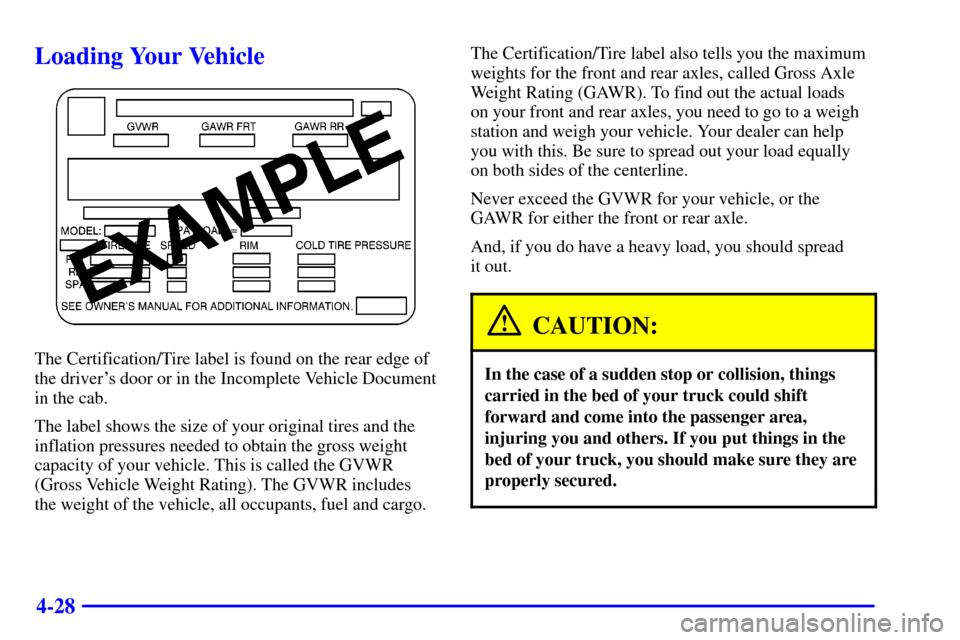
The Certification/Tire label is found on the rear edge of
the driver's door or in the Incomplete Vehicle Document
in the cab.
The label shows the size of your original tires and the
inflation pressures needed to obtain the gross weight
capacity of your vehicle. This is called the GVWR
(Gross Vehicle Weight Rating). The GVWR includes
the weight of the vehicle, all occupants, fuel and cargo.The Certification/Tire label also tells you the maximum
weights for the front and rear axles, called Gross Axle
Weight Rating (GAWR). To find out the actual loads
on your front and rear axles, you need to go to a weigh
station and weigh your vehicle. Your dealer can help
you with this. Be sure to spread out your load equally
on both sides of the centerline.
Never exceed the GVWR for your vehicle, or the
GAWR for either the front or rear axle.
And, if you do have a heavy load, you should spread
it out.
CAUTION:
In the case of a sudden stop or collision, things
carried in the bed of your truck could shift
forward and come into the passenger area,
injuring you and others. If you put things in the
bed of your truck, you should make sure they are
properly secured.
Page 165 of 331

4-33
If you're using a weight-carrying or a weight-distributing
hitch, the trailer tongue weight (A) should be 10 percent
to 15 percent of the total loaded trailer weight (B).
Do not exceed the maximum allowable tongue weight
for your vehicle.
After you've loaded your trailer, weigh the trailer and
then the tongue, separately, to see if the weights are
proper. If they aren't, you may be able to get them
right simply by moving some items around in the trailer.
Total Weight on Your Vehicle's Tires
Be sure your vehicle's tires are inflated to the upper
limit for cold tires. You'll find these numbers on the
Certification/Tire label at the rear edge of the driver's
door or see ªTire Loadingº in the Index. Then be
sure you don't go over the GVW limit for your vehicle,
including the weight of the trailer tongue.
Hitches
It's important to have the correct hitch equipment.
Crosswinds, large trucks going by and rough roads
are a few reasons why you'll need the right hitch.
Safety Chains
You should always attach chains between your vehicle
and your trailer. Cross the safety chains under the
tongue of the trailer to help prevent the tongue from
contacting the road if it becomes separated from the
hitch. Instructions about safety chains may be provided
by the hitch manufacturer or by the trailer manufacturer.
Follow the manufacturer's recommendation for
attaching safety chains. Always leave just enough slack
so you can turn with your rig. Never allow safety chains
to drag on the ground.
Page 173 of 331
5-
5-1
Section 5 Problems on the Road
Here you'll find what to do about some problems that can occur on the road.
5
-2 Hazard Warning Flashers
5
-2 Other Warning Devices
5
-3 Jump Starting
5
-9 Towing Your Vehicle
5
-9 Engine Overheating (Gasoline Engine)5
-13 Cooling System (Gasoline Engine)
5
-21 Engine Fan Noise
5
-21 If a Tire Goes Flat
5
-22 Changing a Flat Tire
5
-23 If You're Stuck: In Sand, Mud, Ice or Snow
Page 193 of 331

5-21
Engine Fan Noise
Your vehicle has a clutched engine cooling fan. When
the clutch is engaged, the fan spins faster to provide
more air to cool the engine. In most everyday driving
conditions, the fan is spinning slower and the clutch is
not fully engaged. This improves fuel economy and
reduces fan noise. Under heavy vehicle loading, trailer
towing and/or high outside temperatures, the fan speed
increases as the clutch more fully engages. So you may
hear an increase in fan noise. This is normal and should
not be mistaken as the transmission slipping or making
extra shifts. It is merely the cooling system functioning
properly. The fan will slow down when additional
cooling is not required and the clutch disengages.
You may also hear this fan noise when you start the
engine. It will go away as the fan clutch partially
disengages.
If a Tire Goes Flat
It's unusual for a tire to ªblow outº while you're driving,
especially if you maintain your tires properly. If air goes
out of a tire, it's much more likely to leak out slowly.
But if you should ever have a ªblowout,º here are a few
tips about what to expect and what to do:
If a front tire fails, the flat tire will create a drag that
pulls the vehicle toward that side. Take your foot off the
accelerator pedal and grip the steering wheel firmly.
Steer to maintain lane position, and then gently brake to
a stop well out of the traffic lane.
A rear blowout, particularly on a curve, acts much like a
skid and may require the same correction you'd use in a
skid. In any rear blowout, remove your foot from the
accelerator pedal. Get the vehicle under control by
steering the way you want the vehicle to go. It may be
very bumpy and noisy, but you can still steer. Gently
brake to a stop
-- well off the road if possible.
If a tire goes flat, avoid further tire and wheel damage
by driving slowly to a level place and turn on your
hazard warning flashers. The next part tells you what
to do.
Page 194 of 331
5-22
Changing a Flat Tire
Your truck, when new, did not include tire changing
equipment or a place to store a tire in the vehicle. Few
drivers of these vehicles have the necessary equipment
aboard to be able to change a flat tire safely. For
example, you would need a truck jack that can lift
several thousand pounds and a torque wrench that can
generate several hundred foot
-pounds (Newton-meters)
of twisting force.
CAUTION:
If you try to put air back into a tire that has run
flat, or even a tire that was quite low on air, the
tire can have a sudden air
-out. This could cause
you to lose control of the vehicle and have a
serious crash. Don't refill a flat or very low tire
with air without first having the tire taken off the
wheel and checked for damage.
So if you're stopped somewhere by a flat or damaged
tire or wheel, you should get expert help. See ªRoadside
Assistanceº in the Index.
CAUTION:
Your vehicle, when new, did not include tire
changing equipment or a place to store a tire in
the vehicle. Special tools and procedures are
required if a tire needs to be serviced. If these
tools and procedures aren't used, you or others
could be injured or killed while trying to change
or service a truck tire.
Page 235 of 331
6-40
Tires
Your new vehicle comes with high-quality tires made by
a leading tire manufacturer. If you ever have questions
about your tire warranty and where to obtain service,
see your GM Warranty booklet for details.
CAUTION:
Poorly maintained and improperly used tires
are dangerous.
�Overloading your tires can cause overheating
as a result of too much friction. You could
have an air
-out and a serious accident.
See ªLoading Your Vehicleº in the Index.
CAUTION: (Continued)
CAUTION: (Continued)
�Underinflated tires pose the same danger
as overloaded tires. The resulting accident
could cause serious injury. Check all tires
frequently to maintain the recommended
pressure. Tire pressure should be checked
when your tires are cold.
�Overinflated tires are more likely to be
cut, punctured or broken by a sudden
impact
-- such as when you hit a pothole.
Keep tires at the recommended pressure.
�Worn, old tires can cause accidents. If your
tread is badly worn, or if your tires have
been damaged, replace them.