Page 238 of 331
6-43
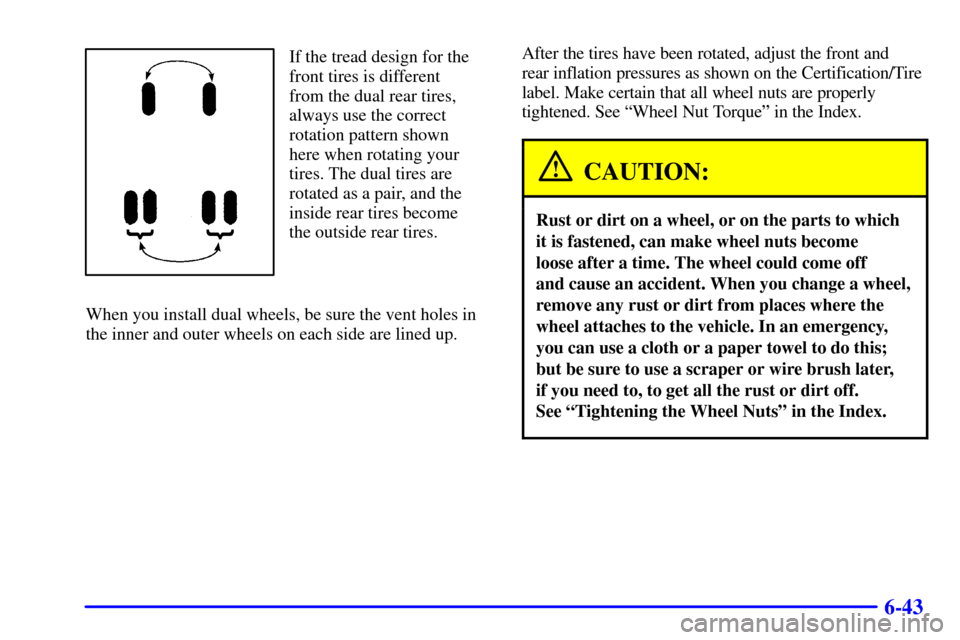
If the tread design for the
front tires is different
from the dual rear tires,
always use the correct
rotation pattern shown
here when rotating your
tires. The dual tires are
rotated as a pair, and the
inside rear tires become
the outside rear tires.
When you install dual wheels, be sure the vent holes in
the inner and outer wheels on each side are lined up.After the tires have been rotated, adjust the front and
rear inflation pressures as shown on the Certification/Tire
label. Make certain that all wheel nuts are properly
tightened. See ªWheel Nut Torqueº in the Index.
CAUTION:
Rust or dirt on a wheel, or on the parts to which
it is fastened, can make wheel nuts become
loose after a time. The wheel could come off
and cause an accident. When you change a wheel,
remove any rust or dirt from places where the
wheel attaches to the vehicle. In an emergency,
you can use a cloth or a paper towel to do this;
but be sure to use a scraper or wire brush later,
if you need to, to get all the rust or dirt off.
See ªTightening the Wheel Nutsº in the Index.
Page 241 of 331
6-46
CAUTION:
Rust or dirt on a wheel, or on the parts to which
it is fastened, can make the wheel nuts become
loose after a time. The wheel could come off and
cause a crash. When you change a wheel, remove
any rust or dirt from the places where the wheel
attaches to the vehicle. In an emergency, you can
use a cloth or a paper towel to do this; but be
sure to use a scraper or wire brush later, if you
need to, to get all the rust or dirt off.
CAUTION:
Never use oil or grease on studs or nuts.
If you do, the wheel nuts might come loose
and the wheel could fall off, causing a crash.
NOTICE:
Improperly tightened wheel nuts can lead to
brake pulsation and rotor damage. To avoid
expensive brake repairs, evenly tighten the wheel
nuts in the proper sequence and to the proper
torque specifications.
Page 246 of 331
6-51
Don't use any of these unless this manual says you can.
In many uses, these will damage your vehicle:
�Alcohol
�Laundry Soap
�Bleach
�Reducing Agents
Cleaning the Inside of Your Vehicle
Use a vacuum cleaner often to get rid of dust and loose
dirt. Wipe vinyl, leather, plastic and painted surfaces
with a clean, damp cloth.
Cleaning of Fabric/Carpet
Your dealer has cleaners for the cleaning of fabric and
carpet. They will clean normal spots and stains very
well. You can get GM
-approved cleaning products from
your dealer. See ªAppearance Care and Materialsº in
the Index.
Here are some cleaning tips:
�Always read the instructions on the cleaner label.
�Clean up stains as soon as you can
-- before they set.�Carefully scrape off any excess stain.
�Use a clean cloth or sponge, and change to a
clean area often. A soft brush may be used if
stains are stubborn.
�If a ring forms on fabric after spot cleaning,
clean the entire area immediately or it will set.
Using Cleaner on Fabric
1. Vacuum and brush the area to remove any loose dirt.
2. Always clean a whole trim panel or section.
Mask surrounding trim along stitch or welt lines.
3. Follow the directions on the container label.
4. Apply cleaner with a clean sponge. Don't saturate
the material and don't rub it roughly.
5. As soon as you've cleaned the section, use a sponge
to remove any excess cleaner.
6. Wipe cleaned area with a clean, water
-dampened
towel or cloth.
7. Wipe with a clean cloth and let dry.
Page 249 of 331
6-54
Cleaning the Outside of the Windshield,
Backglass and Wiper Blades
If the windshield is not clear after using the windshield
washer, or if the wiper blade chatters when running, wax,
sap or other material may be on the blade or windshield.
Clean the outside of the windshield with a full
-strength
glass cleaning liquid. The windshield is clean if beads
do not form when you rinse it with water.
Grime from the windshield will stick to the wiper blades
and affect their performance. Clean the blade by wiping
vigorously with a cloth soaked in full
-strength windshield
washer solvent. Then rinse the blade with water.
Check the wiper blades and clean them as necessary;
replace blades that look worn.
Weatherstrips
Silicone grease on weatherstrips will make them last
longer, seal better, and not stick or squeak. Apply
silicone grease with a clean cloth at least every six
months. During very cold, damp weather more frequent
application may be required. See ªRecommended Fluids
and Lubricantsº in the Index.
Cleaning the Outside of Your Vehicle
The paint finish on your vehicle provides beauty,
depth of color, gloss retention and durability.
Washing Your Vehicle
The best way to preserve your vehicle's finish is to
keep it clean by washing it often with lukewarm or
cold water.
Don't wash your vehicle in the direct rays of the sun.
Use a car washing soap. Don't use strong soaps or
chemical detergents. Be sure to rinse the vehicle well,
removing all soap residue completely. You can get
GM
-approved cleaning products from your dealer.
See ªAppearance Care and Materialsº in the Index.
Don't use cleaning agents that are petroleum based,
or that contain acid or abrasives. All cleaning agents
should be flushed promptly and not allowed to dry on
the surface, or they could stain. Dry the finish with a
soft, clean chamois or an all
-cotton towel to avoid
surface scratches and water spotting.
High pressure car washes may cause water to enter
your vehicle.
Page 268 of 331
Scheduled Maintenance
7-5
Short Trip/City Definition
Follow the Short Trip/City Scheduled Maintenance if
any one of these conditions is true for your vehicle:
�Most trips are less than 5 miles (8 km). This is
particularly important when outside temperatures
are below freezing.
�Most trips include extensive idling (such as frequent
driving in stop
-and-go traffic).
�You frequently tow a trailer.
�If the vehicle is used for delivery service, police, taxi
or other commercial application.
One of the reasons you should follow this schedule if
you operate your vehicle under any of these conditions
is that these conditions cause engine oil to break
down sooner.
Short Trip/City Intervals
Every 3,000 Miles (5 000 km): Engine Oil and Filter
Change (or 3 months, whichever occurs first). Chassis
Lubrication (or 3 months, whichever occurs first).
Rear Axle Fluid Check.
Every 6,000 Miles (10 000 km): Tire Rotation.
Every 15,000 Miles (25 000 km): Shields and
Underhood Insulation Inspection. Diesel Engine
Only: Thermostatically Controlled Engine Cooling
Fan Check (or every 12 months, whichever occurs
first). Diesel Engine Only: Air Intake System
Inspection. Front Wheel Bearing Repack (or at each
brake relining, whichever occurs first).
Every 24,000 Miles (40 000 km): Diesel Engine Only:
Fuel Cap Replacement, if driving in dusty conditions.
Every 30,000 Miles (50 000 km): Rear Axle Fluid
Change with Extreme Overload, Trailer Towing or
High Speed Use. Fuel Filter Replacement.
(Continued)
Page 269 of 331
Scheduled Maintenance
7-6
Short Trip/City Intervals
Every 50,000 Miles (83 000 km): Automatic
Transmission Service.
Every 60,000 Miles (100 000 km): Engine Accessory
Drive Belt Inspection. Evaporative Control System
Inspection. Diesel Engine Only: Crankcase
Depression Regulator Valve (CDRV) System Check.
Every 100,000 Miles (166 000 km): Gasoline Engine
Only: Spark Plug Wire Inspection. Gasoline Engine
Only: Spark Plug Replacement. Gasoline Engine
Only: Automatic Transmission Service (normal
conditions).
Every 150,000 Miles (240 000 km): Cooling System
Service (or every 60 months, whichever occurs first).
These intervals only summarize maintenance services.
Be sure to follow the complete scheduled maintenance
on the following pages.
Long Trip/Highway Definition
Follow this scheduled maintenance only if none of the
conditions from the Short Trip/City Scheduled
Maintenance are true. Do not use this schedule if the
vehicle is used for trailer towing, driven in a dusty area
or used off paved roads. Use the Short Trip/City
schedule for these conditions.
Driving a vehicle with a fully warmed engine under
highway conditions will cause engine oil to break
down slower.
Page 276 of 331
Short Trip/City Scheduled Maintenance
7-13
27,000 Miles (45 000 km)
�Change engine oil and filter (or every 3 months, whichever occurs first).
An Emission Control Service.
�Lubricate chassis components (or every 3 months, whichever occurs first).
(See footnote #.)
�Check rear axle fluid level and add fluid as needed.
30,000 Miles (50 000 km)
�Change engine oil and filter (or every 3 months, whichever occurs first).
An Emission Control Service.
�Lubricate chassis components (or every 3 months, whichever occurs first).
(See footnote #.)
�Check rear axle fluid level and add fluid as needed. Change axle fluid if
the vehicle is driven in extreme overload, trailer towing and/or high
-speed
(above 40 mph or 70 km/h) conditions for extended periods of time.
�Clean and repack the front wheel bearings (or at each brake relining,
whichever occurs first).
(Continued)
ACTUAL
SERVICED BY:MILEAGE
DATE
ACTUAL
SERVICED BY:MILEAGE
DATE
Page 282 of 331
Short Trip/City Scheduled Maintenance
7-19
57,000 Miles (95 000 km)
�Change engine oil and filter (or every 3 months, whichever occurs first).
An Emission Control Service.
�Lubricate chassis components (or every 3 months, whichever occurs first).
(See footnote #.)
�Check rear axle fluid level and add fluid as needed.
60,000 Miles (100 000 km)
�Change engine oil and filter (or every 3 months, whichever occurs first).
An Emission Control Service.
�Lubricate chassis components (or every 3 months, whichever occurs first).
(See footnote #.)
�Check rear axle fluid level and add fluid as needed. Change axle fluid if
the vehicle is driven in extreme overload, trailer towing and/or high
-speed
(above 40 mph or 70 km/h) conditions for extended periods of time.
�Clean and repack the front wheel bearings (or at each brake relining,
whichever occurs first).
(Continued)
ACTUAL
SERVICED BY:MILEAGE
DATE
ACTUAL
SERVICED BY:MILEAGE
DATE