Page 33 of 331
1-26
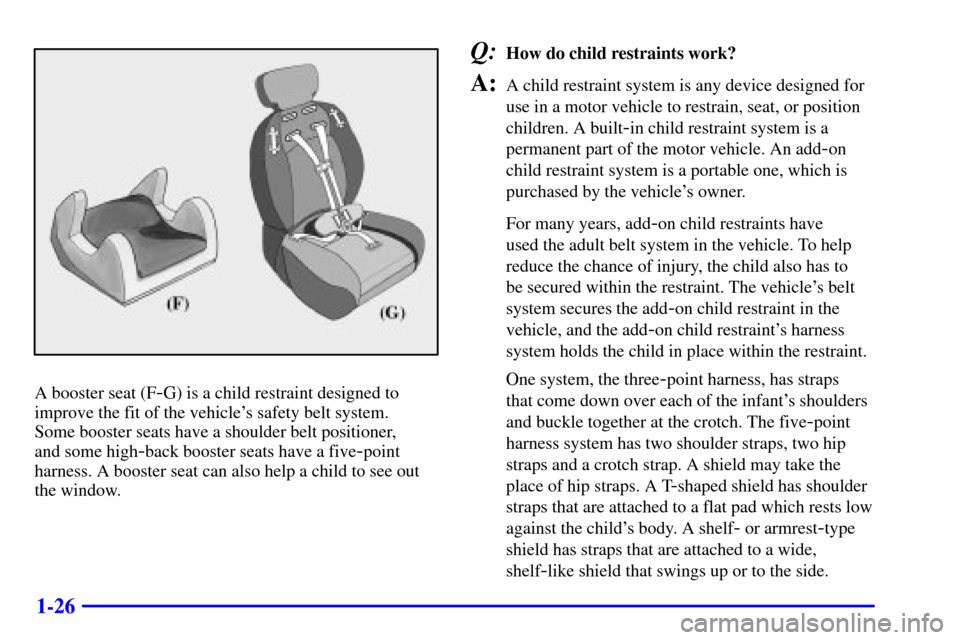
A booster seat (F-G) is a child restraint designed to
improve the fit of the vehicle's safety belt system.
Some booster seats have a shoulder belt positioner,
and some high
-back booster seats have a five-point
harness. A booster seat can also help a child to see out
the window.
Q:How do child restraints work?
A:A child restraint system is any device designed for
use in a motor vehicle to restrain, seat, or position
children. A built
-in child restraint system is a
permanent part of the motor vehicle. An add
-on
child restraint system is a portable one, which is
purchased by the vehicle's owner.
For many years, add
-on child restraints have
used the adult belt system in the vehicle. To help
reduce the chance of injury, the child also has to
be secured within the restraint. The vehicle's belt
system secures the add
-on child restraint in the
vehicle, and the add
-on child restraint's harness
system holds the child in place within the restraint.
One system, the three
-point harness, has straps
that come down over each of the infant's shoulders
and buckle together at the crotch. The five
-point
harness system has two shoulder straps, two hip
straps and a crotch strap. A shield may take the
place of hip straps. A T
-shaped shield has shoulder
straps that are attached to a flat pad which rests low
against the child's body. A shelf
- or armrest-type
shield has straps that are attached to a wide,
shelf
-like shield that swings up or to the side.
Page 40 of 331
1-33
Older Children
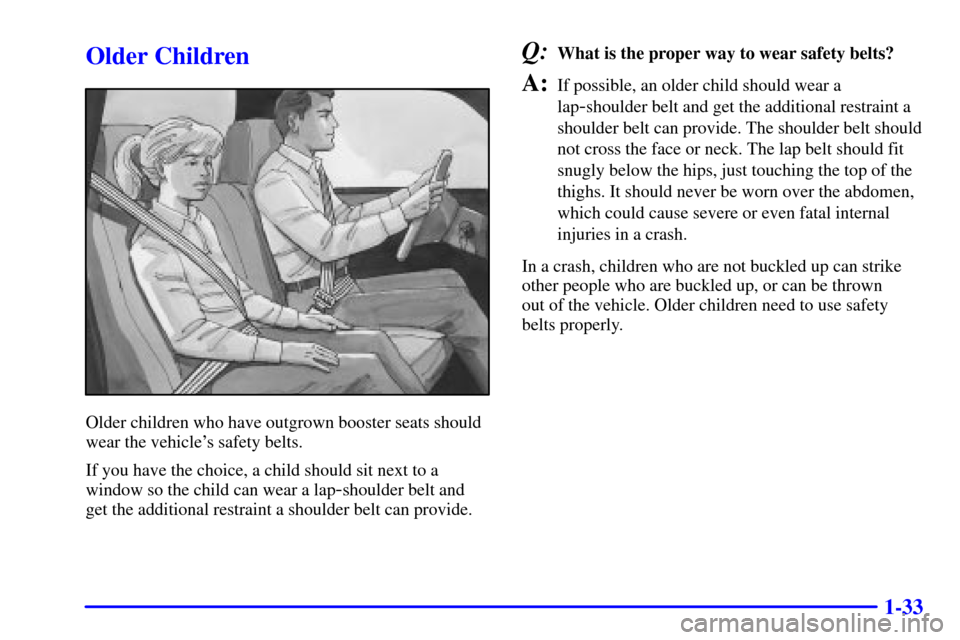
Older children who have outgrown booster seats should
wear the vehicle's safety belts.
If you have the choice, a child should sit next to a
window so the child can wear a lap
-shoulder belt and
get the additional restraint a shoulder belt can provide.
Q:What is the proper way to wear safety belts?
A:If possible, an older child should wear a
lap
-shoulder belt and get the additional restraint a
shoulder belt can provide. The shoulder belt should
not cross the face or neck. The lap belt should fit
snugly below the hips, just touching the top of the
thighs. It should never be worn over the abdomen,
which could cause severe or even fatal internal
injuries in a crash.
In a crash, children who are not buckled up can strike
other people who are buckled up, or can be thrown
out of the vehicle. Older children need to use safety
belts properly.
Page 44 of 331
2-
2-1
Section 2 Features and Controls
Here you can learn about the many standard and optional features on your vehicle, and information on starting,
shifting and braking. Also explained are the instrument panel and the warning systems that tell you if everything is
working properly
-- and what to do if you have a problem.
2
-2 Windows
2
-4 Keys
2
-6 Door Locks
2
-7 Keyless Entry System (If Equipped)
2
-10 Theft
2
-11 Passlock�
2-12 New Vehicle ªBreak-Inº
2
-12 Ignition Positions
2
-14 Starting Your Gasoline Engine
2
-16 Engine Coolant Heater (If Equipped)
2
-17 Automatic Transmission Operation
2
-21 Manual Transmission Operation
2
-23 Parking Brake
2
-24 Shifting Into PARK (P)
(Automatic Transmission Only)
2
-27 Shifting Out of PARK (P)
(Automatic Transmission Only)2
-27 Parking Your Vehicle
(Manual Transmission Models Only)
2
-28 Parking Over Things That Burn
2
-28 Engine Exhaust
2
-29 Running Your Engine While You're Parked
(Automatic Transmission)
2
-30 Tilt Wheel (If Equipped)
2
-30 Turn Signal/Multifunction Lever
2
-37 Exterior Lamps
2
-39 Interior Lamps
2
-41 Mirrors
2
-44 Storage Compartments
2
-48 Instrument Panel - Your Information System
2
-50 Instrument Panel Cluster
2
-52 Warning Lights, Gages and Indicators
Page 45 of 331
2-2
Windows
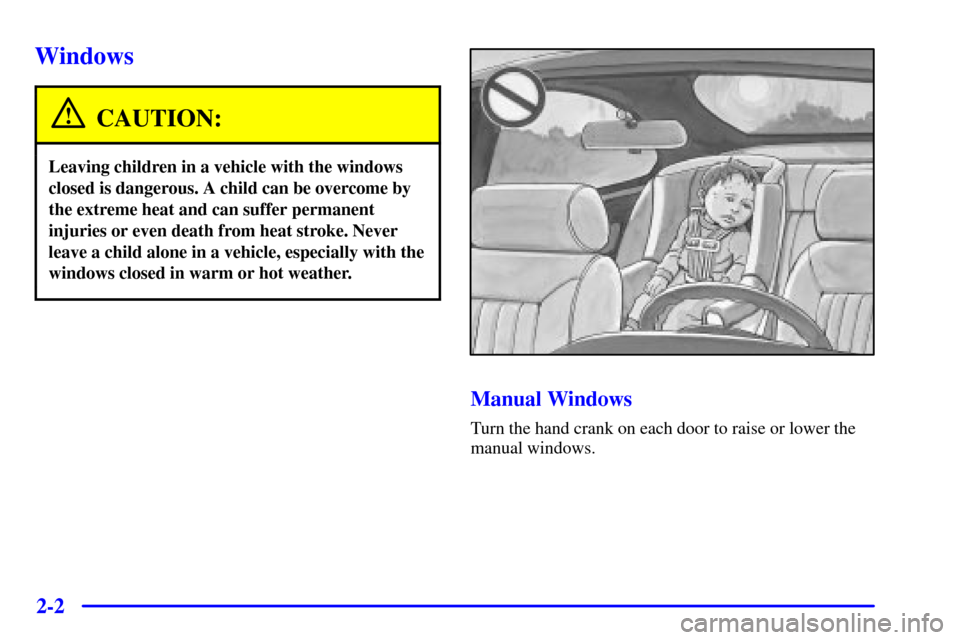
CAUTION:
Leaving children in a vehicle with the windows
closed is dangerous. A child can be overcome by
the extreme heat and can suffer permanent
injuries or even death from heat stroke. Never
leave a child alone in a vehicle, especially with the
windows closed in warm or hot weather.
Manual Windows
Turn the hand crank on each door to raise or lower the
manual windows.
Page 46 of 331
2-3 Power Windows (If Equipped)
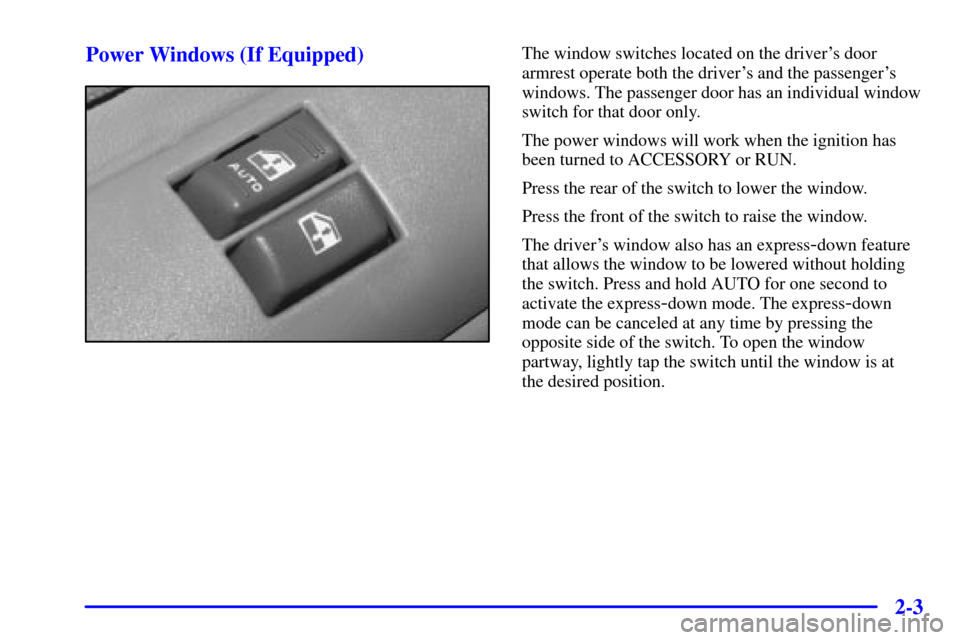
The window switches located on the driver's door
armrest operate both the driver's and the passenger's
windows. The passenger door has an individual window
switch for that door only.
The power windows will work when the ignition has
been turned to ACCESSORY or RUN.
Press the rear of the switch to lower the window.
Press the front of the switch to raise the window.
The driver's window also has an express
-down feature
that allows the window to be lowered without holding
the switch. Press and hold AUTO for one second to
activate the express
-down mode. The express-down
mode can be canceled at any time by pressing the
opposite side of the switch. To open the window
partway, lightly tap the switch until the window is at
the desired position.
Page 47 of 331
2-4
Keys
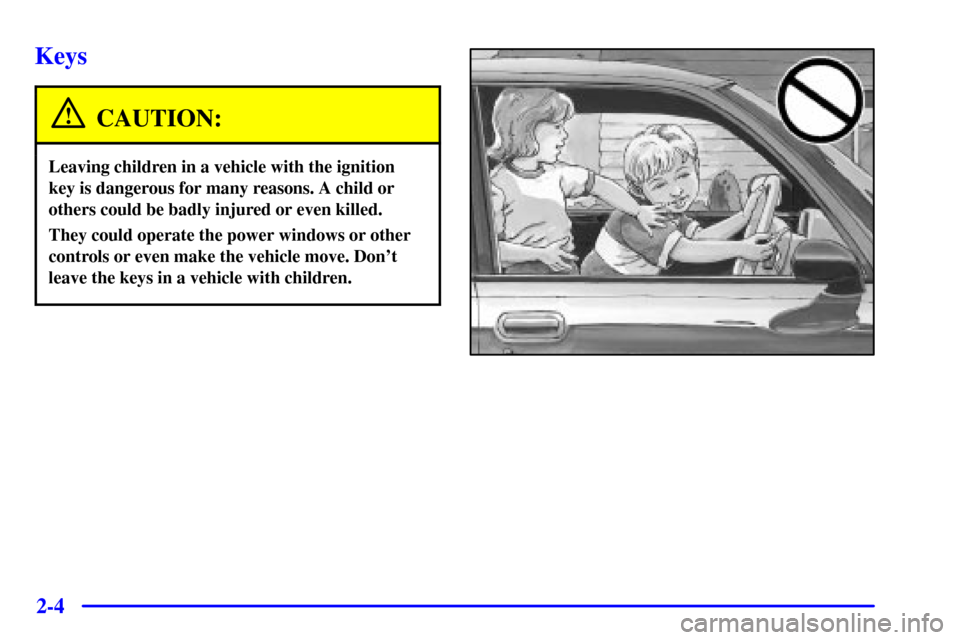
CAUTION:
Leaving children in a vehicle with the ignition
key is dangerous for many reasons. A child or
others could be badly injured or even killed.
They could operate the power windows or other
controls or even make the vehicle move. Don't
leave the keys in a vehicle with children.
Page 54 of 331

2-11 Key in the Ignition
If you leave your vehicle with the keys inside, it's an
easy target for joy riders or professional thieves
-- so
don't do it.
When you park your vehicle and open the driver's door,
you'll hear a tone reminding you to remove your key
from the ignition and take it with you. Always do this.
Your steering wheel will be locked, and so will your
ignition. If you have an automatic transmission, taking
your key out also locks your transmission. Also
remember to lock the doors.
Parking at Night
Park in a lighted spot, close all windows and lock your
vehicle. Remember to keep your valuables out of sight.
Put them in a storage area, or take them with you.
Parking Lots
Even if you park in a lot where someone will be
watching your vehicle, it's still best to lock it up and
take your keys. But what if you have to leave your
ignition key? What if you have to leave something
valuable in your vehicle?
�Put your valuables in a storage area, like your
glove box.�If your vehicle has a remote keyless entry system,
take the transmitter with you.
�Lock all the doors except the driver's.
Passlock�
Your vehicle is equipped with the Passlock
theft
-deterrent system.
Passlock is a passive theft
-deterrent system. Passlock
enables fuel if the ignition lock cylinder is turned with a
valid key. If a correct key is not used or the ignition lock
cylinder is tampered with, fuel is disabled.
During normal operation, the SECURITY light will
go off approximately five seconds after the key is
turned to RUN.
If the engine stalls and the SECURITY light flashes,
wait until the light stops flashing before trying to restart
the engine. Remember to release the key from START
as soon as the engine starts.
If the engine is running and the SECURITY light comes
on, you will be able to restart the engine if you turn the
engine off. However, your Passlock system is not
working properly and must be serviced by your dealer.
Your vehicle is not protected by Passlock at this time.
You may also want to check the fuses. See ªFuses
and Circuit Breakersº in the Index. See your dealer
for service.
Page 55 of 331
2-12
New Vehicle ªBreak-Inº
NOTICE:
Your vehicle doesn't need an elaborate
ªbreak
-in.º But it will perform better in the
long run if you follow these guidelines:
�Keep your speed at 55 mph (88 km/h) or
less for the first 500 miles (805 km).
�Don't drive at any one speed
-- fast or
slow
-- for the first 500 miles (805 km).
Don't make full
-throttle starts.
�Avoid making hard stops for the first
200 miles (322 km) or so. During this time
your new brake linings aren't yet broken
in. Hard stops with new linings can mean
premature wear and earlier replacement.
Follow this breaking
-in guideline every
time you get new brake linings.
�Don't tow a trailer during break
-in. See
ªTowing a Trailerº in the Index for more
information.
Ignition Positions
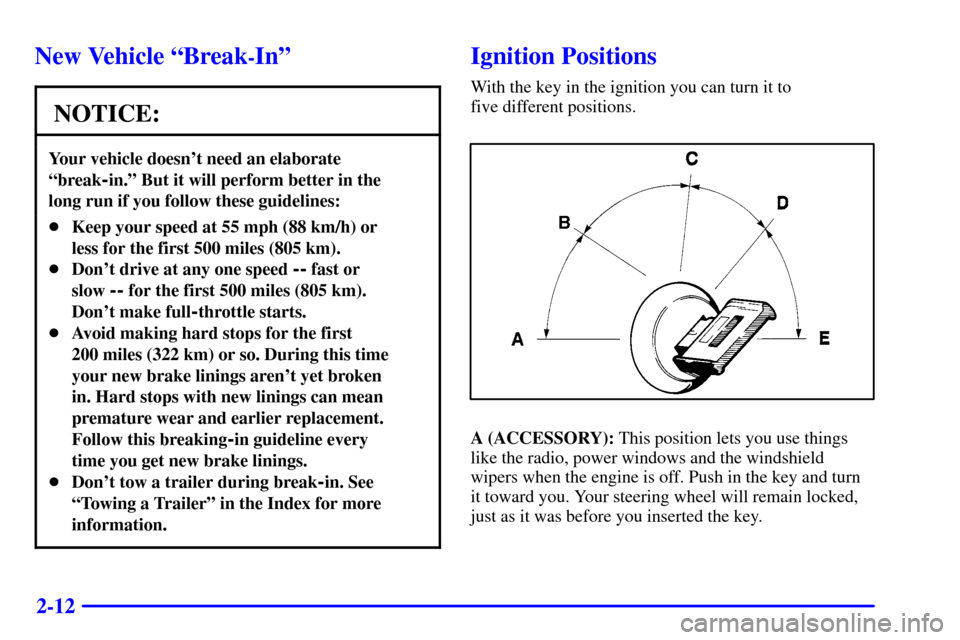
With the key in the ignition you can turn it to
five different positions.
A (ACCESSORY): This position lets you use things
like the radio, power windows and the windshield
wipers when the engine is off. Push in the key and turn
it toward you. Your steering wheel will remain locked,
just as it was before you inserted the key.