Page 64 of 488
1-57
CAUTION:
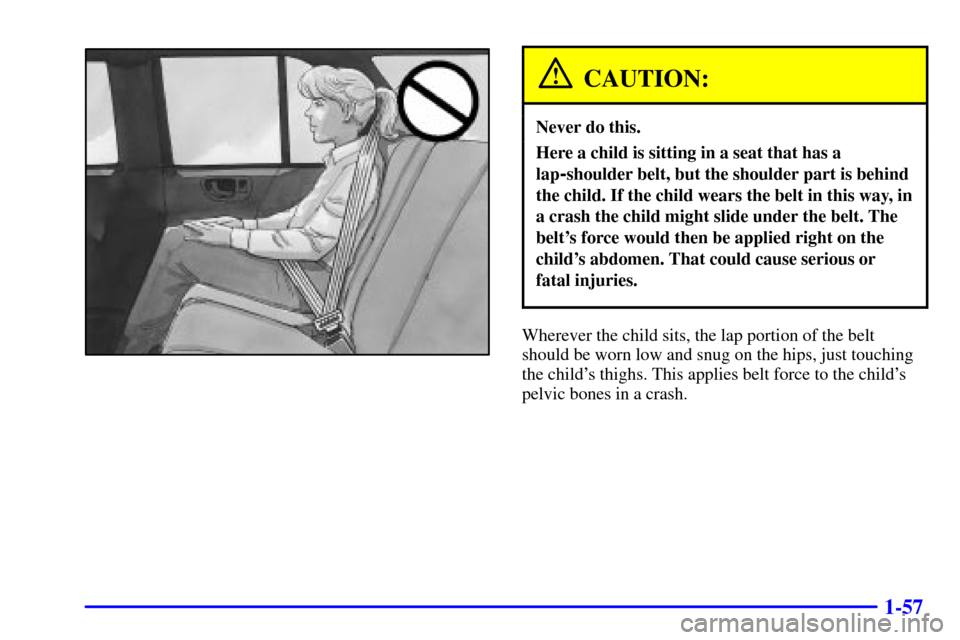
Never do this.
Here a child is sitting in a seat that has a
lap
-shoulder belt, but the shoulder part is behind
the child. If the child wears the belt in this way, in
a crash the child might slide under the belt. The
belt's force would then be applied right on the
child's abdomen. That could cause serious or
fatal injuries.
Wherever the child sits, the lap portion of the belt
should be worn low and snug on the hips, just touching
the child's thighs. This applies belt force to the child's
pelvic bones in a crash.
Page 65 of 488

1-58
Safety Belt Extender
If the vehicle's safety belt will fasten around you, you
should use it.
But if a safety belt isn't long enough to fasten, your
dealer will order you an extender. It's free. When you go
in to order it, take the heaviest coat you will wear, so the
extender will be long enough for you. The extender will
be just for you, and just for the seat in your vehicle that
you choose. Don't let someone else use it, and use it
only for the seat it is made to fit. To wear it, just attach it
to the regular safety belt.
Checking Your Restraint Systems
Now and then, make sure the safety belt reminder light
and all your belts, buckles, latch plates, retractors and
anchorages are working properly. Look for any other
loose or damaged safety belt system parts. If you see
anything that might keep a safety belt system from
doing its job, have it repaired.
Torn or frayed safety belts may not protect you in a
crash. They can rip apart under impact forces. If a belt is
torn or frayed, get a new one right away.
Also look for any opened or broken air bag covers, and
have them repaired or replaced. (The air bag system
does not need regular maintenance.)
Page 66 of 488
1-59
Replacing Restraint System Parts
After a Crash
If you've had a crash, do you need new belts?
After a very minor collision, nothing may be necessary.
But if the belts were stretched, as they would be if worn
during a more severe crash, then you need new parts.
If you ever see a label on
the driver's or the right
front passenger's safety belt
that says to replace the belt,
be sure to do so. Then the
new belt will be there to
help protect you in a
collision. You would see
this label on the belt near
the door opening.If belts are cut or damaged, replace them. Collision
damage also may mean you will need to have safety belt
or seat parts repaired or replaced. New parts and repairs
may be necessary even if the belt wasn't being used at
the time of the collision.
If an air bag inflates, you'll need to replace air bag
system parts. See the part on the air bag system earlier
in this section.
Page 72 of 488
2-6
The key code number tells your dealer or a qualified
locksmith how to make extra keys. Keep this number in
a safe place. If you lose your keys, you'll be able to have
new ones made easily using this number. Your selling
dealer should also have this number.
NOTICE:
Your vehicle has a number of new features that
can help prevent theft. But you can have a lot of
trouble getting into your vehicle if you ever lock
your key inside. You may even have to damage
your vehicle to get in. So be sure you have an
extra key.
If you ever do get locked out of your vehicle, contact
roadside assistance for help. See ªRoadside Assistanceº
in the Index for more information.
Door Locks
CAUTION:
Unlocked doors can be dangerous.
�Passengers -- especially children -- can
easily open the doors and fall out of a
moving vehicle. When a door is locked, the
handle won't open it. You increase the
chance of being thrown out of the vehicle in
a crash if the doors aren't locked. So, wear
safety belts properly and lock the doors
whenever you drive.
�Young children who get into unlocked
vehicles may be unable to get out. A child
can be overcome by extreme heat and can
suffer permanent injuries or even death
from heat stroke. Always lock your vehicle
whenever you leave it.
�Outsiders can easily enter through an
unlocked door when you slow down or stop
your vehicle. Locking your doors can help
prevent this from happening.
Page 153 of 488

2-87
Warning Lights, Gages and
Indicators
This part describes the warning lights and gages that
may be on your vehicle. The pictures will help you
locate them.
Warning lights and gages can signal that something is
wrong before it becomes serious enough to cause an
expensive repair or replacement. Paying attention to
your warning lights and gages could also save you or
others from injury.
Warning lights come on when there may be or is a
problem with one of your vehicle's functions. As you
will see in the details on the next few pages, some
warning lights come on briefly when you start the
engine just to let you know they're working. If you are
familiar with this section, you should not be alarmed
when this happens.
Gages can indicate when there may be or is a problem
with one of your vehicle's functions. Often gages and
warning lights work together to let you know when
there's a problem with your vehicle.When one of the warning lights comes on and stays on
when you are driving, or when one of the gages shows
there may be a problem, check the section that tells you
what to do about it. Please follow this manual's advice.
Waiting to do repairs can be costly
-- and even
dangerous. So please get to know your warning lights
and gages. They're a big help.
Safety Belt Reminder Light
When the key is turned to RUN or START, a chime will
come on for about eight seconds to remind people to
fasten their safety
The safety belt light will
also come on and stay
on for about 20 seconds,
then it will flash for about
55 seconds.
If the driver's belt is already buckled, neither the chime
nor the light will come on.
Page 155 of 488

2-89
Charging System Indicator Light
The charging system light
will come on briefly when
you turn on the ignition,
but the engine is not
running, as a check to
show you it is working.
It should go out once the engine is running. If it stays
on, or comes on while you are driving, you may have a
problem with the charging system. It could indicate that
you have problems with a generator drive belt, or
another electrical problem. Have it checked right away.
Driving while this light is on could drain your battery.
If you must drive a short distance with the light on, be
certain to turn off all your accessories, such as the radio
and air conditioner.
Voltmeter Gage
When your engine is not
running, but the ignition is
on (in RUN), this gage
shows your battery's state of
charge in DC volts.
When the engine is running, the gage shows the
condition of the charging system. Readings between
the low and high warning zones indicate the normal
operating range.
Readings in the low warning zone may occur when a
large number of electrical accessories are operating in
the vehicle and the engine is left at an idle for an
extended period. This condition is normal since the
charging system is not able to provide full power at
engine idle. As engine speeds are increased, this
condition should correct itself as higher engine speeds
allow the charging system to create maximum power.
Page 244 of 488

3-77
If your vehicle is equipped with the AM-FM Stereo
with Cassette Tape Player and Automatic Tone Control
or the AM
-FM Stereo with Cassette Tape Player (Bose)
do the following:
1. Turn the ignition to RUN or ACCESSORY.
2. Turn the radio off.
3. Press and hold the TAPE AUX button for
five seconds. The tape symbol on the display
will flash for two seconds.
4. Insert the scrubbing action cleaning cassette.
5. Eject the cleaning cassette after the manufacturer's
recommended cleaning time.
When the cleaning cassette has been ejected, the broken
tape detection feature is active again.
You may also choose a non
-scrubbing action, wet-type
cleaner which uses a cassette with a fabric belt to clean
the tape head. This type of cleaning cassette will not
eject on its own. A non
-scrubbing action cleaner may
not clean as thoroughly as the scrubbing type cleaner.
The use of a non
-scrubbing action, dry-type cleaning
cassette is not recommended.
After you clean the player, press and hold the EJECT
button for five seconds to reset the CLN indicator. The
radio will display
--- to show the indicator was reset.Cassettes are subject to wear and the sound quality
may degrade over time. Always make sure the cassette
tape is in good condition before you have your tape
player serviced.
Care of Your Remote Cassette Tape Player
A tape player that is not cleaned regularly can cause
reduced sound quality, ruined cassettes or a damaged
mechanism. Cassette tapes should be stored in their
cases away from contaminants, direct sunlight and
extreme heat. If they aren't, they may not operate
properly or may cause failure of the tape player.
Your remote tape player should be cleaned regularly
after every 50 hours of use. Your radio may display
CLN to indicate that you have used your remote cassette
tape player for 50 hours without resetting the tape clean
timer. If this message appears on the display, your
remote cassette tape player needs to be cleaned. It will
still play tapes, but you should clean it as soon as
possible to prevent damage to your tapes and player.
The recommended cleaning method for your remote
cassette tape player is the use of a scrubbing action,
non
-abrasive cleaning cassette with pads which scrub
the tape head as the hubs of the cleaner cassette turn.
The recommended cleaning cassette is available through
your dealer (GM Part No. 12344789).
Page 247 of 488
4-2
Your Driving, the Road and
Your Vehicle
Whenever we drive, we're taking on an important
responsibility. This is true for any motor
vehicle
-- passenger car, van, truck or sport utility.Driver behavior, the driving environment, and the
vehicle's design all affect how well a vehicle performs.
But statistics show that the most important factor, by far,
is how we drive. Knowing how these three factors work
together can help you understand how your vehicle
handles and what you can do to avoid many types of
crashes, including a rollover crash.
Driver Behavior
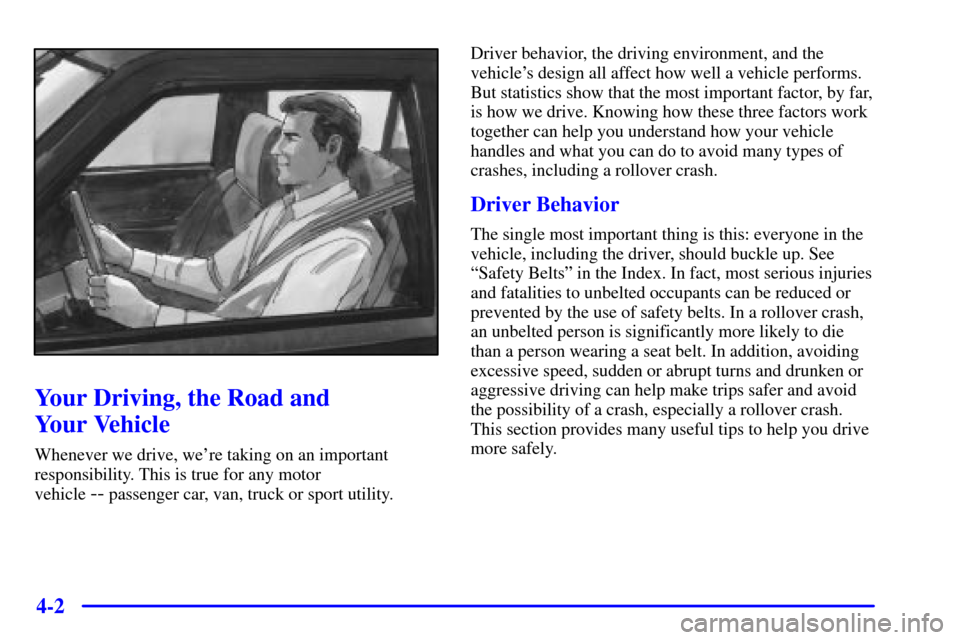
The single most important thing is this: everyone in the
vehicle, including the driver, should buckle up. See
ªSafety Beltsº in the Index. In fact, most serious injuries
and fatalities to unbelted occupants can be reduced or
prevented by the use of safety belts. In a rollover crash,
an unbelted person is significantly more likely to die
than a person wearing a seat belt. In addition, avoiding
excessive speed, sudden or abrupt turns and drunken or
aggressive driving can help make trips safer and avoid
the possibility of a crash, especially a rollover crash.
This section provides many useful tips to help you drive
more safely.