Page 43 of 488
1-36
Rear Safety Belt Comfort Guides
for Children and Small Adults
(4
-Door Models)
Four-door models have rear shoulder belt comfort
guides. This feature will provide added safety belt
comfort for older children who have outgrown booster
seats and for small adults. When installed on a shoulder
belt, the comfort guide better positions the belt away
from the neck and head.
To provide added safety belt comfort for children who
have outgrown child restraints and for smaller adults,
the comfort guides may be installed on the shoulder
belts. Here's how to install a comfort guide and use the
safety belt:
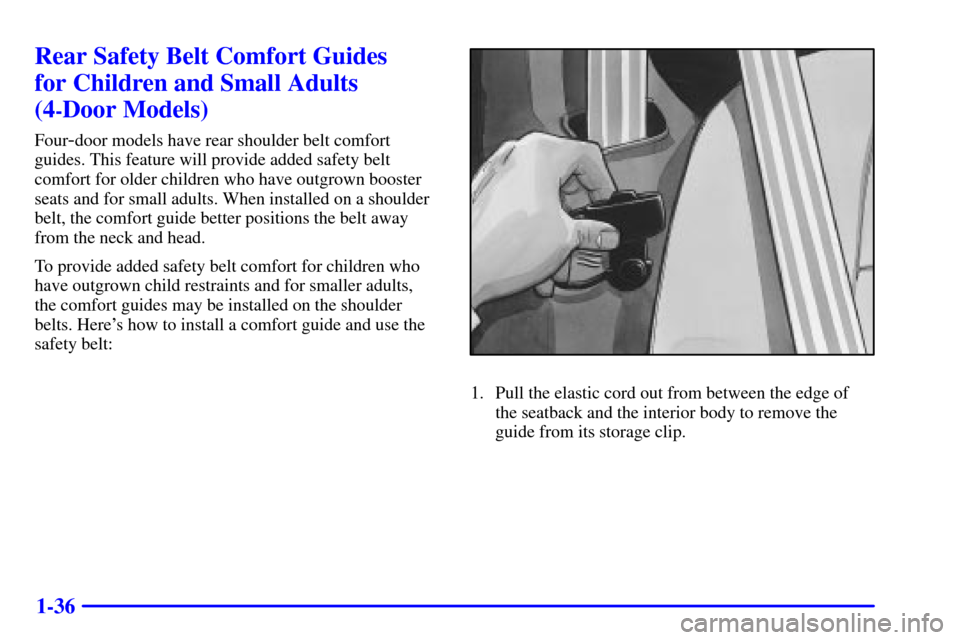
1. Pull the elastic cord out from between the edge of
the seatback and the interior body to remove the
guide from its storage clip.
Page 44 of 488
1-37
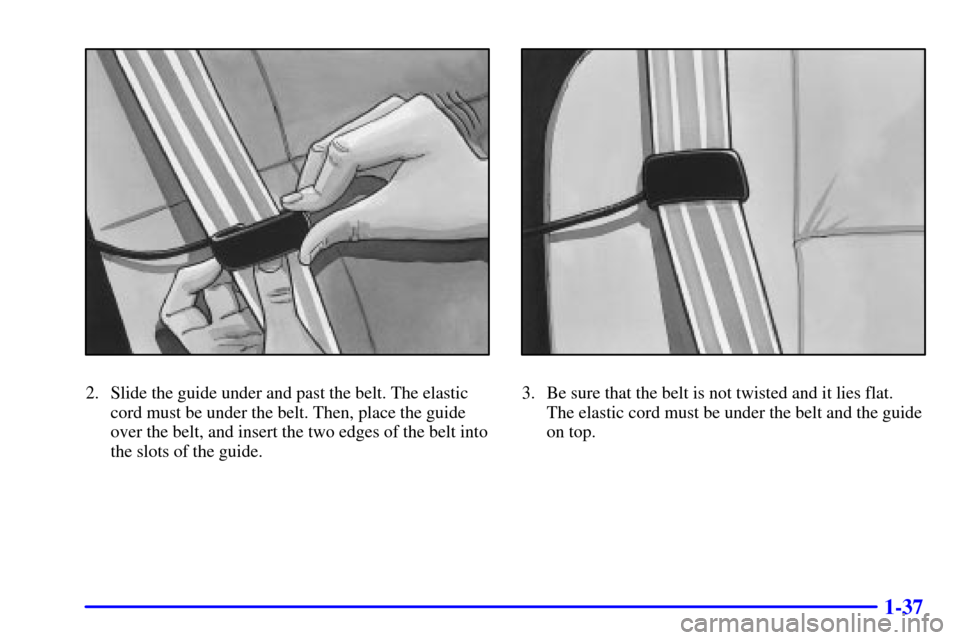
2. Slide the guide under and past the belt. The elastic
cord must be under the belt. Then, place the guide
over the belt, and insert the two edges of the belt into
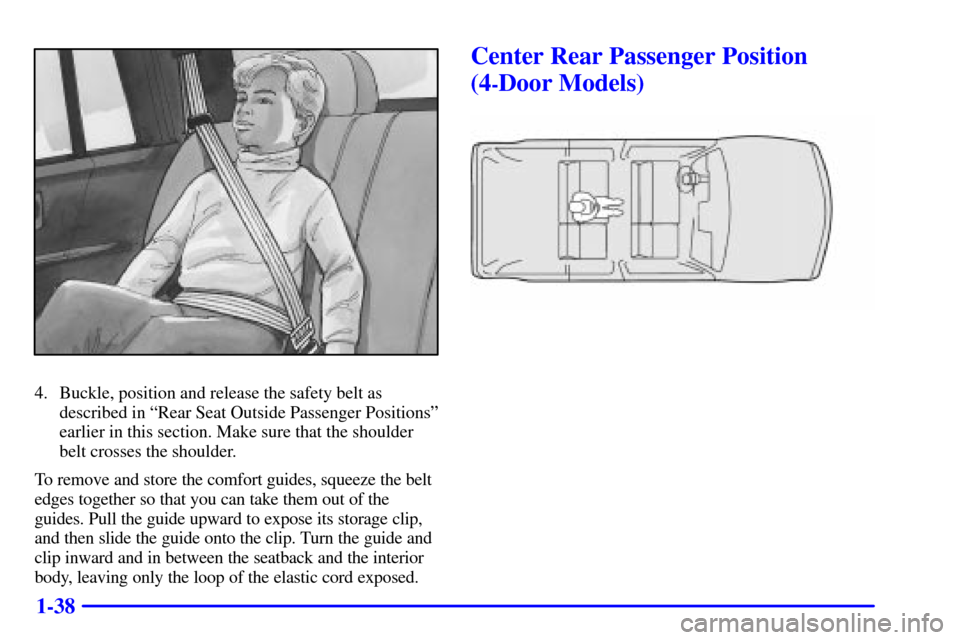
the slots of the guide.3. Be sure that the belt is not twisted and it lies flat.
The elastic cord must be under the belt and the guide
on top.
Page 45 of 488
1-38
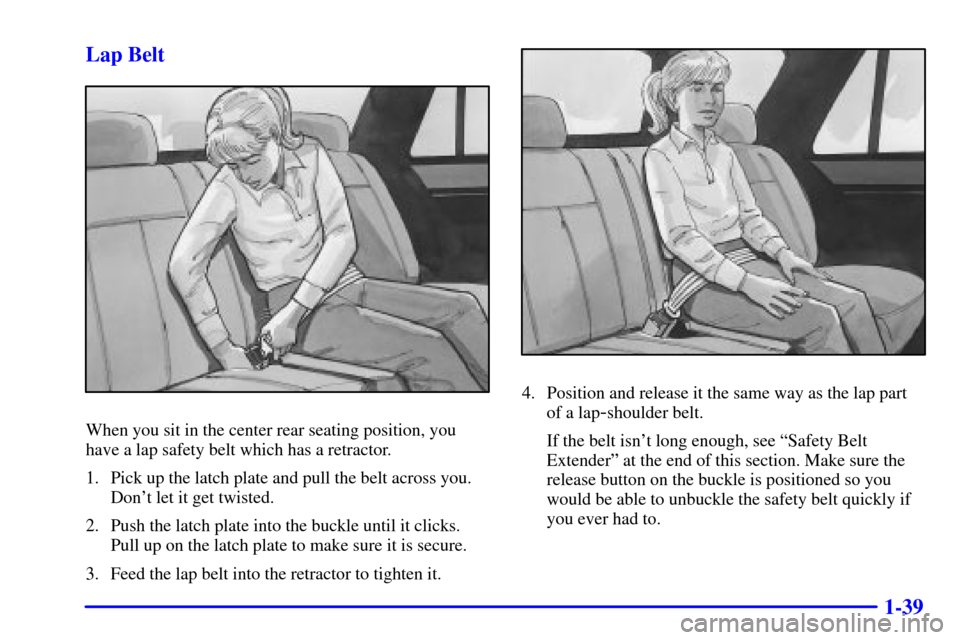
4. Buckle, position and release the safety belt as
described in ªRear Seat Outside Passenger Positionsº
earlier in this section. Make sure that the shoulder
belt crosses the shoulder.
To remove and store the comfort guides, squeeze the belt
edges together so that you can take them out of the
guides. Pull the guide upward to expose its storage clip,
and then slide the guide onto the clip. Turn the guide and
clip inward and in between the seatback and the interior
body, leaving only the loop of the elastic cord exposed.
Center Rear Passenger Position
(4
-Door Models)
Page 46 of 488
1-39 Lap Belt
When you sit in the center rear seating position, you
have a lap safety belt which has a retractor.
1. Pick up the latch plate and pull the belt across you.
Don't let it get twisted.
2. Push the latch plate into the buckle until it clicks.
Pull up on the latch plate to make sure it is secure.
3. Feed the lap belt into the retractor to tighten it.
4. Position and release it the same way as the lap part
of a lap
-shoulder belt.
If the belt isn't long enough, see ªSafety Belt
Extenderº at the end of this section. Make sure the
release button on the buckle is positioned so you
would be able to unbuckle the safety belt quickly if
you ever had to.
Page 47 of 488
1-40
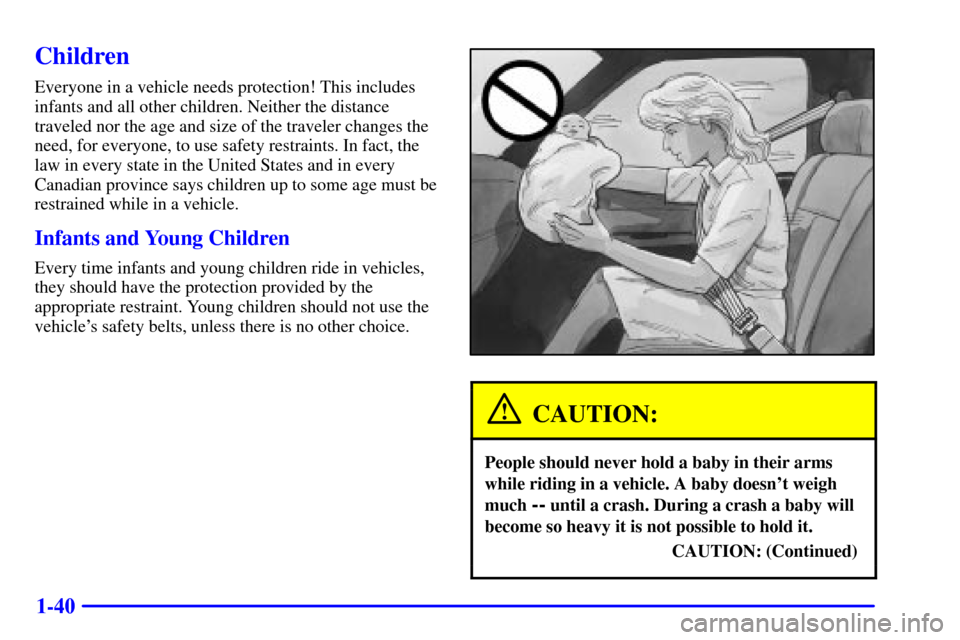
Children
Everyone in a vehicle needs protection! This includes
infants and all other children. Neither the distance
traveled nor the age and size of the traveler changes the
need, for everyone, to use safety restraints. In fact, the
law in every state in the United States and in every
Canadian province says children up to some age must be
restrained while in a vehicle.
Infants and Young Children
Every time infants and young children ride in vehicles,
they should have the protection provided by the
appropriate restraint. Young children should not use the
vehicle's safety belts, unless there is no other choice.
CAUTION:
People should never hold a baby in their arms
while riding in a vehicle. A baby doesn't weigh
much
-- until a crash. During a crash a baby will
become so heavy it is not possible to hold it.
CAUTION: (Continued)
Page 48 of 488
1-41
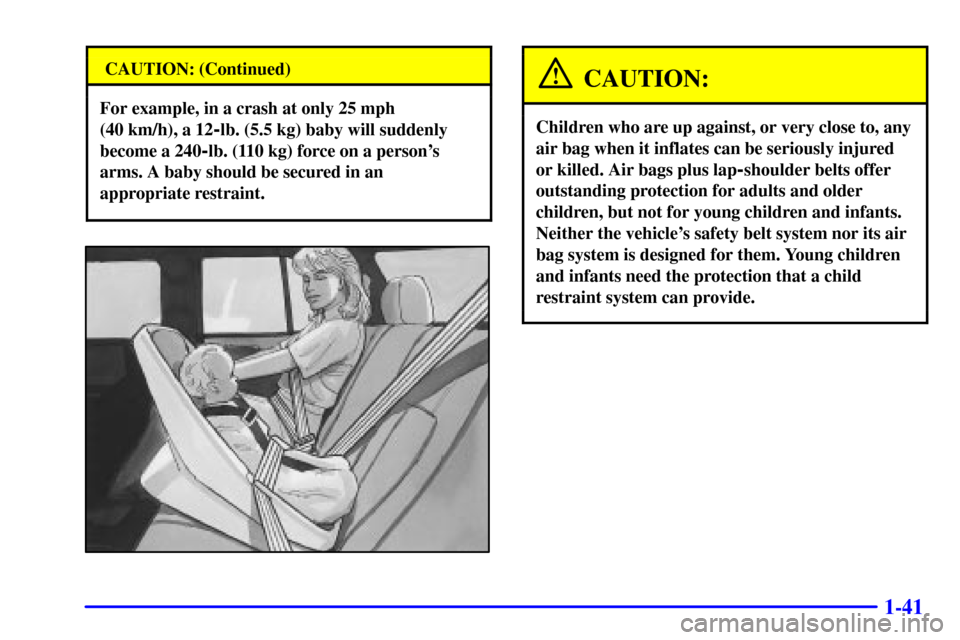
CAUTION: (Continued)
For example, in a crash at only 25 mph
(40 km/h), a 12
-lb. (5.5 kg) baby will suddenly
become a 240
-lb. (110 kg) force on a person's
arms. A baby should be secured in an
appropriate restraint.
CAUTION:
Children who are up against, or very close to, any
air bag when it inflates can be seriously injured
or killed. Air bags plus lap
-shoulder belts offer
outstanding protection for adults and older
children, but not for young children and infants.
Neither the vehicle's safety belt system nor its air
bag system is designed for them. Young children
and infants need the protection that a child
restraint system can provide.
Page 50 of 488
1-43
CAUTION:
The body structure of a young child is quite
unlike that of an adult or older child, for whom
the safety belts are designed. A young child's hip
bones are still so small that the vehicle's regular
safety belt may not remain low on the hip bones,
as it should. Instead, it may settle up around the
child's abdomen. In a crash, the belt would apply
force on a body area that's unprotected by any
bony structure. This alone could cause serious or
fatal injuries. Young children always should be
secured in appropriate child restraints.
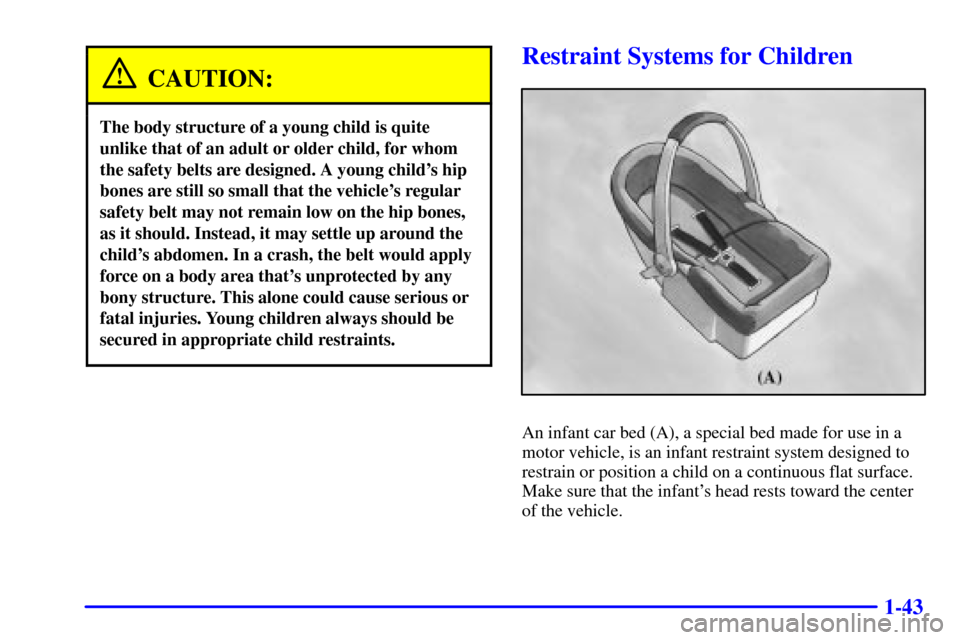
Restraint Systems for Children
An infant car bed (A), a special bed made for use in a
motor vehicle, is an infant restraint system designed to
restrain or position a child on a continuous flat surface.
Make sure that the infant's head rests toward the center
of the vehicle.
Page 52 of 488
1-45
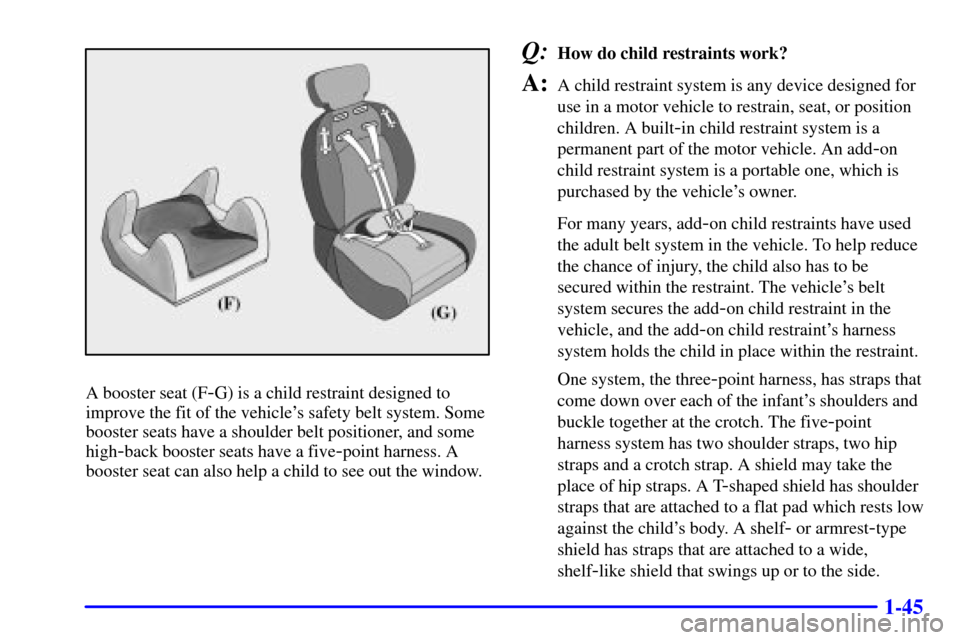
A booster seat (F-G) is a child restraint designed to
improve the fit of the vehicle's safety belt system. Some
booster seats have a shoulder belt positioner, and some
high
-back booster seats have a five-point harness. A
booster seat can also help a child to see out the window.
Q:How do child restraints work?
A:A child restraint system is any device designed for
use in a motor vehicle to restrain, seat, or position
children. A built
-in child restraint system is a
permanent part of the motor vehicle. An add
-on
child restraint system is a portable one, which is
purchased by the vehicle's owner.
For many years, add
-on child restraints have used
the adult belt system in the vehicle. To help reduce
the chance of injury, the child also has to be
secured within the restraint. The vehicle's belt
system secures the add
-on child restraint in the
vehicle, and the add
-on child restraint's harness
system holds the child in place within the restraint.
One system, the three
-point harness, has straps that
come down over each of the infant's shoulders and
buckle together at the crotch. The five
-point
harness system has two shoulder straps, two hip
straps and a crotch strap. A shield may take the
place of hip straps. A T
-shaped shield has shoulder
straps that are attached to a flat pad which rests low
against the child's body. A shelf
- or armrest-type
shield has straps that are attached to a wide,
shelf
-like shield that swings up or to the side.