Page 364 of 488
6-19
Then, without shutting off the engine, follow these steps:
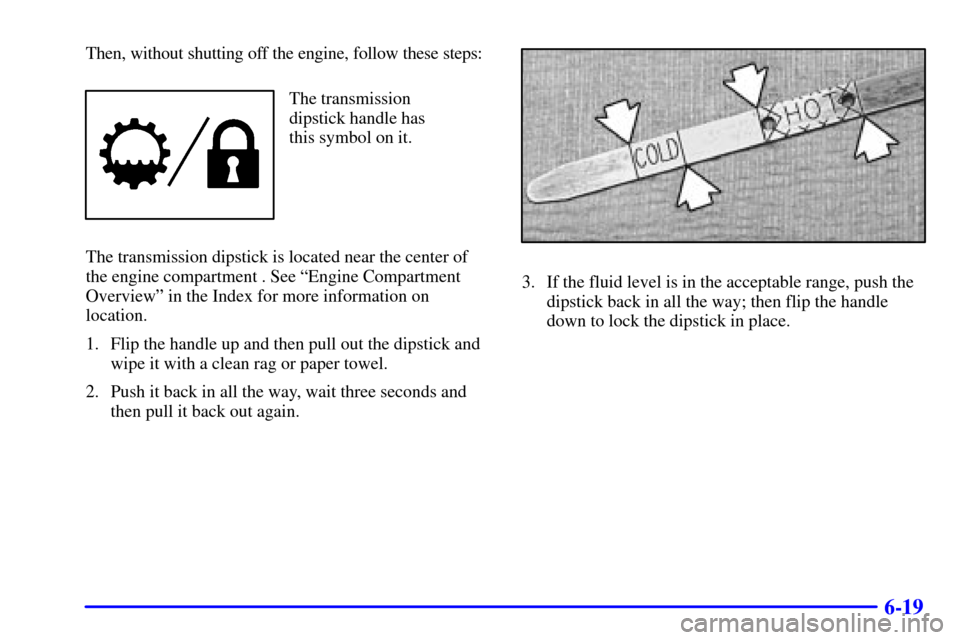
The transmission
dipstick handle has
this symbol on it.
The transmission dipstick is located near the center of
the engine compartment . See ªEngine Compartment
Overviewº in the Index for more information on
location.
1. Flip the handle up and then pull out the dipstick and
wipe it with a clean rag or paper towel.
2. Push it back in all the way, wait three seconds and
then pull it back out again.
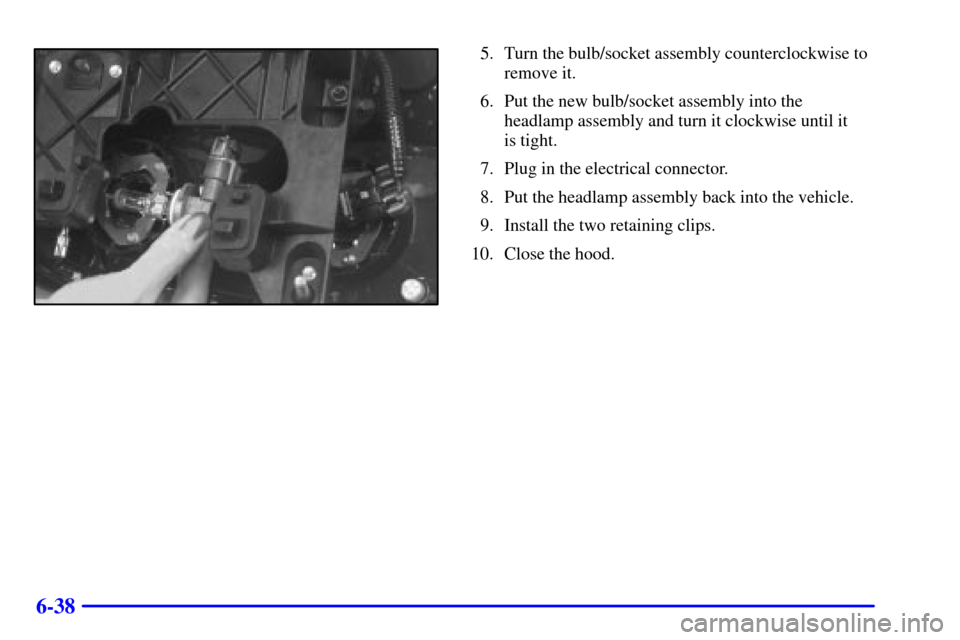
3. If the fluid level is in the acceptable range, push the
dipstick back in all the way; then flip the handle
down to lock the dipstick in place.
Page 365 of 488

6-20 How to Add Fluid
Refer to the Maintenance Schedule to determine what
kind of transmission fluid to use. See ªRecommended
Fluids and Lubricantsº in
Add fluid only after checking the transmission fluid
while it is hot. (A cold check is used only as a
reference.) If the fluid level is low, add only enough of
the proper fluid to bring the level up to the HOT area for
a hot check. It doesn't take much fluid, generally less
than one pint (0.5 L). Don't overfill.
NOTICE:
We recommend you use only fluid labeled
DEXRON�-III, because fluid with that label is
made especially for your automatic transmission.
Damage caused by fluid other than DEXRON
�-III
is not covered by your new vehicle warranty.
�After adding fluid, recheck the fluid level as
described under ªHow to Check.º
�When the correct fluid level is obtained, push the
dipstick back in all the way; then flip the handle
down to lock the dipstick in place.
Manual Transmission Fluid
When to Check
A good time to have it checked is when the engine oil is
changed. However, the fluid in your manual
transmission doesn't require changing.
How to Check
Because this operation can be a little difficult, you may
choose to have this done at your GM dealership service
department.
If you do it yourself, be sure to follow all the
instructions here, or you could get a false reading.
NOTICE:
Too much or too little fluid can damage your
transmission. Too much can mean that some of
the fluid could come out and fall on hot engine
parts or exhaust system parts, starting a fire. Too
little fluid could cause the transmission to
overheat. Be sure to get an accurate reading if
you check your transmission fluid.
Page 383 of 488
6-38
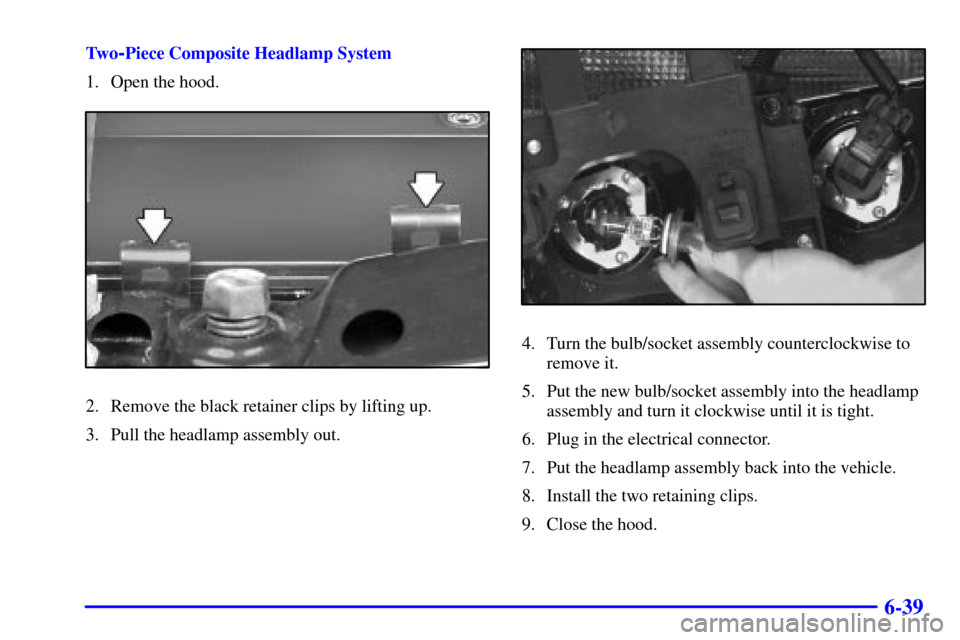
5. Turn the bulb/socket assembly counterclockwise to
remove it.
6. Put the new bulb/socket assembly into the
headlamp assembly and turn it clockwise until it
is tight.
7. Plug in the electrical connector.
8. Put the headlamp assembly back into the vehicle.
9. Install the two retaining clips.
10. Close the hood.
Page 384 of 488
6-39
Tw o-Piece Composite Headlamp System
1. Open the hood.
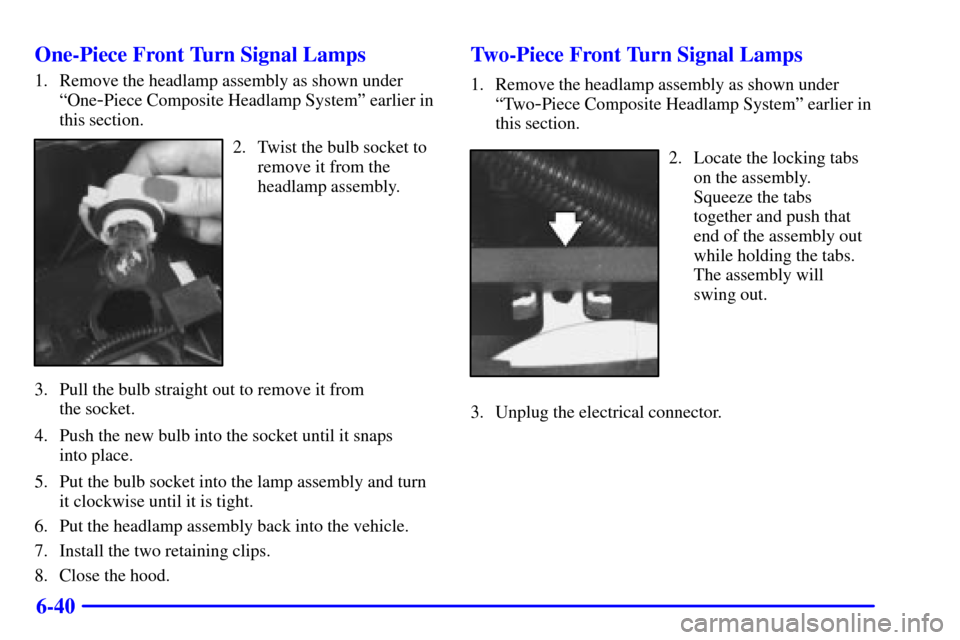
2. Remove the black retainer clips by lifting up.
3. Pull the headlamp assembly out.
4. Turn the bulb/socket assembly counterclockwise to
remove it.
5. Put the new bulb/socket assembly into the headlamp
assembly and turn it clockwise until it is tight.
6. Plug in the electrical connector.
7. Put the headlamp assembly back into the vehicle.
8. Install the two retaining clips.
9. Close the hood.
Page 385 of 488
6-40 One-Piece Front Turn Signal Lamps
1. Remove the headlamp assembly as shown under
ªOne
-Piece Composite Headlamp Systemº earlier in
this section.
2. Twist the bulb socket to
remove it from the
headlamp assembly.
3. Pull the bulb straight out to remove it from
the socket.
4. Push the new bulb into the socket until it snaps
into place.
5. Put the bulb socket into the lamp assembly and turn
it clockwise until it is tight.
6. Put the headlamp assembly back into the vehicle.
7. Install the two retaining clips.
8. Close the hood.
Two-Piece Front Turn Signal Lamps
1. Remove the headlamp assembly as shown under
ªTwo
-Piece Composite Headlamp Systemº earlier in
this section.
2. Locate the locking tabs
on the assembly.
Squeeze the tabs
together and push that
end of the assembly out
while holding the tabs.
The assembly will
swing out.
3. Unplug the electrical connector.
Page 386 of 488
6-41
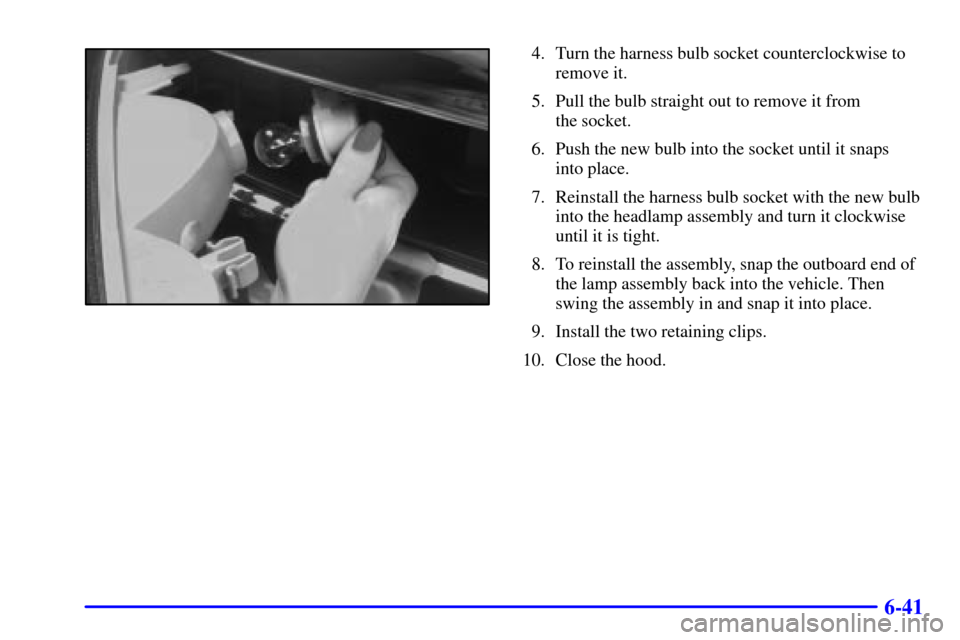
4. Turn the harness bulb socket counterclockwise to
remove it.
5. Pull the bulb straight out to remove it from
the socket.
6. Push the new bulb into the socket until it snaps
into place.
7. Reinstall the harness bulb socket with the new bulb
into the headlamp assembly and turn it clockwise
until it is tight.
8. To reinstall the assembly, snap the outboard end of
the lamp assembly back into the vehicle. Then
swing the assembly in and snap it into place.
9. Install the two retaining clips.
10. Close the hood.
Page 387 of 488
6-42 Taillamps
1. Open the endgate.
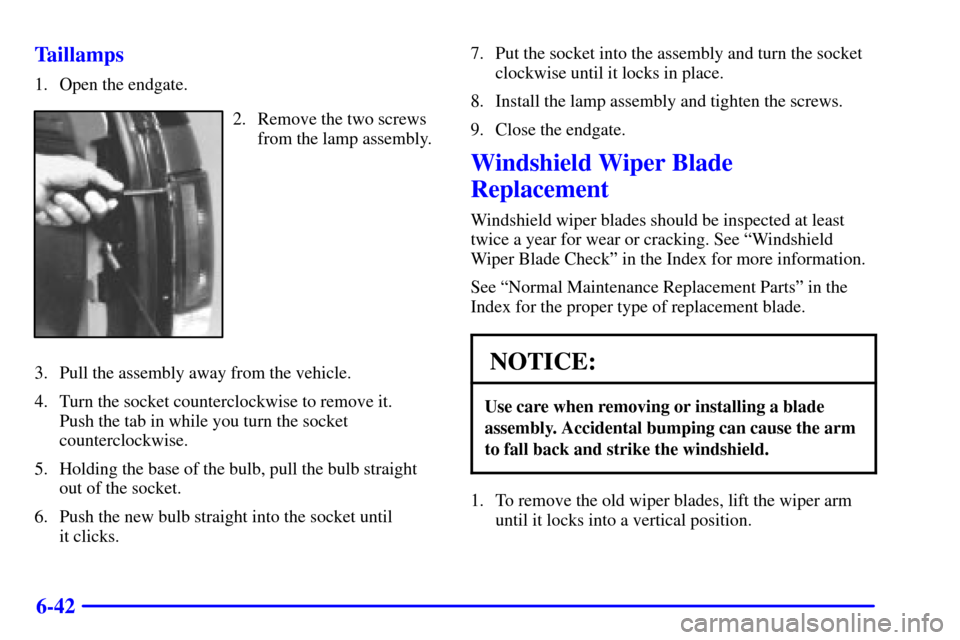
2. Remove the two screws
from the lamp assembly.
3. Pull the assembly away from the vehicle.
4. Turn the socket counterclockwise to remove it.
Push the tab in while you turn the socket
counterclockwise.
5. Holding the base of the bulb, pull the bulb straight
out of the socket.
6. Push the new bulb straight into the socket until
it clicks.7. Put the socket into the assembly and turn the socket
clockwise until it locks in place.
8. Install the lamp assembly and tighten the screws.
9. Close the endgate.
Windshield Wiper Blade
Replacement
Windshield wiper blades should be inspected at least
twice a year for wear or cracking. See ªWindshield
Wiper Blade Checkº in the Index for more information.
See ªNormal Maintenance Replacement Partsº in the
Index for the proper type of replacement blade.
NOTICE:
Use care when removing or installing a blade
assembly. Accidental bumping can cause the arm
to fall back and strike the windshield.
1. To remove the old wiper blades, lift the wiper arm
until it locks into a vertical position.
Page 388 of 488
6-43
A. Blade Assembly
B. Arm Assembly
C. Locking TabD. Blade Pivot
E. Hook Slot
F. Arm Hook
2. Press down on the blade assembly pivot locking tab.
Pull down on the blade assembly to release it from
the wiper arm hook.3. Remove the insert from the blade assembly. The
insert has two notches at one end that are locked by
the bottom claws of the blade assembly. At the
notched end, pull the insert from the blade assembly.
4. To install the new wiper insert, slide the insert (D),
notched end last, into the end with two blade
claws (A). Slide the insert all the way through the
blade claws at the opposite end (B). The plastic
caps (C) will be forced off as the insert is
fully inserted.