Page 333 of 488
5-25
CAUTION:
Getting under a vehicle when it is jacked up is
dangerous. If the vehicle slips off the jack, you
could be badly injured or killed. Never get under
a vehicle when it is supported only by a jack.
CAUTION:
Raising your vehicle with the jack improperly
positioned can damage the vehicle and even
make the vehicle fall. To help avoid personal
injury and vehicle damage, be sure to fit the jack
lift head into the proper location before raising
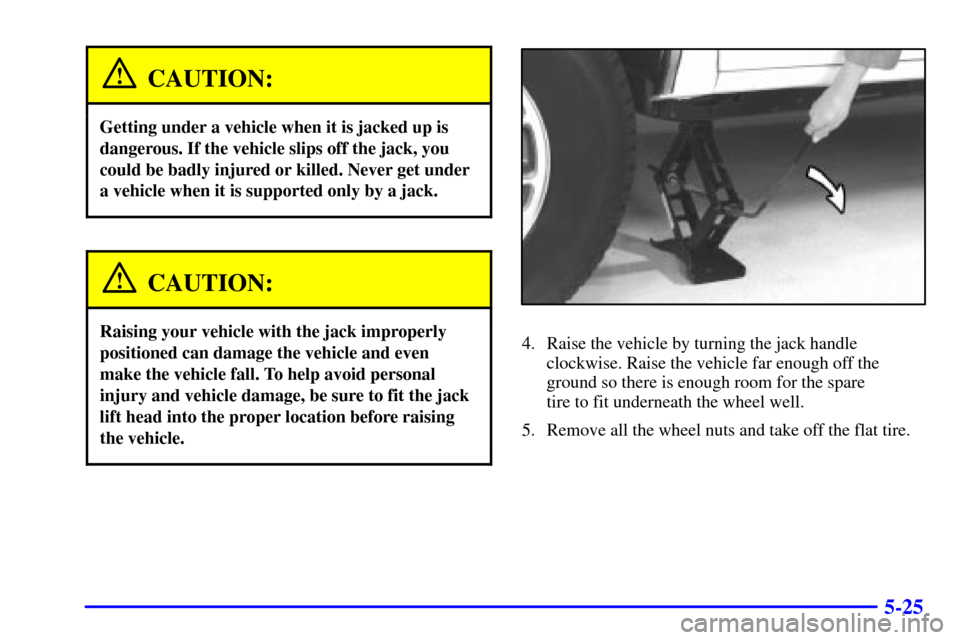
the vehicle.4. Raise the vehicle by turning the jack handle
clockwise. Raise the vehicle far enough off the
ground so there is enough room for the spare
tire to fit underneath the wheel well.
5. Remove all the wheel nuts and take off the flat tire.
Page 336 of 488
5-28
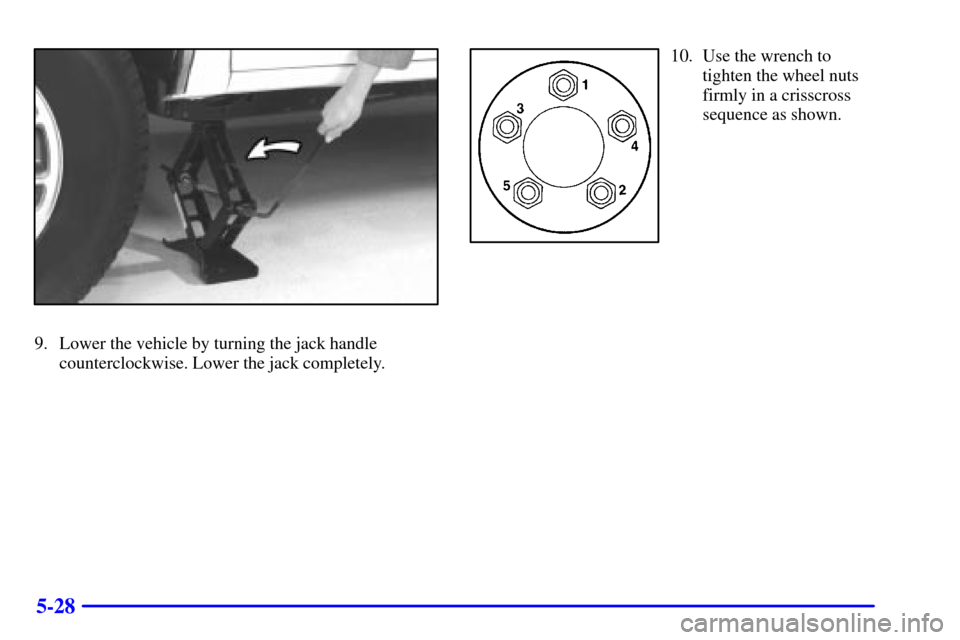
9. Lower the vehicle by turning the jack handle
counterclockwise. Lower the jack completely.
10. Use the wrench to
tighten the wheel nuts
firmly in a crisscross
sequence as shown.
Page 340 of 488
5-32
Follow this diagram for the inside-mounted spare.
A. Spare or Flat Tire
B. Retainer
C. Nut
D. Wheel Carrier
E. HookFollow this diagram for the rear
-mounted spare.
A. Wheel Carrier
B. Spare or Flat Tire
C. Wheel Nut and Locking Nut Cylinder
Page 341 of 488
5-33
6. Reinstall the locking wheel nut using the wheel
wrench. Then push the lock case onto the lug nut
until it stops. The key does not have to be inserted
into the lock. Push the lock case to be sure it is
secured. The special lug nut and lock case is not
intended to be used on any road wheel, only on the
spare wheel carrier. Tighten the nuts on the wheel
carrier to 22 to 32 lb
-ft (30 to 40 N´m).
CAUTION:
Make sure the tire and carrier are secure.
Driving with the tire or carrier unlatched could
injure pedestrians or damage the vehicle.
7. Return the jack, wheel wrench and wheel blocks to
the proper location in your vehicle's rear area.
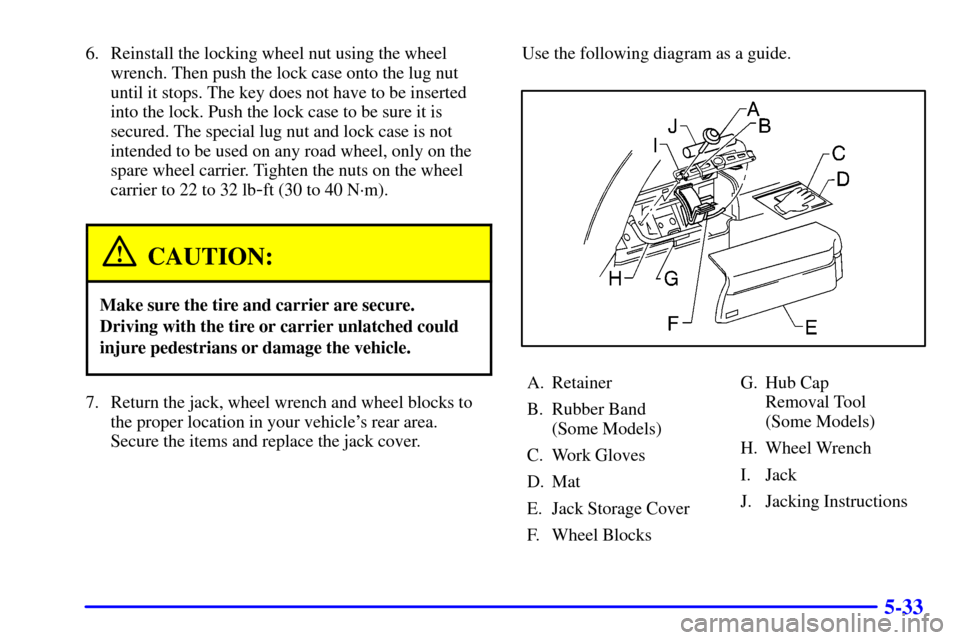
Secure the items and replace the jack cover.Use the following diagram as a guide.
A. Retainer
B. Rubber Band
(Some Models)
C. Work Gloves
D. Mat
E. Jack Storage Cover
F. Wheel BlocksG. Hub Cap
Removal Tool
(Some Models)
H. Wheel Wrench
I. Jack
J. Jacking Instructions
Page 351 of 488
6-6
Filling Your Tank
CAUTION:
Gasoline vapor is highly flammable. It burns
violently, and that can cause very bad injuries.
Don't smoke if you're near gasoline or refueling
your vehicle. Keep sparks, flames and smoking
materials away from gasoline.
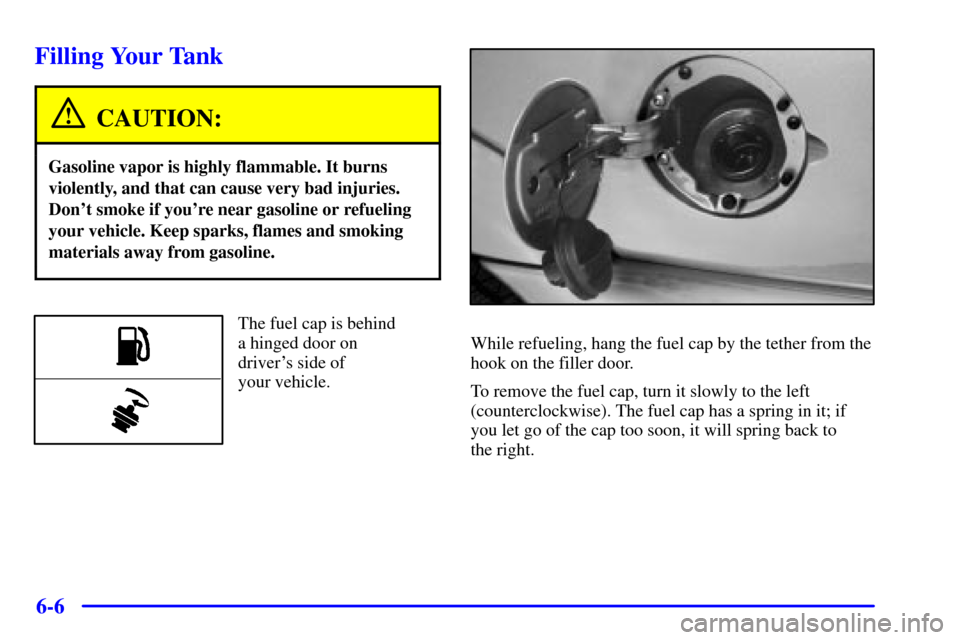
The fuel cap is behind
a hinged door on
driver's side of
your vehicle.
While refueling, hang the fuel cap by the tether from the
hook on the filler door.
To remove the fuel cap, turn it slowly to the left
(counterclockwise). The fuel cap has a spring in it; if
you let go of the cap too soon, it will spring back to
the right.
Page 352 of 488
6-7
CAUTION:
If you get gasoline on yourself and then
something ignites it, you could be badly burned.
Gasoline can spray out on you if you open the
fuel cap too quickly. This spray can happen if
your tank is nearly full, and is more likely in hot
weather. Open the fuel cap slowly and wait for
any ªhissº noise to stop. Then unscrew the cap all
the way.
Be careful not to spill gasoline. Clean gasoline from
painted surfaces as soon as possible. See ªCleaning the
Outside of Your Vehicleº in the Index.When you put the fuel cap back on, turn it to the right
(clockwise) until you hear a clicking sound. Make sure
you fully install the cap. The diagnostic system can
determine if the fuel cap has been left off or improperly
installed. This would allow fuel to evaporate into the
atmosphere. See ªMalfunction Indicator Lampº in
the Index.
NOTICE:
If you need a new fuel cap, be sure to get the
right type. Your dealer can get one for you. If you
get the wrong type, it may not fit properly. This
may cause your malfunction indicator lamp to
light and may damage your fuel tank and
emissions system. See ªMalfunction Indicator
Lampº in the Index.
Page 355 of 488
6-10 Engine Compartment Overview
When you open the hood, you will see the following:
A. Battery
B. Coolant Recovery Tank
C. Engine Oil Dipstick
D. Engine Oil FillE. Automatic Transmission Dipstick
(If Equipped)
F. Power Steering Reservoir
G. Brake Master Cylinder ReservoirH. Engine Air Cleaner/Filter
I. Clutch Master Cylinder Reservoir
J. Engine Compartment Fuse Block
K. Windshield Washer Fluid Reservoir
Page 360 of 488
6-15
Remote Oil Filter (Four-Wheel Drive)
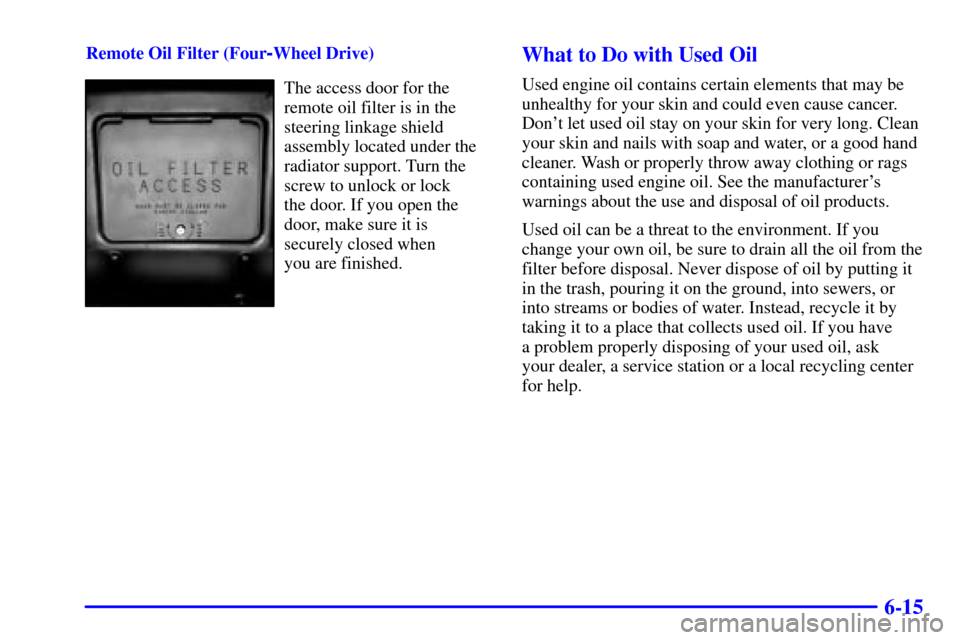
The access door for the
remote oil filter is in the
steering linkage shield
assembly located under the
radiator support. Turn the
screw to unlock or lock
the door. If you open the
door, make sure it is
securely closed when
you are finished.
What to Do with Used Oil
Used engine oil contains certain elements that may be
unhealthy for your skin and could even cause cancer.
Don't let used oil stay on your skin for very long. Clean
your skin and nails with soap and water, or a good hand
cleaner. Wash or properly throw away clothing or rags
containing used engine oil. See the manufacturer's
warnings about the use and disposal of oil products.
Used oil can be a threat to the environment. If you
change your own oil, be sure to drain all the oil from the
filter before disposal. Never dispose of oil by putting it
in the trash, pouring it on the ground, into sewers, or
into streams or bodies of water. Instead, recycle it by
taking it to a place that collects used oil. If you have
a problem properly disposing of your used oil, ask
your dealer, a service station or a local recycling center
for help.