Page 271 of 368

6-17
How to Reset the Change Oil Soon Light
The GM Oil Life System� calculates when to change
your engine oil and filter based on vehicle use. Anytime
your oil is changed, reset the system so it can calculate
when the next oil change is required. If a situation
occurs where you change your oil prior to a CHANGE
OIL SOON light being turned on, reset the system.
After changing the engine oil, reset the system by
performing the following steps:
1. With the engine off, turn the ignition key to RUN.
2. Fully push and release the accelerator pedal slowly
three times within five seconds.
If the CHANGE OIL SOON light flashes, the system
is resetting.
3. Turn the key to OFF, then start the vehicle. The oil
life will change to 100 percent.
If the CHANGE OIL SOON light comes back on, the
system has not reset. Repeat the procedure.
If you have a Driver Information Center, the system may
be reset by pressing the DIC RESET button for five
seconds while viewing the oil life display on the DIC.
See ªDriver Information Centerº in the Index.What to Do with Used Oil
Used engine oil contains certain elements that may be
unhealthy for your skin and could even cause cancer.
Don't let used oil stay on your skin for very long. Clean
your skin and nails with soap and water, or a good hand
cleaner. Wash or properly throw away clothing or rags
containing used engine oil. See the manufacturer's
warnings about the use and disposal of oil products.
Used oil can be a threat to the environment. If you
change your own oil, be sure to drain all the oil from
the filter before disposal. Never dispose of oil by
putting it in the trash, pouring it on the ground, into
sewers, or into streams or bodies of water. Instead,
recycle it by taking it to a place that collects used oil.
If you have a problem properly disposing of your used
oil, ask your dealer, a service station or a local recycling
center for help.
Page 273 of 368
6-19
NOTICE:
If the air cleaner/filter is off, a backfire can
cause a damaging engine fire. And, dirt can
easily get into your engine, which will damage it.
Always have the air cleaner/filter in place when
you're driving.
Passenger Compartment Air Filter
The passenger compartment air filter is located
underneath your hood below the windshield wiper
arm, on the passenger's side (below the air inlet grille)
of the vehicle.
The filter traps most of the pollen from the air entering
the air conditioning module. Like your engine's air
cleaner/filter, it may need to be changed periodically.
For information on how often to change the passenger
compartment air filter, see ªMaintenance Scheduleº in
the Index.To change the passenger compartment air filter, use the
following steps:
1. Turn off the ignition when the windshield wipers are
in the up position.
2. Raise the hood.
3. Disconnect the windshield washer pump hose from
the fender rail and air inlet grille.
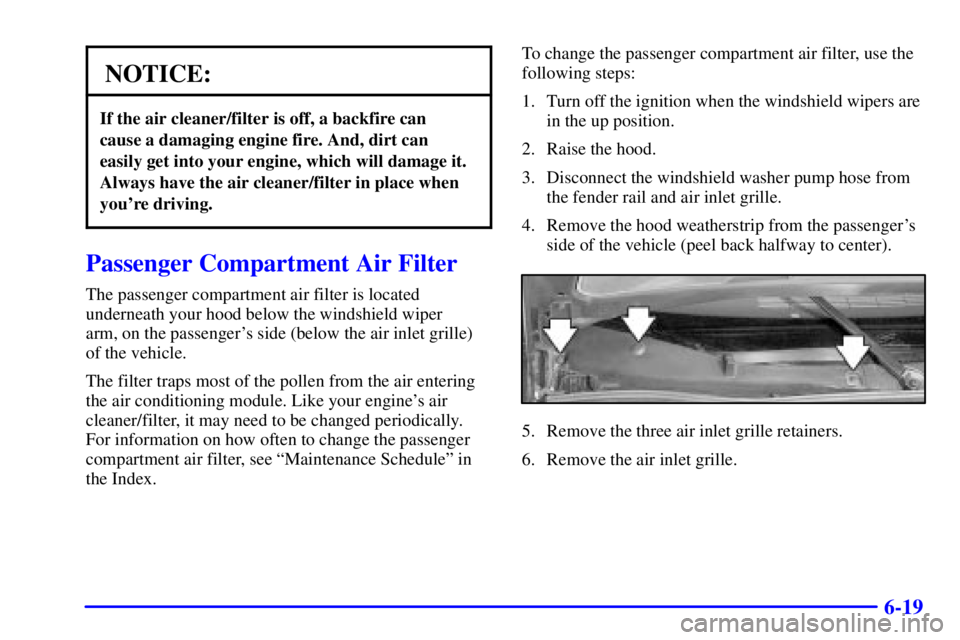
4. Remove the hood weatherstrip from the passenger's
side of the vehicle (peel back halfway to center).
5. Remove the three air inlet grille retainers.
6. Remove the air inlet grille.
Page 289 of 368
6-35
Battery
Your new vehicle comes with a maintenance free
ACDelco� battery. When it's time for a new battery,
get one that has the replacement number shown on the
original battery's label. We recommend an ACDelco
battery. See ªEngine Compartment Overviewº in the
Index for battery location.
WARNING: Battery posts, terminals and related
accessories contain lead and lead compounds, chemicals
known to the State of California to cause cancer and
reproductive harm. Wash hands after handling.
If your battery has a very low charge or is dead, you
may not be able to remove the ignition key from the
ignition switch or shift out of PARK (P). Refer to
ªShifting Out of PARK(P)º in the Index.
Vehicle Storage
If you're not going to drive your vehicle for 25 days
or more, remove the black, negative (
-) cable from
the battery. This will help keep your battery from
running down.
CAUTION:
Batteries have acid that can burn you and gas
that can explode. You can be badly hurt if you
aren't careful. See ªJump Startingº in the Index
for tips on working around a battery without
getting hurt.
Contact your dealer to learn how to prepare your vehicle
for longer storage periods.
Also, for your audio system, see ªTheft
-Deterrent
Featureº in the Index.
Page 297 of 368
6-43
Windshield Wiper Blade Replacement
Windshield wiper blades should be inspected at least
twice a year for wear or cracking. See ªWiper Blade
Checkº in the Index for more information.
1. Turn on the wipers to LO.
2. Turn off the ignition while the wipers are at the
outer positions of the wiper pattern. The blades
are more accessible for removal/replacement while
in this position.
3. Pull the windshield wiper arm 3 to 4 inches
(7.5 to 10 cm) away from the windshield.
4. While holding the wiper arm away from the glass,
push the release clip from under the windshield
wiper arm connecting point and slide the blade
assembly down toward the glass to remove it
from the wiper arm.
5. Slide the new wiper blade securely on the wiper arm
until you hear the release clip ªclickº into place.
For wiper blade length and type, see ªNormal
Maintenance Replacement Partsº in the Index.
Page 300 of 368

6-46 Tire Inflation Monitor System
The tire inflation monitor system can alert you to a large
change in the pressure of one tire. The system ªlearnsº
the pressure at each tire throughout the operating speed
range of your vehicle. The system normally takes
between 45 and 90 minutes of driving to learn the
tire pressures. This time may be longer depending
on your individual driving habits. Learning need not
be accumulated during a single trip. Once learned, the
system will remember the tire pressures until the system
is recalibrated.
After the system has learned tire pressures with properly
inflated tires, the LOW TIRE light will come on if the
pressure in one tire becomes 12 psi (83 kPa) lower than
the other three tires. The tire inflation monitor system
won't alert you if the pressure in more than one tire is
low, if the system is not properly calibrated, or if the
vehicle is moving faster than 70 mph (110 km/h).
The tire inflation monitor system detects differences
in tire rotation speeds that are caused by changes in
tire pressure. The system can alert you about a low
tire
-- but it doesn't replace normal tire maintenance.
See ªTiresº in the Index.When the LOW TIRE light comes on, you should stop
as soon as you can and check all your tires for damage.
(If a tire is flat, see ªIf a Tire Goes Flatº in the Index.)
Also check the tire pressure in all four tires as soon as
you can. See ªInflation
- Tire Pressureº in the Index.
The LOW TIRE light will also be displayed (while the
ignition is on) until you reset (calibrate) the system.
Don't reset the tire inflation monitor system without
first correcting the cause of the problem and checking
and adjusting the pressure in all four tires. If you reset
the system when the tire pressures are incorrect, the
system will not work properly and may not alert you
when a tire is low.
Any time you adjust a tire's pressure, rotate your
tires, or have one or more tires repaired or replaced,
you'll need to reset (calibrate) the tire inflation monitor
system. You'll also need to reset the system whenever
you buy new tires and whenever the vehicle's battery
has been disconnected.
Page 301 of 368

6-47
To reset (calibrate) the system:
1. Turn the ignition to RUN.
2. Locate the red RESET button inside of your
instrument panel fuse block.
The fuse block is located under the cover labeled
FUSES, which is at the end of the instrument panel
on the passenger's side of the vehicle. The RESET
button is the first button in the top row of the
fuse block.
3. Press and hold the RESET button for about
five seconds.
The LOW TIRE light will come on and flash three
times. Then it will go off. If the light doesn't go off,
see your dealer for service.
The system completes the calibration process
during driving.The system normally takes 15 to 20 minutes of driving in
each of three speed ranges to ªlearnº tire pressures. The
speed ranges are 15 to 40 mph (25 to 65 km/h), 40 to
65 mph (65 to 105 km/h) and above 65 mph (105 km/h).
When learning is complete, the system will alert you after
two to eight minutes if a tire is 12 psi (83 kPa) different
from the other three tires. Detection thresholds may be
higher and detection times may be longer on rough roads,
curves and at high speeds. The system is not capable of
detection at speeds greater than 70 mph (110 km/h).
Tire Inspection and Rotation
Tires should be rotated every 6,000 to 8,000 miles
(10 000 to 13 000 km). Any time you notice unusual
wear, rotate your tires as soon as possible and check
wheel alignment. Also check for damaged tires or
wheels. See ªWhen It's Time for New Tiresº and
ªWheel Replacementº later in this section for
more information.
The purpose of regular rotation is to achieve more
uniform wear for all tires on the vehicle. The first
rotation is the most important. See ªScheduled
Maintenance Servicesº in the Index for scheduled
rotation intervals.
Page 321 of 368
6-67
Fuse Usage
PARK LOCK Ignition Key Solenoid
Blank Not Used
Blank Not Used
PCM, BCM,
U/H RELAYIgnition Signal: Hot in Run
and Start, Powertrain Control
Module, Body Control Module,
Underhood Relay
RADIO
PREM. SOUNDRemote Radio Premium Sound
POWER MIRRORS Power Mirrors
Blank Not Used
PANEL DIMMING Panel Dimming
Blank Not Used
IGN 0, CLUSTER,
PCM, BCMIgnition Signal: Hot in Run,
Unlock and Start, Cluster,
Powertrain Control Module,
Body Control ModuleFuse Usage
Blank Not Used
Blank Not Used
Blank Not Used
INADV
POWER BUS
DOOR LOCKS Door Locks
TRAP ALERT Trap Alert�
TAIL LAMPS,
LIC LAMPSTaillamps, License Lamps
RADIO Radio
HEATED MIRROR Heated Mirrors
CRUISE Cruise Control
Blank Not Used
CLUSTER Instrument Panel Cluster
CIGAR LTR Cigarette Lighter,
Auxiliary Power
Connection (Power Drop)
Page 322 of 368
6-68
Fuse Usage
STOP LAMPS Stoplamps
ONSTAR OnStar
�
FRT PARK LPS Parking Lamps
POWER DROP Auxiliary Power Connection
(Power Drop): Hot in ACC
and Run
CRANK SIGNAL,
BCM, CLUSTERCrank Signal, Body Control
Module, Cluster, Powertrain
Control Module
HVAC Ignition Signal, Heating
Ventilation Air Conditioning
Control Head
BTSI PARK LOCK Shifter Lock Solenoid
AIR BAG Air Bag
BCM PWR Body Control Module
HAZARD Hazard FlashersFuse Usage
LH HEATED SEAT Driver's Heated Seat
Blank Not Used
BCM ACC Ignition Signal: Hot in ACC
and Run, Body Control Module
Blank Not Used
LOW BLOWER Low Blower
ABS Anti
-Lock Brakes
TURN SIGNALS,
CORN LPSTurn Signals, Cornering Lamps
RADIO, HVAC,
RFA, CLUSTERRadio, Heating Ventilation Air
Conditioning Head, Remote
Keyless Entry, Cluster
HIGH BLOWER High Blower
RH HEATED SEAT Passenger's Heated Seat
STRG WHL CONT Audio Steering Wheel Controls
WIPER Wipers


