Page 376 of 455

6-31
Your brake master cylinder reservoir is filled with
DOT
-3 brake fluid. See ªEngine Compartment
Overviewº in the Index for the location of the reservoir.
There are only two reasons why the brake fluid level in
the reservoir might go down. The first is that the brake
fluid goes down to an acceptable level during normal
brake lining wear. When new linings are put in, the fluid
level goes back up. The other reason is that fluid is
leaking out of the brake system. If it is, you should
have your brake system fixed, since a leak means that
sooner or later your brakes won't work well, or won't
work at all.
So, it isn't a good idea to ªtop offº your brake fluid.
Adding brake fluid won't correct a leak. If you add fluid
when your linings are worn, then you'll have too much
fluid when you get new brake linings. You should add
(or remove) brake fluid, as necessary, only when work
is done on the brake hydraulic system.CAUTION:
If you have too much brake fluid, it can spill on
the engine. The fluid will burn if the engine is
hot enough. You or others could be burned, and
your vehicle could be damaged. Add brake fluid
only when work is done on the brake hydraulic
system. See ªChecking Brake Fluidº in
this section.
United States Canada
When your brake fluid falls to a low level, your brake
warning light will come on. See ªBrake System Warning
Lightº in the Index.
Page 377 of 455

6-32
What to Add
When you do need brake fluid, use only DOT
-3 brake
fluid. Refer to ªRecommended Fluids and Lubricantsº
in the Index. Use new brake fluid from a sealed
container only.
Always clean the brake fluid reservoir cap and the area
around the cap before removing it. This will help keep
dirt from entering the reservoir.
CAUTION:
With the wrong kind of fluid in your brake
system, your brakes may not work well, or they
may not even work at all. This could cause a
crash. Always use the proper brake fluid.
NOTICE:
�Using the wrong fluid can badly damage
brake system parts. For example, just a few
drops of mineral
-based oil, such as engine
oil, in your brake system can damage brake
system parts so badly that they'll have to be
replaced. Don't let someone put in the
wrong kind of fluid.
�If you spill brake fluid on your vehicle's
painted surfaces, the paint finish can be
damaged. Be careful not to spill brake fluid
on your vehicle. If you do, wash it off
immediately. See ªAppearance Careº in
the Index.
Page 378 of 455

6-33 Brake Wear
Your vehicle has four-wheel disc brakes.
Disc brake pads have built
-in wear indicators that
make a high
-pitched warning sound when the brake
pads are worn and new pads are needed. The sound may
come and go or be heard all the time your vehicle is
moving (except when you are pushing on the brake
pedal firmly).
CAUTION:
The brake wear warning sound means that soon
your brakes won't work well. That could lead to
an accident. When you hear the brake wear
warning sound, have your vehicle serviced.
NOTICE:
Continuing to drive with worn-out brake pads
could result in costly brake repair.
Some driving conditions or climates may cause a brake
squeal when the brakes are first applied or lightly
applied. This does not mean something is wrong with
your brakes.
Properly torqued wheel nuts are necessary to help
prevent brake pulsation. When tires are rotated, inspect
brake pads for wear and evenly tighten wheel nuts in the
proper sequence to GM torque specifications.
Brake linings should always be replaced as complete
axle sets.
See ªBrake System Inspectionº in Section 7 of this
manual under Part C ªPeriodic Maintenance Inspections.º
Brake Pedal Travel
See your dealer if the brake pedal does not return to
normal height, or if there is a rapid increase in pedal
travel. This could be a sign of brake trouble.
Brake Adjustment
Every time you apply the brakes, with or without the
vehicle moving, your brakes adjust for wear.
Page 379 of 455

6-34 Replacing Brake System Parts
The braking system on a vehicle is complex. Its many
parts have to be of top quality and work well together if
the vehicle is to have really good braking. Your vehicle
was designed and tested with top
-quality GM brake
parts. When you replace parts of your braking
system
-- for example, when your brake linings wear
down and you need new ones put in
-- be sure you get
new approved GM replacement parts. If you don't, your
brakes may no longer work properly. For example, if
someone puts in brake linings that are wrong for your
vehicle, the balance between your front and rear brakes
can change
-- for the worse. The braking performance
you've come to expect can change in many other ways
if someone puts in the wrong replacement brake parts.
Battery
Your new vehicle comes with a maintenance free
ACDelco� battery. When it's time for a new battery,
get one that has the replacement number shown on the
original battery's label. We recommend an ACDelco
battery. See ªEngine Compartment Overviewº in the
Index for battery location.
WARNING: Battery posts, terminals and related
accessories contain lead and lead compounds, chemicals
known to the State of California to cause cancer and
reproductive harm. Wash hands after handling.
Page 397 of 455

6-52 Tire Chains
CAUTION:
If your vehicle has P215/70R16 size tires, don't
use tire chains, there's not enough clearance.
Tire chains used on a vehicle without the proper
amount of clearance can cause damage to the
brakes, suspension or other vehicle parts.
The area damaged by the tire chains could cause
you to lose control of your vehicle and you or
others may be injured in a crash.
CAUTION: (Continued)
CAUTION: (Continued)
Use another type of traction device only if its
manufacturer recommends it for use on your
vehicle and tire size combination and road
conditions. Follow that manufacturer's
instructions. To help avoid damage to your
vehicle, drive slowly, readjust or remove the
device if it's contacting your vehicle, and don't
spin your wheels.
If you do find traction devices that will fit, install
them on the front tires for front
-wheel-drive
vehicles. If your vehicle has all
-wheel drive,
install traction devices on either the front tires or
all four tires, but never on the rear tires only.
Page 413 of 455
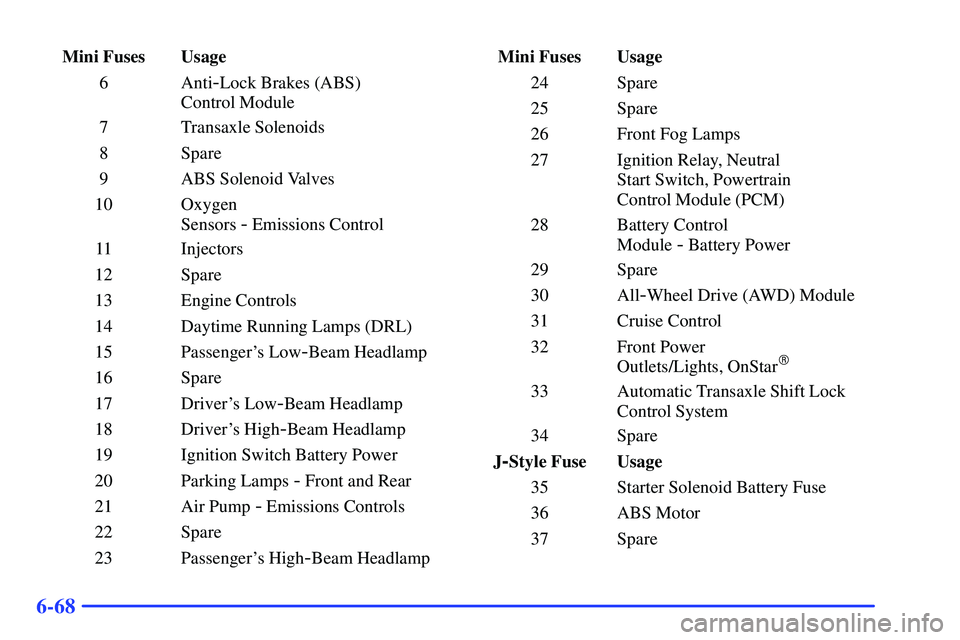
6-68
Mini Fuses Usage
6 Anti
-Lock Brakes (ABS)
Control Module
7 Transaxle Solenoids
8 Spare
9 ABS Solenoid Valves
10 Oxygen
Sensors
- Emissions Control
11 Injectors
12 Spare
13 Engine Controls
14 Daytime Running Lamps (DRL)
15 Passenger's Low
-Beam Headlamp
16 Spare
17 Driver's Low
-Beam Headlamp
18 Driver's High
-Beam Headlamp
19 Ignition Switch Battery Power
20 Parking Lamps
- Front and Rear
21 Air Pump
- Emissions Controls
22 Spare
23 Passenger's High
-Beam HeadlampMini Fuses Usage
24 Spare
25 Spare
26 Front Fog Lamps
27 Ignition Relay, Neutral
Start Switch, Powertrain
Control Module (PCM)
28 Battery Control
Module
- Battery Power
29 Spare
30 All
-Wheel Drive (AWD) Module
31 Cruise Control
32 Front Power
Outlets/Lights, OnStar
�
33 Automatic Transaxle Shift Lock
Control System
34 Spare
J
-Style Fuse Usage
35 Starter Solenoid Battery Fuse
36 ABS Motor
37 Spare
Page 422 of 455

Scheduled Maintenance
7-5
The services shown in this schedule up to 100,000 miles
(166 000 km) should be repeated after 100,000 miles
(166 000 km) at the same intervals for the life of
this vehicle. The services shown at 150,000 miles
(240 000 km) should be repeated at the same interval
after 150,000 miles (240 000 km) for the life of
this vehicle.
See ªOwner Checks and Servicesº and ªPeriodic
Maintenance Inspectionsº following.Footnotes
� The U.S. Environmental Protection Agency or the
California Air Resources Board has determined that the
failure to perform this maintenance item will not nullify
the emission warranty or limit recall liability prior to
the completion of the vehicle's useful life. We, however,
urge that all recommended maintenance services be
performed at the indicated intervals and the
maintenance be recorded.
@ Whenever the tires are rotated, the Check Tire
Pressure System (if equipped) must be reset.
+ A good time to check your brakes is during tire
rotation. See ªBrake System Inspectionº under
ªPeriodic Maintenance Inspectionsº in Part C of
this schedule.
Page 439 of 455

7-22 Throttle System Inspection
Inspect the throttle system for interference or binding,
and for damaged or missing parts. Replace parts as
needed. Replace any components that have high effort
or excessive wear. Do not lubricate accelerator and
cruise control cables.
Transfer Case (Power Transfer Unit) and
Carrier Assembly - Differential (Rear Drive
Module) All-Wheel Drive Inspection
Every 12 months or at engine oil change intervals,
check rear differential and transfer case and add
lubricant when necessary. A fluid loss could indicate a
problem; check and have it repaired, if needed. Check
vent hoses at transfer case and differential for kinks and
proper installation.
Brake System Inspection
Inspect the complete system. Inspect brake lines and
hoses for proper hook
-up, binding, leaks, cracks,
chafing, etc. Inspect disc brake pads for wear and rotors
for surface condition. For vehicles with rear drum
brakes, also inspect drum brake linings for wear and
cracks. Inspect other brake parts, including drums,
wheel cylinders, calipers, parking brake, etc. Check
parking brake adjustment. You may need to have your
brakes inspected more often if your driving habits or
conditions result in frequent braking.