2002 BMW Z3 ECO mode
[x] Cancel search: ECO modePage 102 of 187

102n
Antilock Brake System (ABS)Information for your safetyNot even ABS can suspend the laws
of physics. ABS alone cannot prevent
accidents if the brakes are applied
without an adequate, safe distance
between vehicles or if the speed limit
has been exceeded. Nor can it prevent
the hazards of aquaplaning. Responsi-
bility for these types of situations
remains in the hands (and at the feet) of
the driver. You should never allow the
added safety of ABS to lull you into a
false sense of security, or mislead you
into taking increased risks that could
affect your own safety and that of
others.
Do not make any modifications to
the ABS system.
Service procedures on ABS are to be
performed by authorized technicians
only.< Antilock Brake System (ABS)/
Cornering Brake Control (CBC)CBC is an advanced engineering
design of the ABS. When braking while
cornering at high speed or braking
during high lateral acceleration, or
when braking during a lane change,
vehicle stability is improved and
steering response is enhanced.
In the event of a fault
The ABS warning lamp comes
on, refer to page 21. The brake
system then reverts to conven-
tional operation as on vehicles
without ABS. However, have the
brake system checked by your
BMW center as soon as possible. To
prevent undetected defects and cumu-
lative faults from adversely affecting the
brake system, refer any problems to
your BMW center at the earliest oppor-
tunity.
The red warning lamp for the
brake hydraulic system comes
on together with the yellow indi-
cator lamps for ABS, ASC+T/
DSC
and ADB/DBC
(refer to
page 21), the entire ABS, CBC,
ASC+T/DSC and ADB/DBC
control system has failed.
Continue to drive cautiously and
defensively. Avoid full brake applica-
tions because the vehicle could
become unstable and go out of control.
Have the system checked by your BMW
center as soon as possible.
Warning lamps for Canadian
models.
Page 103 of 187

103n
IndexDataTechnologyRepairsMaintenanceControlsOverview
ABS Disc brakesDynamic Brake Control (DBC)*DBC is included in the DSC, refer to
information beginning on page 74.
If you step on the brake rapidly, this
system automatically produces
maximum braking force boost and thus
helps to achieve the shortest possible
braking distance during "panic stops".
All of the benefits of the ABS system
are exploited under these circum-
stances.
Do not reduce the pressure on the
brake pedal for the duration of the
brake application. When the brake
pedal is released, the DBC is deacti-
vated.
In the event of a malfunction,
the brake warning lamp lights up
yellow. Normal braking effi-
ciency is still fully available.
Have the system checked and
repaired at your BMW center as
soon as possible.
Please observe the section "Infor-
mation for your safety" concerning
the ABS system, which also applies to
the DSC system.<
Disc brakes furnish optimum decelera-
tion and braking control and greater
fade resistance under heavy use.
When the vehicle is driven only occa-
sionally, during extended periods when
the vehicle is not used at all, or in oper-
ating conditions where brake applica-
tions are less frequent, there is an
increased tendency for corrosion of the
rotors and accumulation of contamina-
tion on the brake pads. This occurs
because the minimal pressure which
must be exerted by the pads to clean
the rotors by brake applications is not
reached.
If the brake rotors are corroded, they
will tend to respond to braking with a
pulsating effect which even extended
application will fail to cure.
For your own safety: use only
brake pads that BMW has
approved for your specific vehicle
model. BMW cannot evaluate non-
approved brake pads to determine if
they are suited for use, and therefore
cannot ensure the operating safety of
the vehicle in the event of their use.<
Driving notesWhile driving in wet conditions and in
heavy rain, it is advisable to apply light
pressure to the brake pedal every few
miles Ð watch traffic conditions to
ensure that this maneuver does not
endanger other road users. The heat
generated in this process helps dry the
pads and rotors.
Maximum braking force is obtained
while the wheels continue to rotate,
peaking when the wheels remain on the
verge of locking without actually doing
so. ABS maintains this state automati-
cally. If the ABS fails, you should revert
to the staggered braking technique
described on page 106.
Extended or steep mountain descents
should be driven in the gear in which
only minimal periodic brake application
is required. This avoids excessive strain
on the brakes and possible
impairment of the braking effect.
You can increase the engine's braking
effect by selecting progressively lower
gears, downshifting into first gear, if
necessary. You can also downshift into
first gear if you are using the manual
mode in a vehicle with automatic trans-
mission, refer to page 63.
Page 104 of 187
104n
Disc brakes Brake system Should engine braking prove inade-
quate, you should still avoid extended,
continuous braking. Instead, decelerate
the vehicle with increased pressure on
the brake pedal (watch for following
traffic), release the pedal and then
repeat the brake application (staggered
braking). This staggered braking tech-
nique allows the brakes to cool in the
intervals between active braking
phases, preventing overheating and
ensuring that full braking capacity
remains available at all times.
Do not coast with the clutch
depressed or with the transmis-
sion or selector lever in Neutral. Do not
coast with the engine switched off. The
engine provides no braking effect when
the clutch is depressed and there is no
power-assist for braking or steering
when the engine is not running.
Never allow floor mats, carpets or any
other objects to protrude into the area
around the accelerator, clutch and
brake pedals and obstruct their move-
ment.<
Brake fluid level
The warning lamp for the
hydraulic brake system comes
on:
The brake fluid level is too low in
the reservoir (refer to page 126).
If the brake fluid level is too low
and brake pedal travel has become
noticeably longer, there may be a
defect in one of the two brake system's
hydraulic circuits.
Proceed to the nearest BMW
center. Higher brake application
pressure may be necessary under these
conditions, and braking distances may
be significantly longer. Please
remember to adapt your driving style
accordingly.<
Brake pads
The warning lamp for the brake
pads comes on:
The brake pads have reached
their minimum pad thickness. Proceed
to the nearest BMW center as soon as
possible to have the pads replaced.
For your own safety: use only
brake pads that BMW has
approved for your specific vehicle
model. BMW cannot evaluate non-
approved brake pads to determine if
they are suited for use, and therefore
cannot ensure the operating safety of
the vehicle in the event of their use.<
Page 111 of 187

111n
IndexDataTechnologyRepairsMaintenanceControlsOverview
Tire condition Tire replacementmoderate speeds and with only small
amounts of water on the road.
Never continue driving on a
deflated (flat) tire. A flat tire greatly
impairs steering and braking response,
and can lead to complete loss of
control over the vehicle.
Avoid overloading the vehicle so that
the permitted load on the tires is not
exceeded. Overloading causes over-
heating and damage inside the tires.
The ultimate result can assume the
form of a sudden air loss.
Unusual vibrations encountered during
normal vehicle operation can indicate a
flat tire or some other vehicle malfunc-
tion. The type of problem can be
caused by contact with curbs, etc. This
is also true for irregularities in the
vehicle's handling characteristics, such
as a pronounced tendency to pull to the
left or right. Should this occur, respond
by immediately reducing your speed.
Proceed carefully to the nearest BMW
center or professional tire center, or
have the vehicle towed in to have it, its
wheels and tires inspected.
Tire damage (up to and including
sudden and complete air loss) can pose
an extreme hazard for both vehicle
occupants and other road users.< To maintain good handling and vehicle
response, use only tires of a single tread
configuration from a single manufac-
turer. BMW tests and approves wheel
and tire combinations, refer to page 116.
DOT Quality GradesTread wear
Traction AA A B C
Temperature A B C
All passenger vehicle tires must
conform to Federal Safety
Requirements in addition to these
grades.
when tested under controlled condi-
tions on a specified government test
course.
For example, a tire graded 150 would
wear one and one-half (1g) times as
well on the government course as a tire
graded 100. The relative performance
of tires depends upon the actual condi-
tions of their use, however, and may
depart significantly from the norm due
to variations in driving habits, service
practices and differences in road char-
acteristics and climate.
Page 129 of 187

129n
IndexDataTechnologyRepairsMaintenanceControlsOverview
The BMW Maintenance SystemService and Warranty Information
Booklet (US models)/Warranty
and Service Guide Booklet
(Canadian models)For detailed information on required
maintenance items and the work
involved, please refer to the Service
and Warranty Information Booklet (US
models) or to the Warranty and Service
Guide Booklet (Canadian models).
Depending upon operating conditions,
it may be advisable to have the body
checked for damage from rocks or
gravel as a precaution against rust.Have your BMW center perform
the maintenance and repair.
Your BMW center is always informed on
the latest maintenance work and repair
techniques and is equipped with the
required special tools. In addition,
checking parts known from experience
to be subject to wear is a permanent
part of the maintenance specifications.
Be sure that all maintenance work is
confirmed in the Service and Warranty
Information Booklet (US models) or the
Warranty and Service Guide Booklet
(Canadian models). These entries will
constitute your proof that the vehicle
has received regular maintenance. They
are also required for warranty claims.<
Page 133 of 187

133n
IndexDataTechnologyRepairsMaintenanceControlsOverview
OBD interface socketAccess to the interface socket for the
Onboard Diagnostic system (OBD):
Lift off the side cover in the center
console on the passenger's side
(arrow).
The purpose of the OBD system is to
ensure proper operation of the emis-
sion control system throughout the
vehicle's lifetime by monitoring emis-
sion-related components and systems
for deterioration and malfunction.367us235
An illuminated indicator informs
you of the need for service,
but not of the need to stop the
vehicle. However, the systems should
be checked by your BMW center at the
earliest possible opportunity.
Under certain conditions, the indicator
will blink or flash. This indicates a rather
severe level of engine misfire. When
this occurs, you should reduce speed
and consult the nearest BMW center as
soon as possible. Severe engine misfire
over only a short period of time can
seriously damage emission control
components, especially the catalytic
converter.
"Service Engine Soon" warning
lamp for Canadian models.
When the filler cap is not properly
tightened, the OBD system can
detect the vapor leak and the indicator
will light up. If the filler cap is subse-
quently tightened, the indicator should
go out within a few days.<
Page 153 of 187
153n
IndexDataTechnologyRepairsMaintenanceControlsOverview
Battery
Battery posts, terminals and
related accessories contain lead
and lead compounds. Wash hands after
handling.<
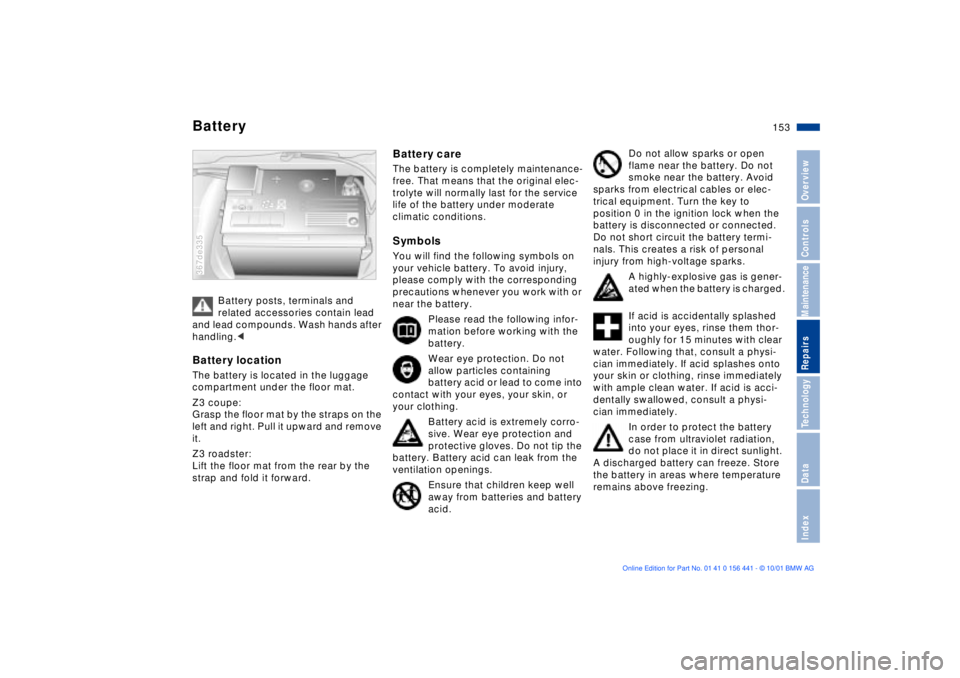
Battery locationThe battery is located in the luggage
compartment under the floor mat.
Z3 coupe:
Grasp the floor mat by the straps on the
left and right. Pull it upward and remove
it.
Z3 roadster:
Lift the floor mat from the rear by the
strap and fold it forward.367de335
Z3 d Z3
Battery careThe battery is completely maintenance-
free. That means that the original elec-
trolyte will normally last for the service
life of the battery under moderate
climatic conditions.SymbolsYou will find the following symbols on
your vehicle battery. To avoid injury,
please comply with the corresponding
precautions whenever you work with or
near the battery.
Please read the following infor-
mation before working with the
battery.
Wear eye protection. Do not
allow particles containing
battery acid or lead to come into
contact with your eyes, your skin, or
your clothing.
Battery acid is extremely corro-
sive. Wear eye protection and
protective gloves. Do not tip the
battery. Battery acid can leak from the
ventilation openings.
Ensure that children keep well
away from batteries and battery
acid.
Do not allow sparks or open
flame near the battery. Do not
smoke near the battery. Avoid
sparks from electrical cables or elec-
trical equipment. Turn the key to
position 0 in the ignition lock when the
battery is disconnected or connected.
Do not short circuit the battery termi-
nals. This creates a risk of personal
injury from high-voltage sparks.
A highly-explosive gas is gener-
ated when the battery is charged.
If acid is accidentally splashed
into your eyes, rinse them thor-
oughly for 15 minutes with clear
water. Following that, consult a physi-
cian immediately. If acid splashes onto
your skin or clothing, rinse immediately
with ample clean water. If acid is acci-
dentally swallowed, consult a physi-
cian immediately.
In order to protect the battery
case from ultraviolet radiation,
do not place it in direct sunlight.
A discharged battery can freeze. Store
the battery in areas where temperature
remains above freezing.
Page 183 of 187

Everything from A to Z
183n
IndexDataTechnologyRepairsMaintenanceControlsOverview
Replacing fuses156t
Replacing windshield wiper
blades136t
Reporting safety defects7
Reservoir, washer
system122t
Roll-up cover93
Roof load capacity172
Roof-mounted luggage
rack95
Rubber seals and
components, winter105SSafety belt tensioner166
Safety belts52
Safety defects, reporting7
Seals and components,
winter105
Seat adjustment49
Seat heating89
Securing cargo94
Selector lever, automatic
transmission62
Service and Warranty
Information Booklet
(US models)129Service Interval
Display69, 128
Set temperature82, 86
Shiftlock62
Side airbags54, 130
Side marker lamps, bulb
replacement139t
Sitting correctly with
airbags55
Skid control106
Slippery roads105
Snow chains105t
Socket92
electrical appliances92
flashlight92
vacuum cleaner92
Spare keys30
Spare tire147t
Spare wheel147t
Spark plugs174
Special features of winter
tires115
Special oils124
Specifications, engine170
Speed, average72
Speed control67
Starting assistance158tStarting problems
59, 100, 158
Starting the engine59
Steel wheel116
Steering106
Steering wheel lock58
Steptronic62
Storage boxes90
Storage compartments90
Storage trays90
Storing the vehicle130
Summer tires114
Sunroof39
Switching off the engine60
Symbols4, 153
TTachometer68
Tail lamp assembly, bulb
replacement139t
Tail lamps139, 140
bulb replace-
ment139t, 140t
Tank capacity173
Technical Data169
Technical
modifications6, 132Telephone
refer to the separate
Owner's Manual
Temperature display
engine coolant69
outside temperature71
Temperature
layering82, 87
Third brake lamp141
Tire change, refer to wheel
change146t
Tire condition110
Tire failure, Z3 roadster,
Z3 coupe146
Tire inflation pressures110
checking26t
Tire Quality Grading112
Tire replacement111, 112
Tire rotation between front
and rear113
Tire size116
Tire tread110
Tires, identification114
Tools136t
Torque170
Tow fittings159t
Towing the vehicle159t