2002 BMW Z3 transmission
[x] Cancel search: transmissionPage 60 of 187
60n
Switching off the engine Parking brakeTurn the ignition key to position 1 or 0.
Do not remove the ignition key
while the vehicle is rolling. The
steering locks and it is impossible to
steer the vehicle.
Always remove the ignition key and
engage the steering lock before leaving
the vehicle.
Vehicles with manual transmission:
Always engage the parking brake when
parking on slopes and inclined
surfaces, since even placing the gear-
shift lever in 1st gear or reverse may not
provide adequate resistance to rolling.
Vehicles with automatic transmission:
Place the selector lever in "P".<
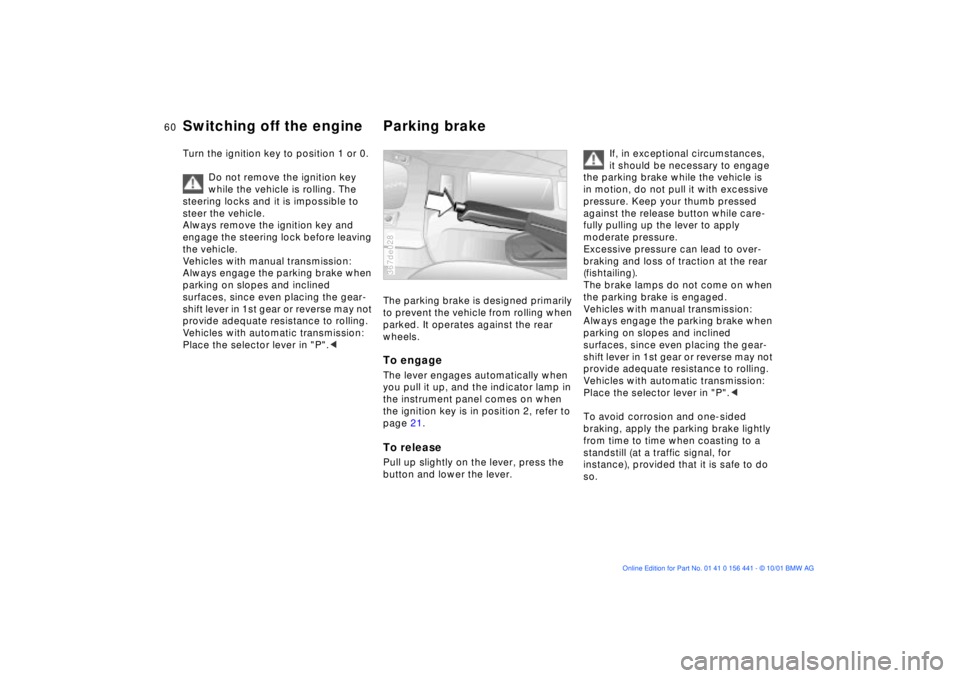
The parking brake is designed primarily
to prevent the vehicle from rolling when
parked. It operates against the rear
wheels.To engageThe lever engages automatically when
you pull it up, and the indicator lamp in
the instrument panel comes on when
the ignition key is in position 2, refer to
page 21.To releasePull up slightly on the lever, press the
button and lower the lever.367de028
If, in exceptional circumstances,
it should be necessary to engage
the parking brake while the vehicle is
in motion, do not pull it with excessive
pressure. Keep your thumb pressed
against the release button while care-
fully pulling up the lever to apply
moderate pressure.
Excessive pressure can lead to over-
braking and loss of traction at the rear
(fishtailing).
The brake lamps do not come on when
the parking brake is engaged.
Vehicles with manual transmission:
Always engage the parking brake when
parking on slopes and inclined
surfaces, since even placing the gear-
shift lever in 1st gear or reverse may not
provide adequate resistance to rolling.
Vehicles with automatic transmission:
Place the selector lever in "P".<
To avoid corrosion and one-sided
braking, apply the parking brake lightly
from time to time when coasting to a
standstill (at a traffic signal, for
instance), provided that it is safe to do
so.
Page 61 of 187
61n
IndexDataTechnologyRepairsMaintenanceControlsOverview
Manual transmissionPress the clutch pedal all the way down
each time you shift, pressing the gear-
shift lever into its proper end position.
Depress the clutch when starting the
vehicle, too, otherwise, lockout will
prevent the engine from starting.
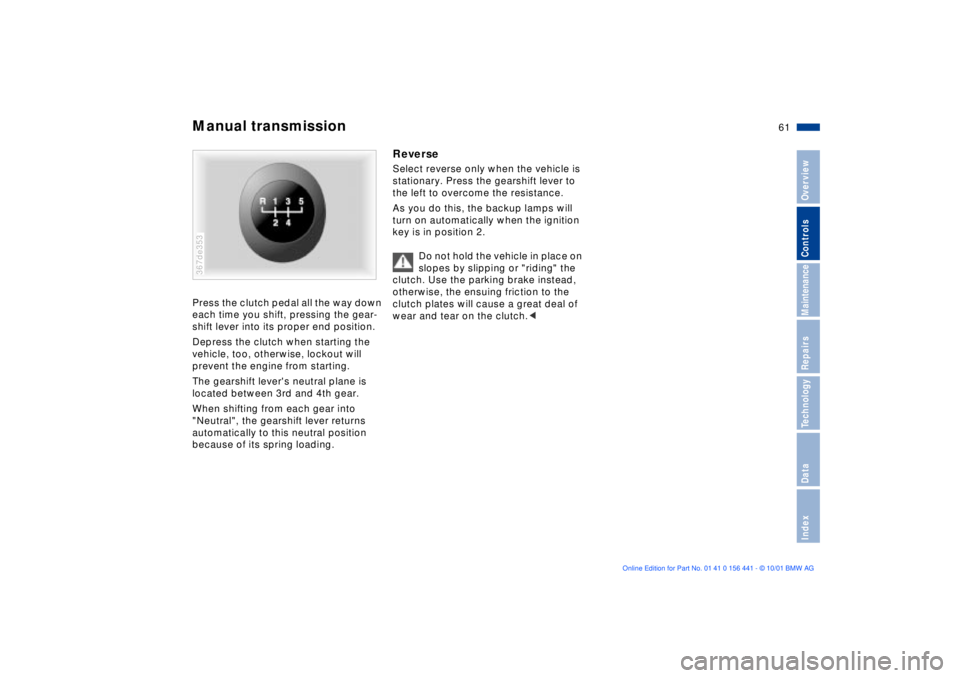
The gearshift lever's neutral plane is
located between 3rd and 4th gear.
When shifting from each gear into
"Neutral", the gearshift lever returns
automatically to this neutral position
because of its spring loading.367de353
ReverseSelect reverse only when the vehicle is
stationary. Press the gearshift lever to
the left to overcome the resistance.
As you do this, the backup lamps will
turn on automatically when the ignition
key is in position 2.
Do not hold the vehicle in place on
slopes by slipping or "riding" the
clutch. Use the parking brake instead,
otherwise, the ensuing friction to the
clutch plates will cause a great deal of
wear and tear on the clutch.<
Page 62 of 187
62n
Automatic transmission with Steptronic
*
You can drive as with a normal auto-
matic transmission. In addition, you can
also shift manually.
When you move the selector lever from
the "D" position to the left into the M/S
range, the performance-oriented shift
programs of the automatic transmission
are engaged. As soon as you briefly tab
the selector lever in the "+" or "Ð" direc-
tion, Steptronic changes the gear. The
manual mode is engaged. When you
wish to use the automatic transmission
mode again, move the selector lever to
the right into the "D" position.
The automatic transmission of your
BMW is equipped with Adaptive Trans-
mission Control (ATC), a system which
reacts with precision to your individual
driving style and the driving conditions.
To achieve this, different shift programs
are automatically engaged.
For additional details concerning the
ATC, please refer to the chapter
"Advanced technology" on page 164.
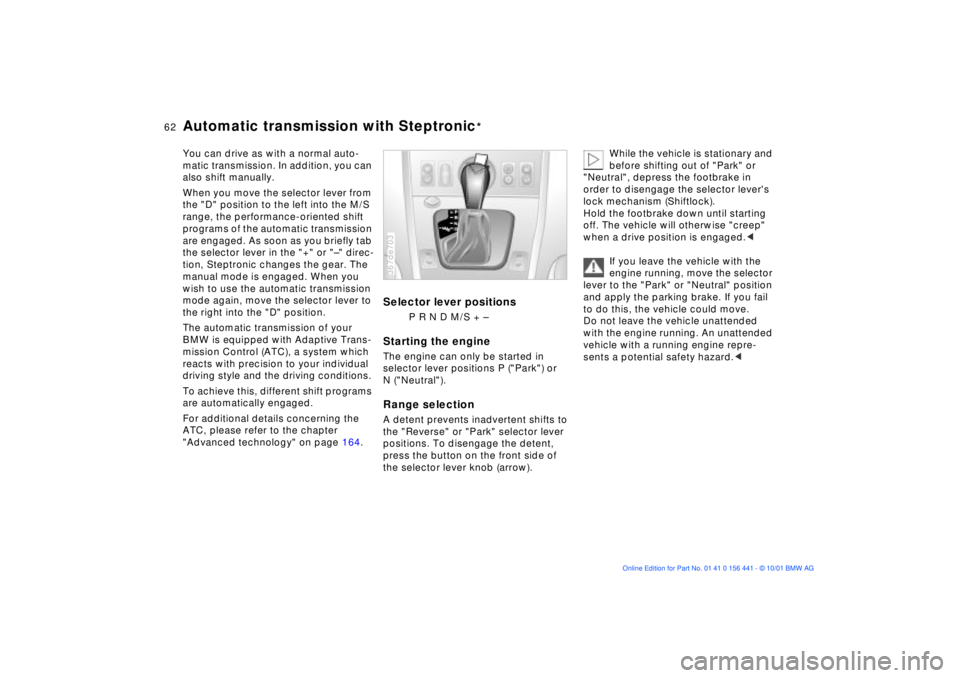
Selector lever positions
P R N D M/S + Ð
Starting the engine The engine can only be started in
selector lever positions P ("Park") or
N ("Neutral"). Range selection A detent prevents inadvertent shifts to
the "Reverse" or "Park" selector lever
positions. To disengage the detent,
press the button on the front side of
the selector lever knob (arrow). 367de703
While the vehicle is stationary and
before shifting out of "Park" or
"Neutral", depress the footbrake in
order to disengage the selector lever's
lock mechanism (Shiftlock).
Hold the footbrake down until starting
off. The vehicle will otherwise "creep"
when a drive position is engaged.<
If you leave the vehicle with the
engine running, move the selector
lever to the "Park" or "Neutral" position
and apply the parking brake. If you fail
to do this, the vehicle could move.
Do not leave the vehicle unattended
with the engine running. An unattended
vehicle with a running engine repre-
sents a potential safety hazard.<
Page 63 of 187

63n
IndexDataTechnologyRepairsMaintenanceControlsOverview
Automatic transmission with Steptronic
*
P Ñ Park Select only when the vehicle is
stationary. The transmission locks to
prevent the rear wheels from turning.R Ñ Reverse Select only when the vehicle is
stationary. N Ñ Neutral Select only if your journey is interrupted
for a longer period. D Ñ Drive
(automatic shift program) This position is designed for driving
under all normal operating conditions.
All forward gears are available. Kickdown In the kickdown mode, you achieve
maximum performance and in
position D, you reach maximum speed.
Depress the accelerator pedal past the
increased resistance point at the full-
throttle position.
M/S Ð manual mode and
Sport Program When you change from D to M/S, the
Sport Program is activated. This is
indicated by "S" in the gear selection
display. The M/S mode is recom-
mended for performance-oriented
driving.
With the first brief touch, the automatic
transmission shifts from the Sport
Program to the manual mode. When
you tab the selector lever in the "+"
direction, the transmission shifts up.
When the lever is tabbed in the
"Ð" direction, the transmission shifts
down. M1 to M5 is indicated in the
transmission range display.
Upshifts or downshifts will only be
carried out by the ATC at appropriate
engine speeds and road speeds. If the 367de704
engine speed is too high, for instance,
the downshift will not be executed. The
gear selected will appear briefly in the
instrument cluster followed by the
current gear.
If you are driving in the manual
mode and wish to accelerate
rapidly Ð to pass another vehicle, for
example Ð shift down manually or with
the "Kickdown" function.<
You can only change from M/S to
selector lever positions "P", "R" and "N"
via the "D" position.
In the following situations, the Steptronic
"thinks" for you in the manual mode:
>In order to prevent engine over-
speeding, the transmission shifts
automatically to the next higher gear
shortly before the engine speed
cutoff point
>At low speeds, the transmission
shifts down automatically Ð you do
not have to act
>In the kickdown mode, the transmis-
sion shifts down to the lowest possible
gear based on the engine speed
>Depending on the situation Ð when
driving in adverse winter conditions,
for example Ð the transmission may
also start out in 2nd or 3rd gear.
Page 64 of 187

64n
Automatic transmission with Steptronic
*
Turn signals/High beams
Available displays
S M1 M2 M3 M4 M5
Electronic transmission control
module
If the indicator lamp comes on
there is a fault in the transmis-
sion system.
All of the selector lever positions can
continue to be used; in the forward
drive positions, however, the vehicle
will be operating with restricted gear
availability.
If this happens, avoid extreme engine
loads and consult the nearest BMW
center.
367us723
Do not work in the engine
compartment when a drive gear
(forward or reverse) is engaged. If you
do so, the vehicle could move.<
Information on jump-starting, tow-
starting and towing, refer to
pages 158, 159.
1 High beams (blue indicator lamp)
2 Headlamp flasher (blue indicator
lamp)
3 Turn signal indicators (green indicator
lamp and rhythmic clicking of the
relay)
If the indicator lamp and the clicking
from the relay are both faster than
normal, one of the turn signal indicators
has failed.To signal brieflyPress the lever up to but not beyond
the pressure point. It then returns to the
center position when released.367us024
Page 67 of 187
67n
IndexDataTechnologyRepairsMaintenanceControlsOverview
Cruise control
*
You can maintain and store any desired
vehicle speed above approx. 25 mph
(40 km/h).
The system is switched off and the
stored speed deleted from its memory
when you turn the ignition key to posi-
tion 0.
Do not use the cruise control on
winding roads, when high traffic
density prevents driving at a constant
speed, when the road surface is slick
(snow, rain, ice) or when the road
surface is loose (rocks or gravel,
sand).< 365us059
To maintain and store speed/
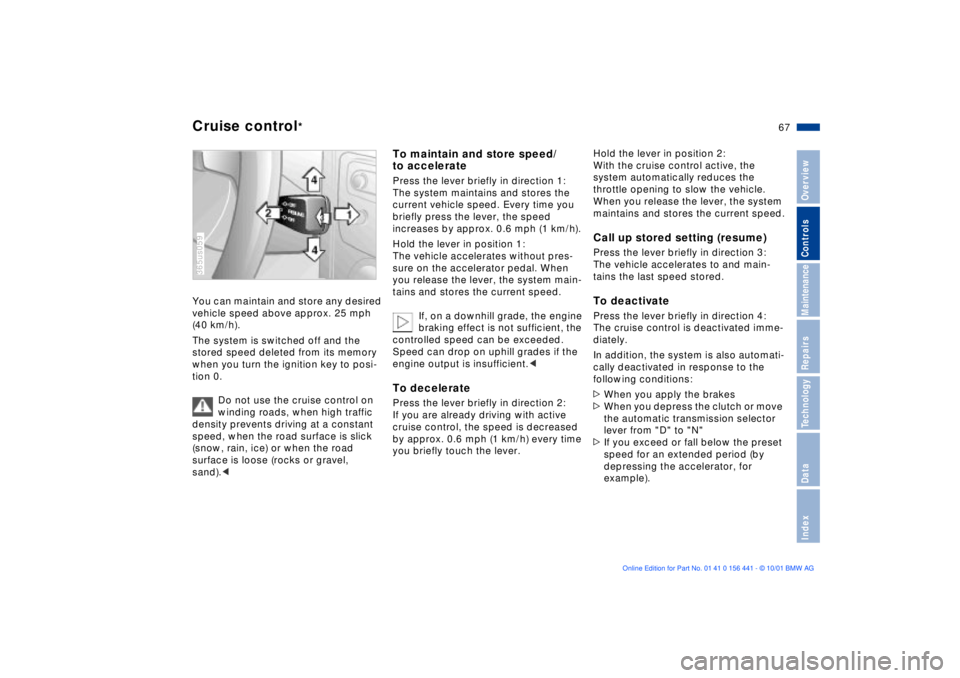
to acceleratePress the lever briefly in direction 1:
The system maintains and stores the
current vehicle speed. Every time you
briefly press the lever, the speed
increases by approx. 0.6 mph (1 km/h).
Hold the lever in position 1:
The vehicle accelerates without pres-
sure on the accelerator pedal. When
you release the lever, the system main-
tains and stores the current speed.
If, on a downhill grade, the engine
braking effect is not sufficient, the
controlled speed can be exceeded.
Speed can drop on uphill grades if the
engine output is insufficient.< To deceleratePress the lever briefly in direction 2:
If you are already driving with active
cruise control, the speed is decreased
by approx. 0.6 mph (1 km/h) every time
you briefly touch the lever.
Hold the lever in position 2:
With the cruise control active, the
system automatically reduces the
throttle opening to slow the vehicle.
When you release the lever, the system
maintains and stores the current speed.Call up stored setting (resume)Press the lever briefly in direction 3:
The vehicle accelerates to and main-
tains the last speed stored.To deactivatePress the lever briefly in direction 4:
The cruise control is deactivated imme-
diately.
In addition, the system is also automati-
cally deactivated in response to the
following conditions:
>When you apply the brakes
>When you depress the clutch or move
the automatic transmission selector
lever from "D" to "N"
>If you exceed or fall below the preset
speed for an extended period (by
depressing the accelerator, for
example).
Page 68 of 187

68n
1 OdometerYou can activate the displays shown in
the illustration with the ignition key in
position 0 by pressing the button in the
instrument cluster (arrow).2 Trip odometer/Gear indicator
for automatic transmission with
Steptronic
*
Trip odometer:
To reset the trip odometer to zero,
press the button (arrow) with the igni-
tion key in position 1 or higher.
Gear indicator:
>S for Sport Program
>M1 to M5 for manual mode.367us710
Never allow the engine to operate with
the needle in the red overspeed sector
of the gauge.
To protect the engine, the engine-
management system automatically
interrupts the fuel supply in this range;
you will notice a loss of power.367de005
When you switch on the ignition, the
indicator lamp comes on briefly to
confirm that the system is operational.
Once the indicator lamp stays on
continuously, there are still approx.
2.1 gallons (8 liters) of fuel in the fuel
tank.
Tank capacity: page 173.
If the tilt of the vehicle varies (extended
driving in mountainous areas, for
example), the needle may fluctuate
slightly.
Please refuel early, since driving
to the last drop of fuel can result in
damage to the engine and/or catalytic
converter.< 367us006
Odometer Tachometer Fuel gauge
Page 99 of 187
99n
IndexDataTechnologyRepairsMaintenanceControlsOverview
Driving notes
Brakes:
Do not drive with your foot resting
on the brake pedal. Even light but
consistent pedal pressure can lead to
high temperatures, brake wear and
possibly even brake failure.
Aquaplaning:
When driving on wet or slushy roads,
reduce vehicle speed. If you do not, a
wedge of water may form between the
tires and the road surface. This
phenomenon is referred to as aqua-
planing or hydroplaning. It is character-
ized by a partial or complete loss of
contact between the tires and the road
surface. The ultimate results are loss of
steering and braking control.
Driving through water:
When there is water on the roads, do
not drive in it if it is deeper than 1 ft
(30 cm). If the water is at that depth,
drive only at walking speed, otherwise
the vehicle can sustain damage to the
engine, the electrical systems and the
transmission.
Clothes hooks (coupe):
Hang items of clothing on the hooks in
such a manner that they do not obstruct
the driver's vision. Do not hang heavy
objects on the hooks. If you do so, they
could cause personal injury during
braking or evasive maneuvers.<