Page 106 of 187

106n
Winter operation Power steeringIf it should occur that the ABS does not
respond in a critical braking situation
and the wheels lock: reduce the pres-
sure on the brake pedal until the wheels
just start to roll again while still main-
taining enough force to continue
braking. Following that, increase pedal
pressure again. Reduce the pressure as
the wheels lock, then reapply pressure.
Repeat this process.
This type of staggered braking will
shorten the braking distance, and the
vehicle still remains responsive to
steering.
You can still attempt to steer around
hazards once you have reduced the
pressure on the brake pedal.
Do not shift down on slick road
surfaces. Doing so could cause
the rear wheels to lose traction and
skid, which could result in the loss of
vehicle control.<
Declutch during hard braking on
road surfaces which provide only
poor or uneven traction.<
Skid controlDepress the clutch and release the
accelerator pedal, or place the selector
lever of the automatic transmission into
the "Neutral" position. Countersteer
carefully and attempt to regain control
of the vehicle.ParkingEngage 1st or reverse gear. If your
vehicle is equipped with an automatic
transmission, place the selector lever in
"Park". On vehicles with manual trans-
mission, also apply the parking brake
when parking on inclined surfaces. In
order to prevent the parking brake
linings from locking due to frost or
corrosion, dry them by gently applying
the parking brake as the vehicle is
coming to a stop. Make sure that
following traffic is not endangered.
The brake lamps do not light
up when the parking brake is
applied.<
If you notice a change in steering
response (high steering effort, for
example):
Consult a BMW center to have the
system checked.
If the power steering fails,
increased effort will be required
to steer the vehicle.<
Page 123 of 187
123n
IndexDataTechnologyRepairsMaintenanceControlsOverview
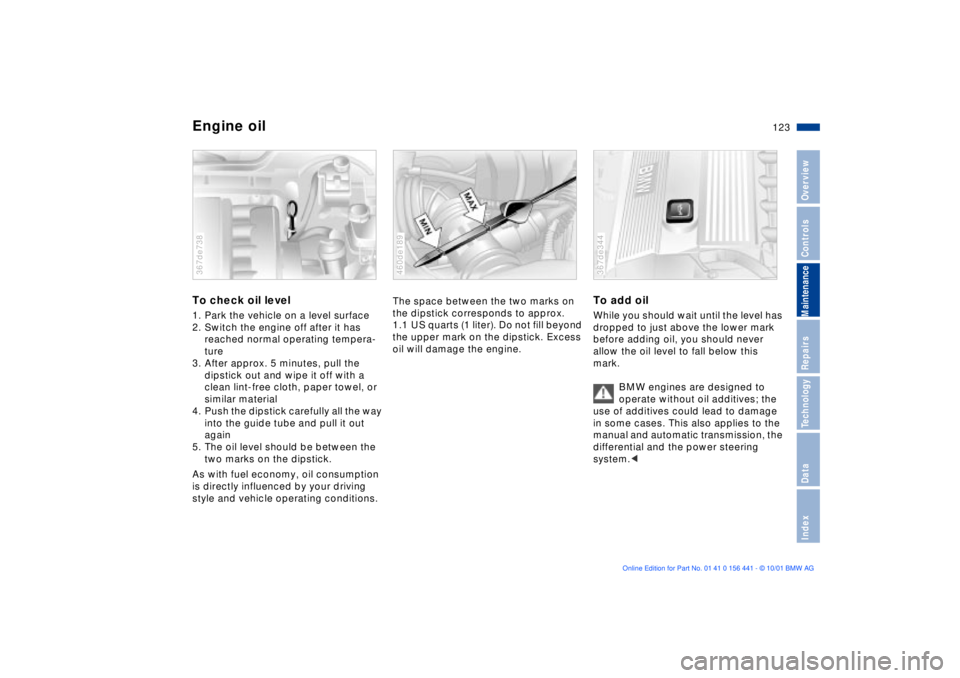
Engine oil To check oil level1. Park the vehicle on a level surface
2. Switch the engine off after it has
reached normal operating tempera-
ture
3. After approx. 5 minutes, pull the
dipstick out and wipe it off with a
clean lint-free cloth, paper towel, or
similar material
4. Push the dipstick carefully all the way
into the guide tube and pull it out
again
5. The oil level should be between the
two marks on the dipstick.
As with fuel economy, oil consumption
is directly influenced by your driving
style and vehicle operating conditions.367de738
The space between the two marks on
the dipstick corresponds to approx.
1.1 US quarts (1 liter). Do not fill beyond
the upper mark on the dipstick. Excess
oil will damage the engine.460de189
To add oilWhile you should wait until the level has
dropped to just above the lower mark
before adding oil, you should never
allow the oil level to fall below this
mark.
BMW engines are designed to
operate without oil additives; the
use of additives could lead to damage
in some cases. This also applies to the
manual and automatic transmission, the
differential and the power steering
system.< 367de344
Page 131 of 187

131n
IndexDataTechnologyRepairsMaintenanceControlsOverview
Storing your vehicle5. Fill the fuel tank completely to
prevent the formation of condensa-
tion
6. Increase the tire inflation pressure to
51 psi (350 kPa).Before parking the vehicle for
storage1. Dry the parking brake and footbrake
by brake applications to prevent the
brake rotors and drums from
corroding
2. Park the vehicle in a covered, dry,
and well-ventilated room. Place the
transmission in 1st gear or set the
selector lever to the "P" position.
Chock the wheels to prevent the
vehicle from rolling if necessary. Do
not set the parking brake
3. Remove the battery, charge it
completely and store it in a cool (but
frost-free) room
Z3 roadster:
4. Remove the hardtop
* and store it
separately, refer to page 109
5. Close the convertible top.
During storageRecharge the battery every six months.
If it is not recharged, it will not be
serviceable. Every time the battery is
discharged, especially over extended
periods, its service life is reduced.
Removing the vehicle from
storageRecharge the battery if the "Magic Eye"
turns black, refer to page 154.
Then have Inspection I performed by
your BMW center, including a brake
fluid replacement if necessary, refer to
the Service Manual.
Page 160 of 187
160n
Towing the vehicle
The towed vehicle should always
be the lighter of the two vehicles.
If this is not the case, it will not be
possible to control vehicle handling.<
Tow-startingIt is not possible to start the engine of a
vehicle with an automatic transmission
by towing or pushing the vehicle.
For instructions on jump-starting, refer
to page 158.
Never attempt to use your vehicle to
push another vehicle. This could result
in damage to the energy-absorbing
bumpers.
Towing a vehicle with automatic
transmission1. Place the selector lever in
position "N"
2. Towing speed:
max. 45 mph (70 km/h)
3. Towing distance:
max. 95 miles (150 km)
4. Leave the ignition key in position 1 to
ensure that brake lamps, turn signal
indicators, horn and windshield
wipers remain operative, and to
prevent the steering lock from
engaging
5. Switch on the hazard-warning
flashers (observe applicable legal
regulations).
Find some means of identifying the
vehicle in tow. Place a sign or warning
triangle in the rear window, for
instance.
Even when the electrical system
has failed, make sure that the igni-
tion key remains in position 1 to prevent
the steering lock from engaging.
The steering and brakes are without
power assist when the engine is off.
This means that increased effort is
required for steering and braking.<
Towing with a commercial tow
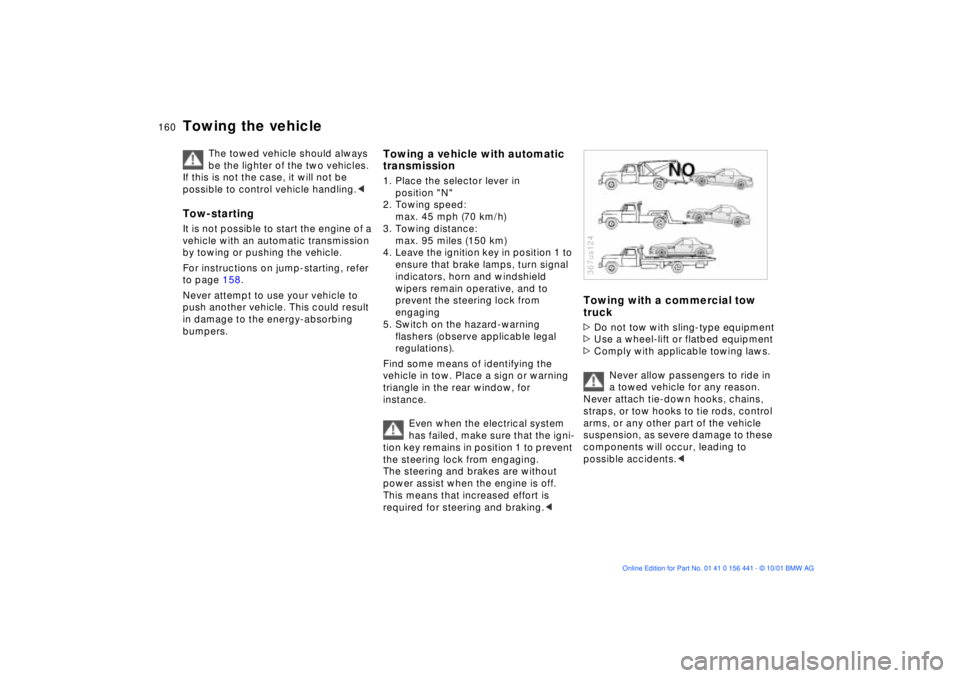
truck>Do not tow with sling-type equipment
>Use a wheel-lift or flatbed equipment
>Comply with applicable towing laws.
Never allow passengers to ride in
a towed vehicle for any reason.
Never attach tie-down hooks, chains,
straps, or tow hooks to tie rods, control
arms, or any other part of the vehicle
suspension, as severe damage to these
components will occur, leading to
possible accidents.< 367us124
Page 163 of 187
Overview
Controls and features
Operation, maintenance
Owner service procedures
Technical data
Index Advanced technology
163n
IndexDataTechnologyRepairsMaintenanceControlsOverview
Adaptive Transmission Control
(ATC)164
Airbags164
Automatic Stability Control plus
Traction (ASC+T)/Dynamic
Stability Control (DSC)165
Car radio reception166
Safety belt tensioner166
Technology
Page 164 of 187

164n
For vehicles with automatic transmis-
sion, Adaptive Transmission Control
(ATC) performs the optimum gear selec-
tion based on a number of factors. This
system reacts to your individual driving
style and the current driving conditions.
The ATC recognizes your individual
driving style from the positions and
movements of the accelerator pedal,
delays during braking, and the vehicle's
lateral acceleration when cornering.
ATC makes the appropriate selection
from different shift characteristics
which range from comfort-oriented to
performance-oriented.
367us358
In order to take driving conditions into
account, ATC registers corners and
both uphill and downhill gradients. For
example, if you maintain speed through
a curve, the transmission does not
upshift.
On uphill gradients, it shifts only when
the engine speed increases in order to
make more efficient use of power
reserves. On downhill gradients ATC
downshifts when the speed of the vehi-
cles increases causing the driver to
step on the brakes.
Deceleration sensors continuously
monitor the physical forces acting upon
the vehicle. In the event of a severe
frontal impact, the gas generators of
the driver and passenger-side front
airbags are ignited simultaneously.
However, the passenger-side airbag is
only triggered if an additional sensor
has recognized that the passenger seat
is occupied.
If it is necessary during a side impact, a
side airbag will be triggered on the side
where the collision occurs.
390de012
ATC
*
Airbags
Page 172 of 187
172n
Weights
Z3 roadster 2.5i Z3 roadster 3.0i Z3 coupŽ 3.0i
Curb weight (with one person, ready for operation, full tank of fuel, options not included)
with manual transmission
with automatic transmissionlbs (kg)
lbs (kg)2,899 (1,315)
2,987 (1,355)2,910 (1,320)
2,998 (1,360)2,943 (1,335)
3,031 (1,375)
Approved gross vehicle weight
with manual transmission
with automatic transmissionlbs (kg)
lbs (kg)3,450 (1,565)
3,538 (1,605)3,461 (1,570)
3,549 (1,610)3,494 (1,585)
3,582 (1,625)
Approved front axle load lbs (kg) 1,852 (840) 1,852 (840) 1,830 (830)
Approved rear axle load lbs (kg) 1,918 (870) 1,918 (870) 1,918 (870)
Approved roof load capacity lbs (kg) 77 (35) 77 (35) 110 (50)
Luggage compartment capacity cu ft (liters) 5.8 (165) 5.8 (165) 7.2 - 14.3 (205 - 405)
Page 173 of 187
173n
IndexDataTechnologyRepairsMaintenanceControlsOverview
Capacities
Notes
Fuel tank
reserve gal. (liters)
gal. (liters)approx. 13.5 (approx. 51)
approx. 2.1 (approx. 8.0)Fuel specification: page 26
Windshield washer system/
Headlamp washer system quarts (liters) approx. 5.3 (approx. 5.0)For details: page 122
Cooling system including heating circuit quarts (liters) 11.1 (10.5) For details: page 125
Engine with oil filter renewal quarts (liters) 6.9 (6.5) "BMW High Performance
Synthetic Oil"
For details: page 124
Manual transmission, automatic
transmission and differentialÐ Lifetime fluid, no fluid change
required