2002 BMW M3 COUPE ECU
[x] Cancel search: ECUPage 37 of 151

37n
OverviewControlsMaintenanceRepairsDataIndex
Alarm system
*
The conceptThe vehicle alarm system responds:
>When a door, the hood or the
luggage compartment lid are opened
>To movement inside the vehicle (inte-
rior motion sensor)
>To variations in the vehicle tilt, as
would occur while attempting to steal
the wheels or tow the vehicle (tilt
alarm sensor)
>To interruption of battery voltage.
The system responds to unauthorized
vehicle entry and attempted theft by
simultaneously activating the following:
>Sounding an acoustic alarm for
30 seconds
>Activating the hazard warning
flashers for approx. five minutes
>Flashing the high beams on and off in
rhythm with the hazard warning
flashers.
To arm and disarm the alarm
systemWhen the vehicle is locked or unlocked
by using a key or the remote control,
the alarm system is also simultaneously
armed or disarmed.
You can have a signal set as
acknowledgment for both arming
and disarming the alarm.<
You can also open the luggage
compartment lid when the system is
armed by pressing the button of the
remote control, refer to page 31. When
it is closed, the lid is once again
secured.
Indicator lamp displaysThe indicator lamp is located under the
interior rearview mirror.
>When the indicator lamp flashes
continuously: the system is armed
>The indicator lamp flashes when it is
armed: the door(s), the hood or
luggage compartment lid are not
completely closed. Even if you do not
close the alerted area, the remaining
areas are secured, and the indicator
lamp flashes continuously after
10 seconds. However, the interior
motion sensor is not activated
>If the indicator lamp goes out when
the system is disarmed: no manipula-
tion or attempted intrusions have
been detected in the period since the
system was armed
Page 52 of 151

52n
Airbags Transporting children safelyOperational status
The indicator lamp in the instru-
ment cluster displays the opera-
tional status of the airbag
system from ignition key position 1.
System operational:
>The indicator lamp comes on briefly
when you turn the ignition key to
position 1 or higher.
System malfunction:
>The indicator lamp fails to come on,
when the ignition key is turned
>The indicator lamp fails to go out
after the engine has been started, or
it comes on during normal driving.
Please respond to any malfunctions in
the system by immediately having it
inspected at your BMW center; other-
wise the airbag could fail to respond to
an accident in which both the angle and
the severity of the impact would
normally trigger airbag deployment.
Commercially available child-restraint
systems are designed to be secured
with a lap belt or with the lap belt
portion of a combination lap/shoulder
belt. Improperly or inadequately
installed restraint systems can increase
the risk of injury to children. Always
read and follow the instructions that
come with the system.
If you use a child-restraint system with
a tether strap, three additional tether
anchorage points have been provided
(refer to the arrows in the illustration).
Depending on the location selected for
seating in the rear passenger area,
attach the strap hook to the corre-
sponding anchorage point to secure the
child-restraint system. Remove the
cover first on the middle location.
If the respective seating position is
fitted with a head restraint lift the head
restraint and pass the tether strap
between the head restraint and the seat
back.
Adjust the tether strap according to the
child-restraint manufacturer's instruc-
tions.
Page 53 of 151
53n
OverviewControlsMaintenanceRepairsDataIndex
Transporting children safely
Before installing any child-
restraint device or child seat,
please read the following:
Never install a rearward-facing child-
restraint system in the front passenger
seat of this vehicle.
Your vehicle is equipped with an airbag
supplemental restraint system for the
front passenger. Because the backrest
on any rearward-facing child-restraint
system (of the kind designed for infants
under 1 year and 20 lbs/9 kg) would be
within the airbag's deployment range,
you should never mount such a device
in the front passenger seat, since the
impact of the airbag against the child
restraint's backrest could lead to
serious or fatal injuries.
If it is necessary for a child (not an
infant) to ride in the front seat, certain
precautions should be taken. First,
move the passenger seat as far away
from the instrument panel as possible.
This important precaution is intended to
maximize the distance between the
airbag and the child. Older children
should be tightly secured with the
safety belt.
Younger children should be secured in
an appropriate forward-facing child-
restraint system that has first been
properly secured with a safety belt.
Never install a rearward-facing child-
restraint system in the front passenger
seat.
We strongly urge you to carefully read
and observe the instructions for instal-
lation and use provided by the child-
restraint's manufacturer whenever you
use such a device.
Be sure that all occupants (of all ages)
remain properly and securely restrained
at all times.c
All rear seating positions in your vehicle
meet the recommendations of SAE
J1819, a industry recommended prac-
tice for securing child-restraint systems
in motor vehicles.
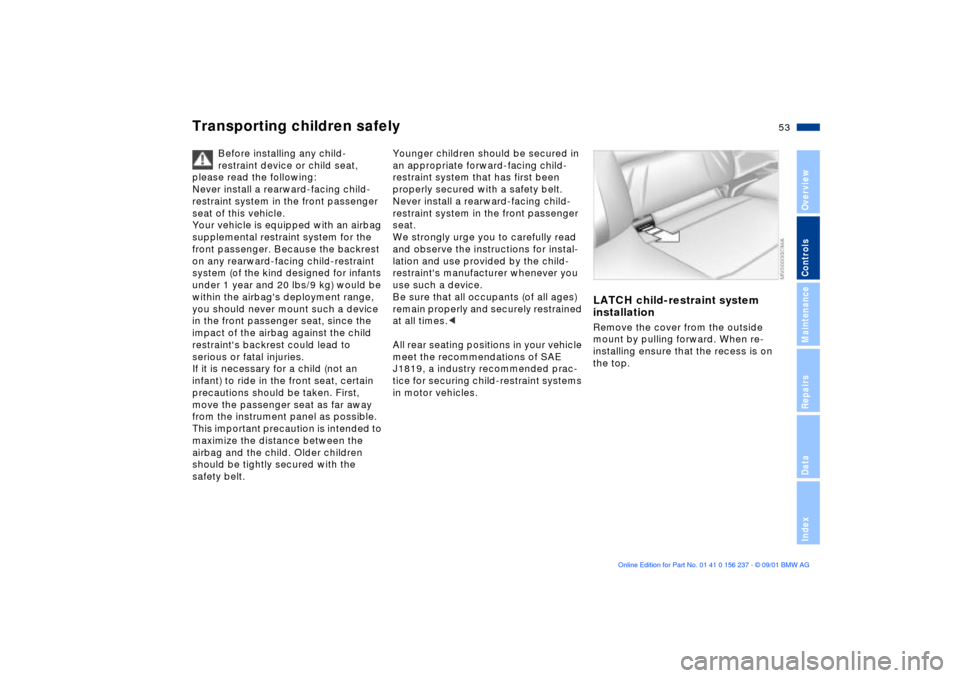
LATCH child-restraint system
installationRemove the cover from the outside
mount by pulling forward. When re-
installing ensure that the recess is on
the top.
Page 54 of 151

54n
Transporting children safelyThe illustration shows the mounts for a
LATCH child-restraint system in the
right rear seat.
To mount the LATCH child-
restraint system, please follow the
manufacturer's operating and safety
precautions.<< < <
Child seat securityAll of the rear belt retractors and the
front passenger's safety belt can be
locked for mounting and securing child-
restraint systems.
A label with the appropriate instructions
for this is located in the immediate
vicinity of the buckle latch of each
safety belt.
Lock the safety beltExtract the entire length of the belt from
the inertia reel mechanism. Allow the
reel to retract the belt somewhat and
engage the buckle, then tighten the belt
against the child-restraint system. The
retraction mechanism is now locked.
The belt cannot be extracted further.
Always observe the installation instruc-
tions provided by the manufacturer of
the child-restraint system.Unlock the safety beltRelease the safety belt, remove the
child-restraint device and retract the
safety belt to its end position on the belt
retractor.
Page 60 of 151

60n
Sequential M gearbox* SMG IISelector lever positionR: Reverse position
0: Position 0
Forward position with one-touch mode:
>S: Sequential mode
>A: Automated mode
>+: Upshifting in sequential mode
>-: Downshifting in sequential mode.
The SMG II is ready for operation from
ignition key position 2.
For your safety, it is only possible to
engage a driving position with the
vehicle stopped approx. 2 seconds
after engaging the position 0 with the
footbrake depressed (shift-lock func-
tion).
It is not necessary to hold the footbrake
depressed until starting off, as the
vehicle does not move forward with the
driving position engaged.Starting engine and driving offTo start the engine:
1. Depress footbrake
2. Move selector lever into position 0
3. Turn the ignition key to position 3,
refer to page 56.
To drive off:
1. Depress footbrake
2. Engage a driving position
3. Release footbrake and slowly
depress accelerator pedal.
With the engine running, the gear
indicator in the instrument cluster
flashes to indicate that a driving posi-
tion is engaged with the driver's door
open or if the hood is not closed prop-
erly, refer to page 61.
If none of the pedals is actuated, then
the gearbox is automatically taken out
of gear after approx. 4 seconds.
Then the desired direction of travel
must be selected again with the
selector lever in position 0.<
Starting off is not possible with the
hood open.<
Before exiting the vehicle with the
engine running, move the selector
lever into position 0 and apply the
parking brake.
Never leave the vehicle unattended
with the engine running. An unat-
tended vehicle with a running engine
represents a potential safety hazard.
forward or reverse position, a gear
automatically remains engaged.
If you turn the ignition key to position 1
or 0 with the selector lever in position 0,
a gong and the flashing gear indicator
in the SMG display remind you that the
vehicle is not secured against rolling.
Page 61 of 151

61n
OverviewControlsMaintenanceRepairsDataIndex
Sequential M gearbox* SMG IIThe warning stops after approx.
10 seconds. If you move the selector
lever into a forward or reverse position
during this time, a gear is automatically
engaged.
The SMG II has no park position
for securing the vehicle against
rolling.
The ignition key can be removed in any
selector lever position.<
Always engage the parking brake
when parking on downhill roads.
Engaging a gear may not sufficiently
secure the vehicle against rolling.<
Display in instrument clusterThe selector lever position, currently
engaged gear and selected driving
program are displayed in the instrument
cluster.
1 Engaged gear
2 Selected driving program
(corresponds to the number of illumi-
nated fields), refer to page 64
3 Tapping the selector lever to the right
switches over into the displayed shift
mode
4 "A" indicates an activated automated
mode.
R Ð Reverse positionOnly engage with the vehicle stopped
or at low speed, e.g. for "rocking free"
in deep snow.0 Ð Position 0Always engage before starting the
engine.
If the driving situation requires, e.g.
when downshifting on slippery roads,
the SMG II automatically disengages
and reengages the clutch, i.e. it is not
necessary to manually engage
position 0. S Ð Sequential modeIn the sequential mode all forward
gears are to be shifted by the driver.
Changeover from automated to
sequential mode:
>Tap the selector lever to the right
toward "S"
or
>change gears with the selector lever
or the shift paddles on the steering
wheel.
You do not need to reduce the throttle
for shifting.
Page 62 of 151

62n
Sequential M gearbox* SMG IIShifting gears with shift paddles on
steering wheel:
>To upshift, briefly pull the right
paddle "+"
>To downshift, briefly pull the left
paddle "Ð."
Shift paddles with various widths
matched to the shape of your
hand are available from your BMW
center.<
Shifting gears with selector lever:
>To upshift, pull the selector lever
backward "+"
>To downshift, push the selector lever
forward "Ð".
No automatic upshifting is carried out in
the sequential mode.
You accelerate from higher gears, e.g.
during passing, by manually down-
shifting.
In the following situations the SMG II
helps you "think" in the sequential
mode:
>Upshifts and downshifts are only
executed when the new gear will
provide a suitable combination of
vehicle and engine speed, i.e., down-
shifts that would cause the engine to
overrev will not be executed
>During a stop the gearbox is auto-
matically downshifted into the first
gear so that, e.g. before a traffic light,
it is only necessary to accelerate to
continue driving
>When the speed is reduced, the
gearbox is automatically down-
shifted shortly before a gear-depen-
dent minimum speed is reached
without you taking any action.
A Ð Automated modeEach time the engine is started, the
automated mode is activated as soon
as you move the selector lever into the
forward driving position.
In the automated mode all forward
gears are automatically shifted.
Changeover from sequential to auto-
mated mode: tap the selector lever to
the right toward "A." Watch the display
in the instrument cluster, refer to
page 61.
For rapid acceleration, e.g. during
passing, depress the accelerator pedal
completely (kick-down). The gearbox
now downshifts in dependence on the
selected driving program.
Even in the automated mode, you can
help specify the shifting point: if a gear-
dependent minimum speed is
exceeded, you can upshift by slowly
reducing pressure on the accelerator
pedal. In the process, the respective
driving situation is detected by sensors
and taken into account.
Page 64 of 151

64n
Sequential M gearbox* SMG II
The vehicle may roll slightly before
it is held by the gradient assis-
tance after releasing the footbrake.
Two seconds after the footbrake is
released, the vehicle begins to roll, as it
is no longer held with the gradient
assistance.<
The gradient assistance must be reacti-
vated before each use.
Indicator lamp
The transmission indicator lamp
in the instrument cluster goes
out after the engine is started.
>If it does not go out, or if it lights up
during driving, a fault has occurred.
The available functions may be
limited under certain circumstances.
Drive carefully and with the Dynamic
Stability Control (DSC) activated.
Have the system checked by the
nearest BMW center
>If the indicator lamp flashes while
driving, the system is overloaded.
Avoid high loads until the indicator
lamp goes out again permanently.
Shift lightsTo achieve the best possible vehicle
acceleration with a sporty driving style
in the sequential mode, shift lights in
the instrument cluster indicate the
optimum shifting point shortly before
the maximum engine speed is reached.
1 When the maximum engine speed is
approached, yellow indicator fields
(shift lights) in the tachometer light up
consecutively to indicate the
approaching upshift time
2 Shift at the latest when the last indi-
cator field lights up red.Tire replacement, snow chainsFollowing a tire or wheel change and
after mounting or removing snow
chains, the slip recognition of the